Trending in Physics
Observational Indistinguishability and the Beginning of the Universe
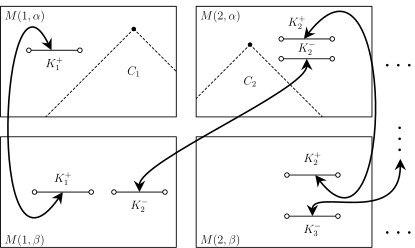
Can we infer whether all of physical reality began to exist? Several novel results are offered suggesting a negative verdict. First, a common strategy for defending a cosmic beginning involves showing that individual beginningless cosmological models are implausible. This strategy is shown to make an elementary error in confirmation theory. Second, two necessary (but not necessarily sufficient) conditions are offered for a cosmic beginning. Third, three extensions are offered to the Malament-Manchak theorems. The three extensions show that in almost all classical spacetimes, observers cannot collect sufficient data to determine whether the application conditions for the classic singularity theorems are satisfied or whether their spacetime satisfies the two necessary conditions for a cosmic beginning. Lastly, a reply is offered to the objection that the skeptical consequences of the three extensions can be overcome with induction. Importantly, all past singular dust FLRW spacetimes have observationally indistinguishable counterparts which, while sharing a number of important local properties, either do not include a singularity to the past of every point or else do not have the sort of time ordering intuitively required for a cosmic beginning.
2603.04159
Mar 2026History and Philosophy of Physics
The informational observer in Relational Quantum Mechanics
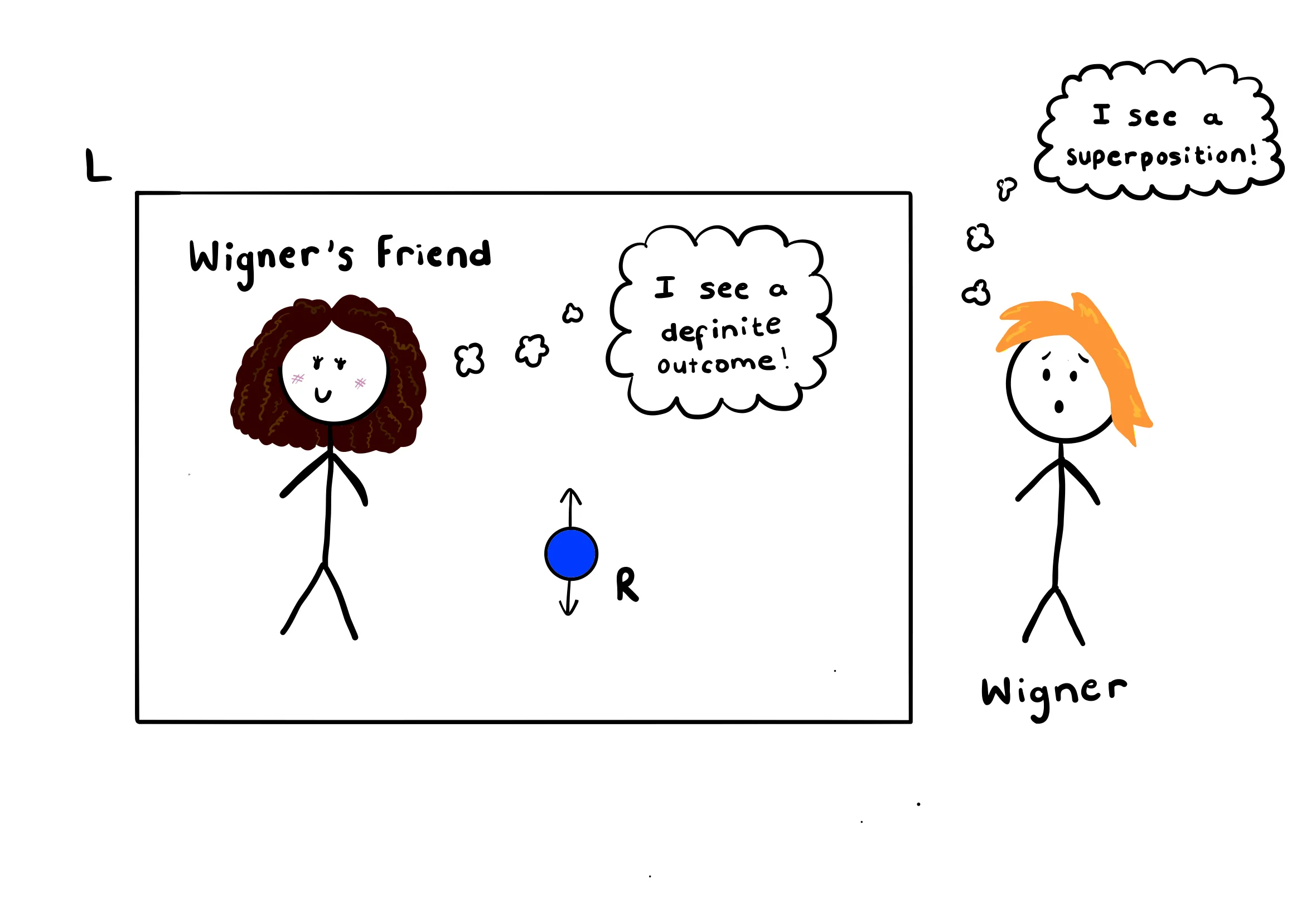
Relational Quantum Mechanics (RQM) treats quantum states as observer-dependent facts rather than absolute properties. While this relational stance is conceptually attractive, it raises concerns about empirical confirmation, particularly in multi-observer scenarios. Existing responses within RQM focus on securing agreement between observers by strengthening the status, stability, or accessibility of recorded outcomes. However, they leave open a more basic question: what grounds the persistence of an observer across time? Scientific observation presupposes stable records and the capacity to relate outcomes across successive measurements. We argue that the minimal definition of the observer in RQM as a merely interacting physical system is insufficient to support this requirement. We propose a complementary account of the observer that distinguishes physical interaction from informational coherence, and show how this distinction supports empirical confirmation in Wigner's friend-type scenarios.
2603.02978
Mar 2026History and Philosophy of Physics
qNEP: A highly efficient neuroevolution potential with dynamic charges for large-scale atomistic simulations
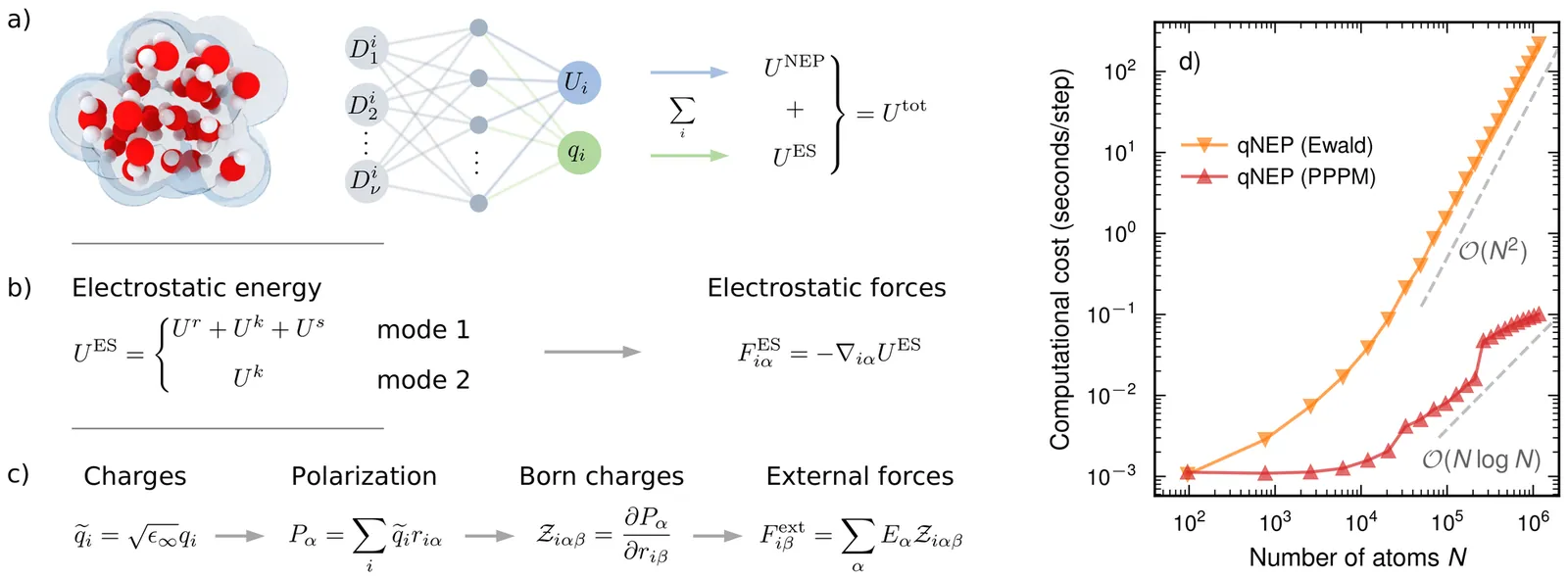
Although electrostatics can be incorporated into machine-learned interatomic potentials, existing approaches are computationally very demanding, limiting large-scale, long-time simulations of electrostatics-driven phenomena such as dielectric response, infrared activity, and field-matter coupling. Here, we extend the neuroevolution potential (NEP), a highly efficient machine-learned interatomic potential, to a charge-aware framework (qNEP) by introducing explicit, environment-dependent partial charges. Each ionic partial charge is represented by a neural network as a function of the local descriptor vector, analogous to the NEP site-energy model. This formulation enables the direct prediction of the Born effective charge tensor for each ion and, consequently, the polarization. As a result, dielectric properties, infrared spectra, and coupling to external electric fields can be evaluated within a unified framework. We derive consistent expressions for the forces and virials that explicitly account for the position dependence of the partial charges. The qNEP method has been implemented in the free-and-open-source GPUMD package, with support for both Ewald summation and particle-particle particle-mesh treatments of electrostatics. We demonstrate the accuracy and efficiency of the qNEP approach through representative applications to water, Li7La3Zr2O12, BaTiO3, and a magnesium-water interface. These results show that qNEP enables accurate atomistic simulations with explicit long-range electrostatics, scalable to million-atom systems on nanosecond time scales using consumer-grade GPUs.
2601.19034
Jan 2026Computational Physics
Ensemble of Fixed Points in Multi-branch Shell Models of Turbulent Cascades
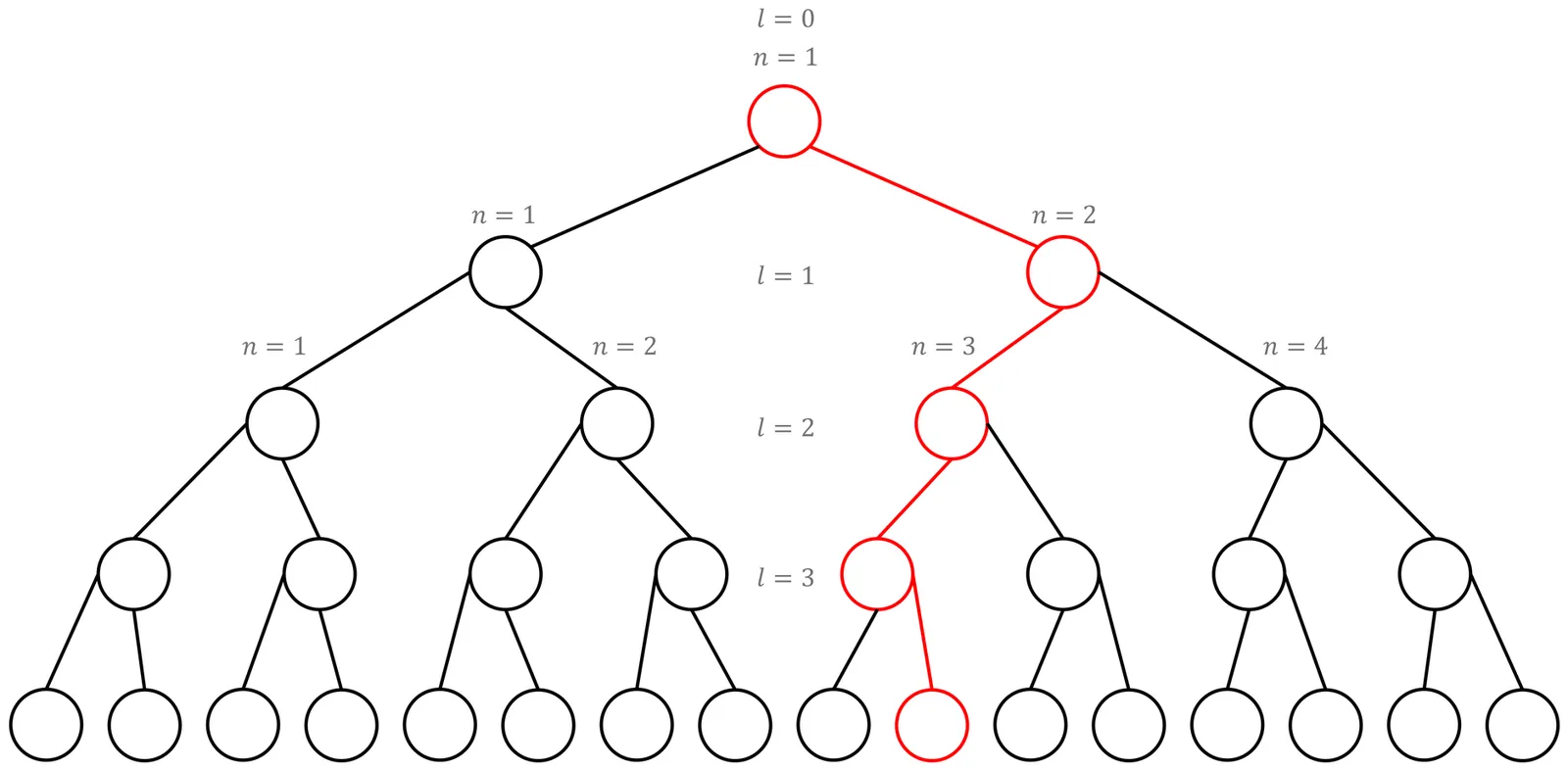
Stationary solutions of a shell model of turbulence defined on a dyadic tree topology are studied. Each node's amplitude is expressed as the product of amplitude multipliers associated with its ancestors, providing a recursive representation of the cascade process. A geometrical rule governs the tree growth, and we prove the existence of a continuum of fixed points, including the Kolmogorov solution, that sustain a strictly forward energy cascade. Sampling along randomly chosen branches defines a homogeneous Markov chain, enabling a stochastic characterization of extended self-similarity and intermittency through the spectral properties of the associated Feynman-Kac operators. Numerical simulations confirm the theoretical predictions, showing that multi-branch shell models offer a minimal yet physically rich framework for exploring the complexity of nonlinear energy transfer across scales.
2601.04788
Jan 2026Fluid Dynamics
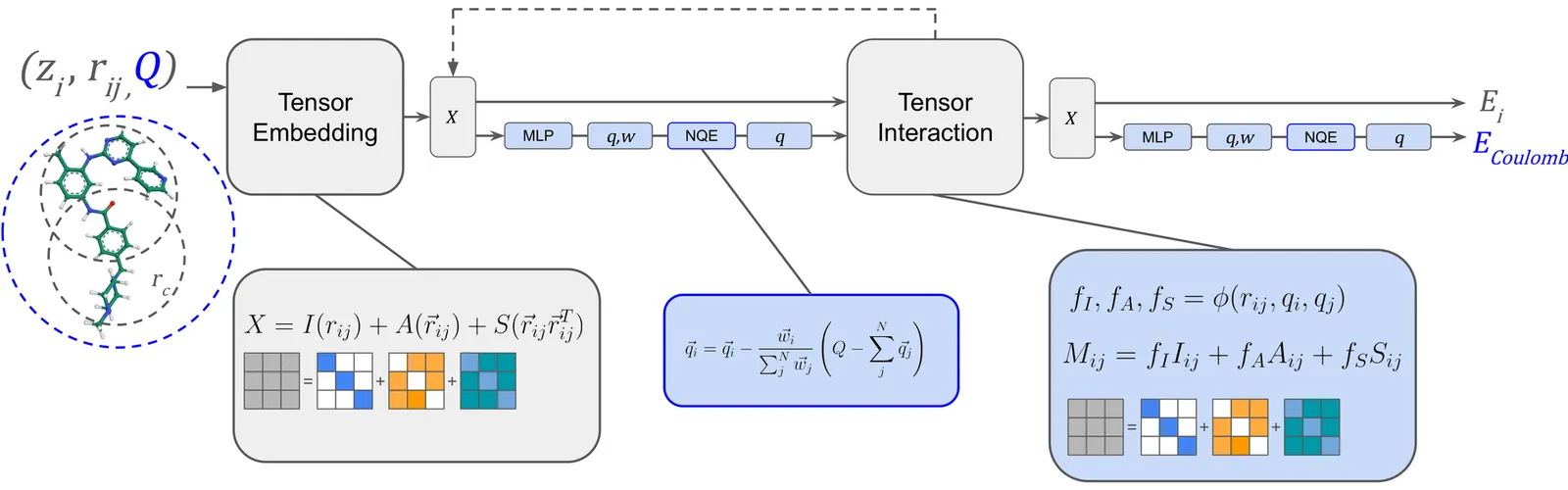
AceFF: A State-of-the-Art Machine Learning Potential for Small Molecules
We introduce AceFF, a pre-trained machine learning interatomic potential (MLIP) optimized for small molecule drug discovery. While MLIPs have emerged as efficient alternatives to Density Functional Theory (DFT), generalizability across diverse chemical spaces remains difficult. AceFF addresses this via a refined TensorNet2 architecture trained on a comprehensive dataset of drug-like compounds. This approach yields a force field that balances high-throughput inference speed with DFT-level accuracy. AceFF fully supports the essential medicinal chemistry elements (H, B, C, N, O, F, Si, P, S, Cl, Br, I) and is explicitly trained to handle charged states. Validation against rigorous benchmarks, including complex torsional energy scans, molecular dynamics trajectories, batched minimizations, and forces and anergy accuracy demonstrates that AceFF establishes a new state-of-the-art for organic molecules. The AceFF-2 model weights and inference code are available at https://huggingface.co/Acellera/AceFF-2.0.
2601.00581
Jan 2026Chemical Physics
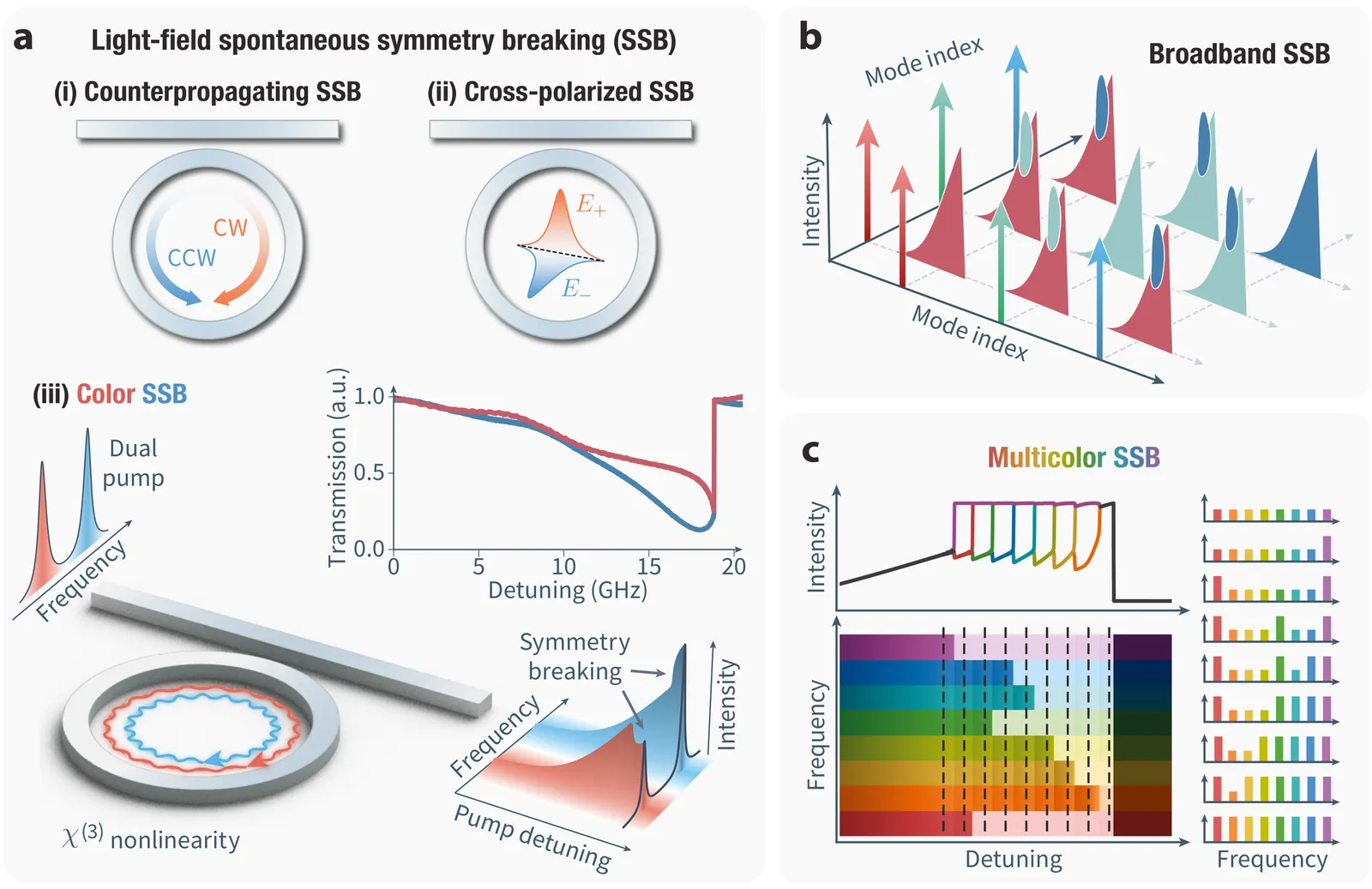
Color symmetry breaking in a nonlinear optical microcavity
Spontaneous symmetry breaking leads to diverse phenomena across the natural sciences, from the Higgs mechanism in particle physics to superconductors and collective animal behavior. In photonic systems, the symmetry of light states can be broken when two optical fields interact through the Kerr nonlinearity, as shown in early demonstrations with counterpropagating and cross-polarized modes. Here, we report the first observation of color symmetry breaking in an integrated silicon nitride microring, where spontaneous power imbalance arises between optical mode at different wavelengths, mediated by the Kerr effect. The threshold power for this effect is as low as 19 mW. By examining the system's homogeneous states, we further demonstrate a Kerr-based nonlinear activation-function generator that produces sigmoid-, quadratic-, and leaky-ReLU-like responses. These findings reveal previously unexplored nonlinear dynamics in dual-pumped Kerr resonators and establish new pathways towards compact, all-optical neuromorphic circuits.
2601.00792
Jan 2026Optics
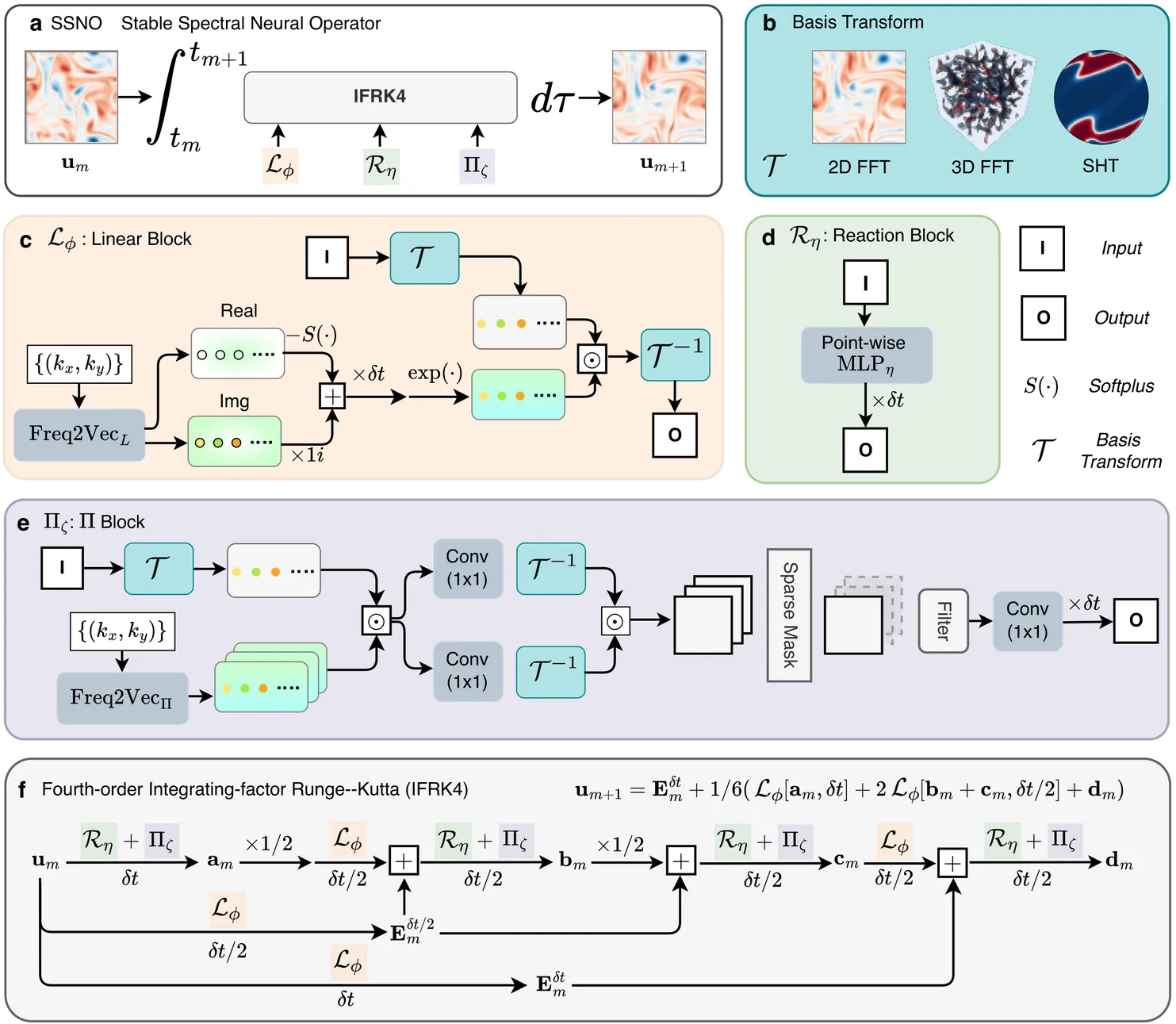
Stable spectral neural operator for learning stiff PDE systems from limited data
Accurate modeling of spatiotemporal dynamics is crucial to understanding complex phenomena across science and engineering. However, this task faces a fundamental challenge when the governing equations are unknown and observational data are sparse. System stiffness, the coupling of multiple time-scales, further exacerbates this problem and hinders long-term prediction. Existing methods fall short: purely data-driven methods demand massive datasets, whereas physics-aware approaches are constrained by their reliance on known equations and fine-grained time steps. To overcome these limitations, we introduce an equation-free learning framework, namely, the Stable Spectral Neural Operator (SSNO), for modeling stiff partial differential equation (PDE) systems based on limited data. Instead of encoding specific equation terms, SSNO embeds spectrally inspired structures in its architecture, yielding strong inductive biases for learning the underlying physics. It automatically learns local and global spatial interactions in the frequency domain, while handling system stiffness with a robust integrating factor time-stepping scheme. Demonstrated across multiple 2D and 3D benchmarks in Cartesian and spherical geometries, SSNO achieves prediction errors one to two orders of magnitude lower than leading models. Crucially, it shows remarkable data efficiency, requiring only very few (2--5) training trajectories for robust generalization to out-of-distribution conditions. This work offers a robust and generalizable approach to learning stiff spatiotemporal dynamics from limited data without explicit \textit{a priori} knowledge of PDE terms.
2512.11686
Dec 2025Computational Physics
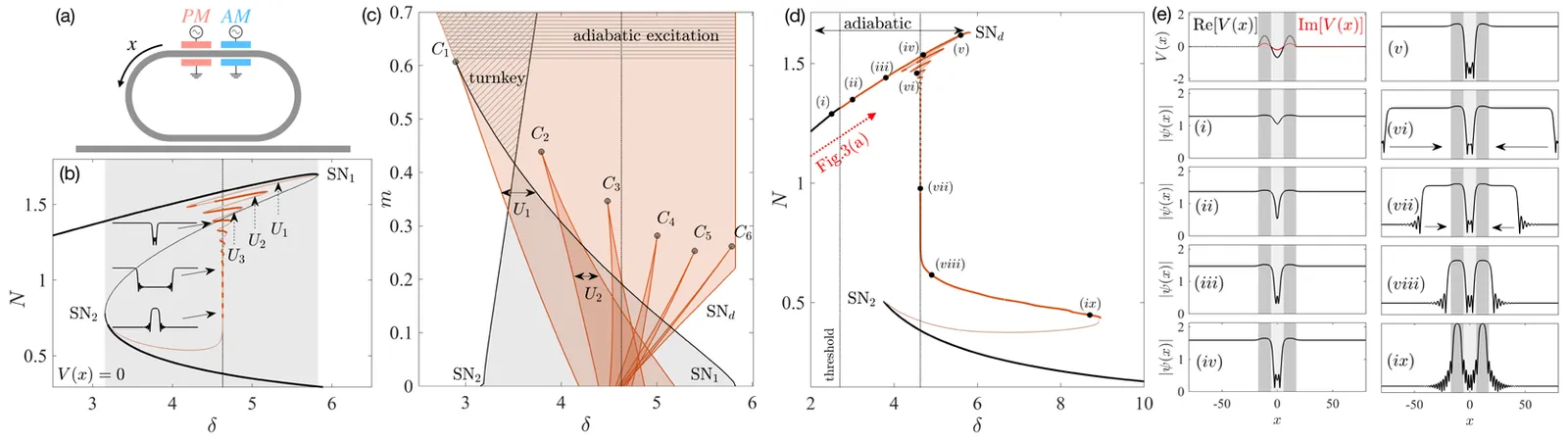
Adiabatic and Deterministic Routes to Soliton Combs in Non-Hermitian Kerr Cavities
We present a cardinal solution for the long-standing and fundamental problem associated with the adiabatic, reversible, and controlled excitation of both dark and bright solitons in Kerr micro-resonators with normal group velocity dispersion. Our findings stem from the inclusion of a localised non-Hermitian potential, which we use to drastically reshape the characteristic collapsed snaking structure associated with such solitons. Consequently, we demonstrate a novel snaking-free bifurcation landscape where solitons of all possible widths are continuously connected via the dynamic change of the cavity detuning, and hence dissipative localised states of unprecedentedly high pump-to-comb conversion efficiencies can be excited in an adiabatic, deterministic, and reversible fashion. Our fundamental discovery has practical implications of paramount importance for frequency comb generation in all-normal dispersion cavities, which are key to comb generation in most spectral regions away from the telecom bands.
2512.11581
Dec 2025Optics
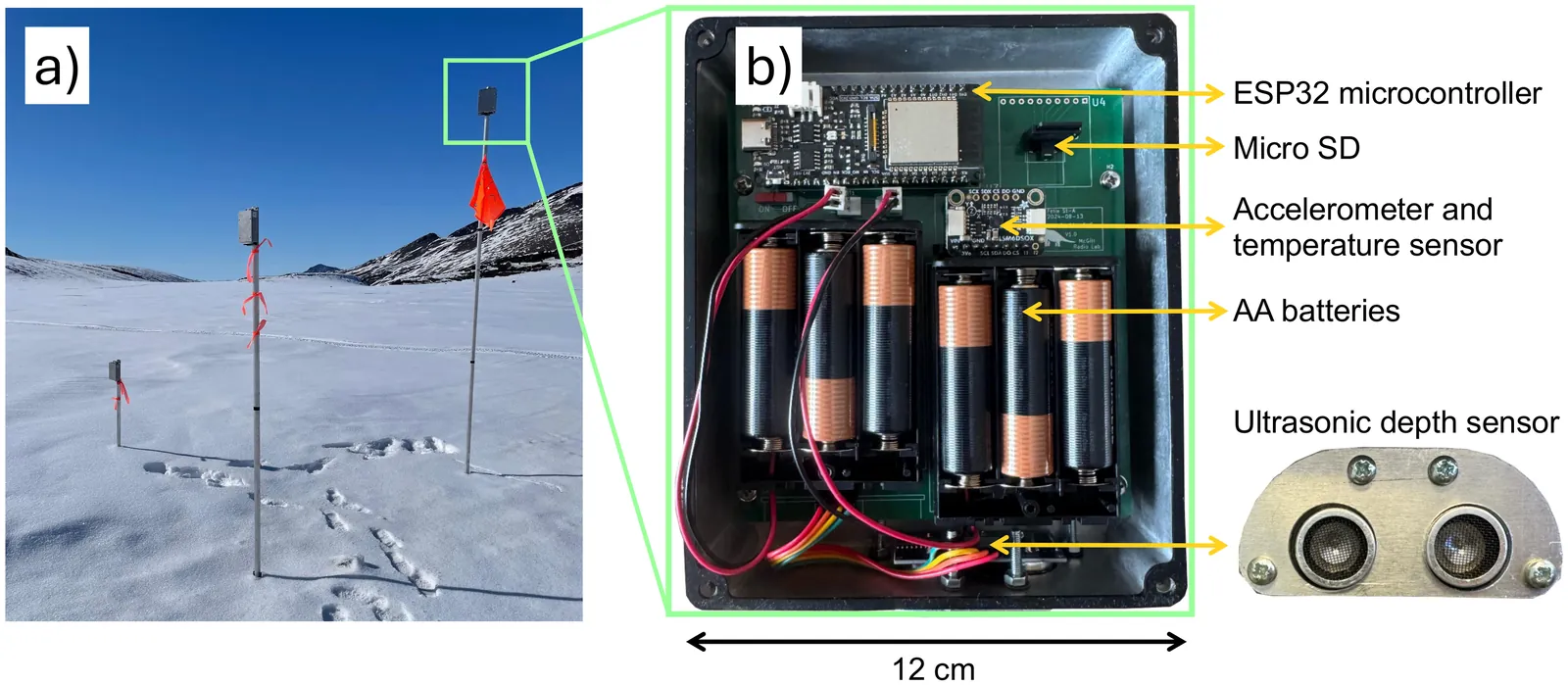
A low-cost ice melt monitoring system using wind-induced motion of mass-balance stakes
Surface ablation measurements of glaciers are critical for understanding mass change over time. Mass-balance stakes are commonly used for localized measurements, with the exposed length typically measured manually at infrequent intervals. This paper presents the design and validation of new instrumentation that automates mass-balance stake readings, thus enabling continuous measurements with high temporal resolution. The instrumentation comprises readout electronics that are mounted on mass-balance stakes to measure wind-induced vibrations. The stake vibrational frequency depends sensitively on the exposed length, and changes in the measured frequency therefore probe glacier surface melt and accumulation. Initial instrumentation field tests conducted at Color Lake on Umingmat Nunaat (Axel Heiberg Island), Nunavut, demonstrate centimeter-level precision on length measurements. The instrumentation can be attached to existing mass-balance stakes and is low-cost (~ $50 USD) in comparison to many other systems that perform automated surface ablation measurements. The accessibility of this instrumentation opens new possibilities for localized, high temporal resolution measurements of glacier surface activity at any locations where mass balance stakes are deployed.
2512.11768
Dec 2025Instrumentation and Detectors
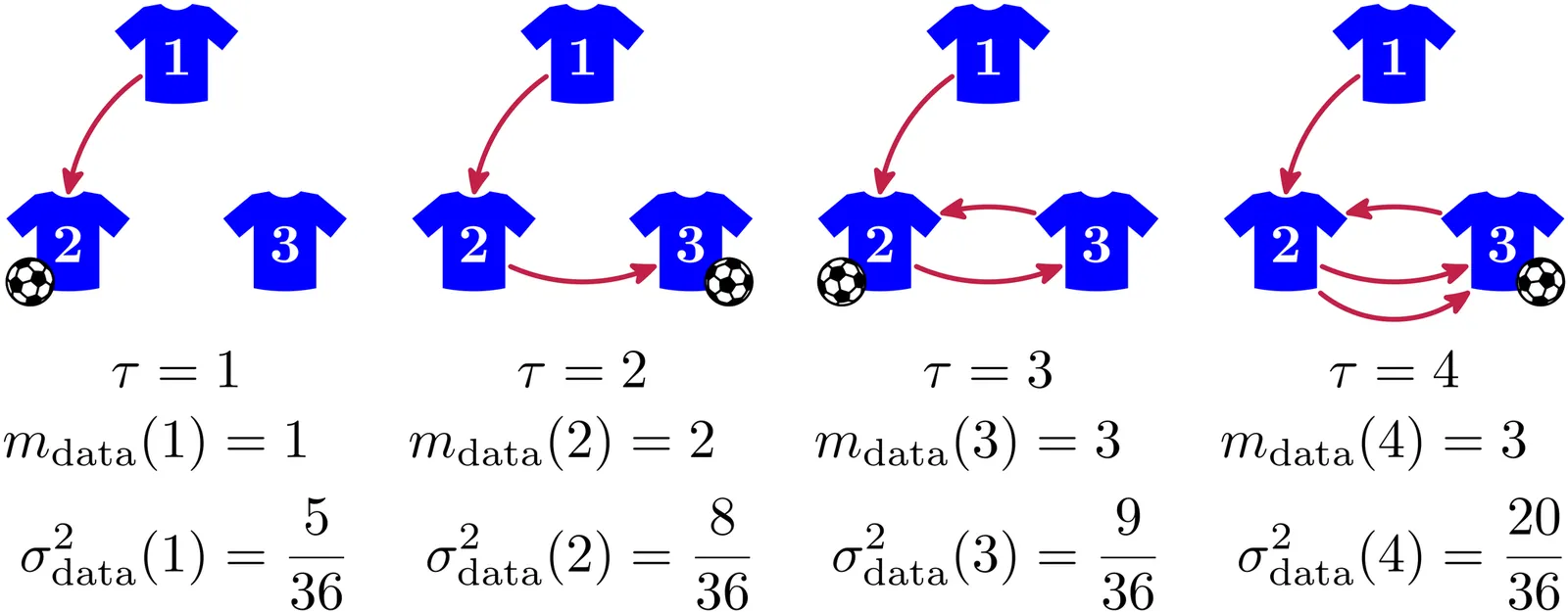
Pólya urn model for analysis of football passes
This study analyzes pass networks in football (soccer) using a stochastic model known as the Pólya urn. By focusing on preferential selection, it theoretically demonstrates that the time evolution of networks can be characterized by a single parameter. Building on this result, a data analysis method is proposed and applied to a large-scale public dataset of professional football matches. The statistical properties of the preferential-selection parameter are examined, demonstrating its correlation with pass accuracy and with mean pass difficulty. This method is applicable to various evolving networks.
2511.04089
Nov 2025Physics and Society