Atomic and molecular structure, dynamics, spectroscopy, chemical reactions.
Looking for a broader view? This category is part of:
A faithful description of chemical processes requires exploring extended regions of the molecular potential energy surface (PES), which remains challenging for strongly correlated systems. Transferable deep-learning variational Monte Carlo (VMC) offers a promising route by efficiently solving the electronic Schrödinger equation jointly across molecular geometries at consistently high accuracy, yet its stochastic nature renders direct exploration of molecular configuration space nontrivial. Here, we present a framework for highly accurate ab initio exploration of PESs that combines transferable deep-learning VMC with a cost-effective estimation of energies, forces, and Hessians. By continuously sampling nuclear configurations during VMC optimization of electronic wave functions, we obtain transferable descriptions that achieve zero-shot chemical accuracy within chemically relevant distributions of molecular geometries. Throughout the subsequent characterization of molecular configuration space, the PES is evaluated only sparsely, with local approximations constructed by estimating VMC energies and forces at sampled geometries and aggregating the resulting noisy data using Gaussian process regression. Our method enables accurate and efficient exploration of complex PES landscapes, including structure relaxation, transition-state searches, and minimum-energy pathways, for both ground and excited states. This opens the door to studying bond breaking, formation, and large structural rearrangements in systems with pronounced multi-reference character.
We introduce a GPU-accelerated multigrid Gaussian-Plane-Wave density fitting (FFTDF) approach for efficient Fock builds and nuclear gradient evaluations within Kohn-Sham density functional theory, as implemented in the GPU4PySCF module of PySCF. Our CUDA kernels employ a grid-based parallelization strategy for contracting Gaussian basis function pairs and achieve up to 80% of the FP64 peak performance on NVIDIA GPUs, with no loss of efficiency for high angular momentum (up to f-shell) functions. Benchmark calculations on molecules and solids with up to 1536 atoms and 20480 basis functions show up to 25x speedup on an H100 GPU relative to the CPU implementation on a 28-core shared memory node. For a 256-water cluster, the ground-state energy and nuclear gradients can be computed in ~30 seconds on a single H100 GPU. This implementation serves as an open-source foundation for many applications, such as ab initio molecular dynamics and high-throughput calculations.
We present a theoretical investigation on the electronic structure and properties of radium monochalcogenides, with chalcogens O, S, and Se, as well as the ionic species RaO +/-. Our approach combines fully relativistic and partially relativistic quantum-chemistry methods. Electronic properties are obtained using the exact two-component Hamiltonian-based coupled-cluster approach with single, double, and perturbative triple excitations [CCSD(T)+ X2C], while potential energy curves are computed using an internally contracted multireference configuration interaction method, including relativistic effects through small-core pseudopotentials and Pauli-Breit operator diagonalization (MRCI+Q+ECP+SO). The dimers exhibit very large permanent dipole moments and sizable dipolar polarizabilities, while the Franck-Condon factors among the lowest electronic states are highly non-diagonal. These features are discussed in terms of the divalent character of the chemical bonding in the neutral species.
We solve the orientation recovery of a tumbling protein in the gas phase from single-event measurements of the spatial positions of its ions after an X-ray laser induced explosion. We simulate diffracted X-ray signal and ion dynamics under experimental conditions and compare our method to conventional orientation recovery in single-particle imaging with X-ray free-electron lasers using only diffraction data. We reconstruct 3D diffraction intensities using orientations recovered from the ion signatures and retrieve the electron density with established phase-retrieval algorithms. We test our orientation recovery procedure on 56 proteins ranging from 14 to 52 kDa (1800 to 6500 atoms), achieving roughly an angular error of around 5°. The resulting 3D electron-density reconstructions are compared to ground-truth volumes simulated at the same nominal resolution, and achieve the resolution at the edge of the detector in conditions similar to current single-particle imaging setups. We investigate the reconstruction quality and demonstrate that ion data can be used for reliable orientation recovery of particles in single-particle imaging, achieving orientation on par or better than currently used recovery techniques. This work shows the potential of ion detection for retrieving additional information from the sample fragmentation, and boost single particle imaging with X-ray lasers in the cases where the diffraction signal is a limiting factor.
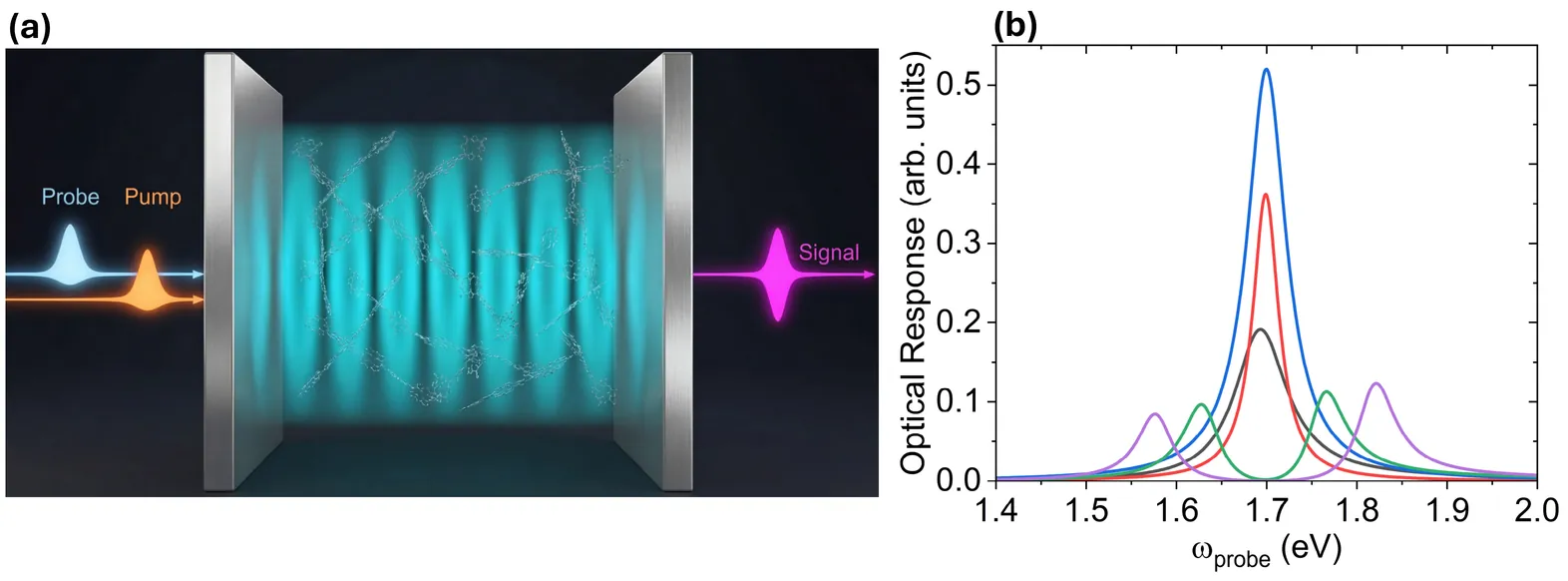
Nonlinear spectroscopy provides a unique perspective to understand time-resolved molecular dynamics under vibrational strong coupling (VSC). Herein, equilibrium-nonequilibrium cavity molecular dynamics simulations are performed to compute the two-dimensional (2D) infrared-infrared-Raman (IIR) spectroscopy of liquid water under VSC. In conventional computational chemistry practices, accurate molecular spectra are often constructed by using an advanced molecular dipole or polarizability model to post-process molecular dynamics trajectories evolved under a computationally efficient potential. By contrast, this work highlights the necessity of employing a consistent dipole surface model in both CavMD simulations and spectroscopic post-processing. While utilizing inconsistent dipole models only mildly influences the linear polariton spectrum, it severely distorts 2D spectra in wide frequency regions. With a consistent dipole-induced-dipole model, compared to the outside-cavity molecular 2D-IIR spectrum, the cavity 2D-IIR spectrum splits the OH stretch band to a pair of polariton branches along only the IR (not Raman) axis, while fading molecular signals at other frequency regions. This work provides the foundation for employing direct CavMD simulations to construct 2D spectra of realistic molecules under VSC.
Why kinetically stable oil droplets in water spontaneously acquire a negative charge remains one of the most vigorously debated questions in interfacial science. Here, we combine neural-network based deep potential molecular dynamics with a data-driven and information theory approach to probe the real-space electron density at an extended decane-water interface. While decane-water clusters show nearly symmetric forward and backward charge transfer (CT) and thus negligible net CT, the extended interface displays a systematic electronic asymmetry, yielding a net CT from water to the hydrocarbon phase producing an average surface charge density of $\sim0.006~e^{-}\,\mathrm{nm}^{-2}$ on the oil phase. This imbalance is accompanied by much larger intra-phase self-polarization, particularly within the hydrocarbon phase, demonstrating that collective many-body polarization dominates the interfacial electronic response. Structural analysis reveals an asymmetry between forward C--H$\cdots$O and backward O--H$\cdots$C motifs, providing a microscopic origin for a net CT from one phase to the other. Curiously, both the water O--H and decane C--H covalent bonds incur subtle contractions which originate from a response to the charge-separation layers at the interface. These features are fully consistent with the weak improper hydrogen-bonds forming at the oil-water interface that results in blue-shifts of the C-H modes.
We present an improved version of the sum-of-Gaussians tensor neural network (SOG-TNN) architecture for solving many-electron Schrödinger equation for one-dimensional soft-Coulomb systems. Model reduction techniques are introduced to reduce the number of tensor-factorized bases under the SOG approximation of the kernel. The Slater determinant ansatz is employed so that the anti-symmetric property of the wave function can be strictly preserved. Numerical results show that the SOG-TNN achieves high accuracy with remarkably small basis sizes. Robust spectral convergence with respect to the basis size is also observed, consistently characterized by a mixed algebraic-exponential model for the error decay. These findings validate that the SOG-TNN architecture provides an ultra-efficient and low-rank representation of complex multi-electron wave functions, shedding light on high-fidelity quantum calculations in larger-scale many-electron systems.
We apply the recently introduced aperiodic defect model (ADM) to a negatively charged monovacancy in a phosphorene monolayer. In contrast to conventional supercell approaches, the ADM treats a single defect embedded in the true non-defective crystalline mean field thereby avoiding spurious defect-defect interactions and the need for charge corrections. At the same time, it effectively reduces the calculation to a fragment, enabling the use of high-level molecular electronic-structure methods. Converging the Hartree-Fock and correlation contributions to the thermodynamic limit yields a benchmark CCSD(T)/POB-TZVP-rev2 formation energy of 0.91 eV for the negatively charged monovacancy in the (5|9) configuration. The excitation energy to the lowest singlet excited state of this defect at the EOM-CCSD/POB-TZVP-rev2 level is found to be 1.95 eV. Overall, the ADM provides a highly promising route towards quantitatively accurate and systematically improvable descriptions of defects in solids and on surfaces, bridging the gap between solid-state physics and molecular quantum chemistry.
Density functional theory (DFT) offers an exceptional balance between accuracy and efficiency, but practical density functional approximations face an unavoidable trade-off among simplicity, accuracy, and transferability. A systematic protocol is therefore needed to develop functionals that are reliably most accurate within a chosen application domain. Here we present such a protocol by combining constraint enforcement, flexible functional forms, and modern optimization. Applying this strategy to the range-separated hybrid (RSH) meta-GGA framework, we obtain the carefully optimized and appropriately constrained hybrid (COACH) functional. Across broad molecular benchmarks, COACH improves both accuracy and transferability relative to leading RSH meta-GGAs, including \omegaB97M-V, while retaining the computational practicality of its rung. Finally, our analysis of the remaining trade-offs and saturation behavior suggests that further systematic progress will likely require the incorporation of genuinely nonlocal information.
2603.23452The inverse Kohn-Sham (KS) problem seeks a local effective potential whose noninteracting ground state reproduces a prescribed electron density. Existing inversion formulations are often expressed in disparate languages, including reduced variational optimization, penalty regularization, response-based iteration, and PDE-constrained optimization. In this work, we develop a unified variational framework for inverse KS theory in two steps. First, we identify the fixed-density noninteracting constrained search embedded in exact density functional theory as the natural variational anchor of inverse KS inversion. In this setting, the KS potential appears as the variational dual object associated with density reproduction. Second, we show how the principal inversion formulations may be understood as realizations of the same inverse-KS structure and how they fit into a broader optimization-theoretic classification according to whether the KS state equations and density-reproduction condition are treated as objectives, constraints, penalties, or feasibility relations. Within this framework, Wu-Yang appears as a reduced exact-multiplier formulation, Zhao-Morrison-Parr as a quadratic-penalty relaxation, and PDE-constrained approaches as explicit state-constraint formulations. The same viewpoint also accommodates augmented-Lagrangian and all-at-once residual formulations, and clarifies the roles of additive-constant ambiguity, asymptotic normalization, nonsmooth variational structure, and weak-gap instability across inversion methods.
Exciton transport in molecular aggregates is a fundamental process governing the performance of organic optoelectronics and light-harvesting systems. While most theoretical studies have emphasized long-time transport behavior, recent advances in ultrafast spectroscopy have brought into focus the short-time regime, in which exciton motion remains ballistic on femtosecond-to-picosecond timescales. In this work, we develop an analytical framework for short-time exciton dynamics in a one-dimensional lattice subject to both on-site energetic (diagonal) disorder and intermolecular coupling (off-diagonal) fluctuations. Utilizing the reciprocal-space analysis, we derive closed-form expressions for the first and second spatial moments considering both localized excitation and moving Gaussian initial conditions. Our analytical and numerical results show that, while the long-time dynamics are influenced by diagonal disorder, the short-time ballistic expansion is governed primarily by off-diagonal disorder. Crucially, we reveal a synergistic interplay between the average intermolecular coupling and the off-diagonal coupling disorder strength, demonstrating that they contribute equivalently to short-time exciton transport. Moreover, we integrate this generic disorder model with a realistic molecular system within the framework of macroscopic quantum electrodynamics, thereby providing a theoretical foundation for characterizing and optimizing ultrafast energy flow of disordered molecular aggregates in complex dielectric media.
2603.23399Exact ground-state density-functional theory contains two parallel variational structures that are often compressed into a single narrative: an interacting hierarchy rooted in Lieb's ensemble formulation and a noninteracting hierarchy rooted in exact ensemble noninteracting theory. We reconstruct exact DFT around this parallel structure and distinguish both exact frameworks from the Kohn-Sham auxiliary density-functional construction that links them on a common admissible density class. From this viewpoint, the Levy-Lieb constrained search, the Hohenberg-Kohn picture, and ordinary pure-state noninteracting or Kohn-Sham formulations appear as narrower specializations under additional restrictions. The same organization also places fractional particle number, piecewise linearity, one-sided chemical potentials, derivative discontinuity, fractional orbital occupations, and Janak-type relations within a single variational picture. Exchange-correlation structure is reconsidered from the same standpoint, where it appears as the interface quantity between the interacting and noninteracting hierarchies rather than merely as the unknown remainder of the Kohn-Sham decomposition. The result is a formal reorganization of exact DFT that clarifies distinctions often blurred in compressed expositions, including functional domain versus representability class, noninteracting supporting-potential structure versus Kohn-Sham auxiliary construction, and density reproduction versus spectral interpretation.
In multi-dimensional time-resolved spectroscopic experiments, multiple (more than two) short laser pulses with variable pulse delay times are employed for the time-resolved exploration of the photoinduced dynamics of molecular chromophores. In the present work, the quasi-classical doorway-window (DW) methodology recently developed for transient absorption pump-probe (PP) spectroscopy [M. F. Gelin et al., J. Chem. Theory Comput. 2021, 17, 2394] has been generalized to multi-pulse spectroscopies. Pump-push-probe (PPP) spectroscopy (involving three laser pulses) and pump-induced two-dimensional (P-2D) spectroscopy (involving five laser pulses) are considered as specific examples. The quasi-classical DW approximation results in conceptually simple and computationally efficient simulation protocols which are suitable for implementation with $ab$ $initio$ on-the-fly electronic-structure calculations. Simulations of PPP and P-2D spectra performed for the hydrogen-bonded heptazine$\cdots$H$_2$O complex illustrate that pump-stimulated experiments provide much richer information on the ultrafast radiationless relaxation dynamics of the excited electronic states of the heptazine$\cdots$H$_2$O complex than conventional PP and 2D experiments.
Gausslets are one of the few examples of basis sets for electronic structure which allow for two-index/diagonal electron-electron interaction terms. A weakness of gausslets is that, because of their 1D origin, they have been tied to Cartesian coordinates. Here we generalize the gausslet construction for the radial coordinate in three dimensions for atomic basis sets. These radial gausslets make a very compact radial basis with a relatively modest number of functions, with diagonal interaction terms. We illustrate the accuracy of this construction with Hartree--Fock and exact diagonalization on atomic systems.
Perchloric acid (HClO$_4$) is widely used to prepare perchlorate salts with applications in propellants, industry, environmental chemistry, and biology. In this work, we used the intermolecular parameters from the extended Madrid-2019 force field for the perchlorate anion (ClO$_4^-$) and the oxonium cation (H$_3$O$^+$) together with TIP4P/2005 water to model perchloric acid solutions. The force field uses scaled charges of $\pm0.85e$ for monovalent ions and has been widely applied for aqueous ionic systems. We used the model to predict thermodynamic properties [densities and temperatures of maximum in density (TMD)], structural features (ion-water correlations: ion-hydrogen and ion-oxygen), and transport properties (self-diffusion coefficients and viscosity) of perchloric acid solutions at several concentrations. Experimental densities are predicted in excellent agreement up to 10 $m$. We also performed molecular simulations over a wide range of temperatures in order to determine the TMD of perchloric acid at different molalities. Predicted viscosities at 298.15 K and 1 bar are in good agreement with experimental data for concentrations below 4 $m$. Results are discussed in terms of model strengths and limitations.
Although continuous symmetry theory has attracted increasing attention in modern chemistry, local symmetry remains under-investigated. As a consequence, the relationship between symmetry and chemical behavior is often obscured, limiting the practical use of fuzzy symmetry measures. In this study, we introduce a novel framework for evaluating local symmetry based on electron density localization, and present continuous symmetry representations for several representative molecules. Our approach not only quantitatively captures global symmetry, but also reveals distinctive features of symmetry in a local chemical environment. The related concept, local chirality or chirotopicity, is also discussed. Overall, the proposed local symmetry and chirality measures provide valuable insights into molecular structure and structure-property relationships.
Solid state nuclear magnetic resonance (ss-NMR) is one of the most sensitive and popular techniques for structure elucidation in geometrically complex crystalline materials, such as zeolites. Synergistic support from computational modelling is vital to interpret experimental spectra, and relate ss-NMR to atomistic models. Nevertheless, computational predictions are hindered by the high expense of calculating magnetic shielding (MS) and electric field gradient (EFG) tensors from first principles. In this work, we leverage a novel tensorial machine learning approach to train a general model for predicting complete NMR tensors. We demonstrate the utility of the approach for a diverse dataset of zeolitic materials and NMR-active nuclei ($^{27}$Al, $^{29}$Si, $^{17}$O, $^{23}$Na and $^{1}$H), predicting all NMR observables to a high degree of precision. These observables are then translated into predictions of the full $^{27}$Al and $^{29}$Si ss-nMR spectra for the exemplary zeolite RTH. Thus, this work opens a pathway to accurate, high-throughput NMR simulation for large-scale and realistic models of chemically complex zeolites.
Microscopic understanding of liquid properties is essential for advancing a wide range of applications from energy applications such as nuclear reactors and batteries to biomedical applications including drug delivery and microfluidics. However, intrinsic dynamic disorder and lack of structural periodicity in liquids have presented fundamental challenges in developing rigorous microscopic theories of their thermodynamic and dynamic behavior. Recent breakthroughs in computational power and experimental metrologies have driven significant progress in unraveling the complex atomic scale dynamics of liquids. In this Review, we provide a brief historical context of liquid state physics and explore recent advances through theoretical, computational, and experimental approaches. For theoretical and computational approaches, instantaneous normal mode and velocity autocorrelation function calculations are discussed. For experiments, we focus on X-ray and neutron scattering techniques that probe liquid dynamics at the atomic level. Finally, we highlight emerging opportunities and future directions in the study of liquid atomic dynamics.
Here we present a density matrix based KS inversion method formulated entirely within a Gaussian basis representation to optimize a KS potential matrix that reproduces a target electron density. Inverse Kohn-Sham (KS) density functional theory (DFT) aims to determine the effective local KS potential that reproduces a target electron density, and is important both for electronic structure analysis and for the development of orbital based correction methods. In finite Gaussian basis implementations, however, conventional inverse KS-DFT approaches such as the Zhao-Morrison-Parr (ZMP) method often become poorly constrained and inefficient, because the real space penalty potential is projected onto a limited number of Gaussian basis matrix elements, which can strongly coarse-grain its spatial variation. In the present method, the density matrix mismatch is defined in a Lowdin orthogonalized basis, which yields a penalty energy invariant under unitary rotations in that basis. The corresponding penalty potential contribution to the KS Hamiltonian is derived analytically in the original nonorthogonal Gaussian basis. Across a wide range of penalty strengths, the self consistent field (SCF) optimization remains robust and efficient for various open shell systems, while progressively tightening the penalty drives the electron density into accurate agreement with the target. Benchmarks on molecules and condensed phase systems show that the method achieves substantially smaller attainable density deviations than the conventional ZMP method. The method provides a fast and accurate route to KS inversion in finite Gaussian basis sets and may also be useful for future orbital based correction schemes.
Machine-learned interatomic potentials hold the promise to enable the modeling of highly concentrated liquids over meaningful timescales, far from reach for current ab initio electronic structure methods. Here we evaluate the performances of various MACE potentials in modeling a $21 m$ water-in-salt electrolyte based on lithium bis(trifluoromethanesulfonyl)imide. We test out-of-the-box foundation models, as well as both fine tuning and from scratch training strategies. Our simulations demonstrate that surrogate models allow to overcome sampling limitations of ab initio molecular dynamics, reaching an excellent agreement with experimental observables such as the structure factor. We also demonstrate the benefit of fine tuning a foundation model over training from scratch: in terms of data efficiency, but most importantly as a means to provide information regarding configurations hard to sample, such as short Li$^+$--Li$^+$ distances. Finally, we show that depending on the reference exchange-correlation functional, empirical dispersion correction schemes can be detrimental. All in all, our work shows that machine-learned interatomic potentials are a good fit for the modeling of highly concentrated electrolytes over long timescales.