Differential Geometry
arXiv:math.DG
Complex, contact, Riemannian, pseudo-Riemannian and Finsler geometry, relativity, gauge theory, global analysis.
Looking for a broader view? This category is part of:
Complex, contact, Riemannian, pseudo-Riemannian and Finsler geometry, relativity, gauge theory, global analysis.
Looking for a broader view? This category is part of:
 2512.24920
We study the Chern-Weil theory for the primitive cohomology of a symplectic manifold. First, given a symplectic manifold, we review the superbundle-valued forms on this manifold and prove a primitive version of the Bianchi identity. Second, as the main result, we prove a transgression formula associated with the boundary map of the primitive cohomology. Third, as an application of the main result, we introduce the concept of primitive characteristic classes and point out a further direction.
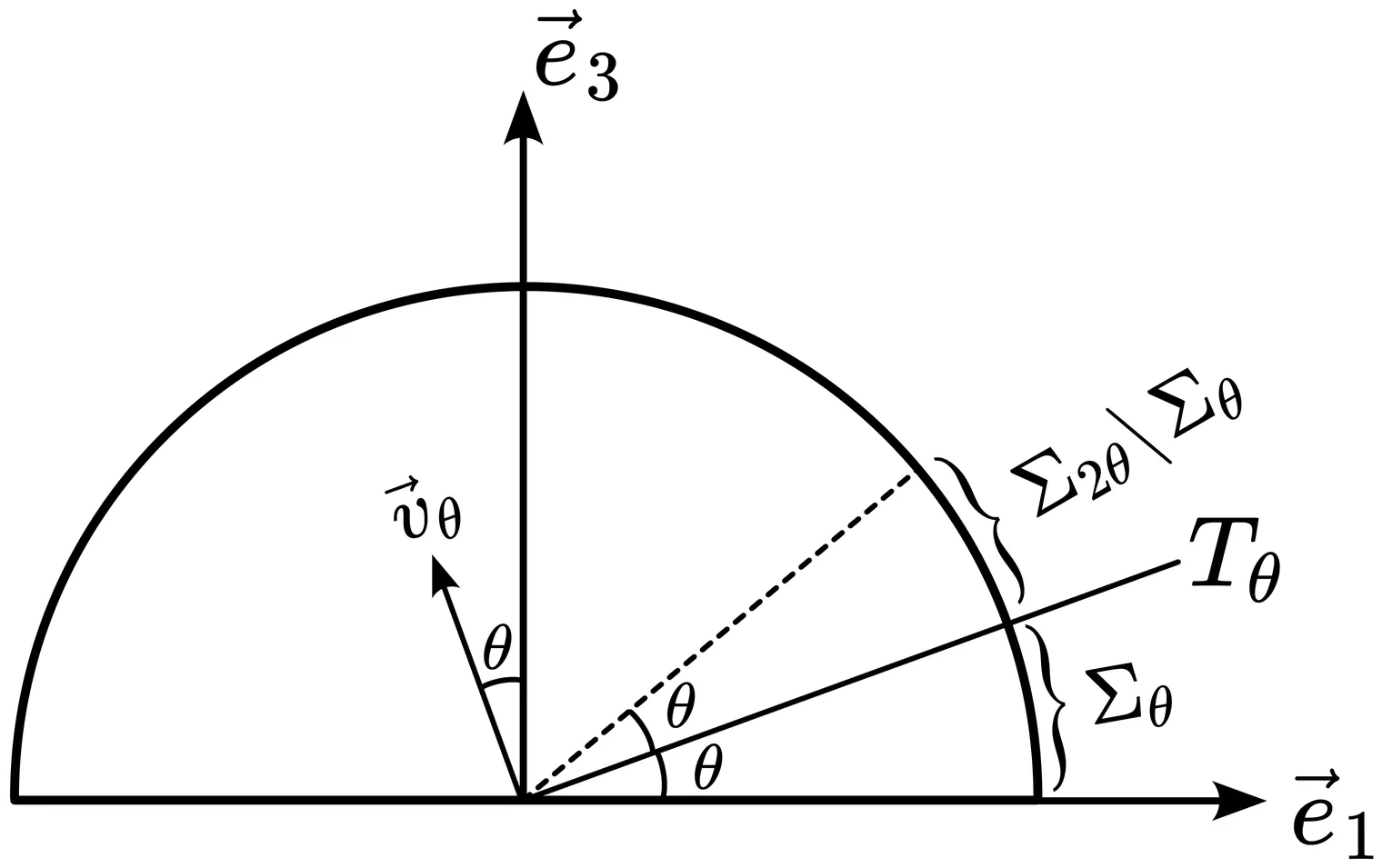
2601.04027We investigate the asymptotic behavior of high-codimensional area-minimizing locally rectifiable currents in hyperbolic space, addressing a problem posed by F.H. Lin and establishing ``boundary regularity at infinity" results for such currents near their asymptotic boundaries under the standard Euclidean metric. Intrinsic obstructions to high-order regularity arise for odd-dimensional minimal surfaces, revealing a constraint dependent on the geometry of the asymptotic boundary. Our work advances the asymptotic theory of high-codimensional minimal surfaces in hyperbolic space.
We verify a conjecture proposed by X. Chen and Y. Shi, which arises from their study of the Green function on spheres in Euclidean space. More precisely, let $M\subset \mathbb{R}^3$ be a closed $C^{2}$ embedded surface and suppose that there exists a point $p\in M$ so that its Green function $G$ is of the form $G(p,q)=-\frac{1}{2π} \ln d_{\mathbb{R}^3}(p,q)+c, \forall q\neq p$, then $M$ must be a round sphere.
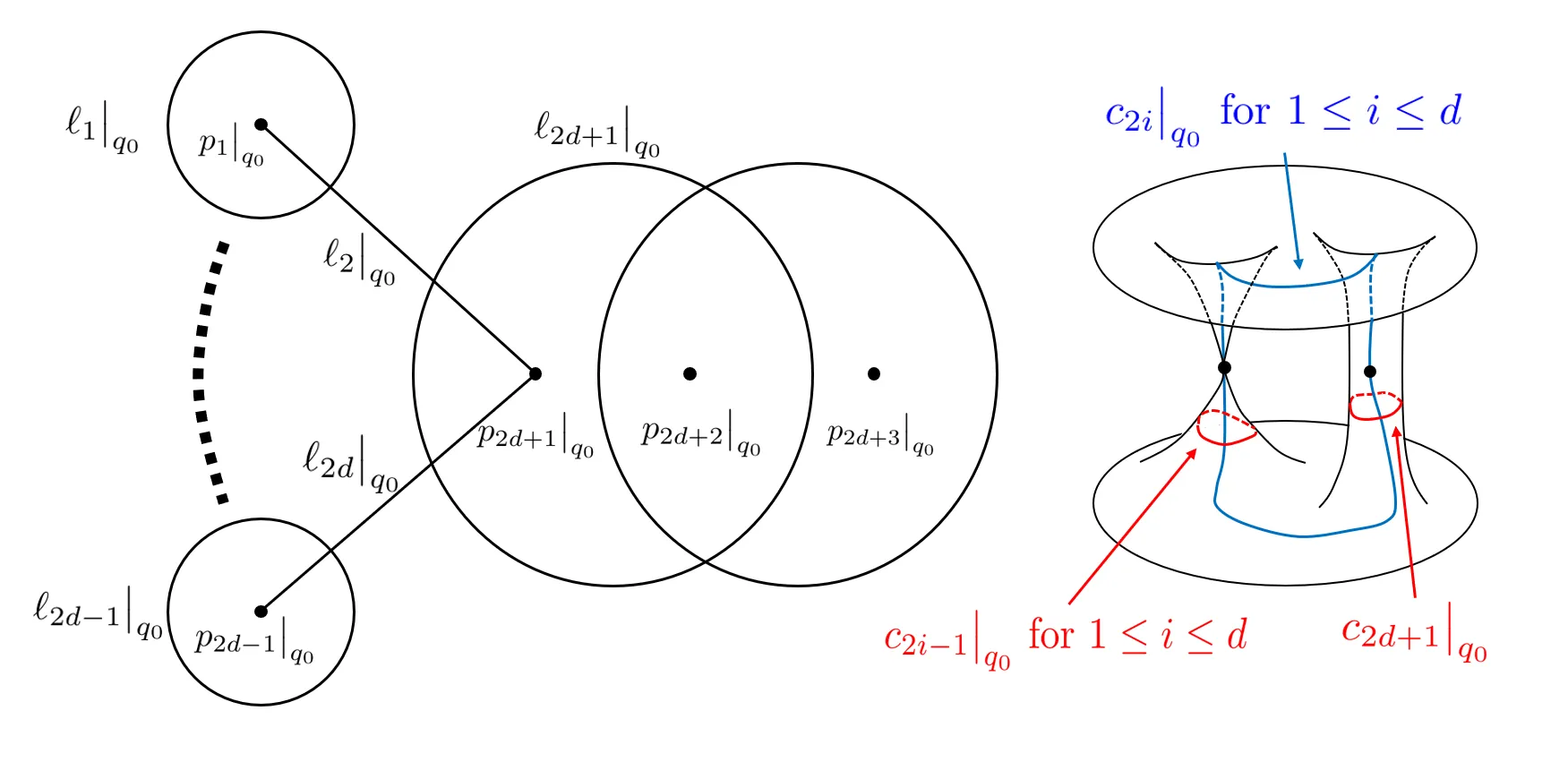
Freed (arXiv:hep-th/9712042) formulated special Kähler structures; in particular, the regular locus of the $\mathrm{SL}_2(\mathbb{C})$ Hitchin base $\mathcal{B}$ carries such a structure, while the associated metric $ω_{\mathrm{SK}}$ is singular along the discriminant locus $\mathcal{D}$. Baraglia-Huang (arXiv:1707.04975) computed its Taylor expansion near points of $\mathcal{B}\setminus\mathcal{D}$. Hitchin (arXiv:1712.09928) then defined subsystems attached to those components of $\mathcal{D}$ whose spectral curves have only nodal singularities; these components form smooth strata with induced special Kähler structures. We show that near such a stratum the canonical special Kähler metric has logarithmic asymptotics in transversal directions, whereas its tangential part converges to a metric on the stratum agreeing with the one from Hitchin's subsystems. Along any complex line through the origin of $\mathcal{B}$ and a point of the stratum, the metric restricts to a cone flat metric with cone angle $π$ at the origin only. Finally, the special Kähler potential extends continuously to these strata, and is $C^1$ on a portion of them.
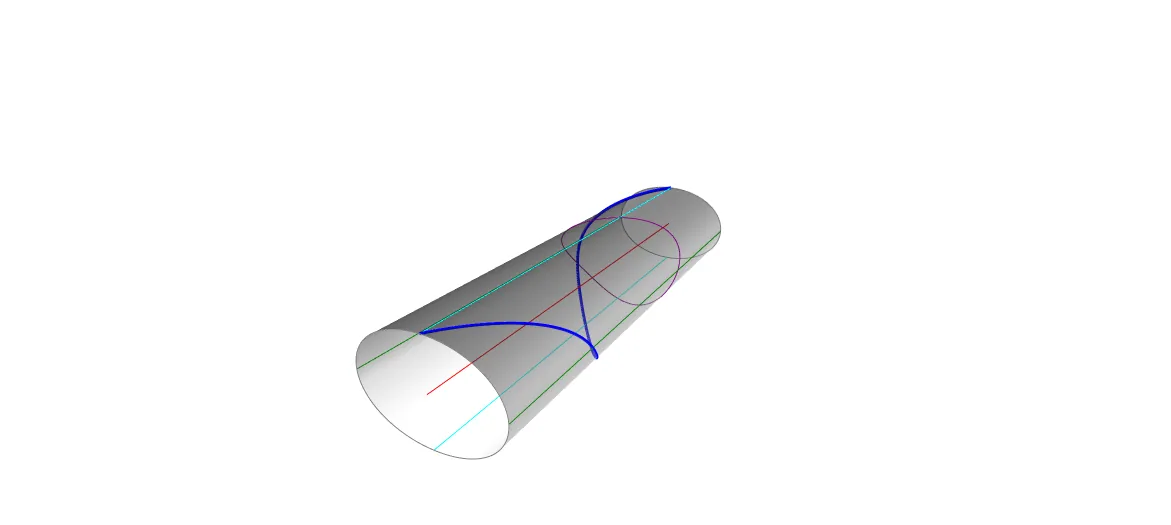
We provide a self-contained geometric description of the geodesic flow in the three-dimensional Lie group $\mathrm{Sol}$, one of Thurston's eight model geometries. The geometry of geodesics is governed by a single invariant $k\in[0,1]$, its modulus. Generic geodesics spiral around an axis, with well-defined amplitude $A(k)$, period $T(k)$, and horizontal drift $H(k)$. We characterize minimal geodesic segments and the cut locus, and obtain an asymptotic estimate showing that distances between points at the same altitude grow logarithmically. This work builds on previous work by Grayson and Coiculescu--Schwartz, but develops an alternative geometric and dynamical viewpoint.
2601.03585Let $Γ\subset \mathsf{PSL}(2,\mathbb{R})$ be a lattice and $ρ:Γ\to \mathsf{Sp}(2n,\mathbb{R})$ be a maximal representation. We show that $ρ$ satisfies a measurable $(1,1,2)-$hypertransversality condition. With this we define a measurable Gromov product and the Bowen-Margulis-Sullivan measure associated to the unstable Jacobian introduced by Pozzetti, Sambarino and Wienhard. As a main application, we prove a strong entropy rigidity result for $ρ$.
2601.03544Geometric Quantization is a term used to describe a wide collection of techniques dating back to the 1960s in the work of Kirillov, Kostant, and Souriau, which take symplectic manifolds and produce complex vector spaces. The name comes from the natural interpretation of symplectic manifolds as the phase spaces of classical mechanical systems and complex vector spaces as the natural domains of wave functions in quantum mechanics. In this thesis, I extend the classical framework of Geometric Quantization to handle a class of singular spaces called Symplectic Stratified Spaces, which date back to the work of Sjamaar and Lerman in the 1990s. As part of this work, I develop the theory of stratified pseudobundles to serve as singular replacements for important auxiliary information in Geometric Quantization: prequantum line bundles and polarizations. I then use this formalism to provide [Q,R]=0 results for singular quotients of toric manifolds and cotangent bundles. I also provide an example of singular Geometric Quantization that does not arise from singular reduction.
2601.03462In this paper, we first derive biharmonic equation for conformal hypersurfaces in a generic Riemannian manifold generalizing that for biharmonic hypersurfaces in \cite{Ou1} and that for biharmonic conformal surfaces in \cite{Ou3, Ou2, Ou4}. We then show that if a totally umbilical hypersurface in a space form admits a biharmonic conformal immersion into the ambient space, then the conformal factor has to be an isoparametric function. We also prove that no part of a non-minimal totally umbilical hypersurface in a space form of nonpositive curvature admits a biharmonic conformally immersion into that space form whilst, for the positive curvature space form, we show that the totally umbilical hypersurface $S^4(\frac{\sqrt{3}}{2})\hookrightarrow S^5$ does admit a biharmonic conformal immersion into $S^5$.
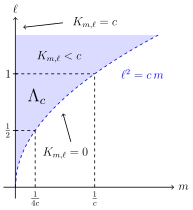
In this article, we study $c$-spherical Ricci metrics, that is, Riemannian metrics whose Gaussian curvature $K$ satisfies \begin{equation*} (K - c)ΔK - |\nabla K|^2 - 4K(K - c)^2 = 0, \end{equation*} for some $c>0$. We explicitly construct a two-parameter family of such metrics with rotational symmetry and show that infinitely many non-isometric examples can be realized on the same torus. Moreover, we investigate their realization as induced metrics on compact rotational surfaces in $\mathbb{S}^3$, establishing the existence of embedded compact spherical Ricci surfaces by controlling a period function associated with the isometric immersion.
2601.03094We investigate several classes of submanifolds of almost quaternionic skew-Hermitian manifolds $(M^{4n}, Q, ω)$, including almost symplectic, almost complex, almost pseudo-Hermitian and almost quaternionic submanifolds. In the torsion-free case, we realize each type of submanifold considered in the theoretical part by constructing explicit examples of submanifolds of semisimple quaternionic skew-Hermitian symmetric spaces.
2601.03092In this work, we discuss the stability of Donaldson's flow of surfaces in a hyperkähler 4-manifold. In \cite{WT2}, Wang and Tsai proved a uniqueness theorem and $C^1$ dynamic stability theorem of the mean curvature flow for minimal surface. We extend their results and obtain a similar dynamic stability theorem of the hyperkähler flow.
2601.02901We study the 2-systole on compact Kähler surfaces of positive scalar curvature. For any such surface $(X,ω)$, we prove the sharp estimate \(\min_X S(ω)\cdot\syst_2(ω)\le12π\), with equality if and only if $X=\PP^2$ and $ω$ is the Fubini--Study metric. Using the classification of positive scalar curvature Kähler surfaces by their minimal models, we also determine the optimal constant in each case and describe the corresponding rigid models: $12π$ when the minimal model is $\PP^2$, $8π$ for Hirzebruch surfaces, and $4π$ for non-rational ruled surfaces. In the non-rational ruled case, we also give an independent analytic proof, adapting Stern's level set method to the holomorphic fibration in Kähler setting.

We prove an upper bound for the Morse index of min-max stationary integral varifolds realizing the $d$-dimensional $p$-width of a closed Riemannian manifold.
2601.02853Using a modified curve shortening flow, we construct $λ$-Angenent curve, which was first constructed by the shooting method.
2601.02742The Riemann curvature tensor fully encodes local geometry, but its Ricci contraction retains only limited information: only the Ricci tensor and the scalar curvature survive, while the Weyl curvature vanishes identically. We show that contracting instead the double dual of the Riemann tensor unlocks the full curvature structure, producing a canonical hierarchy of symmetric, divergence--free $(p,p)$ double forms. These tensors satisfy the first Bianchi identity and obey a hereditary contraction relation interpolating between the double dual tensor and the Einstein tensor. We prove that, in a generic geometric setting, each tensor in this hierarchy is the unique divergence--free $(p,p)$ double form depending linearly on the Riemann curvature tensor, thereby providing canonical higher--rank parents of the Einstein tensor. Their sectional curvatures coincide with the $p$--curvatures; notably, the $2$--curvature determines the full Riemann curvature tensor and forces the $\hat A$--genus of a compact spin manifold to vanish when nonnegative, a property not shared by Ricci or scalar curvature. Finally, we extend the construction to Gauss--Kronecker curvature tensors and Lovelock theory, showing in particular that the second Lovelock tensor $T_4$ admits a genuine four--index parent tensor.
2601.02733We give a detailed description of the nearly Kähler $\frac{\mathrm{SL}(3,\mathbb R)}{\mathbb R\times \mathrm{SO}(2)}$, which is one of the pseudo-Riemannian counterparts of the flag manifold $F(\mathbb{C}^3)$. The main result is the classification of totally geodesic almost complex surfaces in this space.
2601.02726We give a sufficient condition to rule out complete Riemannian metrics with nonnegative scalar curvature on the interior of handlebodies. In higher dimensions, we give examples of ends of manifolds with positive scalar curvature metrics.
2601.02722We prove that compact Riemannian manifolds of dimension $n\ge3$ with harmonic curvature and $\frac{n(n+2)}{2(n+1)}$-nonnegative curvature operator of the second kind must be Einstein. In particular, Building upon Dai-Fu's work \cite{DF}, it follows that if the curvature operator of the second kind is $\min\{\frac{n(n+2)}{2(n+1)},\max\{4,\frac{(n+2)}{4}\}\}$-nonnegative , then such a manifold must be of constant curvature.
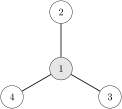
In this paper, we propose a type of Ricci flow on graphs where the probability distribution for the Lin-Lu-Yau curvature remains constant over time, and also study the related Forman curvature flow. These two curvature flows coincide on trees. We first prove the existence and uniqueness of solutions for both curvature flows in general graphs. Then, we obtain that the normalized curvature flow on trees converges to a constant curvature metric, and under the uniform measure, a complete classification of trees can be obtained based on the convergence results.
2601.02035We develop a Bochner theory and Bakry-Emery calculus for horizontal Laplacians associated with general Riemannian foliations. No bundle-like assumption on the metric, nor any total geodesicity or minimality condition on the leaves is imposed. Using a metric connection adapted to the horizontal-vertical splitting, we derive explicit Bochner formulas for the horizontal Laplacian acting on horizontal and vertical gradients, as well as a unified identity for the full gradient. These formulas involve horizontal Ricci curvature, torsion and vertical mean curvature terms intrinsic to the foliated structure. From these identities, we establish generalized curvature dimension inequalities, extending earlier results in sub-Riemannian geometry. As applications, we obtain horizontal Laplacian comparison theorems, Bonnet-Myers type compactness results with explicit diameter bounds, stochastic completeness, first eigenvalue estimates and gradient and regularization estimates for the horizontal heat semigroup. The framework applies, in particular, to contact manifolds and Carnot groups of arbitrary step.
2601.01837We consider nonexistence and gradient estimate for solutions to $Δ_pv +av^{q}=0$ defined on a complete Riemannian manifold with {\it $χ$-type Sobolev inequality}. A Liouville theorem on this equation is established if the lying manifold $(M, g)$ supports a {\it $χ$-type Sobolev inequality} and the $L^{\fracχ{χ-1}}$ norm of $\ric_-(x)$ of $(M, g)$ is bounded from upper by some constant depending on $\dim(M)$, Sobolev constant $\mathbb{S}_χ(M)$ and volume growth order of geodesic ball $B_r\subset M$. This extends and improves some conclusions obtained recently by Ciraolo, Farina and Polvara \cite{CFP}, but our method employed in this paper is different from their ``P-function" method. In particular, for such manifold with a {\it $χ$-type Sobolev inequality}, we give the lower estimate of volume growth of geodesic ball. If $χ\leq n/(n-2)$, we also establish the local logarithm gradient estimate for positive solutions to this equation under the condition $\ric_-(x)$ is $L^γ$-integrable where $γ>{\fracχ{χ-1}}$. As topological applications of main results(see \corref{main5}) we show that for a complete noncompact Riemannian manifold on which the Sobolev inequality \eqref{chi-n} holds true, $\dim(M)=n\geq 3$ and $\ric(x)\geq 0$ outside some geodesic ball $B(o,R_0)$, there exists a positive constant $C(n)$ depending only on $n$ such that, if $$\|\ric_-\|_{L^{\frac{n}{2}}}\leq C(n)\mathbb{S}_{\frac{n}{n-2}}(M),$$ then $(M, g)$ is of a unique end.