Classical Analysis and ODEs
arXiv:math.CA
Special functions, orthogonal polynomials, harmonic analysis, ODEs, differential relations, calculus of variations, approximations, expansions.
Looking for a broader view? This category is part of:
Special functions, orthogonal polynomials, harmonic analysis, ODEs, differential relations, calculus of variations, approximations, expansions.
Looking for a broader view? This category is part of:
 2601.03987
We define a nonlinear Fourier transform which maps sequences of contractive $n \times n$ matrices to $SU(2n)$-valued functions on the circle $\mathbb{T}$. We characterize the image of finitely supported sequences and square-summable sequences on the half-line, and construct an inverse for $SU(2n)$-valued functions whose diagonal $n \times n$ blocks are outer matrix functions. As an application, we relate this nonlinear Fourier transform with quantum signal processing over $U(2n)$ and multivariate quantum signal processing.
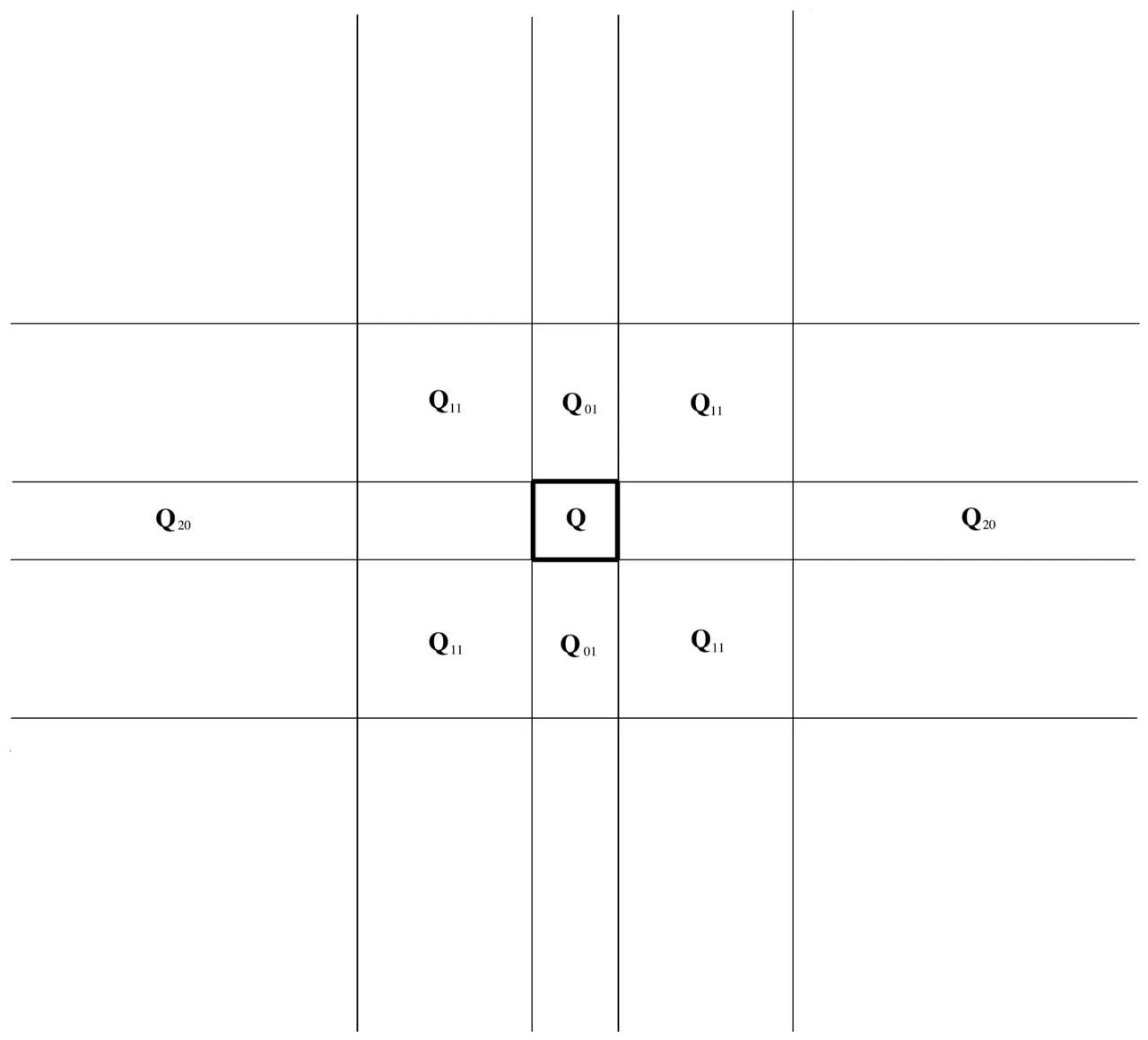
We study a family of fractional integral operators whose kernels satisfying an non-isotropic dilation have singularity on a coordinate subspace. A characterization is given for these operators bounded from the classical, atom decomposable $H^1$-Hardy space to $L^q$-spaces.

We construct a class of homogeneous Cantor-Moran measures with all contraction ratios being reciprocal of integers, and prove that they are pointwise absolutely normal. Our approach relies on methods developed by Davenport, Erd{ő}s, and LeVeque \cite{DEL1963} and properties of the order of integers in the multiplicative groups. The construction of these measures differs from the class of pointwise absolutely normal self-similar measures introduced by Hochman and Shmerkin \cite{Hochman2015}, in which dynamical approaches were used. As an application, for all gauge functions $\varphi(r)$ with $r/\varphi(r)\to 0$ as $r\to 0$, we obtain a set of uniqueness $K$ with ${\mathcal H}^{\varphi}(K)>0$. Moreover, we show that there exists a pointwise absolutely normal measure $ μ$ of dimension one fully supported on $K$. The result demonstrates that having a lot of absolutely normal numbers in a Cantor set, even with dimension one, cannot guarantee that it supports a measure with Fourier decay. It also shows that the ${\mathsf{DEL}}$ criterion being satisfied for all integers does not guarantee any Fourier decay nor the supporting set is a set of multiplicity.
2601.02866We exhibit new biorthogonal sequences generated by index integrals of the squares of the modified Bessel functions and gamma functions. The composition orthogonality, involving differential operators is employed. Generalized Wilson polynomials are introduced. Some properties are investigated.
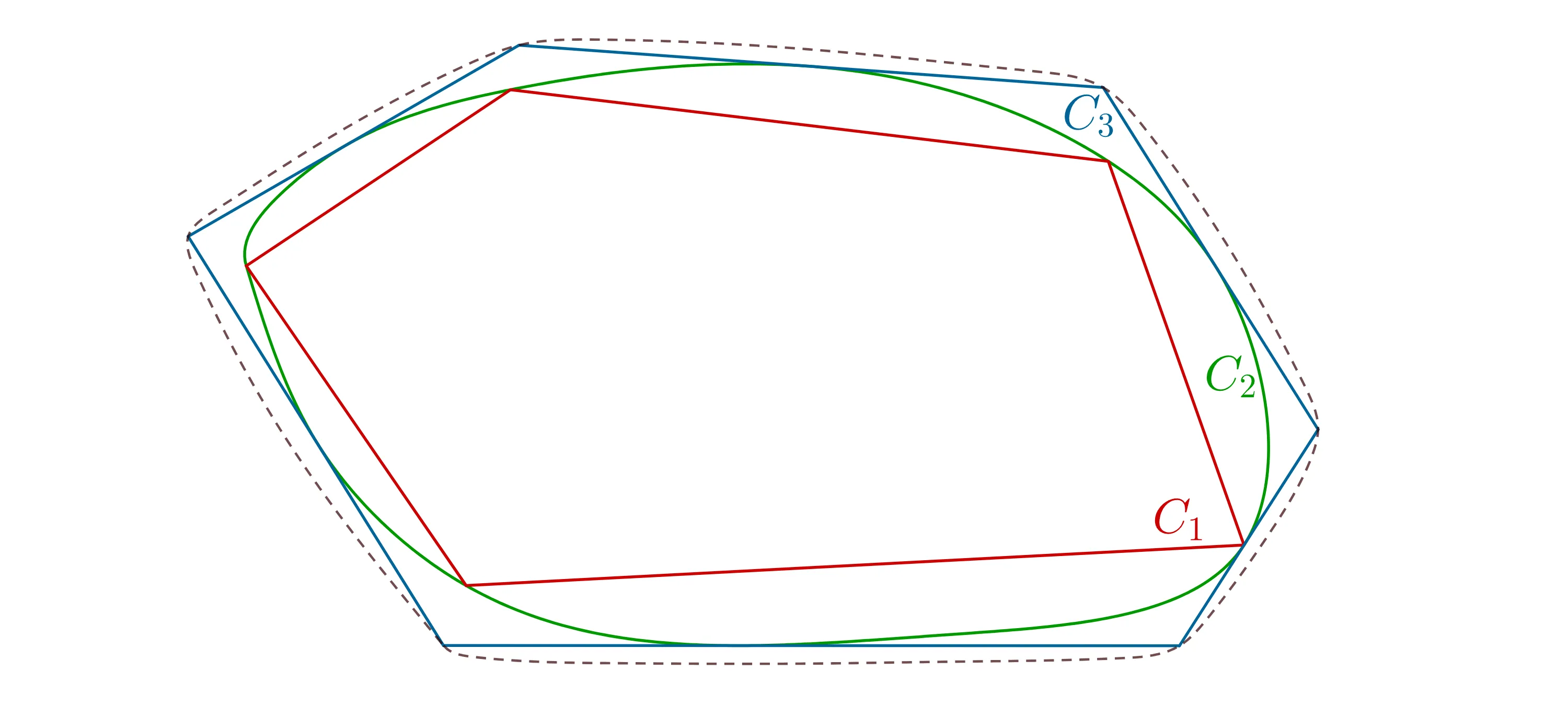
Let $C\subset\mathbb{R}^2$ be a convex body, and let $\mathcal{P}\subset[0,1)^2$ be a set of $N$ points. The discrepancy of $\mathcal{P}$ with respect to $C$ is defined as \begin{equation*} \mathcal{D}(\mathcal{P},\, C)=\sum_{\mathbf{p}\in\mathcal{P}}\sum_{\mathbf{n}\in\mathbb{Z}^2}\mathds{1}_C(\mathbf{p}+\mathbf{n})-N|C|. \end{equation*} A standard approach for estimating how a point distribution deviates from uniformity is to average the latter quantity over a family of sets; in particular, when considering quadratic averages over translations and dilations, one obtains \begin{equation*} \mathcal{D}_2(\mathcal{P},\, C)=\int_{0}^{1}\int_{[0,1)^2}\left|\mathcal{D}( \mathcal{P},\,\boldsymbolτ+δC)\right|^2\,{\rm d}\boldsymbolτ\,{\rm d} δ. \end{equation*} This paper concerns the behaviour of optimal \textit{homothetic quadratic discrepancy} \begin{equation*} \inf_{\# \mathcal{P}=N} \mathcal{D}_2(\mathcal{P},\, C)\quad\text{as}\quad N\to+\infty. \end{equation*} Beck and Chen \cite{MR1489133} showed that the optimal \textit{h.q.d.} of convex polygons has an order of growth of $\log N$. More recently, Brandolini and Travaglini \cite{MR4358540} showed that the optimal \textit{h.q.d.} of planar convex bodies has an order of growth of $N^{1/2}$ if their boundary is $\mathcal{C}^2$, and of $N^{2/5}$ if their boundary is only piecewise-$\mathcal{C}^2$ and not polygonal. We show that, in general, no order of growth is required. First, by an implicit geometric construction, we show that one can obtain prescribed oscillations from a logarithmic order of $\log N$ to polynomial orders of $N^{2/5}$ and $N^{1/2}$, and vice versa. Secondly, by using Fourier-analytic methods, we show that prescribed polynomial-order oscillations in the range $N^α$ with $α\in(2/5,1/2)$ are achievable.
2601.01880We investigate the $L^p$ mapping properties of maximal functions associated with analytic hypersurfaces in $\mathbb R^d$, with a particular emphasis on the role of transversality. Around points that are not transversal, we show that the associated maximal function is bounded on $L^p(\mathbb R^d)$ for all $p>2$, regardless of the decay of the Fourier transform of surface measures. In contrast, away from non-transversal points, we prove that $L^p$ bounds for the maximal operator imply that the Fourier transform of the surface measure decays at rate $1/q$ for $q>p$. Combining these two regimes, we demonstrate that the conjecture of Stein and Iosevich-Sawyer on maximal functions could be re-formulated, in the analytic setting, by restricting attention to transversal points. Moreover, our result completely settles the refined form of the conjecture for certain cases.
2601.01821This paper investigates the stability of wavelet frames within anisotropic function spaces. By replacing classical integral estimates with a matrix algebra approach, we establish the boundedness of frame operators and derive optimal dual wavelets via variational principles. Our analysis reveals fundamental geometric obstructions, identified here as an anisotropic Balian-Low phenomenon, which preclude the existence of tight frames for isotropic generators in high-shear regimes. Furthermore, we apply these results to determine sharp constants for Sobolev embeddings, explicitly quantifying the impact of dilation geometry on analytic stability.
2601.01203We show that for the standard sinusoidal Winfree model, a coupling strength exceeding twice the maximal magnitude of the intrinsic frequencies guarantees the convergence of the system for Lebesgue almost every initial data. This is proven by first showing, via an order parameter bootstrapping argument, that the pathwise critical coupling strength is upper bounded by a function of the order parameter, and then showing by a volumetric argument that for Lebesgue almost every data the order parameter cannot stay below and be bounded away from 1 for all time; this is a Winfree model counterpart of the analysis of Ha and the author (2020) performed for the Kuramoto model. Using concentration of measure and the aforementioned volumetric argument, we show that, except possibly on a set of very small measure, oscillator death is observed in finite time; this rigorously demonstrates the existence of the oscillator death regime numerically observed by Ariaratnam and Strogatz (2001). These results are robust under many other choices of interaction functions often considered for the Winfree model. We demonstrate that the asymptotic dynamics described in this paper are sharp by analyzing the equilibria of the Winfree model, and we bound the total number of equilibria using a polynomial description. The sequel to this paper will deal with the Winfree model on higher-dimensional manifolds, such as the Euclidean spheres and the unitary groups.
2601.01182The paper presents new and known results on estimates of important linear and nonlinear approximation characteristics of generalized Wiener classes of functions of several variables in different metrics.
2601.01032We study optimal multiple weight assumptions in the weighted theory of multilinear Fourier multipliers and multilinear pseudo-differential operators. For multilinear Fourier multipliers, we revisit the weighted Hörmander-type theorem of Li and Sun, as a multilinear version of Kurtz and Wheeden, and show that their multiple weight condition is sharp. This provides the sharp necessary condition in the multilinear setting and simultaneously improves the classical linear necessity established by Kurtz and Wheeden. In the pseudo-differential setting, we consider recent weighted estimates of the authors for symbols in the multilinear Hörmander class and prove that their multiple weight hypothesis is also best possible. As a corollary, we can obtain the optimality of sharp maximal function estimates for multilinear pseudo-differential operators in the papers of the authors which originated from the results of Chanillo and Torchinsky.
2601.00721This paper focuses on symbolic integration of differential forms, with a particular emphasis on historical and modern developments, from Abel's addition theorems for Abelian integrals to Zeilberger's creative telescoping for parameterized integrals. It explores closed rational $p$-forms and provides algorithmic approaches for their integration, extending classical results like Hermite reduction and Liouville's theorem. The integration of closed differential forms with parameters is further examined through telescopers, offering a unified framework for handling both algebraic and transcendental cases.
2601.00201We establish characterization of $H^1$ Sobolev spaces by certain square functions, improving previous results.
2601.00902We study the fractional Hardy inequality on the integer lattice. We prove null-criticality of the Hardy weight and hence optimality of the constant. More specifically, we present a family of Hardy weights with respect to a parameter and show that below a certain threshold the Hardy weight is positive critical while above the threshold it is subcritical. In particular, the Hardy weight at the threshold is optimal in the sense that any larger weight would fail to be a Hardy weight and the Hardy inequality does not allow for a minimizer. A crucial ingredient in our proof is an asymptotic expansion of the fractional discrete Riesz kernel.
2512.24990We give a proof of Fourier extension conjecture on the paraboloid in all dimensions bigger than 2 that begins with a decomposition suggested in Sawyer [Saw8] of writing a smooth Alpert projection as a sum of pieces whose Fourier extensions are localized. This is then used in the case d=3 to establish the trilinear equivalence of the Fourier extension conjecture given in C. Rios and E. Sawyer [RiSa1] and [RiSa3]. A key aspect of the proof is that the trilinear equivalence only requires an averaging over grids, which converts a difficult exponential sum into an oscillatory integral with periodic amplitude, that is then used to prove the localization on the Fourier side. Finally, we extend this argument to all dimensions bigger than 2 using bilinear analogues of the smooth Alpert trilinear inequalities, which generalize those in Tao, Vargas and Vega [TaVaVe].
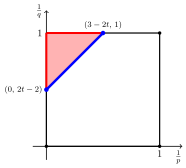
Motivated by the work of Cheng--Fang--Wang--Yu on the hypersingular Bergman projection, we develop a real-variable and dyadic framework for hypersingular operators in regimes where strong-type estimates fail at the critical line. The main new input is a hypersingular sparse domination principle combined with Bourgain's interpolation method, which provides a flexible mechanism to establish critical-line (and endpoint) estimates. In the unit disc setting with $1<t<3/2$, we obtain a full characterization of the $(p,q)$ mapping theory for the dyadic hypersingular maximal operator $\mathcal M_t^{\mathcal D}$, in particular including estimates on the critical line $1/q-1/p=2t-2$ and a weighted endpoint criterion in the radial setting. We also prove endpoint estimates for the hypersingular Bergman projection \[ K_{2t}f(z)=\int_{\mathbb D}\frac{f(w)}{(1-z\overline w)^{2t}}\,dA(w), \] including a restricted weak-type bound at $(p,q)=\bigl(\tfrac{1}{3-2t},1\bigr)$. Finally, we introduce a class of hypersingular cousin of sparse operators in $\mathbb R^n$ associated with \emph{graded} sparse families, quantified by the sparseness $η$ and a new structural parameter (the \emph{degree}) $K_{\mathcal S}$, and we characterize the corresponding strong/weak/restricted weak-type regimes in terms of $(n,t,η,K_{\mathcal S})$. Our real-variable perspective addresses to an inquiry raised by Cheng--Fang--Wang--Yu on developing effective real-analytic tools in the hypersingular regime for $K_{2t}$, and it also provides a new route toward the critical-line analysis of Forelli--Rudin type operators and related hypersingular operators in both real and complex settings.
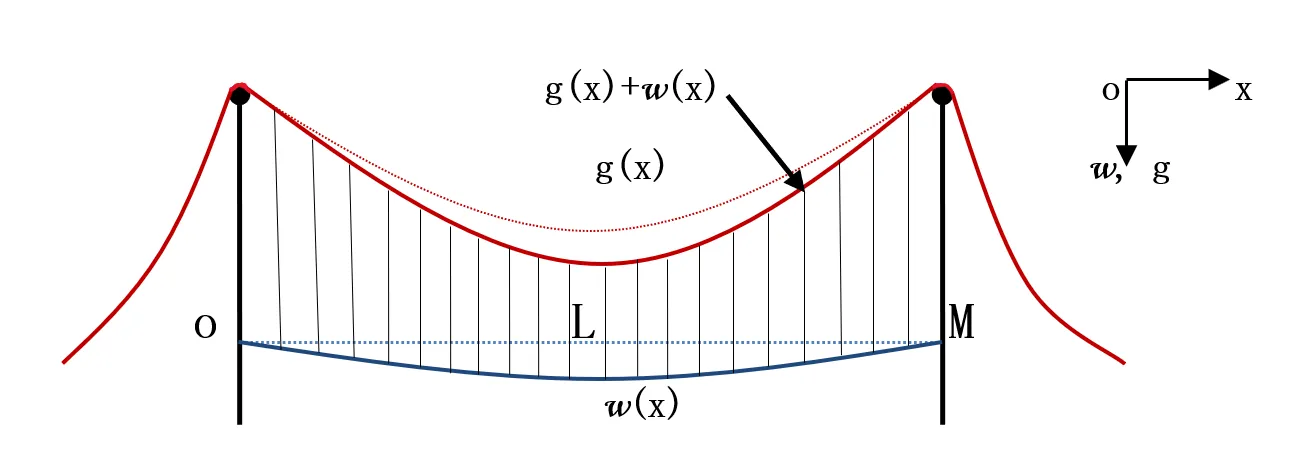
The classical Melan equation modeling suspension bridges is considered. We first study the explicit expression and the uniform positivity of the analytical solution for the simplified ``less stiff'' model, based on which we develop a monotone iterative technique of lower and upper solutions to investigate the existence, uniqueness and approximability of the solution for the original classical Melan equation.The applicability and the efficiency of the monotone iterative technique for engineering design calculations are discussed by verifying some examples of actual bridges. Some open problems are suggested.
2512.24348We explicitly construct a heat kernel as a Neumann series for certain function spaces, such as $L^{1}$, $L^{2}$, and Hilbert spaces, associated to a locally compact Hausdorff space $\mathfrak{X}$ with Borel $σ$-algebra $\mathcal{B}$, and endowed with additional measure-theoretic data. Our approach is an adaptation of classical work due to Minakshishundaram and Pleijel, and it requires as input a parametrix or small time approximation to the heat kernel. The methodology developed in this article applies to yield new instances of heat kernel constructions, including normalized Laplacians on finite and infinite graphs as well as Hilbert spaces with reproducing kernels.
2512.24283The aim of this note is to present the simple observation that a slight refinement of the Contraction Mapping Principle allows one to recover the precise convergence rate in the Picard-Lindelöf Theorem.
2512.23949A theorem of Hoischen states that given a positive continuous function $\varepsilon:\mathbb{R}\to\mathbb{R}$, an integer $n\geq 0$, and a closed discrete set $E\subseteq\mathbb{R}$, any $C^n$ function $f:\mathbb{R}\to\mathbb{R}$ can be approximated by an entire function $g$ so that for $k=0,\dots,n$, and $x\in\mathbb{R}$, $|D^{k}g(x)-D^{k}f(x)|<\varepsilon(x)$, and if $x\in E$ then $D^{k}g(x)=D^{k}f(x)$. The approximating function $g$ is entire and hence piecewise monotone. Building on earlier work, for $n\leq 3$, we determine conditions under which when $f$ is piecewise monotone we can choose $g$ to be comonotone with $f$ (increasing and decreasing on the same intervals), and under which the derivatives of $g$ can be taken to be comonotone with the corresponding derivatives of $f$ if the latter are piecewise monotone. The proof for $n\leq 3$ establishes the theorem for all $n$, assuming a conjecture (shown in previous work with Haris and Madhavendra to hold for $n\leq 3$) regarding the set of $2(n+1)$-tuples $(f(0),Df(0),\dots,D^nf(0),f(1),Df(1),\dots,D^nf(1))$ of the values at the endpoints of the derivatives of a $C^n$ function $f$ on $[0,1]$ for which $D^nf$ is increasing and not constant.
2512.23876We study the existence of positive eigenvalues with associated nonnegative mild eigenfunctions for a class of abstract initial value problems in Banach spaces with functional, possibly nonlocal, initial conditions. The framework includes periodic, multipoint, and integral average conditions. Our approach relies on nonlinear analysis, topological methods, and the theory of strongly continuous semigroups, yielding results applicable to a wide range of models. As an illustration, we apply the abstract theory to a reaction-diffusion equation with a nonlocal initial condition arising from a heat flow problem.
2601.01203We show that for the standard sinusoidal Winfree model, a coupling strength exceeding twice the maximal magnitude of the intrinsic frequencies guarantees the convergence of the system for Lebesgue almost every initial data. This is proven by first showing, via an order parameter bootstrapping argument, that the pathwise critical coupling strength is upper bounded by a function of the order parameter, and then showing by a volumetric argument that for Lebesgue almost every data the order parameter cannot stay below and be bounded away from 1 for all time; this is a Winfree model counterpart of the analysis of Ha and the author (2020) performed for the Kuramoto model. Using concentration of measure and the aforementioned volumetric argument, we show that, except possibly on a set of very small measure, oscillator death is observed in finite time; this rigorously demonstrates the existence of the oscillator death regime numerically observed by Ariaratnam and Strogatz (2001). These results are robust under many other choices of interaction functions often considered for the Winfree model. We demonstrate that the asymptotic dynamics described in this paper are sharp by analyzing the equilibria of the Winfree model, and we bound the total number of equilibria using a polynomial description. The sequel to this paper will deal with the Winfree model on higher-dimensional manifolds, such as the Euclidean spheres and the unitary groups.
2512.18058We discover a new instability mechanism for short-time Fourier transform phase retrieval which yields that for any reasonable window function $φ$ in any dimension $d$, the local stability constant $c(f)$ defined via \begin{equation*} \inf_{|λ|=1}\|f- λg\|_{M^p(\mathbb{R}^{d})}\leq c(f)\| |V_φf|-|V_φ g|\|_\mathcal{D}, \hspace{5mm} \forall g\in M^p(\mathbb{R}^d), \end{equation*} is infinite on a dense set of vectors for all weighted fractional Sobolev norms $\mathcal{D}$, up to the sharp maximal regularity level ensuring that the problem is well-defined. This, in particular, answers an open problem of Rathmair, who asked whether exponential concentration of the Gabor transform on $\mathbb{R}^2$ guaranteed a finite local stability constant. For the specific case of Gabor phase retrieval, we further show that there is a complementary dense set where the local stability constant on $\mathbb{R}^{2d}$ is finite. Our results extend and complement a series of fundamental stability theorems for Gabor phase retrieval which have been proven over the last ten years. Of particular note is the work of Grohs and Rathmair, who showed that for sufficiently strong weighted Sobolev norms $\mathcal{D}$ on $\mathbb{R}^{2d}$, the local stability constant for Gabor phase retrieval is bounded by the inverse of the Cheeger constant of the flat metric conformally multiplied by $|V_φf|$. As a consequence of our analysis, we determine two dense families of functions, one of which has associated Cheeger constant zero and the other strictly positive. We also revisit the stability problem for STFT phase retrieval on bounded subsets of the time-frequency plane, for more general windows, and for restricted signal classes, extending and simplifying many influential results in the literature.
2512.03651We present a local weighted estimate for the Riesz potential in $\mathbb{R}^n$, which improves the main theorem of Alberico, Cianchi, and Sbordone [C. R. Math. Acad. Sci. Paris \textbf{347} (2009)] in several ways. As a consequence, we derive weighted Poincaré-Sobolev inequalities with sharp dependence on the constants. We answer positively to a conjecture proposed by Pérez and Rela [Trans. Amer. Math. Soc. 372 (2019)] related to the sharp exponent in the $A_1$ constant in the $(p^*,p)$ Poincaré-Sobolev inequality with $A_1$ weights. Our approach is versatile enough to prove Poincaré-Sobolev inequalities for high-order derivatives and fractional Poincaré-Sobolev inequalities with the BBM extra gain factor $(1-δ)^{1/p}$. In particular, we improve one of the main results from Hurri-Syrjänen, Martínez-Perales, Pérez, and Vähäkangas [Int. Math. Res. Not. 20 (2023)].
2511.20438We characterize exponential systems on sets of finite measure that form a frame or a Riesz sequence at the critical density. Namely, they are precisely those systems for which the underlying point set admits a weak limit that yields a Riesz basis. In combination with a recent result by Kozma, Nitzan and Olevskii, this shows that there exist sets that fail to possess a frame or Riesz sequence at the critical density, solving an open problem posed by Olevskii. As another consequence, we show that exponential frames and Riesz sequences over repetitive point sets (such as cut-and-project sets) at the critical density are already Riesz bases.
We study the Fourier ratio of a signal $f:\mathbb Z_N\to\mathbb C$, \[ \mathrm{FR}(f)\ :=\ \sqrt{N}\,\frac{\|\widehat f\|_{L^1(μ)}}{\|\widehat f\|_{L^2(μ)}} \ =\ \frac{\|\widehat f\|_1}{\|\widehat f\|_2}, \] as a simple scalar parameter governing Fourier-side complexity, structure, and learnability. Using the Bourgain--Talagrand theory of random subsets of orthonormal systems, we show that signals concentrated on generic sparse sets necessarily have large Fourier ratio, while small $\mathrm{FR}(f)$ forces $f$ to be well-approximated in both $L^2$ and $L^\infty$ by low-degree trigonometric polynomials. Quantitatively, the class $\{f:\mathrm{FR}(f)\le r\}$ admits degree $O(r^2)$ $L^2$-approximants, which we use to prove that small Fourier ratio implies small algorithmic rate--distortion, a stable refinement of Kolmogorov complexity.
2511.18032A general integral expression to transform power series is applied to $\arcsin{x}$ and its positive integer powers. We concentrate on the first to the fourth powers and obtain infinite classes of new power series involving central binomial coefficients. Specializing the variable to appropriate simple values leads to different classes of series expansions for $π$ and some of its positive integer powers. We also discuss several limit expressions and connections with hypergeometric series.
2511.15899We use recent advances in the theory of Furstenberg sets to prove new incidence results of Szemerédi--Trotter strength for $δ$-discretized structures with Cartesian product flavor. We use these results to make progress on a number of problems that include energy estimates and Fourier decay of fractal measures supported on curves, as well as various sum-product-like results governed by fractal dimension.
2511.15128Let $(μ, Λ)$ be the canonical spectral pair generated by a Hadamard triple $(N,B,L)$ in $\mathbb{R}$ with $0\in B \cap L$, which means that the family $\big\{ e_λ(x)=e^{2π\mathrm{i} λx}: λ\in Λ\big\}$ forms an orthonormal basis in $L^2(μ)$.We prove that if $\#B < N^{0.677}$, then there are infinitely many primes $p$ such that $(μ, pΛ)$ is also a spectral pair. Under Artin's primitive root conjecture or the Elliott-Halberstam conjecture, the same conclusion holds for $\# B < N$.
2511.11559Sequences are often conveniently encoded in the form of a generating function depending on a formal variable. This note presents two observations that allow one to draw conclusions about the generated sequence from the generating function. The first constructively produces "recursion relations" for the sequence from differential operators in the formal variable having the generating function as an eigenfunction. The second allows one to determine whether the sequence is orthogonal with respect to some inner product by considering the result of taking the inner product of the generating function with itself. Examples presented to demonstrate the use and value of these methods include a sequence of numbers, a family of Exceptional Hermite Polynomials, and an example illustrating the result in a non-commutative setting.
2511.08757We prove finite-field analogs of Bourgain's projection theorem in higher dimensions. In particular, for a certain range of parameters we improve on an exceptional set estimate by Chen in all dimensions and codimensions.
2511.00841Let $R^{\frac{1}{2}}$ be a large integer, and $ω$ be a nonnegative weight in the $R$-ball $B_R=[0,R]^2$ such that $ω(B_R)\le R$. For any complex sequence $\{a_n\}$, define the quadratic exponential sum \[ G(x,t)=\sum_{n=1}^{R^{\frac{1}{2}}} a_n e\big(\frac{n}{R^{\frac{1}{2}}} x+\frac{n^2}{R} t\big). \] It holds that \[ \int |G|^2 ω\lessapprox \sup_{T}ω(T)^{\frac{1}{2}}\cdot R \,\|a_n\|_{l^2}^2 \] where $T$ ranges over $R\times R^{\frac{1}{2}}$ tubes in $B_R$. The proof is established through exploring the distributions of superlevel sets of the $G$ function. It is based on the $TT^*$ method and the circle method.
2510.04345Let $Γ$ be a compact patch of a well-curved $C^{n+1}$ curve in $\mathbb{R}^n$ with induced Lebesgue measure ${\rm d} λ$, and let $g \mapsto \widehat{g \,{\rm d}λ}$ be the Fourier extension operator for $Γ$. Then we have, for arbitrary non-negative weights $w$, \begin{equation*} \int_{B_R} |\widehat{g \,{\rm d}λ}|^2w \leq C_{n,a} R^{a} \sup_S \left(\int_S w\right)\int_Γ|g|^2 \, {\rm d} λ \end{equation*} for any $a> \frac{n-3}{2} + \frac{2}{n} - \frac{2}{n^2(n+1)}$, where the $\sup$ is over all $1$-neighbourhoods $S$ of hyperplanes whose normals are parallel to the tangent at some point of $Γ$. This represents partial progress on the Mizohata-Takeuchi conjecture for curves in dimensions $n \geq 3$, improving upon the exponent $a=n-1$ which can be obtained as a consequence of the Agmon-Hörmander trace inequality. Our main tool in establishing this inequality will be a weighted formulation of refined decoupling for well-curved curves. We also discuss the sharpness of the exponents we obtain in this and in auxiliary results, and further explore this in the context of axiomatic decoupling for curves.
2509.25900The Radon hypergeometric function (Radon HGF) F(z;\a) of type łon the Grassmannian Gr(m,N), N=rn for some integers r,n>0, is defined as a Radon transform of the character of the universal covering of the Lie group H_ł\subset GL(N) specified by a partition łof n, where \a \in C^{n} is the parameter to in the character. For this Radon HGF, we give the contiguity relations of the form L^{(i,j)}F(z;\a)=\b(\a_{0}^{(j)})F(z;\a+\e^{(i)}-\e^{(j)}) with a differential operator L^{(i,j)} of order r and the polynomial \b(s) called b-function. As its application, we derive the contiguity relation for the beta and gamma functions defined by Hermitian matrix integral. In establishing the contiguity relations for Radon HGF, the classical Capelli identity and Cayley's formula play an essential role.
2509.23839Let $\mathcal H_{\infty}^δ$ denote the Hausdorff content of dimension $δ\in(0,n]$ defined on subsets of $\mathbb R^n$. The principal problem, considered in this paper, is to characterize the non-negative function $w$ for which the weighted $L^p$-norm inequality with $p\in(1,\infty)$ and the weighted weak $L^1$-norm inequality on Hardy-Littlewood maximal operators associated with Hausdorff contents hold true. To achieve this, we introduce a class of capacitary Muckenhoupt weights depending on the dimension $δ$, denoted as $\mathcal A_{p,δ}$, which enjoys the strict monotonicity on the dimension index $δ$. Then we show that, for any $p\in(1,\infty)$ and $δ\in(0,n]$, the weighted $L^p$-norm inequality holds true if and only if $w\in\mathcal A_{p,δ}$, and the weighted weak $L^1$-norm inequality holds true if and only if $w\in\mathcal A_{1,δ}$ by a new approach developed in this paper. As the second objective, applying this new approach, the seminal properties of classical Muckenhoupt $A_p$ weights, such as the reverse Hölder inequality [R. R. Coifman and C. Fefferman, Studia Math. 51 (1974), 241-250], the self-improving property [B. Muckenhoupt, Trans. Amer. Math. Soc. 165 (1972), 207-226], and Jones' factorization theorem [P. W. Jones, Ann. of Math. (2) 111 (1980), 511-530], are all established within the framework of capacitary Muckenhoupt weight class $\mathcal A_{p,δ}$. Finally, we also show that the maximal operator is bounded on the weak weighted Choquet-Lebesgue space $L_w^{p,\infty}(\mathbb R^n,{\mathcal H}_\infty^δ)$ if and only if $w\in\mathcal A_{p,δ}$ with $p\in(1,\infty)$ and $δ\in(0,n]$.
2509.21869We prove two-ends Furstenberg estimates in the plane for a Katz-Tao $(δ,t)$-set of lines, for general $t\in[0,2]$.
2509.17600Motivated by the recent work of Kulikov, Nazarov, and Sodin, we construct sufficient conditions for discrete subsets of $\mathbb{R}$, which lie between the supercritical and subcritical cases, to constitute Fourier uniqueness pairs. This family of critical uniqueness pairs includes pairs that are strongly asymmetric, stretching beyond those associated with zeros of zeta and L-functions, discovered by Bondarenko, Radchenko, and Seip, and getting arbitrarily close to the classical Shannon--Whittaker uniqueness pair. We also identify a somewhat more restrictive family of strongly asymmetric uniqueness pairs that yield frames and hence Fourier interpolation.
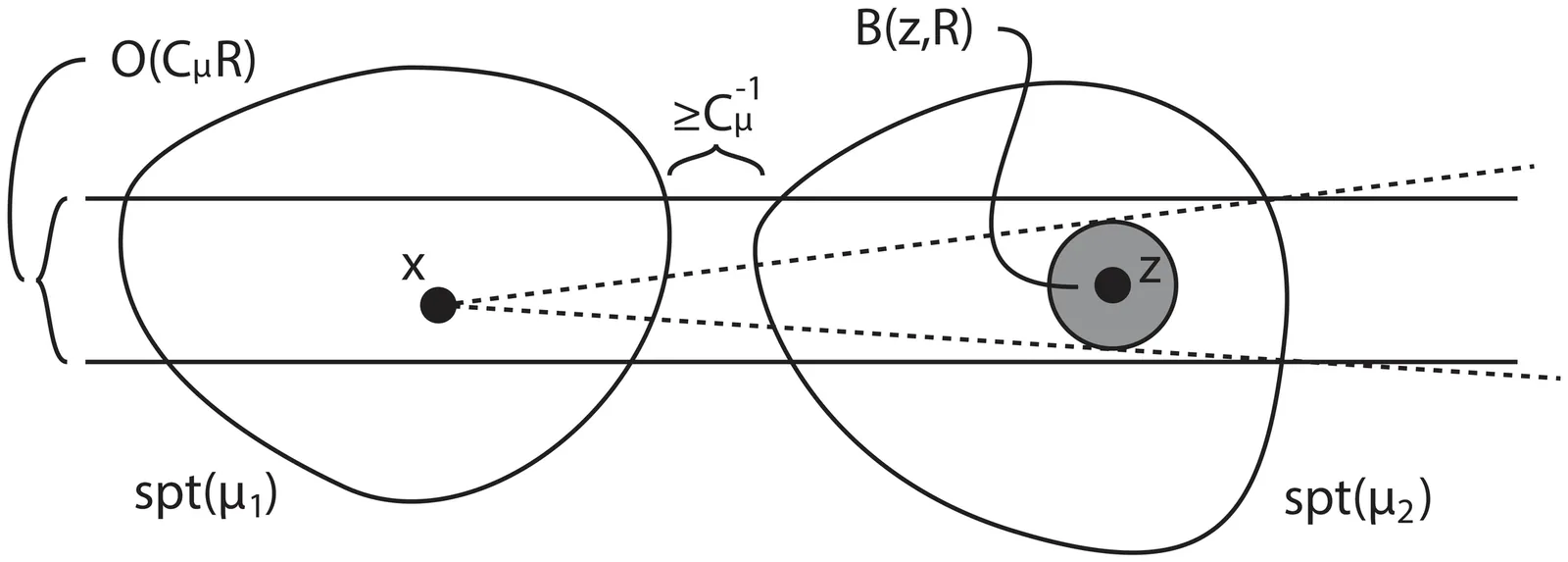
Uniformly perfect measures are a common generalisation of Ahlfors regular measures, self-conformal measures on the line, and their push-forwards under sufficiently regular maps. We show that every uniformly perfect measure $σ$ on a strictly convex planar $C^{2}$-graph is $L^{2}$-flattening. That is, for every $ε>0$, there exists $p = p(ε,σ) \geq 1$ such that $$\|\hatσ\|_{L^{p}(B(R))}^{p} \lesssim_{ε,σ} R^ε, \qquad R \geq 1.$$
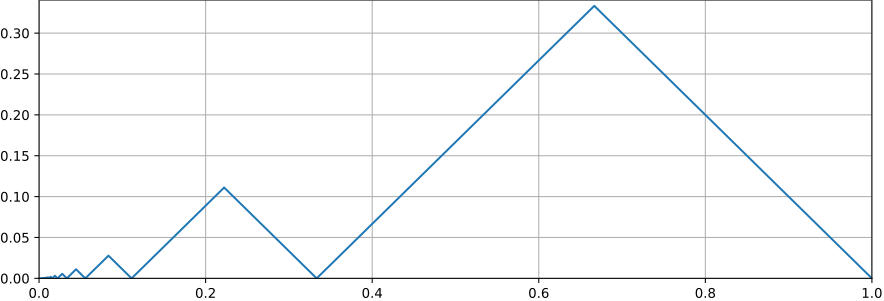
In this work, we extend the concept of the Stieltjes derivative to encompass left-continuous derivators with bounded variation, thereby relaxing the monotonicity constraint. This generalization necessitates a refined definition of the Stieltjes derivative applicable across the entire domain, accommodating derivators that may change sign. We establish a generalized Fundamental Theorem of Calculus for the Lebesgue-Stieltjes integral in this broader context, presenting both "almost-everywhere" and "everywhere" versions. The latter requires a specific condition relating the derivator to its variation function, which we prove to be optimal through a density theorem. Our framework bridges the gap between Stieltjes differential equations and measure differential equations, offering a tool for modeling complex systems with non-monotonic dynamics.
2508.01939Recently, Kulikov (\cite{Ku}) has shown that certain convex functionals on weighted Bergman spaces are maximized by reproducing kernels. We show a sharp quantitative stability of these estimates with the optimal norm and the exponent and an explicit constant asymptotically sharp in both directions ($α\rightarrow -1$ and $α\rightarrow +\infty$). Several applications of this result include recovering the appropriate result for Fock spaces, interpretation to Cauchy wavelets, and the Hardy space counterpart for functionals induced by increasing function. In addition, we prove a higher-dimensional analog of the main result assuming that all convex functionals on the weighted Bergman space $\mathcal{A}^2_α(\mathbb{B}_n)$ attain their extrema in reproducing kernels.
We introduce Frostman conditions for bivariate random variables and study discretized entropy sum-product phenomena in both independent and dependent settings. Fix $0 < s < 1$, and let $(X,Y)$ be a bivariate real random variable with bounded support, whose distribution satisfies a Frostman condition of dimension $s$. Let $φ(x,y)$ be a polynomial obtained from a diagonal polynomial $ρ_1(x)+ρ_2(y)\in \mathbb{R}[x, y]$ of degree $d\ge 2$ by applying an invertible rational linear change of variables in $(x,y)$. We show that there exists $ε= ε(φ,s)>0$ such that $$ \max\{H_n(X+Y), H_n(φ(X,Y))\} \geq n(s+ε) $$ for all sufficiently large $n$, where the precise assumptions on $(X,Y)$ depend on the Frostman level. The proof introduces a novel multi-step entropy framework, combining the submodularity formula, the discretized entropy Balog-Szemerédi-Gowers theorem, and state-of-the-art results on the Falconer distance problem, to reduce general forms to a diagonal core case. As an application, we obtain discretized sum-product type estimates. In particular, for a $δ$-separated set $A\subseteq [0, 1]$ of cardinality $δ^{-s}$, satisfying certain non-concentration conditions, and a dense subset $G\subseteq A\times A$, there exists $ε=ε(s, φ)>0$ such that $$ E_δ(A+_GA) + E_δ(φ_G(A, A)) \ggδ^{-ε}(\#A) $$ for all $δ$ small enough. Here $E_δ(A)$ denotes the $δ$-covering number of $A$, $A+_GA:=\{x+y\colon (x, y)\in G\}$, and $φ_G(A,A):=\{φ(x, y)\colon (x, y)\in G\}$.