Algebraic Topology
arXiv:math.AT
Homotopy theory, homological algebra, algebraic treatments of manifolds.
Looking for a broader view? This category is part of:
Homotopy theory, homological algebra, algebraic treatments of manifolds.
Looking for a broader view? This category is part of:
 2601.00683
We give a presentation of the $\mathrm{GL}_n(\C)$-equivariant cohomology ring with $\Z$-coefficients of the variety $\Hom(\Z^2,\mathrm{GL}_n(\C))\subseteq \mathrm{GL}_n(\C)^2$ for any $n$. It is torsion free and minimally generated as a $H^\ast B\mathrm{GL}_n(\C)$-algebra by $3n$ elements. The ideal of relations is the saturation of an $n$-generator ideal by even powers of the Vandermonde polynomial. For coefficients in a field whose characteristic does not divide $n!$, we also give a presentation of the non-equivariant cohomology ring of $\Hom(\Z^2,\mathrm{GL}_n(\C))$.
2601.02895Dwyer-Kan localization at pairs of quasi-isomorphisms of the category of dg Lie-Rinehart pairs $(A,M)$, where $A$ is a semi-free cdga over a field $k$ of characteristic zero and $M$ a cell complex in $A$-modules, is shown to be equivalent to that of strong homotopy Lie-Rinehart (SH LR) pairs satisfying the same cofibrancy condition. Latter is a category of fibrant objects. We introduce cofibrations of SH LR pairs, construct factorizations, and prove lifting properties. Applying them, we show uniqueness up to homotopy of certain BV-type resolutions. Restricting to dg LR pairs whose underlying cdga is of finite type, and using a different (co)fibrancy condition, we show that the functor $(A,M)\mapsto A$ is a Cartesian fibration with presentable fibers. The two (co)fibrancy conditions yield equivalent $\infty$-categories under Dwyer-Kan localization.
2601.00683We give a presentation of the $\mathrm{GL}_n(\C)$-equivariant cohomology ring with $\Z$-coefficients of the variety $\Hom(\Z^2,\mathrm{GL}_n(\C))\subseteq \mathrm{GL}_n(\C)^2$ for any $n$. It is torsion free and minimally generated as a $H^\ast B\mathrm{GL}_n(\C)$-algebra by $3n$ elements. The ideal of relations is the saturation of an $n$-generator ideal by even powers of the Vandermonde polynomial. For coefficients in a field whose characteristic does not divide $n!$, we also give a presentation of the non-equivariant cohomology ring of $\Hom(\Z^2,\mathrm{GL}_n(\C))$.
2512.23348We propose a functorial framework for persistent homology based on finite topological spaces and their associated posets. Starting from a finite metric space, we associate a filtration of finite topologies whose structure maps are continuous identity maps. By passing functorially to posets and to simplicial complexes via crosscut constructions, we obtain persistence modules without requiring inclusion relations between the resulting complexes. We show that standard poset-level simplifications preserve persistent invariants and prove stability of the resulting persistence diagrams under perturbations of the input metric in a density-based instantiation.
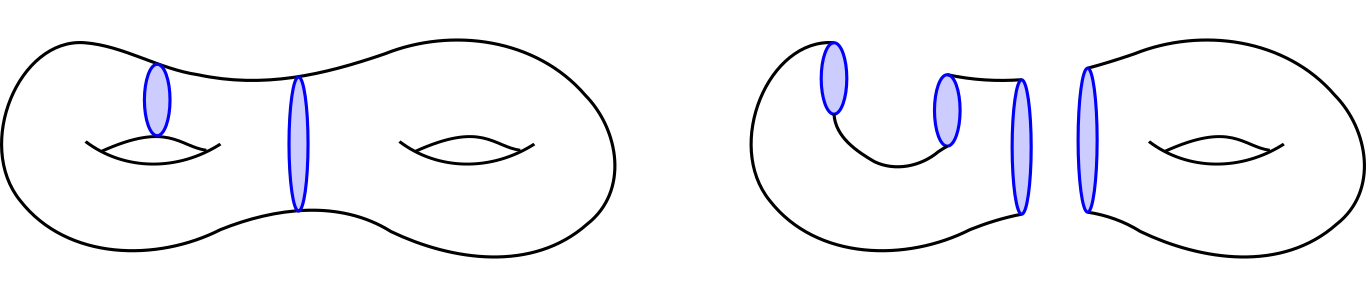
We show that the common basis complex of a free group of rank $n$ has the homotopy type of a wedge of spheres of dimension $2n-3$. This establishes an $\mathrm{Aut}(F_n)$-analogue of the connectivity conjecture that Rognes originally stated for $\mathrm{GL}_n(R)$. To prove this, we provide several homotopy-equivalent models of the common basis complex, both in terms of free factors in free groups and in terms of sphere systems in 3-manifolds.
2512.11637We show that the moduli space of $n$ suitably embedded copies of a closed smooth manifold $P$ inside a closed smooth manifold $M$ satisfies cohomological periodicity over $\mathbb F_\ell$ when $n$ grows, with an explicit linear bound on the period and the periodicity range. This generalizes a known result about configuration spaces. We also show integral stability of the cohomology when $M$ is open, reproving a result of Palmer and improving the slope when inverting $2$. The main input in the proof is Goodwillie and Klein's multiple disjunction lemma for embedding spaces. As a corollary we get stability and periodicity results for some classes of symmetric diffeomorphism groups of manifolds.
2512.11338Fix an odd prime $p$ and let $C_p$ be the cyclic group of order $p$. We compute the spoke topological Hochschild homology of $\underline{\mathbb{F}}_p$ and prove it exhibits a form of Bökstedt periodicity. Here spoke topological Hochschild homology is a variant of topological Hochschild homology where one replaces the circle in the construction with the unreduced suspension of $C_p$. As an application, we use this result to give a new proof of the Segal conjecture for the cyclic group of order an odd prime $p$.
2512.10274We prove a space-level enhancement of the Pontryagin--Thom theorem, identifying the space of maps from a manifold to a Thom space with a moduli space of submanifolds.
2512.10182We develop the Lefschetz fixed-point theory for noncompact manifolds of bounded geometry and uniformly continuous maps. Specifically, we define the uniform Lefschetz class $\mathscr{L}(f)$ of a uniformly continuous map $f\colon M\to M$ of a uniform simply-connected noncompact complete Riemannian manifold of bounded geometry $M$ satisfying $d(f,1)<\infty$, and prove that $\mathscr{L}(f)=0$ if and only if $f$ is uniformly homotopic to a strongly fixed-point free (without fixed-points on $M$ and at infinity) uniformly continuous map. To achieve this, we introduce a new cohomology for metric spaces, called uniform bounded cohomology, which is a variant of bounded cohomology, and develop an obstruction theory formulated in terms of this cohomology.
2512.05848In the context of complex algebraic varieties, the decomposition theorem for semi-small maps provides a decomposition of the direct image of the constant sheaf. In this work, we develop a decomposition theorem for branched coverings of topological spaces. To achieve this, we start by constructing a decomposition theorem for unramified covering maps using transition functions. For a given branched covering of closed topological manifolds, we use the previous result to establish a decomposition of the direct image of the constant sheaf on the covering space. In the next step, we generalize our discussion to the case where the target space is not necessarily a topological manifold.
2512.05618We initiate a systematic study of cohomology theories for partial groups, algebraic structures introduced by Chermak that generalize groups by allowing only partially defined products. Inspired by classical group cohomology, we develop two parallel approaches - an algebraic theory based on Chermak's framework and a simplicial-set-based theory using local coefficient systems - and show that they coincide. As an application, we illustrate how the extension theory of partial groups, as developed by Broto and Gonzalez, can be interpreted and computed using our cohomology theory, including explicit examples such as extensions of free partial groups, and compare these results with classical group extensions.
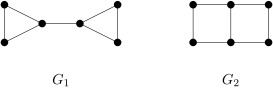
Vectorization methods for \emph{Persistent Homology} (PH), such as the \emph{Persistence Image} (PI), encode persistence diagrams into finite dimensional vector spaces while preserving stability. In parallel, the \emph{Persistent Laplacian} (PL) has been proposed, whose spectra contain the information of PH as well as richer geometric and combinatorial features. In this work, we develop an analogous vectorization for PL. We introduce \emph{signatures} that map PL to real values and assemble these into a \emph{Persistent Laplacian Diagram} (PLD) and a \emph{Persistent Laplacian Image} (PLI). We prove the stability of PLI under the noise on PD. Furthermore, we illustrate the resulting framework on explicit graph examples that are indistinguishable by both PH and a signature of the combinatorial Laplacian but are separated by the signature of PL.
2512.03648Condensed mathematics as developed by Clausen and Scholze yields a version of derived functors over the category of continuous $G$-modules for a Hausdorff topological group $G$. We study the resulting notion of group cohomology and its relation to continuous group cohomology and the condensed/sheaf/singular cohomology of classifying spaces. While condensed group cohomology is generally a more refined invariant than continuous group cohomology, we show that for a broad class of topological groups, continuous group cohomology with solid coefficients, such as locally profinite continuous $G$-modules, can be realized as a derived functor in the condensed setting. We also revisit cornerstones of condensed mathematics, paying special attention to set-theoretic size issues. To this end, we review a framework for working with accessible (hyper)sheaves on large sites satisfying suitable accessibility conditions and show that the associated categories retain many topos-like properties. Moreover, we generalize identifications of condensed with sheaf cohomology obtained by Clausen and Scholze.
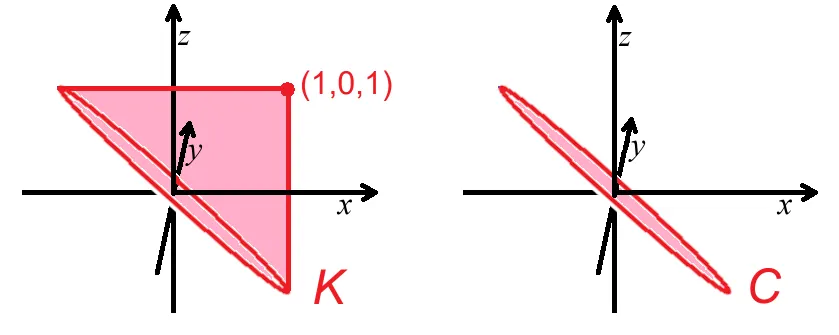
We introduce the convex matching distance, a novel metric for comparing functions with values in the real plane. This metric measures the maximal bottleneck distance between the persistence diagrams associated with the convex combinations of the two function components. Similarly to the traditional matching distance, the convex matching distance aggregates the information provided by two real-valued components. However, whereas the matching distance depends on two parameters, the convex matching distance depends on only one, offering improved computational efficiency. We further show that the convex matching distance can be more discriminative than the traditional matching distance in certain cases, although the two metrics are generally not comparable. Moreover, we prove that the convex matching distance is stable and characterize the coefficients of the convex combination at which it is attained. Finally, we demonstrate that this new aggregation framework benefits from the computational advantages provided by the Pareto grid, a collection of curves in the plane whose points lie in the image of the Pareto critical set associated with functions assuming values on the real plane.
2512.01371We study the homology group of the Milnor fiber boundary of a hyperplane arrangement in $\mathbb{C}^{3}$. By the work of Némethi--Szilárd, the homeomorphism type of the Milnor fiber boundary is combinatorially determined, and an explicit formula for the first Betti number is known. However, the torsion part of the first homology group is poorly understood. In this paper, under some conditions, we prove that the number of even-order torsion summands of the first homology group is greater than or equal to the Euler characteristic of the projectivized complement.
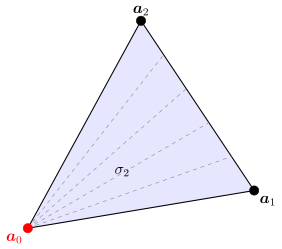
This paper develops a complete foundational treatment of simplicial complexes from Euclidean spaces through geometric realizations, emphasizing concrete computations, examples, and practical verification methods. Beginning with finite point sets in finite and infinite-dimensional Euclidean spaces, geometric independence is established via linear independence of relative vectors, with explicit matrix rank tests. $n$-simplices arise as convex hulls of such independent points, proven convex, compact, uniquely spanned, and homeomorphic to unit balls, with detailed barycentric coordinate. Simplicial complexes form through collections closed under faces and with simplex intersections either empty or common faces, verified by necessary and sufficient disjoint interior conditions, illustrated across dimensions from lines to tetrahedra plus non-examples. Derived structures including subcomplexes, $p$-skeletons, vertices, stars, and links lead to geometric realizations as continuous spaces with weak topology, proven Hausdorff and locally compact, alongside ray characterizations of convexity and continuity via simplicial maps.
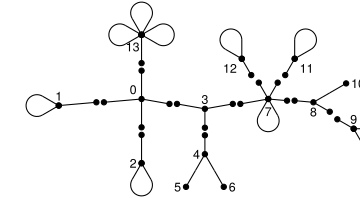
We introduce a coshuffle comultiplication on the singular chain complex of configuration spaces, and we show that this structure endows the configuration space with the structure of a differential graded coalgebra (DGCoAlg). We then prove that the coshuffle comultiplication is compatible with the external product through a natural commutation relation. As an application, we investigate configuration spaces of graphs and the associated graph braid groups. In particular, for graphs of topological circumference at most 1, we prove that the singular chain complex of the configuration space is formal as a DGCoAlg. Moreover, we obtain a complete classification of the primitivity in the homology of configuration spaces of such graphs.
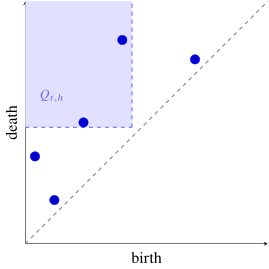
As the size of data increase, persistence diagrams often exhibit structured asymptotic behavior, converging weakly to a Radon measure. However, conventional vector summaries such as persistence landscapes are not well-behaved in this setting, particularly for diagrams with high point multiplicities. We introduce continuous persistence landscapes, a new vectorization defined on a special class of Borel measures, which we call q-tame measures. It includes both the persistence diagrams and their weak limits. Our construction generalizes persistence landscapes to a measure-theoretic setting, preserving the intrinsic structure of persistence measures. We show that this vector summary is bijective and L^1-stable under mild assumptions, and that the original measure can be uniquely reconstructed. This approach gives a more faithful description of the shape of data in the limit and provides a stable, invertible way to analyze topological features in large systems.
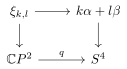
This paper presents a classification of the total spaces of $S^3$-bundles over $\mathbb{C}P^2$ up to orientation-preserving homotopy equivalence. Our approach proceeds in two steps: we first derive the PL-homeomorphism classification for these manifolds by computing their Kreck-Stolz invariants. Then, building upon this PL classification result and through an application of surgery theory, we establish the homotopy equivalence classification.
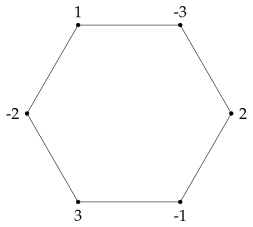
We propose definitions of the common bases complex, the poset of decompositions, and the poset of partial decompositions for arbitrary spherical buildings. We show that the poset of decompositions is Cohen-Macaulay, and that the poset of partial decompositions is spherical and homotopy equivalent to the common bases complex. To prove these results, we rely on the concepts of opposition, Levi spheres, and convexity in buildings. In particular, our results extend the already known constructions for the linear case (vector spaces) to arbitrary buildings. As a byproduct, we see that the poset of ordered partial decompositions carries the square of the Steinberg representation.

The depth poset of a filtered Lefschetz complex reflects the dependencies between the cancellations of different shallow birth-death pairs. Using the fast algorithms for computing the depth poset in the present work and for updating the persistence diagram under transpositions (Vineyard persistence), we give a complete case analysis of how transpositions of cells in the filter affect the depth poset. In addition, we present statistics on the depth poset for random point data and its sensitivity to the transpositions that occur in random straight-line homotopies.