Algebra & Topology
Group theory, representation theory, algebraic topology, and category theory
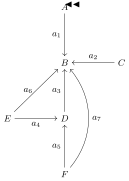
Derksen and Weyman described the cone of semi-invariants associated with a quiver. We give an inductive description of this cone, followed by an example of refinement of the inequalities characterising anti-invariant weights in the case of a quiver equipped with an involution.
By their nature it is difficult to differentiate chaotic dynamical systems through measurement. In recent years, work has begun on using methods of Topological Data Analysis (TDA) to qualitatively type dynamical data by approximating the topology of the underlying attracting set. This comes with the additional challenges of high dimensionality incurring computational complexity along with the lack of directional information encoded in the approximated topology. Due to the latter fact, standard methods of TDA for this high dimensional dynamical data do not differentiate between periodic cycles and non-periodic cycles in the attractor. We present a framework to address both of these challenges. We begin by binning the dynamical data, and capturing the sequential information in the form of a coarse-grained weighted and directed network. We then calculate the persistent Dowker homology of the asymmetric network, encoding spatial and temporal information. Analytically, we highlight the differences in periodic and non-periodic cycles by providing a full characterization of their one-dimensional Dowker persistences. We prove how the homologies of graph wedge sums can be described in terms of the wedge component homologies. Finally, we generalize our characterization to cactus graphs with arbitrary edge weights and orientations. Our analytical results give insight into how our method captures temporal information in its asymmetry, producing a persistence framework robust to noise and sensitive to dynamical structure.
We construct gradings on the simple modules of 2-boundary Temperley--Lieb algebras and symplectic blob algebras by realising the latter algebras as quotients of Varagnolo--Vasserot's orientifold quiver Hecke algebras. We prove that the symplectic blob algebras are graded cellular and provide a conjectural algorithm for calculating their graded decomposition matrices. In doing so, we give the first explicit family of finite-dimensional graded quotients of the orientifold quiver Hecke algebras, providing a new entry point for the structure of these algebras -- in the spirit of Libedinsky--Plaza's ``blob algebra approach'' to modular representation theory.
2601.04008We provide an affine cellular structure on the extended affine Hecke algebra and affine $q$-Schur algebra of type $A_{n-1}$ that is defined over $\mathbb{Z}\left[q^{\pm1}\right]$, that is, without an adjoined $q^{\frac{1}{2}}$. This is with an eye to applications in the representation theory of $\mathrm{GL}_n(F)$ for a $p$-adic field $F$ over coefficient rings in which $p$ is invertible but does not have a square root, which have been a topic of recent interest. This is achieved via a renormalisation of the known affine cellular structure over $\mathbb{Z}\left[q^{\pm\frac{1}{2}}\right]$ at each left and right cell, which is chosen to ensure that the diagonal intersections remain subalgebras and that the left and right cells remain isomorphic. We furthermore show that the affine cellular structure on the Schur algebra has idempotence properties which imply finite global dimension, an important ingredient for the applications to representations of $p$-adic groups.
Geometric and Topological Deep Learning are rapidly growing research areas that enhance machine learning through the use of geometric and topological structures. Within this framework, Group Equivariant Non-Expansive Operators (GENEOs) have emerged as a powerful class of operators for encoding symmetries and designing efficient, interpretable neural architectures. Originally introduced in Topological Data Analysis, GENEOs have since found applications in Deep Learning as tools for constructing equivariant models with reduced parameter complexity. GENEOs provide a unifying framework bridging Geometric and Topological Deep Learning and include the operator computing persistence diagrams as a special case. Their theoretical foundations rely on group actions, equivariance, and compactness properties of operator spaces, grounding them in algebra and geometry while enabling both mathematical rigor and practical relevance. While a previous representation theorem characterized linear GENEOs acting on data of the same type, many real-world applications require operators between heterogeneous data spaces. In this work, we address this limitation by introducing a new representation theorem for linear GENEOs acting between different perception pairs, based on generalized T-permutant measures. Under mild assumptions on the data domains and group actions, our result provides a complete characterization of such operators. We also prove the compactness and convexity of the space of linear GENEOs. We further demonstrate the practical impact of this theory by applying the proposed framework to improve the performance of autoencoders, highlighting the relevance of GENEOs in modern machine learning applications.
2601.03206I give a short proof of a recent result due to Kiefer and Ryzhikov showing that a finite irreducible semigroup of $n\times n$ matrices has cardinality at most $3^{n^2}$.
2601.03128Let $\mathcal{A}$ and $\mathcal{B}$ be subcategories of tensor categories $\mathcal{C}$ and $\mathcal{D}$, respectively, both of which are abelian categories with finitely many isomorphism classes of simple objects. We prove that if their derived categories $\mathbf{D}^b(\mathcal{A})$ and $\mathbf{D}^b(\mathcal{B})$ are left triangulated tensor ideals and are equivalent as triangulated $\mathbf{D}^b(\mathcal{C})$-module categories via an equivalence induced by a monoidal triangulated functor $F:\mathbf{D}^b(\mathcal{C})\rightarrow \mathbf{D}^b(\mathcal{D})$, then the original module categories $\mathcal{A}$ and $\mathcal{B}$ are themselves equivalent. We then apply this result to smash product algebras. Furthermore, the localization theory of module categories and triangulated module categories is investigated.
2601.03049Let $G$ be a real reductive Lie group and $H$ a reductive subgroup of $G$. Benoist-Kobayashi studied when $L^2(G/H)$ is a tempered representation of $G$. They introduced the functions $ρ$ on Lie algebras and gave a necessary and sufficient condition for the temperedness of $L^2(G/H)$ in terms of an inequality on $ρ$. In a joint work with Y. Oshima, we considered when $L^2(G/H)$ is equivalent to a unitary subrepresentation of $L^2(G)$ and gave a sufficient condition for this in terms of a strict inequality of $ρ$. In this paper, we will classify the pairs $(\mathfrak{g}, \mathfrak{h})$ with $\mathfrak{g}$ complex reductive and $\mathfrak{h}$ complex semisimple which satisfy that strict inequality of $ρ$.
2601.02895Dwyer-Kan localization at pairs of quasi-isomorphisms of the category of dg Lie-Rinehart pairs $(A,M)$, where $A$ is a semi-free cdga over a field $k$ of characteristic zero and $M$ a cell complex in $A$-modules, is shown to be equivalent to that of strong homotopy Lie-Rinehart (SH LR) pairs satisfying the same cofibrancy condition. Latter is a category of fibrant objects. We introduce cofibrations of SH LR pairs, construct factorizations, and prove lifting properties. Applying them, we show uniqueness up to homotopy of certain BV-type resolutions. Restricting to dg LR pairs whose underlying cdga is of finite type, and using a different (co)fibrancy condition, we show that the functor $(A,M)\mapsto A$ is a Cartesian fibration with presentable fibers. The two (co)fibrancy conditions yield equivalent $\infty$-categories under Dwyer-Kan localization.
2601.02844The sequence reconstruction problem asks for the recovery of a sequence from multiple noisy copies, where each copy may contain up to $r$ errors. In the case of permutations on \(n\) letters under the Hamming metric, this problem is closely related to the parameter $N(n,r)$, the maximum intersection size of two Hamming balls of radius $r$. While previous work has resolved \(N(n,r)\) for small radii (\(r \leq 4\)) and established asymptotic bounds for larger \(r\), we present new exact formulas for \(r \in \{5,6,7\}\) using group action techniques. In addition, we develop a formula for \(N(n,r)\) based on the irreducible characters of the symmetric group \(S_n\), along with an algorithm that enables computation of \(N(n,r)\) for larger parameters, including cases such as \(N(43,8)\) and \(N(24,14)\).
2601.02258We formulate the normalized period conjecture proposed by Ben-Zvi, Sakellaridis and Venkatesh in the framework of the categorical local Langlands correspondence and study its relation to distinction problems. Motivated by the work of Feng and Wang in the geometric setting, we verify the conjecture for the Iwasawa-Tate and Hecke periods, assuming the existence of the categorical local Langlands correspondence for $\mathrm{GL}_2$ with the Eisenstein compatibility.
2601.02188Let $G$ be a real reductive Lie group and $H$ a reductive subgroup of $G$. Benoist-Kobayashi studied when $L^2(G/H)$ is a tempered representation of $G$ and in particular they gave a necessary and sufficient condition for the temperedness in terms of certain functions on Lie algebras. In this paper, we consider when $L^2(G/H)$ is equivalent to a unitary subrepresentation of $L^2(G)$ and we will give a sufficient condition for this in terms of functions introduced by Benoist-Kobayashi. As a corollary, we prove the non-existence of discrete series for homogeneous spaces $G/H$ satisfying certain conditions.
2601.01738This is the third and the last of a series of three papers where we prove the Gan--Gross--Prasad conjecture for Fourier--Jacobi periods on unitary groups and an Ichino--Ikeda type refinement. Our strategy is based on the comparison of relative trace formulae formulated by Liu. In this paper, we compute the spectral expansions of these formulae and end the proof of the conjectures via a reduction to the corank zero case.
2601.01544We study the relationship between the existence of Hall $π$-subgroups and that of irreducible characters of $π'$-degree with prescribed fields of values in finite groups. This work extends a result of Navarro and Tiep from a single odd prime to multiple odd primes.
2601.01518Given a symmetric quiver with potential, we develop a geometric construction of shifted Yangians acting on the critical cohomologies of antidominantly framed quiver varieties with extended potentials, using the $R$-matrices constructed from critical stable envelopes. We relate such Reshetikhin type Yangians to Drinfeld type Yangians arising from critical cohomological Hall algebras. Several detailed examples, including the trivial, Jordan, and tripled Jordan quivers are explicitly computed. For symmetric quiver varieties with potentials, by using the smallness property of their affinization maps, we derive explicit formulas for quantum multiplication by divisors in terms of Casimir elements of the associated Lie (super)algebras, extending results from Nakajima quiver varieties to the critical setting. A similar formula in the antidominantly framed case is also obtained, which includes Hilbert schemes of points on $\mathbb C^3$ as examples.
2601.01133Given a finite group $G$, the difference graph of $G$, denoted by $\mathcal{D}(G)$, is the difference of the enhanced power graph of $G$ and the power graph of $G$, with all isolated vertices removed. This paper mainly studies the dominating sets of the difference graph of a finite group. In particular, we prove that the diameter of the difference graph of a nilpotent group has an upper bound of $4$. Furthermore, we generalize and refine the result by Biswas et al. by classifying all nilpotent groups whose difference graph has diameter $k$, for each $k\le 4$.
2601.00683We give a presentation of the $\mathrm{GL}_n(\C)$-equivariant cohomology ring with $\Z$-coefficients of the variety $\Hom(\Z^2,\mathrm{GL}_n(\C))\subseteq \mathrm{GL}_n(\C)^2$ for any $n$. It is torsion free and minimally generated as a $H^\ast B\mathrm{GL}_n(\C)$-algebra by $3n$ elements. The ideal of relations is the saturation of an $n$-generator ideal by even powers of the Vandermonde polynomial. For coefficients in a field whose characteristic does not divide $n!$, we also give a presentation of the non-equivariant cohomology ring of $\Hom(\Z^2,\mathrm{GL}_n(\C))$.
2601.00674Let $F$ be a non-Archimedean local field. For an irreducible smooth representation $π$ of $\mathrm{GL}_n(F)$ and a multisegment $\mathfrak m$, one associates a simple quotient $D_{\mathfrak m}(π)$ of a Bernstein-Zelevinsky derivative of $π$. In the preceding article, we showed that \[ \mathcal S(π, τ) :=\left\{ \mathfrak m : D_{\mathfrak m}(π)\cong τ\right\} , \] has a unique minimal element under the Zelevinsky ordering, where $\mathfrak m$ runs for all multisegments. The main result of this article includes commutativity and subsequent property of the minimal sequence. At the end of this article, we conjecture some module structure arising from the minimality.
2601.00124In this short note we study the Hall induction of cotangent representations of reductive groups. We prove its torsion freeness in Borel-Moore homology. In K-theory we find an analog of wheel conditions verified by the image of restriction map to the fixed point and consider examples.
2512.24881We describe totally compatible structures on the Jacobson radical of the incidence algebra of a finite poset over a field. We show that such structures are in general non-proper.