Category Theory
arXiv:math.CT
Enriched categories, topoi, abelian categories, monoidal categories, homological algebra.
Looking for a broader view? This category is part of:
Enriched categories, topoi, abelian categories, monoidal categories, homological algebra.
Looking for a broader view? This category is part of:
 2512.11692
Bourke and Garner described how to cofibrantly generate algebraic weak factorisation systems by a small double category of morphisms. However they did not give an explicit construction of the resulting factorisations as in the classical small object argument. In this paper we give such an explicit construction, as the colimit of a chain, which makes the result applicable in constructive settings; in particular, our methods provide a constructive proof that the effective Kan fibrations introduced by Van den Berg and Faber appear as the right class of an algebraic weak factorisation system.
2512.18487We show that the category of sober étale groupoids and actors admits all small limits. This is achieved by computing the limits in the equivalent category of pseudogroups with pseudogroup morphisms, which we show admits a forgetful functor to the category of sets which creates limits. We give an alternative proof of the adjunction of Cockett and Garner in the specific setting of étale groupoids and pseudogroups which is a central tool for computing limits of sober étale groupoids.
2512.15613We construct classifying $\infty$-topoi by showing that the $(\infty,2)$-category of topoi has weighted limits. We show that several prestacks of interest have a classifying topos, including the prestack of spectra.
2512.15485Building on work of Chen, we give a universal property of the Markov category BorelStoch of standard Borel spaces and Markov kernels between them. To do this, we introduce a new notion of *coinflip*, or unbiased binary choice, in a Markov category. These are unique if they exist, and automatically preserved by all Markov functors which preserve coproducts. We also provide universal characterizations of various Markov categories of discrete kernels.
2512.14988We develop a general framework for working with structured lifting problems, establishing closure and uniqueness properties of their solutions. In a subsequent paper, we apply these results to axiomatize computation rules of cubical type theory.
2512.11692Bourke and Garner described how to cofibrantly generate algebraic weak factorisation systems by a small double category of morphisms. However they did not give an explicit construction of the resulting factorisations as in the classical small object argument. In this paper we give such an explicit construction, as the colimit of a chain, which makes the result applicable in constructive settings; in particular, our methods provide a constructive proof that the effective Kan fibrations introduced by Van den Berg and Faber appear as the right class of an algebraic weak factorisation system.
2512.11211In this paper, we introduce the notation of monobricks in an extriangulated length category as a generalization of the semibricks. We prove that there is a bijection between monobricks and left Schur subcategories. Then we show that this bijection restricts to bijection between cofinally closed monobricks and torsion-free classes. These extend the results of Enomoto for abelian length categories.

Relational presheaves generalize traditional presheaves by going to the category of sets and relations (as opposed to sets and functions) and by allowing functors which are lax. This added generality is useful because it intuitively allows one to encode situations where we have representables without boundaries or with multiple boundaries at once. In particular, the relational generalization of precubical sets has natural application to modeling concurrency. In this article, we study categories of relational presheaves, and construct realization functors for those. We begin by observing that they form the category of set-based models of a cartesian theory, which implies in particular that they are locally finitely presentable categories. By using general results from categorical logic, we then show that the realization of such presheaves in a cocomplete category is a model of the theory in the opposite category, which allows characterizing situations in which we have a realization functor. Finally, we explain that our work has applications in the semantics of concurrency theory. The realization namely allows one to compare syntactic constructions on relational presheaves and geometric ones. Thanks to it, we are able to provide a syntactic counterpart of the blowup operation, which was recently introduced by Haucourt on directed geometric semantics, as way of turning a directed space into a manifold.
2512.05631We describe a simple criterion which makes it easy to recognise when a pseudomonad is lax-idempotent. The criterion concerns the behaviour of colax bilimits of arrows - certain comma objects - and is easy to verify in examples. Building on this, we obtain a new characterisation of lax-idempotent pseudomonads on 2-categories with colax bilimits of arrows.
2512.05232For any category ${\mathcal E}$ and monad $T$ thereon, we introduce the notion of $T$-simplicial object in ${\mathcal E}$. Any $T$-category in the sense of Burroni induces a $T$-simplicial object as its nerve. This nerve construction defines a fully faithful functor from the category $\mathbf{Cat}_T({\mathcal E})$ of $T$-categories to the category $s_T({\mathcal E})$ of $T$-simplicial objects, whose essential image is characterized by a simple condition. We show that the category $s_T({\mathcal E})$ is enriched over the category of simplicial sets, and that this induces the usual 2-category structure on $\mathbf{Cat}_T({\mathcal E})$. We also study enriched limits and colimits in $s_T({\mathcal E})$ and $\mathbf{Cat}_T({\mathcal E})$, and show that if ${\mathcal E}$ is locally finitely presentable and $T$ is finitary, then $\mathbf{Cat}_T({\mathcal E})$ is locally finitely presentable as a 2-category and $s_T({\mathcal E})$ is locally finitely presentable as a simplicially-enriched category.
2512.04818We study categories of dualizable torsion and complete objects for compactly-rigidly generated tensor-triangulated categories T with a Noetherian central action of a graded commutative Noetherian ring R. We show that they always admit a natural Noetherian action of the completed graded ring R^ and that the categories of dualizable torsion and complete objects can be abstractly reconstructed as tensor-triangulated R^-linear categories from the category of compact torsions objects with the corresponding structure. If the category of compact objects of T in addition admits a strong generator g, we show that the torsion coreflection (resp. complete reflection) of g is a strong generator for the category of dualizable torsion (resp. dualizable complete) objects. In that case, we also show that the categories of dualizable torsion and compact torsion objects determine each other in terms of Brown-type representability theorems.
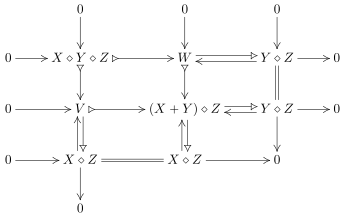
We establish a right-exactness theorem for the cross-effects of bifunctors, and consequently for cosmash products, in Janelidze-Márki-Tholen semi-abelian categories. This result motivates an intrinsic definition of a bilinear product, a tensor-like operation on objects of a category, constructed in terms of limits and colimits. Given two objects in the category, their bilinear product is the abelian object obtained as the cosmash product in the category of two-nilpotent objects of the reflections of these objects. In many concrete cases, this operation, applied to a pair of abelian objects, captures a classical tensor product. We explain this by proving a recognition theorem, which states that any symmetric, bi-cocontinuous bifunctor on an abelian variety of algebras can be recovered as the bilinear product within a suitable semi-abelian variety, namely of algebras over a certain two-nilpotent operad. In other words, the extra structure carried by such a bifunctor on the abelian variety (for instance, a tensor product, known in the literature) is encoded by means of a surrounding semi-abelian variety whose abelian core is the original variety. We illustrate the construction with several examples, develop its basic properties, and compare it to the semi-abelian analogue of the Brown-Loday non-abelian tensor product. As an application, we present a categorical version of Ganea's six-term exact homology sequence. Finally, we characterise abelian extensions via internal action cores, yielding explicit descriptions of cosmash products and bilinear products in certain categories of representations.
2512.03371Restriction categories provide a categorical framework for partiality. In this paper, we introduce three new categorical theories for partiality: local categories, partial categories, and inclusion categories. The objects of a local category are partially accessible resources, and morphisms are processes between these resources. In a partial category, partiality is addressed via two operators, restriction and contraction, which control the domain of definition of a morphism. Finally, an inclusion category is a category equipped with a family of monics which axiomatize the inclusions between sets. The main result of this paper shows that restriction categories are $2$-equivalent to local categories, that partial categories are $2$-equivalent to inclusion categories, and that both restriction/local categories are $2$-equivalent to bounded partial/inclusion categories. Our result offers four equivalent ways to describe partiality: on morphisms, via restriction categories; on objects, with local categories; operationally, with partial categories; and via inclusions, with inclusion categories. We also translate several key concepts from restriction category theory to the local category context, which allows us to show that various special kinds of restriction categories, such as inverse categories, are $2$-equivalent to their analogous kind of local categories. In particular, the equivalence between inverse (restriction) categories and inverse local categories is a generalization of the celebrated Ehresmann-Schein-Nambooripad theorem for inverse semigroups.
2512.03338Cohomology theories with values in LCA (locally compact abelian) groups suffer from the problem that the latter do not form an abelian category. However, the category LCA has a canonical abelian category envelope, the heart of a suitable t-structure. It adds formal cokernel objects. We show the surprising result that these abstract cokernels can also be interpreted as Hausdorff topological abelian groups, at least up to lattice isogenies. These need not be locally compact.
2511.23206The original Lawvere condition asserts that every reflexive graph admits a unique natural structure of internal groupoid. This property was identified by P. T. Johnstone, following a question by A. Carboni and a suggestion by F. W. Lawvere, and it plays a central role in the characterization of naturally Mal'tsev categories. A broad and conceptually rich generalization emerges when the condition is formulated relative to a chosen class of spans. In this setting, the familiar Mal'tsev situation is recovered when the class consists of internal relations (that is, jointly monic spans) in which case the condition states that every internal reflexive relation is an equivalence relation. The purpose of this paper is to establish a comprehensive equivalence theorem that unifies the various categorical and diagrammatic formulations of the relative Lawvere condition. Furthermore, this formulation retains its significance even beyond the context of categories with finite limits, extending, for example, to categories admitting pullbacks of split epimorphisms along split epimorphisms. In addition to providing a fresh perspective on previously established results, we present a new characterization involving Janelidze-Pedicchio pseudogroupoids.
2511.21913In this note, we propose a generalisation of G. Janelidze's notion of an ideally exact category beyond the Barr exact setting. We define an ideally regular category as a regular, Bourn protomodular category with finite coproducts in which the unique morphism 0 -> 1 is effective for descent. As in the ideally exact case, ideally regular categories support a notion of ideal that classifies regular quotients. Moreover, they admit a characterisation in terms of monadicity over a homological category (rather than a semi-abelian one, as in the exact setting). Examples include Bourn protomodular quasivarieties of universal algebra in which 0 -> 1 is effective for descent (such as the category of torsion-free unital rings), all Bourn protomodular topological varieties with at least one constant (such as topological rings), and all semi-localisations of ideally exact categories.
2511.21623This research aims at providing a mathematical model of the organization of the polity and its transformation. For that purpose we construct two categories named respectively Political Configuration and Political Foundation. Our construction depends on a couple of variables called the foundational pair. One variable, called the Base, consists of a finite number of members (agents), while the other, called the Ground, consists of a set of states that reflect all relevant interests/values/aspirations of the base members. An object of the Configuration, called p-formation, extends the notion of simplicial complex, and a morphism, which expresses the recomposition of the base, extends the notion of simplicial map. An object of the Foundation, called p-site, describes the profile of the polity, that is, how the states of the ground are intertwined between the agents. A morphism between political sites consists of a pair of maps, namely a Base map and a Ground map, satisfying appropriate conditions. Two functors relate the Foundation and the Configuration: the Knit which attributes to each p-site a p-formation and the Nerve which attributes to each p-site a simplicial complex. In the opposite direction a functor, called Canon, which attributes to any p-formation its canonical p-site, turns out to be in an appropriate sense the inverse of the Knit and the Nerve.
2511.17152We give a general notion of combinatory completeness with respect to a faithful cartesian club and use it systematically to obtain characterisations of a number of different kinds of applicative system. Each faithful cartesian club determines a notion of structured multicategory, with the different notions of structured multicategory obtained in this way giving different notions of polynomial over an applicative system, which in turn give different notions of combinatory completeness. We obtain the classical characterisation of combinatory algebras as combinatory complete applicative systems as a specific instance.
2511.17024For a small quantaloid $\mathcal{Q}$, we introduce $\mathcal{M}$-(co)complete $\mathcal{Q}$-categories, i.e., (co)complete $\mathcal{Q}$-categories up to Morita equivalence, as Eilenberg--Moore algebras of the presheaf monad on the category of $\mathcal{Q}$-categories and left adjoint $\mathcal{Q}$-distributors, and characterize such $\mathcal{Q}$-categories through $\mathcal{M}$-(co)tensoredness and $\mathcal{M}$-conical (co)completeness.
2511.15410We axiomatise the dagger category of complex Hilbert spaces and bounded linear maps, using exclusively purely categorical conditions. Our axioms are chosen with the aim of an easy interpretability: two of them describe the composition of objecs, two further ones deal with the decomposition of objects, and a final axiom expresses a symmetry property. The categorical reconstruction of complex Hilbert spaces addresses foundational issues in quantum physics. We present a simplified alternative to recent characterisations.
2511.15264We construct various multiple categories, based on generalised Ehresmann quintets. The main construction is a multiple category whose objects are all the `lax' multiple categories; the transversal arrows are their strict multiple functors while the arrows in a positive direction are multiple functors of a `mixed laxity', varying from the lax ones (in direction 1) to the colax ones (in direction \infty).