Riemannian geometry, manifolds, curvature, and geometric analysis
We present a general construction of embedded minimal and constant mean curvature surfaces in $\mathbb{S}^n$ and one-phase free boundaries joined by a smooth interpolation by capillary hypersurfaces. This framework recovers all known families and produces new minimal surfaces in the sphere with rich topological structures as sphere bundles over base spaces which include space-form products, projective planes over division algebras, Stiefel manifolds, complex quadrics, and twisted products and quotients of Lie subgroups of $SO(n)$. We show these bundles are non-trivial and study their homotopy types using topological obstructions, including characteristic classes and tools from $K$-theory and stable homotopy theory. Finally, we prove uniqueness results for the rotationally invariant capillary CMC problem.
2604.04865We introduce the Legendre bundle, a geometric structure encoding the essential duality of dually flat (Hessian) manifolds, and demonstrate that both exponential families in information geometry and a natural class of quantum field theories -- which we term Hessian QFTs -- arise as distinct realisations of this single framework. The Legendre bundle is shown to carry a canonical para-Kähler structure.
2604.04710We establish uniform diameter estimates and volume non-collapsing estimates for the Chern-Ricci flow on smooth Hermitian minimal models of general type, assuming the initial metric is Kähler in a neighborhood of the null locus of the canonical bundle. This yields subsequential Gromov-Hausdorff convergence, partially resolving a conjecture of Tosatti and Weinkove. When the underlying manifold is Kähler, we further prove the uniqueness of the limit space. Analytically, we overcome the difficulties posed by non-Kähler torsion in the Green's formula by exploiting our local Kähler assumption, successfully adapting recent estimates of Kähler Green's function to the Hermitian setting. To prove the uniqueness of the limit, we introduce Perelman's reduced length to the Chern-Ricci flow. By establishing a uniform Chern scalar curvature bound and an almost monotonicity formula for the reduced volume, we deduce an almost-avoidance principle for the singular set, allowing us to effectively compare the flow distance with the canonical limit distance.
2604.04605We compute the $\barν$-invariant of homogeneous nearly-parallel $G_2$-structures on Aloff--Wallach spaces $N_{k,l} = SU(3)/S^1_{k,l}$. Using Goette's formulas for the $η$-invariants of homogeneous spaces, we derive an explicit expression for $\barν$ in terms of representation-theoretic data and show that for the two homogeneous nearly-parallel structures $\varphi^\pm$ on $N_{k,l}$ one has \[\barν(\varphi^\pm) = \mp 41.\] Additionally, we compare the $\barν$-invariants of the nearly-parallel $G_2$-structures arising from the 3-Sasakian structure.
2604.04336We introduce a new family of closed differential forms naturally associated with minimal graphical submanifolds in Euclidean space, defined in arbitrary codimension. For each minimal graph, we construct an explicit closed form whose restriction coincides with the induced volume form. These forms admit a geometric interpretation as pullbacks, via the Gauss map, of tautological differential forms on the Grassmannian. In contrast to most known calibrations, they are generally not parallel and do not arise from special holonomy or symmetry considerations. The calibration problem is thus reduced to estimating the pointwise comass of the constructed forms. We show that the comass bound can be characterized in terms of explicit inequalities involving the singular values of the defining map of the graph, formulated via its two-dilations and we identify precise conditions ensuring that the comass is at most one. As a consequence, any minimal graph satisfying these conditions is calibrated and hence area-minimizing. This yields a broad class of new calibrated minimal graphs, extending the classical codimension-one theory, and provides an effective criterion for determining precisely where a given minimal graph is area-minimizing. As an application of our construction, we confirm a conjecture of Lawson and Osserman under two-dilation conditions, in arbitrary codimesnion.
The neural Willmore flow of a closed oriented $2$-surface in $\mathbb{R}^3$ is introduced as a natural evolution process to minimise the Willmore energy, which is the squared $L^2$-norm of mean curvature. Neural architectures are used to model maps from topological $2d$ domains to $3d$ Euclidean space, where the learning process minimises a PINN-style loss for the Willmore energy as a functional on the embedding. Training reproduces the expected round sphere for genus $0$ surfaces, and the Clifford torus for genus $1$ surfaces, respectively. Furthermore, the experiment in the genus $2$ case provides a novel approach to search for minimal Willmore surfaces in this open problem.
Let $(Y,g_0)$ be a compact Kähler space with a finite number of singular points, where the metric at each singular point is modelled on an admissible Kähler cone. We show that the Kähler-Ricci flow with such initial data satisfies a $C/t$ curvature bound, and that the flow near each singular point is modelled on the unique Kähler-Ricci expander asymptotic to the corresponding cone. Our motivation is to give a geometric description of the Kähler--Ricci flow emerging from singularities arising in the analytic minimal model program.
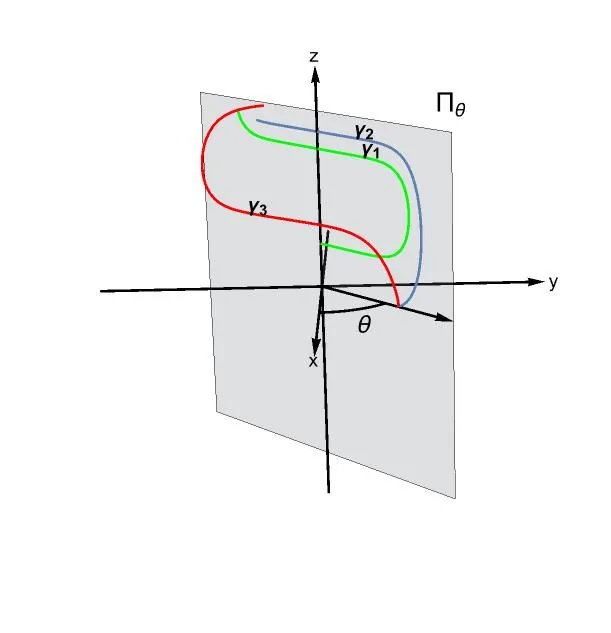
We study the geometry of $\mathbb{R}^3$ equipped with a rotationally invariant Carnot-Carthéodory metric obtained by weighting motion in the $z$-direction by a function $f(r)$ of the cylindrical radius. When $f$ vanishes only at $r=0$, the space exhibits a Grushin--type singularity along the vertical axis. We provide sufficient conditions on $f$ ensuring a Grushin--like structure and describe the full optimal synthesis at singular points. For Riemannian points, we propose a candidate cut time determined by a discrete symmetry of the Hamiltonian flow. In the integrable case $f(r)=r$, we prove that this candidate coincides with the true cut time and give an explicit description of the cut locus.
2604.04134We show that every Vaisman manifold with high first Betti number and vanishing first basic Chern class is diffeomorphic to a Kodaira-Thurston manifold. Furthermore, its complex structure is left-invariant, the characteristic foliation is regular, and the associated fibration is given by the Albanese map. Under the additional assumption that the LCK rank is $1$, the Vaisman structure is also left-invariant. We further prove that if all basic harmonic $1$-forms have constant length, then the Vaisman manifold with high first Betti number is diffeomorphic to a Kodaira-Thurston manifold and its complex structure is the standard complex structure. Finally, we discuss the relationship of this condition with transverse geometric formality in this setting.
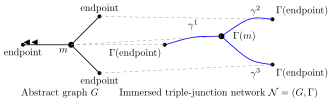
The minimal network problem is a classical topic in geometric measure theory and the calculus of variations, which aims to find networks of minimal length connecting given points. Most classical results are established in the Euclidean plane, while a complete theory for constant-curvature Riemannian manifolds remains to be developed. In this paper, we locally extend the theory of minimal networks and the calibration method from the Euclidean plane to the standard unit sphere \(S^2\). We redefine \(\mathbb{R}^2\)-valued co-vectors, differential forms, currents, and calibrations adapted to spherical geometry. Using exponential maps and local metric perturbation estimates, we prove that spherical minimal networks composed of great-circle arcs with \(120^\circ\) triple junctions are \textbf{locally length-minimizing only within sufficiently small geodesic balls} on \(S^2\), without obtaining global minimality results. Our work partially enriches the theory of minimal networks on constant-curvature spaces, and provides a theoretical reference and technical basis for future research on extending such results to higher-dimensional Riemannian manifolds and more general surfaces.
2604.04052We investigate the geometric implications of spectral curvature bounds, extending classical rigidity results in scalar curvature geometry to the spectral setting. By systematically employing the warped $μ$-bubble method, we show classification theorems for stable weighted minimal hypersurfaces in 3-manifolds with nonnegative spectral scalar curvature, and we establish band width estimates for both spectral Ricci and spectral scalar curvatures. Furthermore, we prove some splitting theorems under spectral curvature conditions, including a spectral version of the Geroch conjecture for manifolds with arbitrary ends and a result related to the Milnor conjecture.
2604.03894We show that if an oriented closed 4-manifold $M$ admits a Ricci soliton metric, then its Euler characteristic and signature must satisfy $$χ(M) \geq \frac{3}{2}|τ(M)| - \frac{1}{16π^2}\!\int_M |\mathring{\text{Ric}}|^2,$$ where $\mathring{\text{Ric}}$ is the traceless Ricci tensor of the metric.
2604.03378We deal with critical nonlinear problems involving the p-Laplacian operator on bounded domains with mixed boundary conditions. We prove the existence of least energy solutions. Our work shows a significant difference between the semi-linear case p = 2 and the quasilinear case for the existence results. Moreover, neither the results for the Laplacian can be extended to the p-Laplacian, nor the method for the p-Laplacian can apply to the Laplacian setting. Additionally, the cases (p < 2 and p > 2) present different challenges and need to be studied separately. More precisely, when p > 2, the effect of the geometry of the boundary conditions dominates that one of the potential, whereas for p < 2 the opposite behavior holds true.
2604.03195We study Frobenius algebras of operator fields and introduce a novel notion of duality for them. We show that, under the assumption that the operator fields forming the Frobenius algebra are mutual symmetries, the operator fields in the dual Frobenius algebra are also mutual symmetries. This result allows one to construct new infinite-dimensional integrable systems of hydrodynamic type starting from a given one. As the main application, we solve the long-standing Eisenhart--Stäckel problem for any Segre characteristic and in arbitrary dimension: namely, we describe all nondegenerate finite-dimensional integrable systems whose integrals are quadratic in momenta such that the corresponding $(1,1)$-tensors commute as operator fields.
2604.02931We study harmonic map sequences from surfaces to compact homogeneous spaces. For sequences developing a single bubble, we derive refined asymptotic expansions in the neck region and prove new obstruction relations among the leading coefficients. These strengthen earlier results by converting an inequality into an equality. For weakly conformal maps, this yields geometric constraints: in low dimensions the tangent planes of the limit map and bubble must coincide, while in higher dimensions they are isoclinic.
2604.02679In this paper, we solve the prescribed Hermitian-Yang-Mills tensor problem for Higgs bundles over compact complex manifolds. Let $ (E,θ) $ be a Higgs bundle over a compact Hermitian manifold $(M,ω_g) $. Suppose that there exists a smooth Hermitian metric $ h_0 $ on $E$ such that the Hermitian-Yang-Mills tensor $ Λ_{ω_g}\left(\sqrt{-1} R^{D^{h_0}}\right) $ of the Higgs connection is positive definite. Then for any Hermitian positive definite tensor $ P\in Γ\left(M,E^*\otimes \bar E^*\right) $, there exists a unique smooth Hermitian metric $ h $ on $E$ such that $$Λ_{ω_g} \left(\sqrt{-1} R^{D^h}\right)=P.$$ We also establish quantitative Chern number inequalities for Higgs bundles.
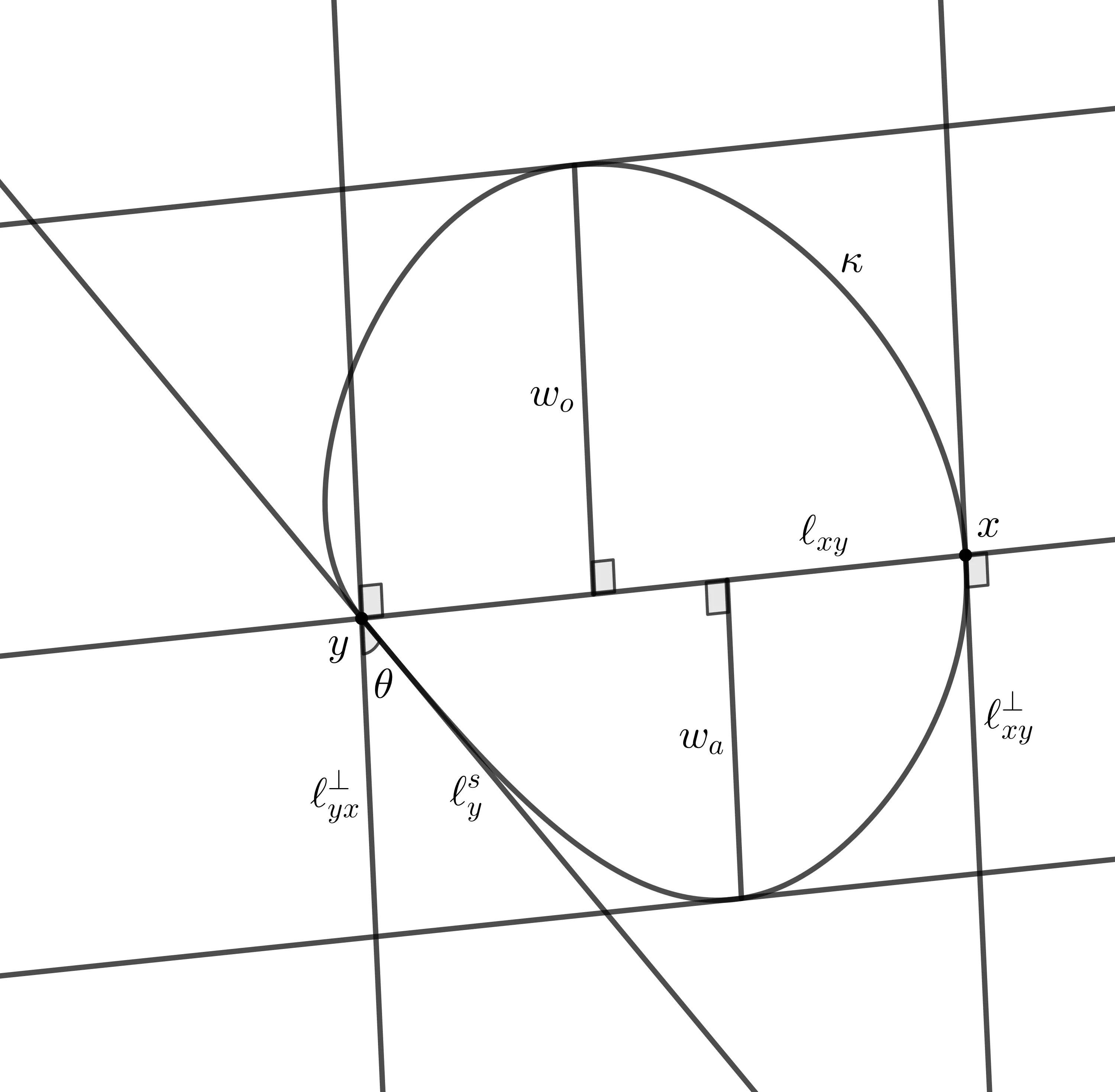
We establish a lower bound for the surface area of a closed, convex hypersurface in Euclidean space in terms of its displacement under continuous maps. As a result, a hypothesized lower bound for the volume of a Riemannian $n$-sphere, proved by Berger in dimension $n=2$ and disproved by Croke in dimensions $n \geq 3$, is valid for convex hypersurfaces in all dimensions. We also establish a sharp lower bound for the mean width of a convex hypersurface.
In this paper, we study the closed timelike geodesics of de-Sitter tori with one singularity and prove their uniqueness in their free homotopy class. We introduce the notion of timelike marked length spectrum of such a torus, and establish its rigidity with respect to the lengths of two homotopy classes of intersection number one. We also construct length-twist coordinates on the deformation space of de-Sitter tori with one singularity.
2604.01839The integrability problem for transitive Lie algebroids can be looked at from different perspectives, revealing an interplay between cohomological methods and homotopical constructions. Mackenzie introduced a cohomological obstruction defined via sheaf-theoretic methods. On the other hand, Crainic and Fernandes used a path space approach and characterized integrability in terms of the monodromy. Recently, Meinrenken formulated the monodromy in terms of a clutching construction. We show that all of these agree. In particular, we identify the monodromy map with the Mackenzie obstruction class through the natural pairing between cohomology and homotopy.
2604.01415We study non-positively curved closed manifolds $M$ and $n$-dimensional totally geodesic submanifolds of $M \times M$ which satisfy a transversality condition. We prove that, under some mild irreducibility requirements on $M$, if $M \times M$ admits infinitely many such submanifolds or just a single dense such submanifold, then $M$ is a locally symmetric space. In proving this, we prove a stronger version which only requires such submanifolds to exist in the universal cover $\widetilde M \times \widetilde M$.