635 papers
 2604.04019
Threshold Virtual States of a Jacobi operator
We prove that the set of parameters for which a virtual level appears at the edge of the continuous spectrum of a Jacobi matrix with a finite-rank diagonal perturbation constitutes an algebraic variety of codimension one. This variety partitions the parameter space into connected components, with their number determined by the size of the perturbation support. We also reveal a hierarchical structure underlying these critical varieties as the rank of the perturbation increases.
2604.04019Apr 2026
View2604.03418Optimal bounds for the first two Steklov eigenvalues of Euclidean domains
We establish upper bounds for the first two nonzero Steklov eigenvalues of bounded domains in Euclidean spaces of dimension $d \geq 3$, under a natural normalization involving volume and boundary measure, and show that these bounds are sharp for $d \geq 7$.
2604.03418Apr 2026
View2604.02839Anderson Localization for Schrödinger Operators with Monotone Potentials Generated by the Doubling Map
In this paper, we consider the Schrödinger operators on $ \ell^{2}(\N) $, defined for all $ x\in\mathbb{T} $ by \begin{equation} (H(x)u)_n = u_{n+1} + u_{n-1} + λf(2^{n} x) u_n, \quad \text{for } n \geq 0,\notag \end{equation} with the Dirichlet boundary condition $ u_{-1}=0 $. Building on Zhang's recent breakthrough work [Comm.Math.Phys.405:231(2024)] that resolved Damanik's open problem [Proc.Sympos. Pure Math.76,Amer.Math.Soc.(2007)] on the uniform positivity of the Lyapunov exponent, for the potential $ f \in C^{1}(0,1)$ with $ \|f\|_{C^{1}(0,1)} < C $ and $ \inf_{x \in (0,1)} |f^{\prime}(x)| > c>0 $, we obtain the large deviation estimate and prove that for a.e. $ x \in \mathbb{T} $ and sufficiently large $ λ> λ_{0} $, the operators $ H(x) $ display Anderson localization. Furthermore, if the potentials also have zero mean, our analysis reveals that the doubling map models can exhibit localization behavior for both small and large coupling constants $ λ$.
2604.02839Apr 2026
View
Continuity of Weighted Dirac Spectra
For the weighted Dirac eigenvalue problem, we show that the two-sided weighted spectrum depends continuously on the weight under continuous deformations within a uniformly elliptic class. Moreover, for differentiable families of weights we obtain a quantitative Lipschitz estimate for the full spectrum in the arsinh--metric, based on a weighted Hellmann--Feynman variational identity.
2604.02195Apr 2026
View
Quantum ergodicity in the Benjamini--Schramm limit for locally symmetric spaces
We prove that for almost all symmetric spaces $X$ and for any sequence of compact locally symmetric spaces $Y_n$ which is uniformly discrete, has a uniform spectral gap, and converges in the sense of Benjamini--Schramm to $X$, the joint eigenfunctions of all invariant differential operators on $Y_n$ delocalize on average when their spectral parameters are taken to lie in a fixed spectral window.
2604.01075Apr 2026
View2604.00976On the Effectless Cut Method for Laplacian Eigenvalues in any dimensions
In this paper, we study the optimization of the first Laplacian eigenvalue on axisymmetric doubly connected domains under positive Robin boundary conditions. Under additional geometric constraints, we prove that spherical shells maximize this eigenvalue. Our approach combines known isoperimetric inequalities for mixed Laplacian eigenvalues with a higher-dimensional extension of the effectless cut technique introduced by Hersch to study multiply connected membranes of given area fixed along their boundaries.
2604.00976Apr 2026
View2604.00541The direct spectral problem for indefinite canonical systems
For indefinite (Pontryagin space) canonical systems that contain an inner singularity we prove the existence of generalised boundary values at the singularity, which are used to formulate interface conditions. With the help of such interface conditions we construct the monodromy matrix of the canonical system and write it as a product of matrices, which separates the contributions of the Hamiltonian function and the finitely many discrete parameters that are associated with the singularity.
2604.00541Apr 2026
View
On the measure of spectra for discrete Schrödinger operators on periodic graphs
We consider discrete Schrödinger operators $H_{μQ}=Δ+μQ$ with real periodic potentials $Q$ on periodic graphs, where $Δ$ is the adjacency operator and $μ\in\mathbb R$ is a coupling constant. The spectra of the operators consist of a finite number of closed intervals (bands). In the large coupling regime, we obtain an asymptotic upper bound for the measure of the spectrum of $H_{μQ}$ which depends essentially on a "degeneracy degree" of the potential $Q$. This result extends the result of Y. Last obtained for the one-dimensional lattice $\mathbb Z$ to the case of general periodic graphs. It also may serve as a certain quantitative complement to the recent criterion of J. Fillman for the measure of the spectrum of $H_{μQ}$ to go to zero as $μ\to\infty$.
2603.29898Mar 2026
View2604.00052Spectral-Dimension Obstructions for Operators with Superlinear Counting Laws
We show that single-valuation exponential kernels, under mild regularity assumptions, converge in the continuum limit to a fourth-order operator with heat asymptotics $Θ(t)\sim t^{-1/4}$ and hence spectral dimension $d_s=\tfrac12$. Independently, a Tauberian analysis implies that any self-adjoint operator with superlinear eigenvalue counting $N(λ)\sim λ\,L(λ)$ must satisfy $Θ(t)\sim t^{-1}L(1/t)$ and therefore has spectral dimension $d_s=2$. Since spectral dimension is invariant under unitary equivalence and compact perturbations, these exponents are incompatible, yielding a structural obstruction that separates single-valuation kernel limits from operators with accelerated spectral growth.
2604.00052Mar 2026
View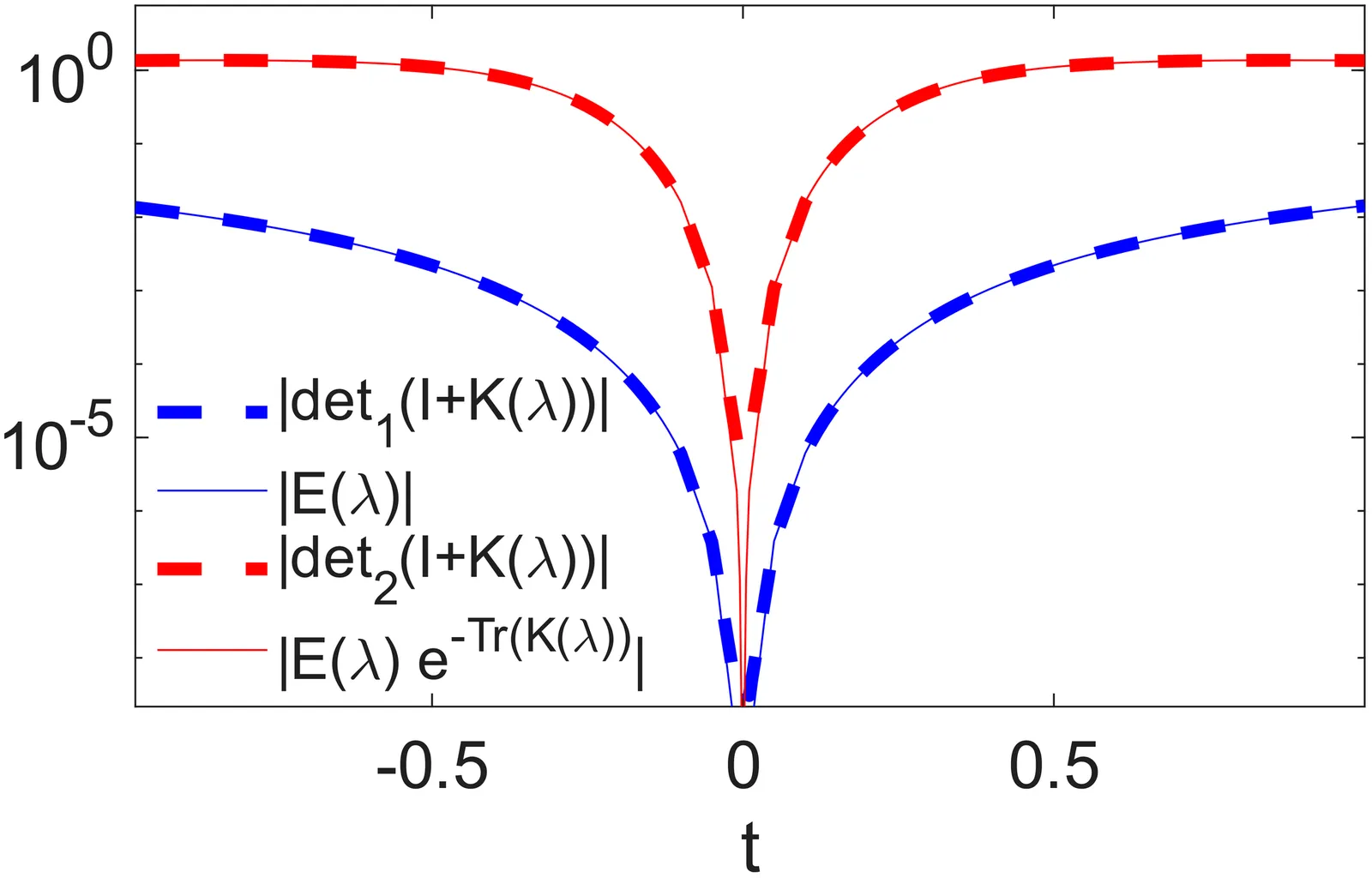
Stability of Ginzburg-Landau pulses via Fredholm determinants of Birman-Schwinger operators
We introduce a numerical method to determine the stability of stationary pulse solutions of the complex Ginzburg-Landau equation. The method involves the computation of the point spectrum of the first-order linear differential operator with matrix-valued coefficients on the real line obtained by linearizing the Ginzburg-Landau equation about a stationary pulse. Applying a general theory of Gesztesy, Latushkin, and Makarov, we show that this point spectrum is given by the set of zeros of a 2-modified Fredholm determinant of a Hilbert-Schmidt, Birman-Schwinger operator. We establish conditions which guarantee that this operator is trace class. Applying results of Bornemann on the numerical computation of Fredholm determinants, we obtain a bound on the error between the regular Fredholm determinant of the trace class operator and its numerical approximation by a matrix determinant. We verify the new numerical Fredholm determinant method for computing the point spectrum of a Ginzburg-Landau pulse by exhibiting excellent agreement with previous methods. This new approach avoids the challenge of solving the numerically stiff system of equations for the matrix-valued Jost solutions, and it opens the way for the spectral analysis of breather solutions of nonlinear wave equations, for which an Evans function does not exist.
2603.29040Mar 2026
View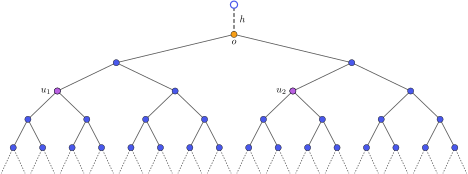
Resonances on geometrically finite graphs
In analogy with the spectral theory of geometrically finite hyperbolic manifolds, we initiate the study of resonances on geometrically finite (q+1)-regular graphs of groups. We prove the meromorphic continuation of the resolvent of the adjacency operator on such spaces and give a geometric characterization of the resonant states. In contrast to the hyperbolic surfaces setting, geometrically finite graphs have only finitely many resonances and may be computed explicitly, yet exhibit many of the same qualitative phenomena as in the hyperbolic manifolds setting. Particularly interesting examples arise from algebraic curves over finite fields.
2603.26443Mar 2026
View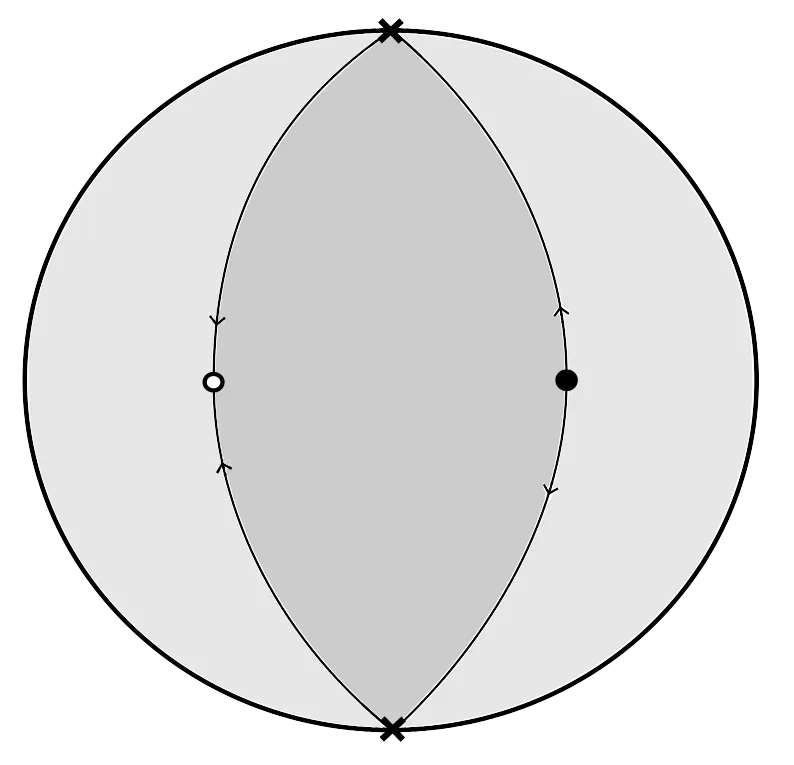
On Courant-like bound for Neumann domain count
In this work we show that in general there is no Courant-like bound for Neumann domain count. In order to do that we construct a sequence of domains $Ω^n$ such that the first Dirichlet eigenfunction for $Ω^n$ has at least $n$ Neumann domains. Also a special case of convex domains is considered and sufficient conditions for existence of Courant-like bound for small eigenvalues are found.
2603.26279Mar 2026
View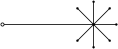
Bounds on eigenvalue ratios of quantum graphs
We study ratios of eigenvalues of the Laplacian on compact metric graphs. Our goals are threefold: First, we prove a sharp Ashbaugh--Benguria-type bound for the ratio of the first two eigenvalues on compact trees with Dirichlet conditions at all leaves, concretely showing that the ratio is maximized when the graph is an interval or an equilateral star. This improves a previous Payne--Pólya--Weinberger-type result due to Nicaise [Bull. Sci. Math., II. Sér. 111 (1987), 401--413]. Second, we extend this bound to a set of inequalities for the ratio of any pair of eigenvalues of such compact Dirichlet trees which respect the Weyl asymptotics up to an absolute constant. Third, we show that on non-trees, on which we also allow any mix of Neumann and Dirichlet conditions at the leaves, it is possible to recover bounds on the eigenvalue ratios depending only on the number of independent cycles and the number of Neumann leaves, in addition to the eigenvalue indices. This complements previously known counterexamples to analogues of the Ashbaugh--Benguria bound for general quantum graphs, by showing that the only way the bound can fail is through cycles and Neumann leaves, and by explicitly quantifying the extent to which it can fail.
2603.26172Mar 2026
View2603.25601WKB for semiclassical operators: How to fly over caustics (and more)
The method initiated by Wentzel, Kramers, and Brillouin to find approximate solutions to the Schrödinger equation lies at the origin of the spectacular development of microlocal and semiclassical analysis. When used naively, the approach appears to break down at caustics, but Maslov showed how a simple generalization could overcome this difficulty. In this paper, after a partial historical review, we take advantage of more recent advances in microlocal analysis to present a unified treatment of this generalized Maslov-WKB method, using a microlocal sheaf-theoretic approach. This framework provides a rigorous proof of the Bohr Sommerfeld Einstein Brillouin Keller quantization conditions for the eigenvalues of general semiclassical operators (pseudodifferential and Berezin Toeplitz) in one degree of freedom. We also review some applications and extensions.
2603.25601Mar 2026
View2603.25438A class of nonselfadjoint spectral differential operators of interest in physics
It is shown that the nonselfadjoint (and non-normal) linear ordinary differential operators of a certain class are spectral operators of scalar type in the sense of Dunford and Bade. Operators of this kind appear in physical problems such as the scattering of spin waves by magnetic solitons.
2603.25438Mar 2026
View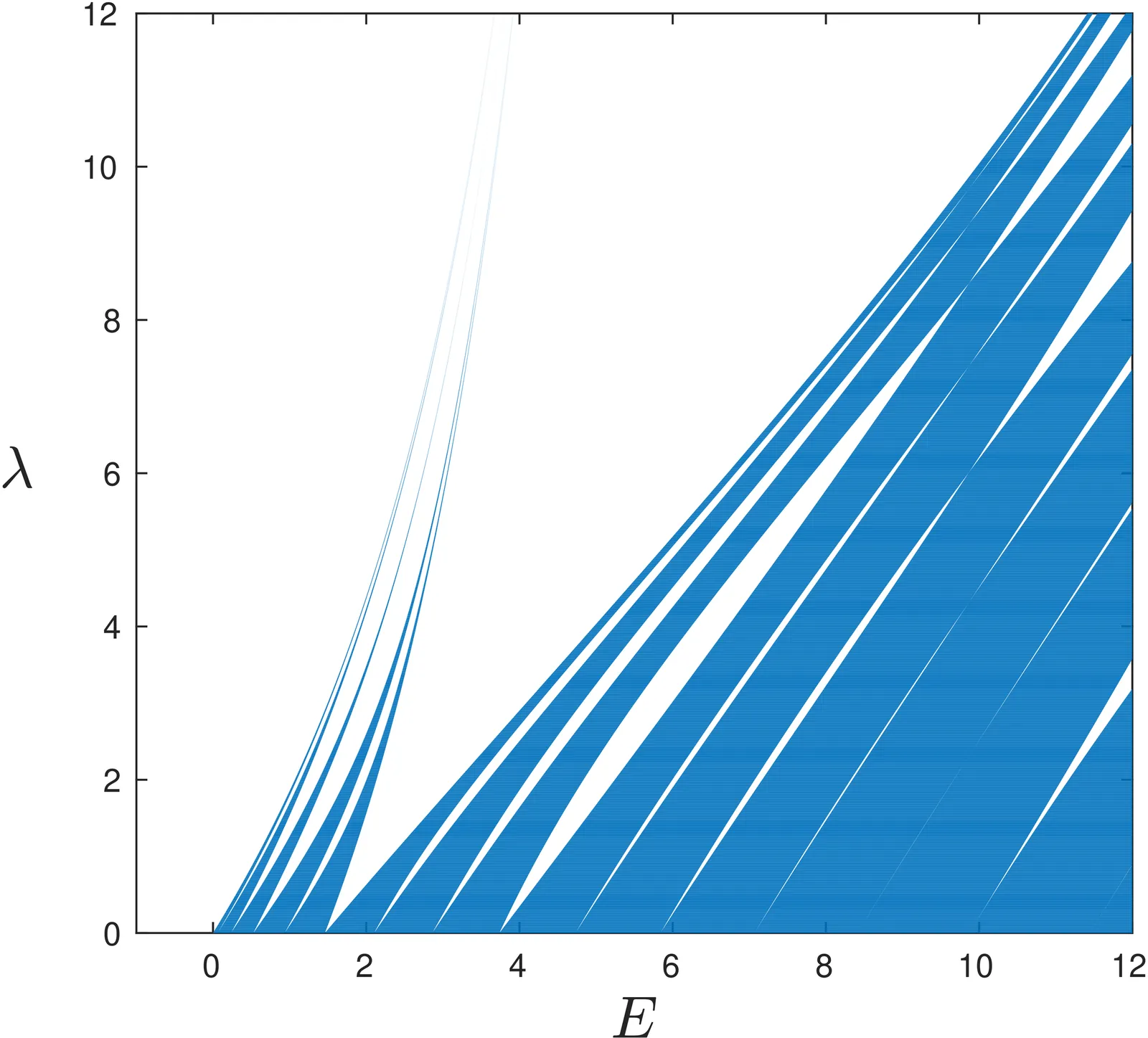
Continuum Fibonacci Schrödinger Operators in the Strongly Coupled Regime
We study Schrödinger operators on the real line whose potentials are generated by the Fibonacci substitution sequence and a rule that replaces symbols by compactly supported potential pieces. We consider the case in which one of those pieces is identically zero, and study the dimension of the spectrum in the large-coupling regime. Our results include a generalization of theorems regarding explicit examples that were studied previously and a counterexample that shows that the naïve generalization of previously established statements is false. In particular, in the aperiodic case, the local Hausdorff dimension of the spectrum does not necessarily converge to zero uniformly on compact subsets as the coupling constant is sent to infinity.
2603.24462Mar 2026
View2603.23832Sharp estimates for eigenvalues of localization operators with applications to area laws
We study the eigenvalues of the localization operator $S_{A, B} = P_A\mathcal{F}^{-1}P_B\mathcal{F} P_A$, where $\mathcal{F}$ is the Fourier transform and $A = cA_0, B = B_0$ for some fixed sets $A_0, B_0\subset \mathbb{R}^d$ and a large parameter $c > 0$. For the counting function of the eigenvalues $|\{n: \varepsilon < λ_n(A,B)\le 1-\varepsilon\}|$ we obtain a sharp uniform upper bound if one of the sets is a finite disjoint union of parallelepipeds and a bound which is only a single logarithm off the conjectural optimal bound in the general case. These bounds are applied to the estimation of traces ${\rm{Tr}}\, f(S_{A,B})$ for functions $f$ with a very low regularity, in particular establishing an enhanced area law in the former case.
2603.23832Mar 2026
View2603.21240An Approximate Inverse Spectral Theorem for Manifolds of Constant Negative Curvature
A classical theorem of Colin de Verdière shows that on a closed manifold of fixed topology one can prescribe an arbitrary finite portion of the Laplace-Beltrami spectrum (including multiplicities, subject to the usual topological constraints) by choosing a sufficiently heterogeneous smooth metric. In this paper, we study the same inverse problem under the rigid geometric constraint of \emph{constant negative sectional curvature}. Allowing the topological complexity to vary, we prove that any finite strictly increasing target list can be approximated to arbitrary precision by a closed manifold of constant negative curvature in any dimension $d\ge2$. In $d=2$ the construction uses hyperbolic collar degeneration and the discrete spectral limit theorems of Burger, building on the collar estimates of Buser; in $d\ge3$ we build macroscopically heterogeneous hyperbolic covering manifolds assembled from ``heavy'' vertex clusters and ``long'' corridor chains whose low-energy limit is a prescribed \emph{discrete} graph Laplacian. We also record the universal obstructions at curvature normalization $κ\equiv -1$: Yang-Yau in $d=2$ and Kazhdan-Margulis combined with Bishop--Gromov volume comparison in $d\ge3$. In particular, $λ_1$ is universally bounded at $κ=-1$, so target lists whose first positive eigenvalue exceeds this bound cannot be approximated within the class $κ\equiv -1$, and accommodating arbitrarily large prescribed $λ_1^*$ forces $|κ|\to\infty$. A corollary on the arbitrarily precise prescription of scale-invariant eigenvalue ratios at $κ\equiv -1$ and an explicit worked example are included.
2603.21240Mar 2026
View2603.17213On spectral stability for self-adjoint extensions
We prove that given a symmetric completely non-selfadjoint operator $B$ with finite deficiency indices $(n,n)$ on a Hilbert space and a boundary triplet $\left(\mathbb{C}^{n},Γ_{1},Γ_{2}\right)$ for $B^{*}$, the set of points in the spectrum of $A_{1}$ (the self-adjoint extension with domain $Ker\;Γ_{1}$) which are not eigenvalues of maximum multiplicity for any self-adjoint extension of $B$ disjoint of $A_{1}$, is a dense $\textit{G}_δ$ set in $σ(A_{1})$. Furthermore, a proof of a Malamud's theorem that generalizes a well-known result of the Aronszajn-Donoghue theory on the characterization of eigenvalues is offered.
2603.17213Mar 2026
View2603.16135A note on the distribution of Neumann eigenvalues of the Laplacian on a Euclidean convex domain
We establish two universal inequalities for Neumann eigenvalues of the Laplacian on a Euclidean convex domain.
2603.16135Mar 2026
ViewPage 1 of 32