Hamiltonian systems, symplectic flows, classical integrable systems.
2604.04358We investigate the geometry of a certain space of meromorphic connections with irregular singularities, and prove in particular that it is a (real) symplectic Lie groupoid. The connections have a physical meaning: they correspond to certain solutions of the topological-antitopological fusion (tt*) equations of Cecotti and Vafa, and hence to deformations of supersymmetric quantum field theories. The groupoid structure arises because we restrict ourselves to the tt* equations of Toda type, whose monodromy data has a Lie theoretic description. To obtain these results, we show first that the universal centralizer of a Lie group is a holomorphic symplectic groupoid over the Steinberg cross section.
Using our previous work we give a tropical formula for disk potentials for Lagrangian tori in almost toric four-manifolds, that is, fibrations by Lagrangian tori with only toric and focus-focus singularities, generalizing results of Mikhalkin for holomorphic spheres in the projective plane. As examples, we directly compute potentials for Lagrangian tori in del Pezzo surfaces equipped with monotone symplectic forms. These formulas were established in the monotone case by different methods in Pascaleff-Tonkonog, and investigated from the point of view of the Gross-Siebert program in Carl-Pumperla-Siebert, Bardwell-Evans--Cheung--Hong--Lin and also Lau-Lee-Lin.
2604.01208To a noncompact orientable surface with no closed boundary, we associate the sum of Fukaya categories of (Liouville sectors associated to) its symmetric powers. We construct sectorial covers with the combinatorics of the bar resolution to show this association extends to an open 2d topological field theory -- without naming a Lagrangian, let alone a holomorphic disk. In particular, we recover results of Rouquier and Manion on extending Heegaard-Floer theory down to an interval.
2604.01009We prove a compactness result for gradient flow lines in a general set-up which comprises both the situation of Morse gradient flow lines as well as Floer cylinders converging to a critical submanifold respectively. For the compactness result we have to impose two conditions. Both are readily verified in the Morse case but establishing the second condition in the Floer case poses a technical challenge and relies on an exponential decay estimate for Floer cylinders, with coefficient function continuously depending on the initial loop. This is a result of independent interest.
We study contact 3-manifolds $Y$ with a special global frame inspired by Cartan's structure equations. This frame is dual to a generalized Finsler structure defined by Bryant. We present some examples and rigidity results on the class of manifolds whose frame satisfies certain natural conditions on a scalar function $K\colon Y\to \mathbb{R}$, related to the frame. This function realizes the curvature when $Y$ is the unit tangent bundle with respect to a metric on a surface. As applications, we obtain sharp estimates for the action of a Reeb orbit in terms of this scalar function, under the assumption that the frame satisfies specific conditions. In particular, we recover a classical upper bound on the systole of positively curved metrics on $S^2$ due to Toponogov.
A contact form $λ$ on a closed contact three-manifold $(M,ξ)$ is called weakly convex if either it has no contractible Reeb orbit, or the first Chern class of $ξ$ vanishes on $π_2(M)$, and the index of every contractible Reeb orbit is at least $2$. We present conditions for a weakly convex contact form to admit a well-defined cylindrical contact homology. The key point is a cancellation mechanism for boundary degenerations involving index-2 Reeb orbits, based on a parity property of holomorphic planes.
Parallel to the study of toric domains, symplectically convex, and dynamically convex domains in $(\mathbb R^4, ω_{\rm std})$, we build an analogous framework and corresponding subclasses for Liouville domains in $(T^*\mathbb T^2,ω_{\rm can})$. A key feature of this framework is the introduction of a new notion of convexity, based on systolic ratios. Via various machinery in quantitative symplectic geometry, including ECH capacities, shape invariant, dynamical zeta function, etc., we investigate the relations between subclasses of Liouville domains in $T^*\mathbb T^2$, obtain large-scale geometry of Liouville domains in $T^*\mathbb T^2$ with respect to coarse Banach-Mazur distance, provide a non-flat codisc bundle of torus even under the action of exact symplectomorphisms, and verify the agreement of normalized capacities for a wide class of Liouville domains in $T^*\mathbb T^2$.
In this article we consider two classical problems in Quantum Mechanics, namely the 'particle on a ring' and the 'particle in a box' from the viewpoint of symplectic topology. Interpreting the solutions of the corresponding time independent Schrödinger equation as orbits in a suitably chosen time dependent Hamiltonian system allows us to investigate them using Floer theory. More precisely we extend the definition of Rabinowitz Floer homology to non-autonomous Hamiltonians on $\mathbb{R}^{2n}$ with its standard symplectic structure and show that compactness of the moduli space of J-holomorphic curves still holds. With this homology we are then able to prove existence results for energy $E$ eigenstates on the 'ring' or in the 'box' for a big range of exterior potentials.
2603.28007Let $M$ be a closed manifold. We introduce a family of Legendrian isotopy invariants for Legendrians in $J^1M$, which we collectively call Legendrian higher torsion. Given a choice of a class $\mathcal{F}$ of fibre bundles over $M$, equipped with suitable unitary local systems, the Legendrian higher torsion of a Legendrian $Λ\subset J^1M$ is the subset of $H^*(M;\mathbf{R})$ consisting of higher Reidemeister torsion cohomology classes of fibre bundles $W$ over $M$ in the class $\mathcal{F}$ such that $Λ$ admits a generating function on a stabilization of $W$. For the class of tube bundles in the sense of Waldhausen we call the invariant tube torsion. In particular, we show that the tube torsion of a nearby Lagrangian $L \subset T^*M$ is well-defined when the stable Gauss map $L \to U/O$ is trivial and consists of a union of cosets of a normalized version of the Pontryagin character. We also identify a distinguished coset, invariant under Hamiltonian isotopy of $L$, which we call nearby Lagrangian torsion. We do not know whether nearby Lagrangians must have trivial tube torsion, as would follow from the nearby Lagrangian conjecture. However, we show that there exist Legendrians $Λ\subset J^1M$ with nontrivial tube torsion whose projection $Λ\to M$ is homotopic to a diffeomorphism.
In this paper, we introduce \emph{$\ell^p$-information geometry}, an infinite-dimensional framework that shares key features with the geometry of the space of probability densities \( \mathrm{Dens}(M) \) on a closed manifold, while also incorporating aspects of measure-valued information geometry. We define the \emph{$\ell^2$-probability simplex} with a noncanonical differentiable structure induced via the \emph{$q$-root transform} from an open subset of the \( \ell^q \)-sphere. This choice makes the \(q\)-root transform an \emph{isometry} and allows us to construct the \(\ell^2\)- and \(\ell^q\)-Fisher--Rao geometries, including \emph{Amari--Čencov \(α\)-connections} and a \emph{Chern connection} in the \(\ell^q\)-setting. We then apply this framework to an infinite-dimensional linear optimization problem. We show that the corresponding gradient flow with respect to the \(\ell^2\)--Fisher--Rao metric can be solved explicitly, converges to a maximizer under a natural monotonicity assumption, and admits an interpretation as the geodesic flow of an \emph{exponential connection}. In particular, we prove that this \(e\)-connection is \emph{geodesically complete}. We further relate these flows to a \emph{completely integrable Hamiltonian system} through a \emph{momentum map} associated with a Hamiltonian torus action on infinite-dimensional complex projective space. Finally, inspired by the \(\ell^2\)-theory, we outline an analogous Fisher--Rao geometry for \( \mathrm{Dens}(M) \) on possibly noncompact Riemannian manifolds, showing that, with a suitable spherical differentiable structure, the square-root transform remains an \emph{isometry}.
Dirac brackets are widely used to study constrained Hamiltonian dynamics. In this paper we develop a Dirac-bracket approach to normal forms on momentum levels and relate it to symplectic reduction in the cases where reduction yields a (stratified) symplectic quotient. We consider a proper Hamiltonian $G$-action on a symplectic manifold $(M,ω)$ with an equivariant momentum map $J$. We fix $μ\in \mathfrak g^*$and work on $J^{-1}(μ)$. For $G$-invariant Hamiltonians whose induced vector field on $J^{-1}(μ)$ is tangent to a local $G_μ$-slice, we show that the induced evolution on $J^{-1}(μ)$ coincides with that defined by the Dirac bracket on a local second-class slice, and descends to the corresponding symplectic stratum of $J^{-1}(μ)/G_μ$. As a main application we study Birkhoff normal forms near a relative equilibrium. When the quadratic part of a symmetric Hamiltonian is tangent to a local $G_μ$-slice, a Birkhoff normal form can be constructed entirely on the manifold $J^{-1}(μ)$, and it descends to a Birkhoff normal form for the reduced dynamics on the corresponding stratum, even when the reduced space is singular. We show that for a class of simple mechanical systems this condition holds automatically at a relative equilibrium. We illustrate the method on the double spherical pendulum. Finally, we relate our results to Moser's constrained dynamics by identifying Moser's constrained vector field with the Dirac Hamiltonian vector field. We show that, if the reduced Hamiltonian is near-integrable on a stratum, then its pullback to the symplectic slice is near-integrable with respect to the Dirac bracket, and vice versa. In particular, this provides a practical route to KAM-type results for the constrained dynamics.
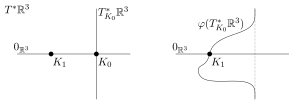
Fix a knot $K_0$ in $\mathbb{R}^3$ and consider a Lagrangian submanifold $L$ of $T^*\mathbb{R}^3$ that is isotopic to the conormal bundle of $K_0$ by a compactly supported Hamiltonian isotopy and intersects the zero section $\mathbb{R}^3$ cleanly along a knot. In this paper, using microlocal sheaf theory and some results in $3$-manifold theory, we prove that the knot type of $K_1 := L\cap \mathbb{R}^3$ in $\mathbb{R}^3$ is strictly constrained from the knot type of $K_0$. Specifically, we deduce the existence of a surjective group homomorphism $π_1(\mathbb{R}^3\setminus K_0) \to π_1(\mathbb{R}^3\setminus K_1)$ preserving the longitude and meridian with respect to the Seifert framing. Moreover, combining with a previous work by the second author, we obtain a rigidity result which was only known for the unknot: If $K_0$ is the $(2,q)$-torus knot or the figure-eight knot, $K_1$ must have the same knot type as $K_0$.
We compute the Poisson cohomology of the linear Poisson structure dual to the n-dimensional "book" Lie algebra, defined by [e_0,e_i]=e_i, [e_i,e_j]=0, for i,j=1,...,n-1.
In this paper, we study a family of symplectic manifolds introduced by Woodward. These manifolds belong to the broader class of \emph{multiplicity-free} Hamiltonian $G$-manifolds, a generalization of toric manifolds for non-abelian Hamiltonian group actions. Prominent examples of multiplicity-free spaces include coadjoint orbits of $U(n)$ and $SO(n)$ equipped with multiplicity-free $U(n-1)$- and $SO(n-1)$-actions, respectively. Although these multiplicity-free $U(2)$-manifolds are not toric, we may study a family of Lagrangian tori by performing a symplectic cut that allows us to apply the toric Lagrangian Floer theory. In particular, we employ Venugopalan--Woodward's study of pseudoholomorphic curves under symplectic cuts to obtain the leading order potential. This allows us to identify a number of critical points of the potential function which correspond to a non-displaceable Lagrangian submanifold. Moreover, we adapt McDuff's probe method to show that the majority of the other Lagrangian submanifolds in these spaces are displaceable. Finally, we prove that the open-closed map for the Fukaya subcategory generated by these branes is an isomorphism. It follows that they satisfy Abouzaid--Fukaya--Oh--Ohta--Ono's generation criterion.
For given smooth functions $(f_1,\dots,f_n)$ on $M$, Fukaya and Oh showed that the moduli space of pseudoholomorphic disks in $T^*M$ which are bounded by Lagrangian sections $\{L_i^ε=\operatorname{graph}(εdf_i)\}$ is diffeomorphic to the moduli space of gradient trees in $M$ which consist of gradient curves of $\{f_i-f_j\}$. When the image of the pseudoholomorphic disk $w_ε$ is a polygon in $\mathbb{C}\simeq T^*\mathbb{R}$, we can describe $w_ε$ by a Schwarz-Christoffel map. In \cite{S25}, we proved that pseudoholomorphic disks $w_ε$ converge to the gradient tree in the limit $ε\to+0$ when the image of $w_ε$ is a generic convex quadrilateral. In this paper, we show such a convergence for any convex quadrilaterals by studying the non-generic case.
Let a torus $T$ act on a symplectic manifold $(M,ω)$ with moment map $φ$. We say that the Hamiltonian $T$-manifold $(M,ω,φ)$ has complexity one if $\frac{1}{2} \dim M - \dim T = 1$, and that it is Kähler if it admits an invariant compatible complex structure. In this paper, we show how the class of Kähler complexity one Hamiltonian $T$-manifolds sits inside the class of complexity one Hamiltonian $T$-manifolds by proving that every compact, connected Kähler complexity one Hamiltonian $T$-manifold has a trivial painting. As a corollary, we show that two tall compact, connected Kähler complexity one Hamiltonian $T$-manifolds are symplectomorphic exactly if they have the same genus, Duistermaat-Heckman measure, and skeleton. Here, $(M,ω,φ)$ is tall exactly if every non-empty fiber $φ^{-1}(α)$ contains more than one orbit.
The goal of these lectures is to introduce the completion of the set of Lagrangian submanifolds of a symplectic manifold with respect to the spectral metric first introduced by V. Humilière and recently revisited by C. Viterbo. We establish a number of basic properties of this completion, in particular through the notion of $γ$-support, which we develop as a refinement of Humilière's original concept. We then present an application of these notions to conformally symplectic dynamics, generalizing the notion of Birkhoff attractor as defined and studied by G.D. Birkhoff, M. Charpentier, and more recently P. Le Calvez. Finally, we briefly mention several other applications of the Humilière completion and highlight many open questions. These are notes elaborated from the lectures with the same title given by C. Viterbo at the CIME School ''Symplectic Dynamics and Topology'' held in Cetraro (CS), Italy, from 16th to 20th June 2025.
2603.08384For a symplectic geometry $X$, suppose the (derived) Fukaya category $\mathrm{Fuk}(X)$ of $X$ is equipped with a monoidal structure. Then its Balmer spectrum recovers a mirror $Y$ of $X$ if there exists homological mirror symmetry $\mathrm{Fuk}(X)\cong D^b\mathrm{coh}(Y)$ and the monoidal structure is the mirror of the standard one of $D^b\mathrm{coh}(Y)$. In this short note, we fill one gap of this story in the literature: we show that the monoidal structure determines the homological mirror functor $\mathrm{Fuk}(X)\to D^b\mathrm{coh}(Y)$.
2603.07894In this paper, it is proved that under dynamically convex condition, there exist at least $[\frac{n+1}{2}]$ closed Reeb orbits on a closed contact type hypersurface in $T^*S^n$ enclosing the zero section and bounding a simply connected Liouville domain. Furthermore, if the contact form is non-degenerate and has finitely many closed Reeb orbits, then there exist at least two irrationally elliptic closed Reeb orbits.
2603.07731We show that a topological symplectic manifold has a canonically associated bi-Lipschitz structure. As a corollary, we obtain the first examples of non-existence and non-uniqueness for topological symplectic structures. Our arguments hold for any topological manifold admitting an atlas with transition maps that are $C^0$--limits of bi-Lipschitz homeomorphisms.