1,076 papers
 2604.04813
Drinfeld-Xu bialgebroid 2-cocycles twist the antipode
Ping Xu generalized Drinfeld 2-cocycles from bialgebras to associative bialgebroids over noncommutative base algebras. Any counital Drinfeld--Xu 2-cocycle twists the base algebra of the bialgebroid and a comultiplication on the total algebra, obtaining a new, twisted bialgebroid. Antipodes for bialgebroids have been considered, but finding a general way to twist the antipode, which is straightforward in the Hopf algebra case, appeared somewhat elusive. In this article, we prove that if an invertible antipode $S$ for the original bialgebroid exists, and another expression $V_F$ depending on the 2-cocycle $F$ is invertible, then the expected conjugation formula $S_F(-) = V_F^{-1} S(-) V_F$ indeed produces an invertible antipode $S_F$ for the twisted bialgebroid.
2604.04813Apr 2026
View2604.04666Quantum affine vertex algebra at root of unity
Let $\mathfrak g$ be a finite simple Lie algebra, and let $r$ denote the ratio of the square length of long roots to that of short roots. Let $\wp>2r$ be an integer and $ζ$ a primitive $\wp$-th root of unity. Denote by $\mathcal U_ζ(\widehat{\mathfrak g})$ the Lusztig big quantum affine algebra at root of unity defined by divided powers. In this paper, we establish a current algebra presentation of $\mathcal U_ζ(\widehat{\mathfrak g})$. Based on this presentation, we construct a $\mathbb Z_\wp$-module quantum vertex algebras $V_{\wp,τ}^\ell(\mathfrak g)$ for each integer $\ell$. Moreover, we establish a fully faithful functor from the category of smooth weighted $\mathcal U_ζ(\widehat{\mathfrak g})$-modules of level $\ell$ to the category of $(\mathbb Z_\wp,χ_φ)$-equivariant $φ$-coordinated quasi-modules of $V_{\wp,τ}^\ell(\mathfrak g)$, where $χ_φ:\mathbb Z_\wp\to\mathbb C^\times$ is the group homomorphism defined by $s\mapsto ζ^s$. We also determine the image of this functor. The structure $V_{\wp,τ}^\ell(\mathfrak g)$ is substantially different from that of affine vertex algebras. We realize $V_{\wp,τ}^\ell(\mathfrak g)$ as a deformation of a simpler quantum vertex algebra $V_{\wp,\varepsilon}^\ell(\mathfrak g)$ by using vertex bialgebras, and decompose $V_{\wp,\varepsilon}^\ell(\mathfrak g)$ into a Heisenberg vertex algebra and a more interesting quantum vertex algebra determined by a quiver.
2604.04666Apr 2026
View2604.04476Cancellation-free version of the quantum $K$-theoretic divisor axiom for the flag manifold in the quasi-minuscule case
We prove a cancellation-free version of the quantum $K$-theoretic divisor axiom for the flag manifold in the quasi-minuscule case. Namely, we remove the cancellations from the quantum $K$-theoretic divisor axiom due to Lenart-Naito-Sagaki-Xu in the case where the fundametal weight corresponding to the divisor class is quasi-minuscule.
2604.04476Apr 2026
View2604.04396Quantum Borcherds-Bozec Superalgebras
We introduce quantum Borcherds-Bozec superalgebras. We present and prove various results of the quantum superalgebras including a bilinear form, higher Serre relation, quasi-R-matrix, character formula for the irreducible highest weight modules. We also prove the category of integrable representations is semi-simple.
2604.04396Apr 2026
View2604.03394Graded Satake diagrams and super-symmetric pairs
We list classical spherical subalgebras in basic matrix Lie superalgebras which are quantizable to coideal subalgebras in the standard quantum supergroups, for any choice of Borel subalgebra. We classify the corresponding Satake-type diagrams and prove that each of them defines a family of proper spherical subalgebras.
2604.03394Apr 2026
View2604.02929Classification of Extended Abelian Chern-Simons Theories
We classify extended Abelian Chern-Simons theories with gauge group $U(1)^n$ as extended $(2+1)$-dimensional topological quantum field theories. For an even integral nondegenerate lattice $(Λ,K)$, let $(G_K,q_K)$ denote its discriminant quadratic module. We prove that the associated theory is determined, up to symmetric monoidal natural isomorphism, by this finite quadratic module, and that every finite quadratic module is realized as the discriminant quadratic module of an even integral nondegenerate lattice. It follows that finite quadratic modules classify extended Abelian Chern-Simons theories, pointed Abelian Reshetikhin-Turaev TQFTs, and pointed modular tensor categories.
2604.02929Apr 2026
View2604.02571Representation Category of Free Wreath Product of Classical Groups
In this paper, we construct a rigid concrete $C^*$-tensor category whose associated compact quantum group, reconstructed via Woronowicz--Tannaka--Krein duality, is the free wreath product of classical groups.
2604.02571Apr 2026
View2604.01982Equivalence of toral Chern-Simons and Reshetikhin-Turaev theories
We prove a natural isomorphism between toral Chern-Simons theory with gauge group $\mathbb T=\mathcal t/Λ\cong U(1)^n$ and the Reshetikhin-Turaev theory associated with the finite quadratic module determined by an even, integral, nondegenerate symmetric bilinear form $K:Λ\timesΛ\to\mathbb Z.$ More precisely, let $G_K=Λ^*/KΛ$ be the discriminant group of $K$, equipped with its induced quadratic form $q_K$, and let $C(G_K,q_K)$ be the corresponding pointed modular category. Using the geometric quantization formulation of toral Chern-Simons theory, we show that the resulting toral TQFT is naturally isomorphic to the Reshetikhin-Turaev TQFT determined by $C(G_K,q_K)$. The comparison is established both for closed $3$-manifold invariants and for bordisms with boundary, yielding an isomorphism of extended $(2+1)$-dimensional TQFTs.
2604.01982Apr 2026
View2604.01058Universal $T$-matrices for quantum Poincaré groups: contractions and quantum reference frames
Universal $T$-matrices, or Hopf algebra dual forms, for quantum groups are revisited, and their contraction theory is developed. As a first illustrative example, the (1+1) timelike $κ$-Poincaré $T$-matrix is explicitly worked out. Afterwards, motivated by recent results on the role of the Hopf algebra dual form of a quantum (1+1) centrally extended Galilei group as the algebraic object underlying non-relativistic quantum reference frame transformations, a new quantum deformation of the (1+1) centrally extended Poincaré Lie algebra is obtained, and its universal $T$-matrix is presented. Finally, the Hopf algebra dual form contraction is applied to this Poincaré $T$-matrix, showing that its corresponding non-relativistic counterpart is precisely the Galilei $T$-matrix associated with quantum reference frames. In this way, the Poincaré Hopf algebra dual form introduced here stands as a natural candidate for describing the symmetry structure of relativistic quantum reference frame transformations. In the appropriate basis, the associated quantum Poincaré group is recognized, remarkably, as a non-trivial central extension of the (1+1) spacelike $κ$-Poincaré dual Hopf algebra.
2604.01058Apr 2026
View2604.00837Deformations of mixed associators in module categories
We set up a cochain complex $C^\bullet_{\mathrm{mix}}(\mathcal{M})$ whose cohomology controls deformations of the mixed associator of a module category $\mathcal{M}$ over a $\Bbbk$-linear monoidal category $\mathcal{C}$. We show that $C^\bullet_{\mathrm{mix}}(\mathcal{M})$ is isomorphic to the Davydov-Yetter (DY) complex of the representation functor $ρ: \mathcal{C} \to \mathrm{End}(\mathcal{M})$. Using our previous results on DY cohomology (arXiv:2411.19111), we prove that if $\mathcal{C}$ and $\mathcal{M}$ are finite then the cohomology $H^\bullet_{\mathrm{mix}}(\mathcal{M})$ is isomorphic to the relative Ext groups $\mathrm{Ext}^\bullet_{\mathcal{Z}(\mathcal{C}),\mathcal{C}}(\boldsymbol{1},\mathcal{A}_{\mathcal{M}})$ for the usual adjunction between the Drinfeld center $\mathcal{Z}(\mathcal{C})$ and $\mathcal{C}$, where $\mathcal{A}_{\mathcal{M}}$ is the so-called adjoint algebra of $\mathcal{M}$. This allows us to give a dimension formula for $H^n_{\mathrm{mix}}(\mathcal{M})$ in terms of certain Hom spaces in $\mathcal{Z}(\mathcal{C})$, and also to prove that $H^{>0}_{\mathrm{mix}}(\mathcal{C}) = 0$. We also show that the algebra $\mathcal{A}_{\mathcal{M}}$ is the ``full center'' of an algebra in $\mathcal{C}$ realizing $\mathcal{M}$. We furthermore establish a generalized version of Ocneanu rigidity for monoidal functors with coefficients, and provide its application to general (non-exact and non-finite) $\mathcal{C}$-module categories over a fusion category $\mathcal{C}$ such that $\dim(\mathcal{C}) \neq 0$. We spell out these results for module categories defined by finite-dimensional comodule algebras over finite-dimensional Hopf algebras. Examples based on comodule algebras over Sweedler's Hopf algebra are worked out in detail and yield new continuous families of inequivalent non-exact module categories.
2604.00837Apr 2026
View2604.00532Formal Deformation quantization as a Fréchet algebra
We define a Fréchet topology on the space $C^\infty(X)[[\hbar]]$ of formal smooth functions on a symplectic manifold $X$, by constructing a sequence of semi-norms on it. For any star product $\star$ on $C^\infty(X)[[\hbar]]$ making it a formal deformation quantization of $X$, we will show that the quantum product $\star$ is jointly continuous, and making it a Fréchet algebra. We will show a quantum Weierstrass theorem which says quantum polynomials are locally dense in all formal smooth functions. We will also show that the canonical trace of any formal deformation quantization is continuous under this Fréchet topology.
2604.00532Apr 2026
View2603.29896Qudit stabilizers beyond the free case and the twisted Kitaev model
We study the stabiliser formalism for qudits of arbitrary dimension $d$. In the free case, we show that the basic theorem of the stabiliser formalism remains valid: if the stabiliser subgroup $H$ is free as a $Z/dZ$-module and contains no non-trivial scalars, then the protected space $V^H$ is naturally identified with the state space of a smaller number of qudits of the same dimension, and the quotient $N(H)/H$ is identified with the Pauli group on a smaller number of qudits. We then remove the freeness assumption and describe the resulting structure in general. In this case, the protected space is identified with a tensor product of qudit spaces of possibly smaller dimensions, and the quotient $N(H)/H$ is described by a corresponding product of qudit Pauli groups, possibly of smaller dimensions, over a common center. We also characterise the shifted free case, which is exactly the situation in which $N(H)/H$ is again an ordinary qudit Pauli group. Our approach is algebraic and uniform, and applies in particular to the qudit Kitaev model and to its shifted and twisted variants.
2603.29896Mar 2026
View2603.29701The discrete quantum group $su_q(2)$ and its dual
Discrete quantum groups were introduced as duals of compact quantum groups by Podleś and Woronowicz in 1990. They have been studied intrinsically by Effros and Ruan (1994) and by the author (1996). In a more recent note (2025), we have given a slightly updated treatment, viewing the duality between discrete and compact quantum groups as a special case of the more general duality of algebraic quantum groups. Along these lines, we start in this paper with the discrete quantum group $su_q(2)$, not constructed as the dual of the compact quantum group $SU_q(2)$ but rather from the Hopf algebra deformation of the enveloping algebra of the Lie algebra of $SU(2)$, as given by Jimbo (1985). The passage to the discrete quantum group as studied in earlier papers is not completely trivial as we will see. This is a known phenomenon. We consider the dual of this discrete quantum group in the sense of duality of algebraic quantum groups and see that this indeed is the compact quantum group $SU_q(2)$.
2603.29701Mar 2026
View2603.29639On the Drinfeld double of a finite group scheme and its representation category
We classify equivalence classes of Hopf algebra quotient pairs $(D,θ)$ of the Drinfeld double $D(G)$ of a finite group scheme $G$ over an algebraically closed field $\mathbf{k}$ of characteristic $p\ge 0$, in terms of group scheme-theoretical data. We prove that such Hopf algebra quotients $D$ are Hopf algebra extensions $\mathscr{O}(K)^{\mathrm{cop}}\#_σ^τ \mathbf{k}[G/H]$, where $K$ and $H$ are normal subgroup schemes of $G$ that centralize each other and $B:\mathbf{k}[H]\to \mathscr{O}(K)$ is a $G$-equivariant Hopf algebra map, and describe the surjective Hopf algebra map $θ:D(G)\twoheadrightarrow D$. Using this classification, we determine the tensor subcategories of the center $\mathscr{Z}(G):=\Rep(D(G))$ of $G$, describe their centralizers, determine when they are symmetric or non-degenerate, and give a description of their simple and projective objects using \cite{GS}. Our categorical results generalize those found in \cite{NNW} in characteristic $0$.
2603.29639Mar 2026
View2603.28970The Drinfeld Center of the Generic Temperley--Lieb Category
We show that the Temperley--Lieb category $\mathbf{TL}(q;\mathbb{C})$ embeds in an ultraproduct of modular tensor categories when $q$ is not a root of unity. As a result, we show that its Drinfeld center is semisimple and describe its simple objects. The canonical functor $$\mathbf{TL}(q;\mathbb{C})\boxtimes \mathbf{TL}(q;\mathbb{C})^{\mathrm{rev}} \boxtimes \mathbf{Rep}(\mathbb{Z}/2\mathbb{Z}) \to \mathcal Z(\mathbf{TL}(q;\mathbb{C})),$$ induced by the braiding and the $\mathbb{Z}/2\mathbb{Z}$--grading on the Temperley--Lieb category, is thus shown to be a monoidal equivalence, which becomes a braided equivalence upon twisting the braiding by a certain bicharacter. Along the way, we formalize some general results about ultraproducts of tensor categories and tensor functors, building on earlier works of Crumley, Harman, and Flake--Harman--Laugwitz. We also discuss the center at some exceptional values of $q$.
2603.28970Mar 2026
View2603.28446Shifted affine iquantum groups of quasi-split ADE types
We formulate shifted affine iquantum groups of arbitrary quasi-split ADE types via Drinfeld presentations. We construct GKLO-type representations of shifted affine iquantum groups via algebras of difference operators, which allow us to construct truncated shifted affine iquantum groups. This provides a q-deformation of truncated shifted iYangians in our prior work arising as a quantization of affine Grassmannian islices.
2603.28446Mar 2026
View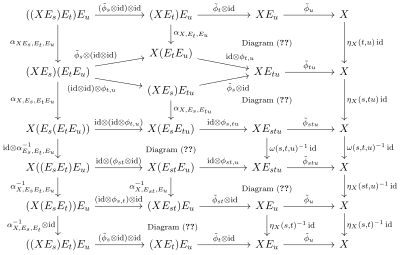
Ribbon categories from ind-exact algebras: simple current case
We give criteria for when finitely generated local modules over a commutative algebra $A$ in the ind-completion $\widehat{\mathcal{C}}$ of a braided tensor category $\mathcal{C}$ inherit the structure of a (rigid, braided, ribbon) tensor category. We then apply this to simple current algebras $A = \bigoplus_{g \in Γ} E_g$, where $Γ$ is a subgroup of invertible objects in $\mathcal{C}$. Using a description of simple $A$-modules, we verify the required hypotheses for this class of algebras and deduce rigidity, braided, ribbon, and non-degeneracy properties for their finitely generated local modules. As applications, we construct examples of ribbon tensor categories from quantum supergroup categories for unrolled $\mathfrak{gl}(1|1)$.
2603.28215Mar 2026
View2603.27925Universal $R$-matrix of double parameter quantum affine algebra $U_{q,Q}({\hat {sl_2}})$
We give the explicit formula of the universal $R$-matrix of a double parameter (or two-parameter, or multi-parameter) quantum affine algebra of type ${\mathrm{A}}_1^{(1)}$. For $N$ with $q_{00}q_{01}$ being a primitive $N$-th root of unity, we introduce its $2N$-dimensional representation and explicitly calculate the $R$-matrix associated with it via the universal $R$-matrix.
2603.27925Mar 2026
View2603.27688Extended Equivalence of $U(1)$ Chern-Simons and Reshetikhin-Turaev TQFTs
We establish the equivalence between $U(1)$ Chern-Simons and Reshetikhin-Turaev TQFTs associated with finite quadratic modules. For gauge group $U(1)$ and even level $k$, we prove that the corresponding Chern--Simons TQFT is naturally isomorphic to the Reshetikhin-Turaev TQFT determined by the pointed modular category $\mathrm{C}(\mathbb{Z}_k,q_k)$. The equivalence holds both for closed $3$-manifolds and for bordisms with boundary, so that the two constructions define naturally isomorphic extended $(2+1)$-dimensional TQFTs. In particular, the finite quadratic module $(\mathbb Z_k,q_k)$ completely determines the even-level $U(1)$ Chern--Simons theory.
2603.27688Mar 2026
View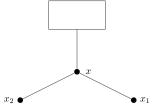
An introduction to quantum symmetries
These notes are an introduction to the theory of quantum symmetries of finite and infinite sets, graphs, and locally compact spaces.
2603.25141Mar 2026
ViewPage 1 of 54