1,029 papers
 2604.04835
On Relative Invariant Subalgebra Rigidity Property
A countable discrete group $Γ$ is said to have the relative ISR-property if for every non-trivial normal subgroup $N\trianglelefteqΓ$ and every von Neumann subalgebra $\mathcal{M}\subseteq L(Γ)$ invariant under conjugation by $N$, one has $\mathcal{M}=L(K)$ for some subgroup $K\leΓ$. Similarly, $Γ$ has the relative $C^*$-ISR-property if every $N$-invariant unital $C^*$-subalgebra $\mathcal{A} \subseteq C_r^*(Γ)$ is of the form $C_r^*(K)$. We show that every torsion-free acylindrically hyperbolic group with trivial amenable radical satisfies the relative ISR property. Moreover, we also show that all torsion-free hyperbolic groups have the relative $C^*$-ISR property. Furthermore, we establish an analogous relative ISR-property for irreducible lattices in higher-rank semisimple Lie groups, such as $\mathrm{SL}_d(\mathbb{Z})$ ($d \geq 3$), with trivial center.
2604.04835Apr 2026
View2604.04697Gauge-invariant ideal structure of C*-algebras associated with proper product systems over $\mathbb{Z}_+^d$
We show that the gauge-invariant ideal parametrisation results of the author and Kakariadis are in agreement with those of Bilich in the case of a proper product system over $\mathbb{Z}_+^d$. This is accomplished in two ways: first via the use of Nica-covariant representations and Gauge-Invariant Uniqueness Theorems (the indirect route), and second via the definitions of the parametrising objects alone (the direct route). We then apply our findings to simplify the main parametrisation result of the author and Kakariadis in the proper case, thereby fully describing the gauge-invariant ideal structure of each equivariant quotient of the Toeplitz-Nica-Pimsner algebra. We close by providing applications in the contexts of C*-dynamical systems and row-finite higher-rank graphs.
2604.04697Apr 2026
View2604.04663On the Haagerup property for partial crossed products
Let $(A,G,α)$ be a partial dynamical system and let $A\rtimes_{α,r} G$ denote the associated reduced partial crossed product. In this article, we introduce the Haagerup property for partial actions of discrete groups on $C^*$-algebras. We prove that the partial crossed product $A\rtimes_{α,r} G$ has the Haagerup property if and only if both $A$ and the partial action $α$ have the Haagerup property. As a consequence, we obtain an equivalence between the Haagerup property of the partial crossed product and that of the underlying $C^*$-algebra and the acting group. We also show that the Haagerup property is preserved under inductive limits and apply this result to study the Haagerup property of inductive limits of partial crossed products.
2604.04663Apr 2026
View
On split exact sequences and KK-equivalences of amplified graph C*-algebras
We give a general methodology for constructing split exact sequences of amplified graph C*-algebras with sinks. This in turn allows us to construct explicit KK-equivalences with $\mathbb{C}^N$ for a large class of C*-algebras, including the quantum Grassmannian $\mathrm{Gr}_q(2,4)$. We discuss compatibility with known (quantum) CW-constructions and give an explicit KK-equivalence between the classical and quantum projective spaces $\mathbb{C}P^1$ and $\mathbb{C}P_q^1$.
2604.04597Apr 2026
View
A universal property for groupoid C*-algebras. II. Fell bundles
We define possibly unsaturated, upper semicontinuous Fell bundles over Hausdorff, locally compact groupoids and establish a universal property for representations of their full section C*-algebras on Hilbert modules over arbitrary C*-algebras. Based on this, we prove that the full section C*-algebra is functorial and exact, and we define a quasi-orbit space and a quasi-orbit map. We deduce and extend Renault's Integration and Disintegration Theorems to general Fell bundles using our universal property.
2604.04397Apr 2026
View
Bures--Kuratowski metrics and simplicial complexes for completely bounded maps
Let $A$ be a unital $C^*$-algebra and $H$ a Hilbert space. The cone $\CP(A,B(H))$ of completely positive maps carries the Bures metric $β$, closely related to the cb-norm. We introduce a family of Bures--Kuratowski (BK) metrics on $\CB(A,B(H))$ that extend $β$ exactly on $\CP(A,B(H))$. The construction combines a Kuratowski embedding of the Bures cone, based at an anchor $θ\in\CP(A,B(H))$, with a regular-representation Hausdorff coordinate arising from universal regular models. Each BK metric admits an $\ell^p$-wedge decomposition, splitting $\CB(A,B(H))$ into the Bures cone and a non-CP component attached at $θ$. We then study Vietoris--Rips and Čech complexes of BK metric spaces. The wedge formula yields explicit criteria for mixed simplices, a join-type description of the mixed Rips complex, and ball-intersection criteria for mixed Čech simplices. For finite point clouds, this makes the mixed simplicial geometry computable from the two component metrics and reveals new homological features arising from the interaction between the CP and non-CP sectors.
2604.04248Apr 2026
View2604.03668Some remarks on Reduced $C^*$-algebras of semigroup dynamical systems and product systems
We study the exactness of the reduced crossed product of a semigroup dynamical system and the reduced $C^{*}$-algebra of a product system. We show that for a semigroup dynamical system $(A, P,α)$, under reasonable hypotheses (e.g., $P$ is abelian and finitely generated), the reduced crossed product $A \rtimes_{red} P$ is exact if and only if $A$ is exact. This strengthens our earlier result (\cite{Amir_Sundar-product-system}), where it was assumed that the action of $P$ on $A$ is by injective endomorphisms. We also compare the groupoid crossed product described in \cite{Amir_Sundar-product-system} and the Fell bundle constructed in \cite{Rennie_Sims} for a product system, and show that they are equivalent as Fell bundles.
2604.03668Apr 2026
View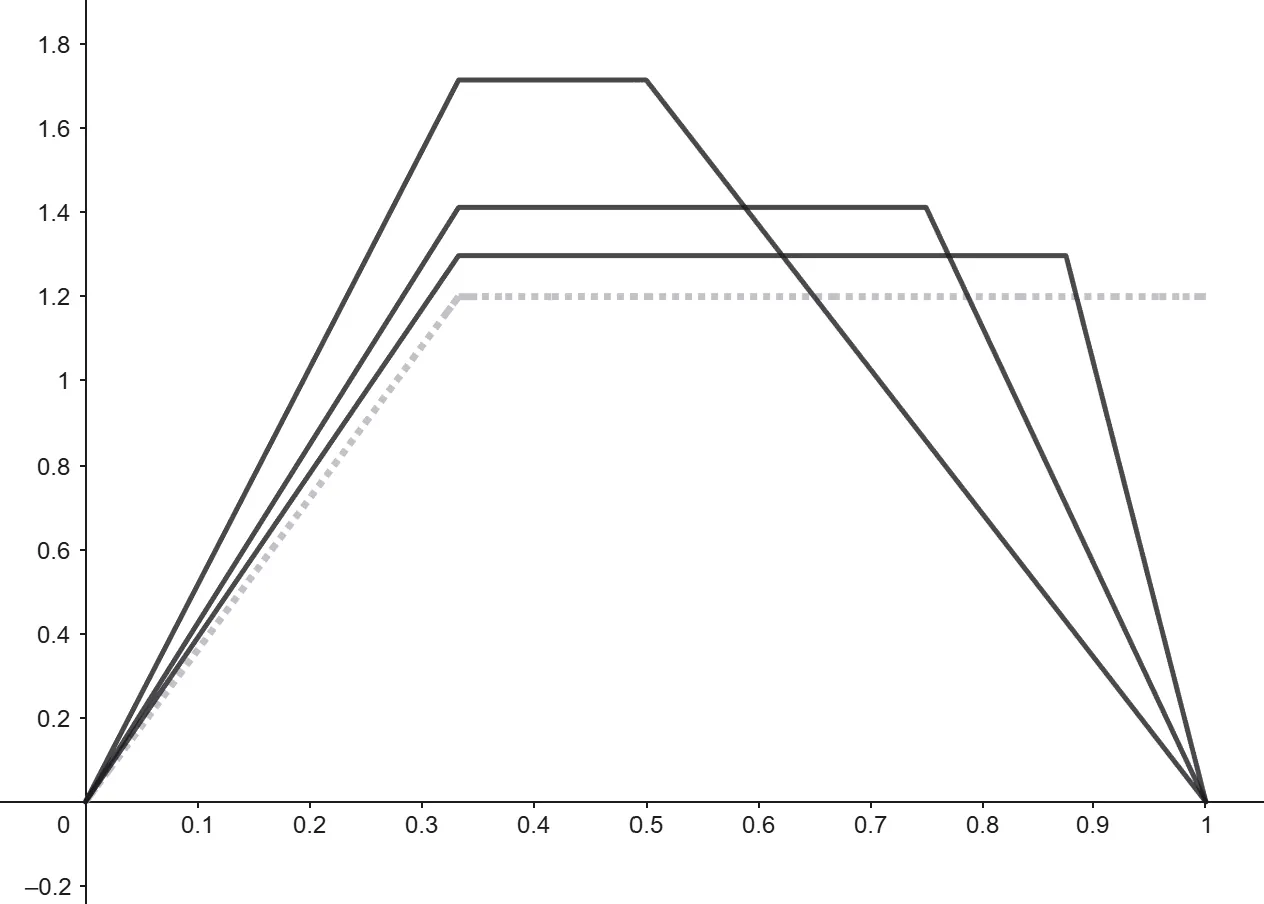
The Bures metric and the quantum metric on the density space of a C*-algebra: the non-unital case
Building off work of Farenick and Rahaman, we extend the definition of the density space and the Bures metric to the setting of non-unital C*-algebras equipped with a faithful trace and prove that the Bures metric is also a metric in this case and show that its topology is weaker than the topology induced by the C*-norm. Furthermore, we prove a Heine-Borel type theorem for C*-algebras and the density space. In particular, we prove that for any C*-algebra (unital or non-unital) equipped with a faithful trace, the density space equipped with the Bures metric topology is not compact if and only if the C*-algebra is infinite dimensional. We also exhibit several examples of sequences that have no converging sequence in the unital and non-unital case including both commutative and noncommutative C*-algebras. Next, building off work from some of the authors, we extend the definition of the quantum metric on the density space to the non-unital C*-algebra case by introducing the notion of a quantum Lipschitz triple, which form a subclass of quantum locally compact metric spaces of Latrémolière that utilize Rieffel's notion of a quantum metric (we also introduce new classes of quantum locally compact metric spaces that include certain noncommutative homogeneous C*-algebras). Furthermore, we prove that this quantum metric topology is weaker than the topology of the one induced by the C*-norm and finish the article with an analysis of matrix-valued functions on the quantized interval, which provides commutative and noncommuataive examples where the quantum metric topology on the density space is not compact and is not uniformly equivalent to both the Bures metric and the metric induced by the C*-norm.
2604.02117Apr 2026
View2603.29985The Homotopy 3-Type of Abelian C*-Algebras
We compute the homotopy groups at each unital abelian C*-algebra $C(T)$ in the Morita $3$-category of abelian C*-algebras, C*-algebras with central maps, C*-correspondences, and adjointable bimodule maps. We describe these groups in terms of the topological data of the underlying compact Hausdorff space $T$. We also compute the actions of the first homotopy group on the second and third homotopy groups in terms of these topological invariants of $T$.
2603.29985Mar 2026
View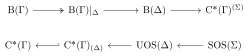
Operator systems and positive extensions over discrete groups
The extension problem asks whether positive semi-definite functions on a symmetric unital subset of a discrete group can be extended to positive semi-definite functions on the whole group. It has been known at least since the work of Rudin in the 1960s that this is closely related to the problem of finding sums of squares factorisations of positive elements in the group C*-algebra. We give an operator system perspective at these two problems explaining their equivalence: the extension property is characterised by a certain quotient map on the Fourier--Stieltjes algebra, and the factorisation property by a certain complete order embedding into the group C*-algebra. These properties are linked to the duality of the operator systems which have recently emerged from spectral and Fourier truncations in noncommutative geometry. We exemplify how one can relate certain extension problems to operator system techniques such as nuclearity and the C*-envelope.
2603.29958Mar 2026
View2603.29556Separable neighbourhood of identity in C$^{\ast}$-algebras
We study the structure of separable elements in bipartite C$^{\ast}$-algebras, focusing on the existence and size of a separable neighbourhood around the identity element. While this phenomenon is well understood in the finite-dimensional setting, its extension to general C$^{\ast}$-algebras presents additional challenges. We show that the problem of determining such a neighbourhood can be reduced to estimating the completely bounded norm of contractive positive maps. This approach allows us to characterize the size of such neighbourhoods in terms of structural properties of the algebra, notably its rank. As a consequence, we also resolve a recent conjecture of Musat and Rørdam.
2603.29556Mar 2026
View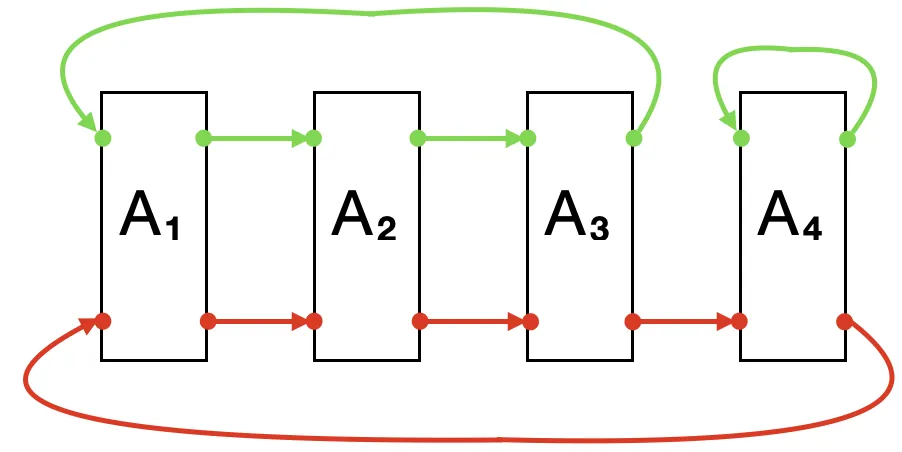
Operator Norm Bounds for Multi-leg Matrix Tensors and Applications to Random Matrix Theory
We investigate the extremal values of partial traces of matrix tensors under operator norm constraints. To evaluate these multi-linear quantities, we develop a comprehensive graphical formalism that encodes multi-leg partial traces, partial permutations, and their moments using colored directed graphs. With this graphical framework, we establish optimal, sharp bounds for the partial trace $(\mathrm{Tr}_{σ_1} \otimes \ldots \otimes \mathrm{Tr}_{σ_k})(A_1, \ldots, A_m)$ over matrices bounded by $\|A_i\| \le 1$. Specifically, we prove that this maximum evaluates exactly to $N^{M(σ_1,\ldots,σ_k)}$, where $N$ is the dimension and $M$ represents the maximal number of directed cycles in the associated graph across all possible internal vertex pairings. We further derive explicit operator norm estimates for matrices generated by partial traces of partial permutations. Finally, we apply these combinatorial bounds to multi-matrix random matrix theory. By examining models involving Ginibre ensembles, we extend concepts of asymptotic freeness to matrix coefficient algebras, establishing operator norm estimates that rigorously separate the asymptotic behavior of non-crossing and crossing pairings.
2603.27659Mar 2026
View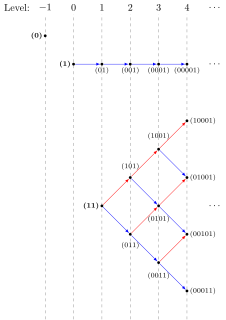
Semi-Cosimplicial Hilbert Spaces with Isometric Coface Operators
Semi-cosimplicial objects in the category of Hilbert spaces with isometries which are motivated by non-commutative probability theory, in particular by the distributional symmetry of spreadability, are introduced and systematically developed in various directions: partial shifts, cohomology, a related graph, decomposition into labeled subspaces, representation theory of the infinite symmetric and braid groups, extension problems and a toy version of spreadability.
2603.27373Mar 2026
View2603.24855Uniformity and isotypic smallness for quantum-group representations
Compact-group representations on Banach spaces are known to be norm-continuous precisely when they have finite spectra. For a quantum group with continuous-function algebra $\mathcal{C}(\mathbb{G})$ norm continuity can be cast analogously as the bounded weak$^*$-norm continuity of the representation's attached map $\mathcal{C}(\mathbb{G})^*\to \mathrm{End}(E)$. While the uniformity/isotypic finiteness equivalence no longer holds generally, it does for compact quantum groups either coamenable or having dimension-bounded irreducible representations. This generalizes the aforementioned classical variant, providing two independent quantum-specific mechanisms of recovering it.
2603.24855Mar 2026
View2603.24042Bounded modular functionals and operators on Hilbert C*-modules are regular
We prove that for any C*-algebra $A$ and Hilbert $A$-modules $M\subseteq N$ with $M^\perp=\{0\}$, every bounded $A$-linear map $N\to A$ (or $N\to N)$ vanishing on $M$ is the zero map. This verifies the conjectures of the first author and settles the regularity problem for bounded modular functionals and operators on Hilbert C*-modules. As a consequence, kernels of bounded C*-linear operators on Hilbert C*-modules are shown to be biorthogonally complemented, which gives a correct proof of Lemma 2.4 in ``On Hahn-Banach type theorems for Hilbert C*-modules'', Internat. J. Math. 13(2002), 1--19, in full generality.
2603.24042Mar 2026
View2603.23651Quantum Graph Theory by Example
Quantum graphs have been introduced by Duan, Severini, and Winter to describe the zero-error behaviour of quantum channels. Since then, quantum graph theory has become a field of study in its own right. A substantial source of difficulty in working with quantum graphs compared to classical graphs stems from the fact that they are no longer discrete objects. This makes it generally difficult to construct insightful, non-trivial examples. We present a collection of non-trivial quantum graphs that can be thought of in discrete terms, and that can be expressed in the diagrammatic formalism introduced by Musto, Reutter, and Verdon. The examples arise as the quantum graphs acted on by increasingly smaller classical matrix groups, and are parametrised by triples of matrices $(A, B, C)$. The parametrisation reveals a clean decomposition of quantum graph structure into classical and genuinely quantum components: $A$ and $C$ are described by a classical weighted graph called the strange graph, while $B$ provides a purely quantum contribution with no classical analogue. Based on this model, we give exact formulas or establish bounds for quantum graph parameters, such as the number of connected components, the chromatic number, the independence number, and the clique number. Our results provide the first large, parametric families of quantum graphs for which standard graph parameters can be computed analytically.
2603.23651Mar 2026
View2603.23366A tautological continuous field of Roe bimodules
We generalize the notion of a continuous field of C*-algebras to that of Hilbert C*-bimodules. Given a partially ordered set $P$ and a monotonically non-decreasing family of ternary rings of operators (TROs) assigned to the points of $P$, we equip $P$ with a certain zero-dimensional Hausdorff topology and use a certain compactification $γP$ to get the base space for a continuous field of Hilbert C*-bimodules over $γP$. As a motivating example, we consider the set $D(X,Y)$ of coarse equivalence classes of metrics on the disjoint union of two metric spaces, $X$ and $Y$. Each such class gives rise to a uniform Roe bimodule, a TRO linking the uniform Roe algebras of $X$ and $Y$. The resulting family of TROs is non-decreasing with respect to the natural partial order on $D(X,Y)$ and thus yields a tautological continuous field of Hilbert C*-bimodules over $γD(X,Y)$.
2603.23366Mar 2026
View2603.22162The Unitary Conjugation Groupoid as a Universal Mediator of the Baum--Connes Assembly Map
We show that the Baum--Connes assembly map factors canonically through the unitary conjugation groupoid, which serves as a universal mediator among groupoid models that are Morita equivalent to a given transformation groupoid. This establishes a structural link between groupoid-based index theory and the Baum--Connes program at the level of K-theory. Building on our previous development of unitary conjugation groupoids and their associated index theory, we extend the $K_1$ index framework beyond the Type I setting to non-Type I examples, including the irrational rotation algebra and amenable crossed products. Using Morita equivalence, we relate unitary conjugation groupoids to transformation and action groupoids, enabling the transfer of descent-type index constructions to these settings. Our main result shows that, among all groupoid realizations that are Morita equivalent to a transformation groupoid, the factorization through the unitary conjugation groupoid is canonical at the level of K-theory. This identifies the unitary conjugation groupoid as a universal intermediary for the Baum--Connes assembly map. As applications, we recover the classical index pairing with the tracial state for the irrational rotation algebra in the sense of Connes, and we prove that for amenable crossed products the descent construction agrees with the analytic Baum--Connes assembly map under Morita equivalence. These results provide a conceptual interpretation of the assembly map in terms of internal symmetries of crossed product algebras and suggest a unified framework connecting Fredholm-type index data with equivariant K-theory via groupoid methods.
2603.22162Mar 2026
View2603.21946B(H) is not a twisted groupoid C*-algebra
We show that $B(H)$ for an infinite dimensional Hilbert space $H$ cannot be realized as the reduced twisted $C^*$-algebra of any locally compact Hausdorff étale groupoid. The proof is based on the canonical conditional expectation $$C_r^*(G,Σ)\to C_0(G^{(0)})$$ and a structural analysis of the resulting diagonal subalgebra inside $B(H)$. We show that this diagonal must be an atomic abelian von Neumann algebra, and then exclude both possibilities for its spectrum. If the unit space is finite, one obtains a tracial state on $C_r^*(G,Σ)$, which is impossible for $B(H)$. If it is infinite, the groupoid structure forces a block-sparsity phenomenon for compactly supported sections, which is incompatible with $B(H)$. This provides the first examples of $C^*$-algebras that cannot be realized as reduced twisted étale groupoid $C^*$-algebras.
2603.21946Mar 2026
View2603.21372Polynomials in $c$-free random variables with applications to free denoising
We study distributions of polynomials in conditionally free (c-free) random variables, a notion of independence for two-state noncommutative probability spaces introduced by Bozejko, Leinert and Speicher. To this end we establish recursive relations between the joint Boolean cumulants of c-free random variables, analogous to previously found recursions for Boolean cumulants of free random variables. The algebraic reformulation of these recursions on the free associative algebra provides an effective formal machinery for the computation of the moment generating functions and thus the distributions of arbitrary self-adjoint polynomials in c-free random variables. As an application of a recent observation, our approach can be used to determine conditional expectations of the form $E[a|P(a,b)]$, where $P(a,b)$ is a self-adjoint polynomial in free (in the sense of Voiculescu) random variables $a,b$. We illustrate this with an example where $P(a,b)=i[a,b]$. Finally we define orthogonal projections that formally play the role of conditional expectations in the framework of c-freeness and share some properties with the conditional expectations of free variables. In particular they can be used to re-derive by purely algebraic methods the formula of Popa and Wang for the $Σ$-transform for the c-free multiplicative convolution.
2603.21372Mar 2026
ViewPage 1 of 52