911 papers
 2604.23468
A Milestone in Formalization: The Sphere Packing Problem in Dimension 8
In 2016, Viazovska famously solved the sphere packing problem in dimension $8$, using modular forms to construct a 'magic' function satisfying optimality conditions determined by Cohn and Elkies in 2003. In March 2024, Hariharan and Viazovska launched a project to formalize this solution and related mathematical facts in the Lean Theorem Prover. A significant milestone was achieved in February 2026: the result was formally verified, with the final stages of the verification done by Math, Inc.'s autoformalization model 'Gauss'. We discuss the techniques used to achieve this milestone, reflect on the unique collaboration between humans and Gauss, and discuss project objectives that remain.
2604.23468Apr 2026
View2604.04889An improved bound for sumsets of thick compact sets via the Shapley--Folkman theorem
Let $E_1,\dots,E_n \subset \mathbb{R}^d$ be compact sets of positive diameter with Feng--Wu thickness at least $c>0$. Feng and Wu proved that $E_1+\cdots+E_n$ has non-empty interior when $n>2^{11}c^{-3}+1$. We show that \[n>\frac{\sqrt d}{(\sqrt{1+c}-1)^2}=\frac{\sqrt d\,(\sqrt{1+c}+1)^2}{c^2}\] already suffices. In particular, since $0<c\le 1$, the bound $n>6\sqrt d\,c^{-2}$ is enough. For fixed dimension $d$, this improves the exponent in $c^{-1}$ from $3$ to $2$, while introducing only an explicit factor of $\sqrt d$. The proof replaces the one-summand-at-a-time enlargement of Feng--Wu by a simultaneous convexification step based on a radius form of the Shapley--Folkman theorem.
2604.04889Apr 2026
View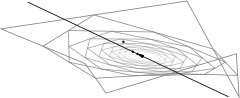
Exact colinearity of centroids of iterated midpoint hexagons
We study the iteration that replaces a planar hexagon by the hexagon formed by joining the midpoints of consecutive edges. While this iteration quickly drives any polygon toward a point and their shapes asymptotically regularize, we show a stronger and unexpected rigidity holds for hexagons: from the second iterate onward, the centroids of the filled hexagons all lie exactly on a fixed line. This exact colinearity reflects a special algebraic feature of the hexagonal case and does not hold generally for any other polygons.
2604.04668Apr 2026
View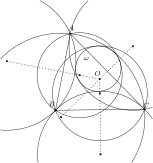
On the Inscribed Sphere and Concurrent Lines through the Centers of Apollonius Spheres in $\mathbb{R}^n$
The Apollonius problem asks for a sphere tangent to $n+1$ given spheres or hyperplanes in $\mathbb{R}^n$. This problem has been widely studied for an isolated configuration of $n+1$ spheres. In this paper, we study relations among the solutions of the Apollonius problem arising from a common family of spheres within the framework of Lie sphere geometry. More precisely, we consider a configuration of $n+2$ spheres in $\mathbb{R}^n$ and the solutions of the Apollonius problem corresponding to all its subsets of size $n+1$. The first main result concerns lines passing through the centers of pairs of solutions to the Apollonius problem. We prove that all these lines intersect at a single point $P_X$. We then introduce a two--step construction of further Apollonius spheres and show that the lines determined by their centers also pass through $P_X$. This yields numerous applications in two and three dimensions and, at the same time, automatically extends them to $\mathbb{R}^n$. The second main result is an $n$--dimensional generalization of K. Morita's three-dimensional theorem on the inscribed sphere in a configuration of mutually tangent spheres. We show that Morita's theorem is a special case of our result for an arbitrary configuration of $n+2$ spheres in $\mathbb{R}^n$, not necessarily mutually tangent. Moreover, we connect this result with the preceding ones by proving that the center of the corresponding inscribed sphere is again the point $P_X$.
2604.03067Apr 2026
View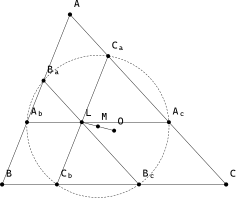
A New Lemoine-Type Circle
This paper presents a new Lemoine-type circle defined by a six-point configuration satisfying a cocyclicity criterion. We prove the result, establish a converse theorem, and relate the new circle to previously known Lemoine circles, in particular the one introduced by Q.T. Bui. We show that the new circle does not belong to the family of Tucker circles.
2604.03054Apr 2026
View2604.02925On the maximum volume solid wrappable by a given sheet of paper
We consider the problem of wrapping three-dimensional solid bodies with a given planar sheet of paper, where the paper may be folded or wrinkled but not stretched or torn. We propose a conjecture characterising the maximumvolume solid wrappable by any given sheet: the maximum is always achieved (or approached) by a non-convex body. In other words, for any convex solid wrappable by a given sheet, there exists a non-convex solid of strictly greater volume that the same sheet can wrap. We discuss related work, a key subquestion involving the sphere, and several further directions.
2604.02925Apr 2026
View2604.01950Self perimeter of convex sets
This paper introduces a natural definition for the volume of the unit ball in $n$-dimensional normed spaces $\mathbb{R}^n$. This definition preserves the Euclidean relation $P(B)/V(B)=n$ between the perimiter and the volume of the unit ball $B$ in $R^n$. We show that this volume definition is invariant under origin-preserving affine transformations and polar duality. For $n=2$, we derive an explicit integral formula for the self-perimeter of the unit ball, extend it to non-centrally symmetric sets;. The construction is extended to $\mathbb{R}^n$ via a recursive integration over the boundary, utilizing $(n-1)$-dimensional volumes of planar intersections. Finally, we pose and discuss an Alexandrov-type problem for the associated surface measure, providing perturbative solutions in the 2D case. In particular we prove that, generically, any perturbation of the surface measure of the Euclidean 2-D disk yields a 4-fold symmetric convex set in the leading order.
2604.01950Apr 2026
View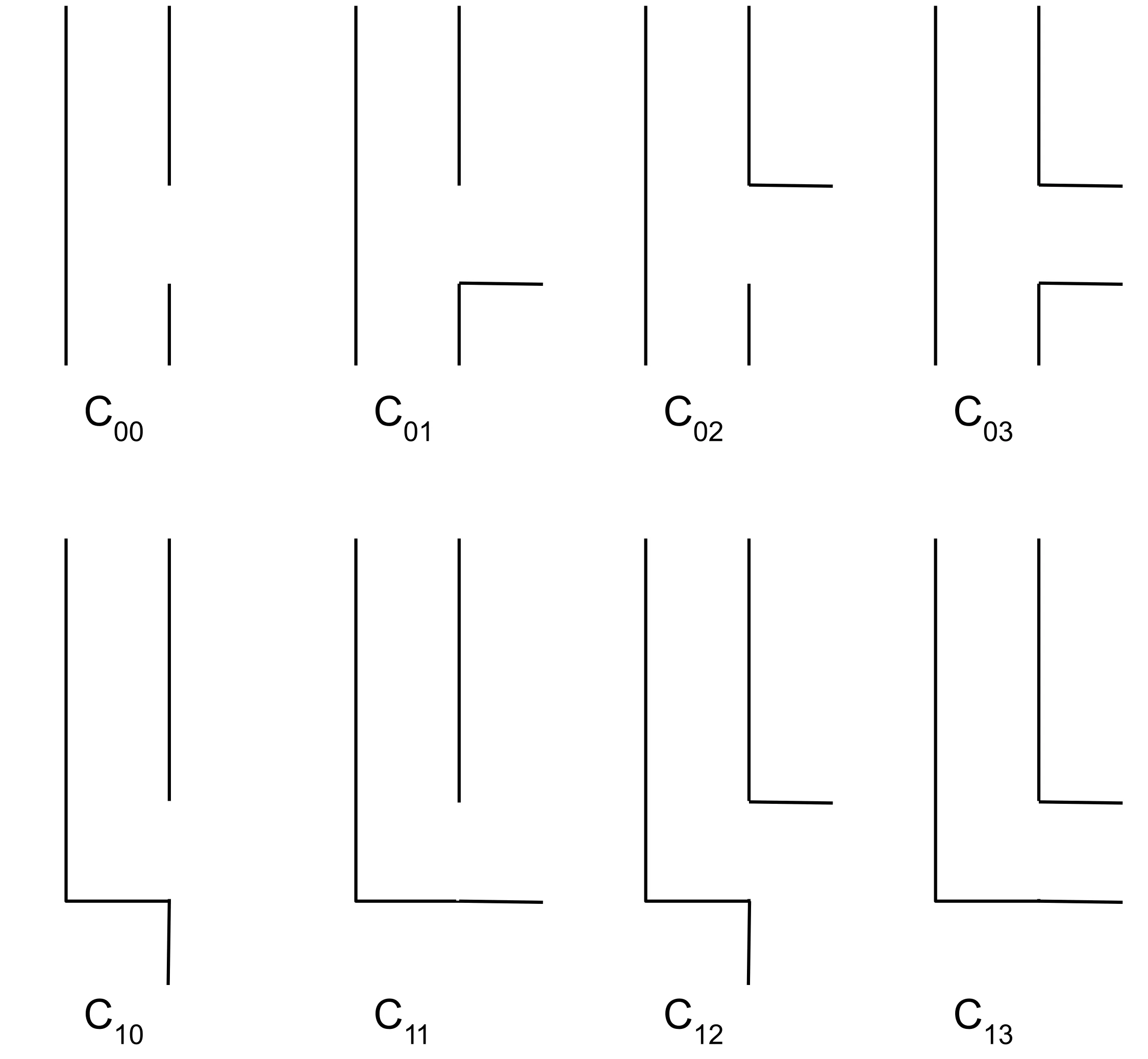
Moving rectangular sofas in planar and spatial corridors
We consider eight natural planar corridors, including the standard $\mathrm{L}$-shaped one, and characterize the rectangles that can move around their corners. As a bi-product we describe completely the corresponding rectangles with maximum area, as well as the rectangular parallelepipeds with maximum volume that can move around the corners of the spatial analogues of the considered eight planar corridors.
2604.01174Apr 2026
View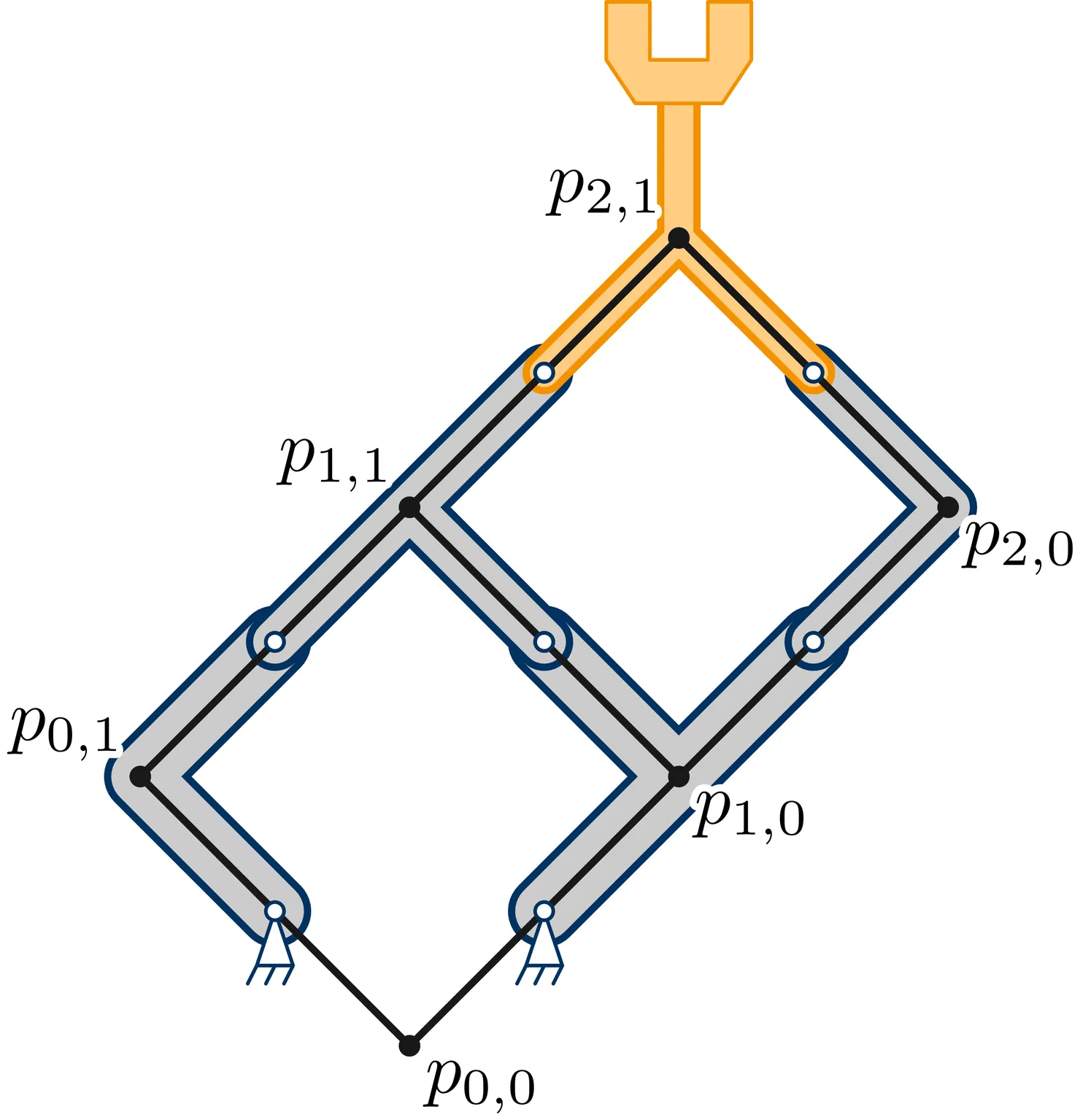
Bistable Quad-Nets Composed of Four-Bar Linkages
We study mechanical structures composed of spatial four-bar linkages that are bistable, that is, they allow for two distinct configurations. They have an interpretation as quad nets in the Study quadric which can be used to prove existence of arbitrarily large structures of this type. We propose a purely geometric construction of such examples, starting from infinitesimally flexible quad nets in Euclidean space and applying Whiteley de-averaging. This point of view situates the problem within the broader framework of discrete differential geometry and enables the construction of bistable structures from well-known classes of quad nets, such as discrete minimal surfaces. The proposed construction does not rely on numerical optimization and allows control over axis positions and snap angles.
2604.00527Apr 2026
View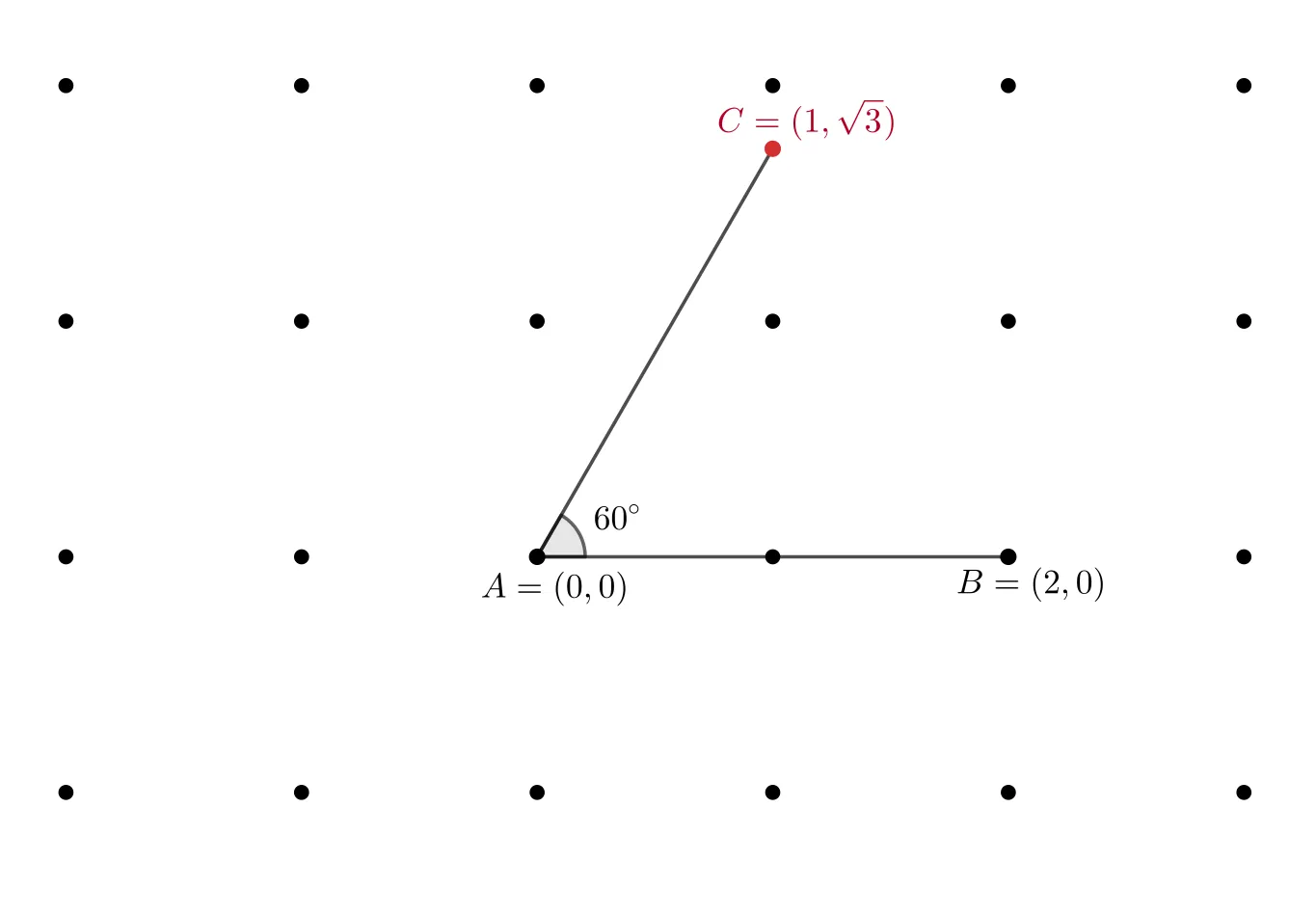
From discrete to dense: explorations in the moduli space of triangles
The moduli space of triangles is a two-dimensional space that records triangle shapes in the plane, considered up to similarity. We study the subset corresponding to \textit{lattice triangles}, which are triangles whose vertices have integer coordinates. We prove that this subset is \textit{dense}, that is, every triangle shape can be approximated arbitrarily well by lattice triangles. However, when one restricts to lattice triangles in the square $[-N,N]^2$, their shapes do \textit{not} become uniformly distributed in the moduli space as $N$ grows. Along the way, we encounter connections with geometry, number theory, analysis, and probability.
2604.00373Apr 2026
View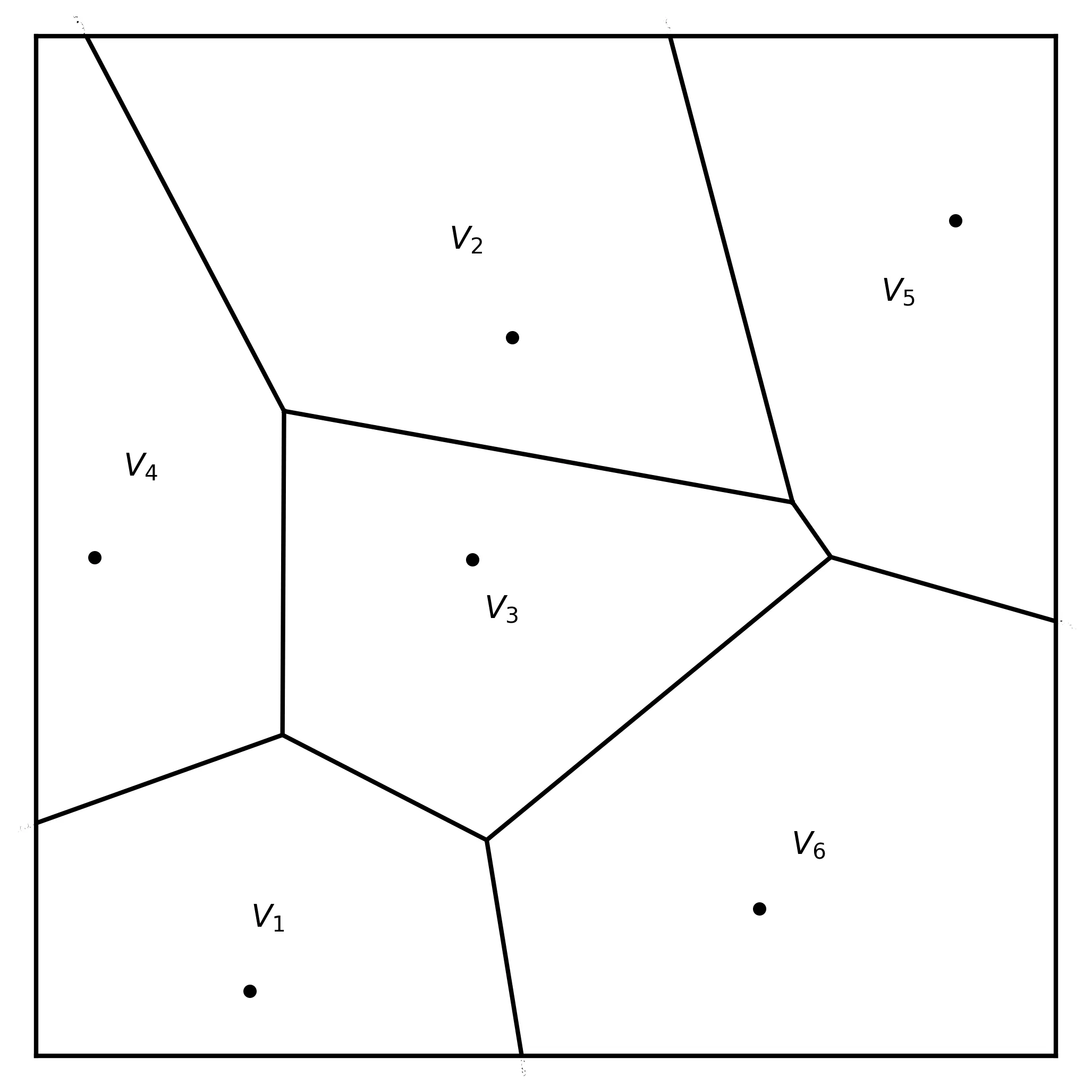
Voronoi-Based Vacuum Leakage Detection in Composite Manufacturing
In this article, we investigate vacuum leakage detection problems in composite manufacturing. Our approach uses Voronoi diagrams, a well-known structure in discrete geometry. The Voronoi diagram of the vacuum connection positions partitions the component surface. We use this partition to narrow down potential leak locations to a small area, making an efficient manual search feasible. To further reduce the search area, we propose refined Voronoi diagrams. We evaluate both variants using a novel dataset consisting of several hundred one- and two-leak positions along with their corresponding flow values. Our experimental results demonstrate that Voronoi-based predictive models are highly accurate and have the potential to resolve the leakage detection bottleneck in composite manufacturing.
2603.29980Mar 2026
View2603.29683Another simple proof of the 1-dimensional flat chain conjecture
We provide a short proof of the 1-dimensional flat chain conjecture.
2603.29683Mar 2026
View
On flat shadow boundaries from point light sources and the characterization of ellipsoids
In his classical work, W. Blaschke proved that a convex body whose shadow boundaries are flat for every direction of parallel illumination must be an ellipsoid. An extension recently proposed by I. Gonzalez-García, J. Jerónimo-Castro, E. Morales-Amaya, and D.J. Verdusco-Hernández predicts that the same conclusion holds for illumination by point light sources located on a hypersurface enclosing the body. We confirm this conjecture for convex bodies with sufficiently smooth boundaries. We further develop a duality framework relating illumination by point light sources to classical symmetry properties of hyperplane sections, linking several known and conjectured characterizations of quadrics from these complementary viewpoints.
2603.29130Mar 2026
View2603.27221Local minimality of the truncated octahedron for the isoperimetric problem on parallelohedra
We investigate the isoperimetric problem for the Voronoi cells of three-dimensional lattices. Using Selling parameters, we derive an explicit closed formula for the scale-invariant isoperimetric quotient $F$ in terms of six non-negative variables. We then analyse the local behaviour of $F$ at the most relevant lattice configurations: we prove that the body-centered cubic lattice (BCC) is a strict local minimiser of $F$ at fixed volume, whereas the face-centered cubic lattice (FCC) and the simple cubic lattice (SC) are not local minimisers. Then, we consider a family of lattices which interpolates between BCC and FCC, showing that BCC is the global minimiser of $F$ restricted to this family.
2603.27221Mar 2026
View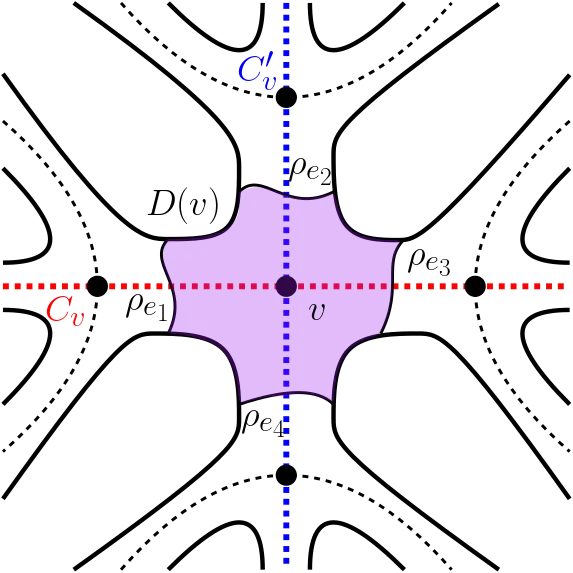
Surfaces without quasi-isometric simplicial triangulations
We construct a complete Riemannian surface $Σ$ that admits no triangulation $G\subset Σ$ such that the inclusion $G^{(1)} \hookrightarrow Σ$ is a quasi-isometry, where $G^{(1)}$ is the simplicial 1-skeleton of $G$. Our construction is without boundary, has arbitrarily large systole, and furthermore, there is no embedded graph $G\subsetΣ$ such that $G^{(1)} \hookrightarrow Σ$ is a quasi-isometry. This answers a question of Georgakopoulos.
2603.26652Mar 2026
View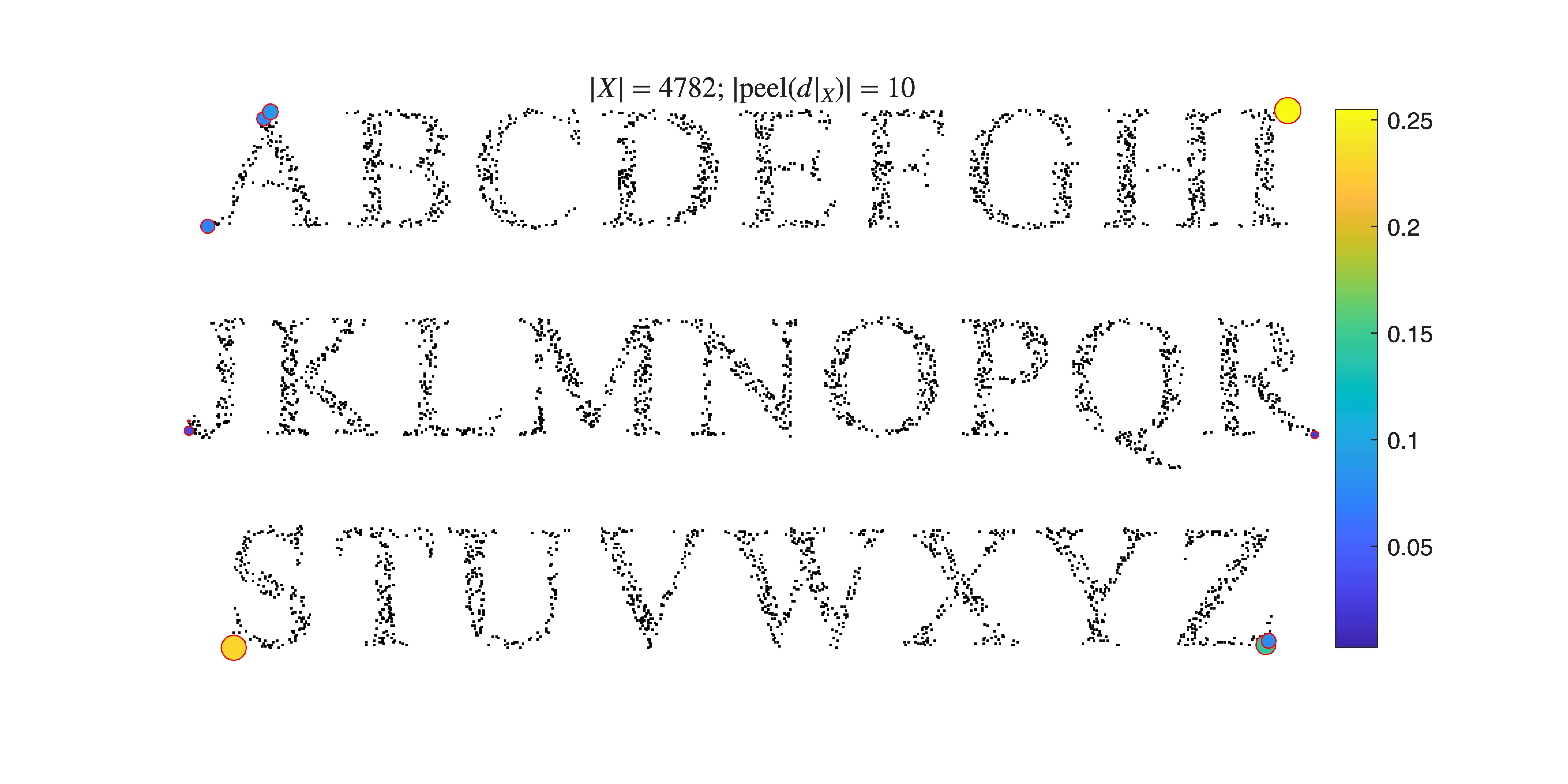
Peel neighborhoods
We introduce the canonical, parameter-free, and efficiently computable notion of peel neighborhoods in a finite metric space of strict negative type. Using a soft threshold to upper bound their radius or cardinality allows peel neighborhoods to be computed at scale, enabling useful microscopic descriptions of geometry and topology. As an example of their utility, peel neighborhoods enable efficient and performant estimates of local dimension and detections of singularities in samples from stratified manifolds.
2603.26645Mar 2026
View2603.26428Classical and continuous Gromov-Hausdorff distances
Starting from the definition of the Gromov-Hausdorff distance via distortion of correspondences, we add the requirement of semicontinuity of each correspondence and its inverse. It turns out that in the case of lower semicontinuity we obtain the same classical Gromov-Hausdorff distance, while for upper semicontinuity we are able to prove coincidence with the classical one only in cases where the spaces are either totally bounded or boundedly compact.
2603.26428Mar 2026
View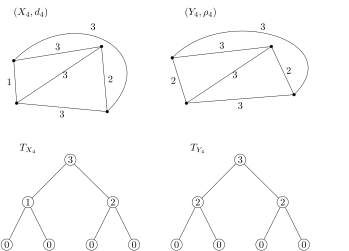
On the center of distances of finite ultrametric spaces
The center of distances of a metric space $(X,d)$ is the set $C(X)$ of all $t\in \mathbb R^+$ for which the equation $d(x,p)=t$ has a solution for each $p\in X$. We prove the inequality $|C(X)| \le 1 + \lfloor \log_2 n \rfloor$ for all finite ultrametric spaces $(X,d)$ which have exactly $n$ points. It is also shown that for every integer $n \geq 1$ there exists a finite ultrametric space $(Y,ρ)$ such that $|Y| = n$ and $|C(Y)| = 1 + \log_2 \lfloor n \rfloor. $
2603.25850Mar 2026
View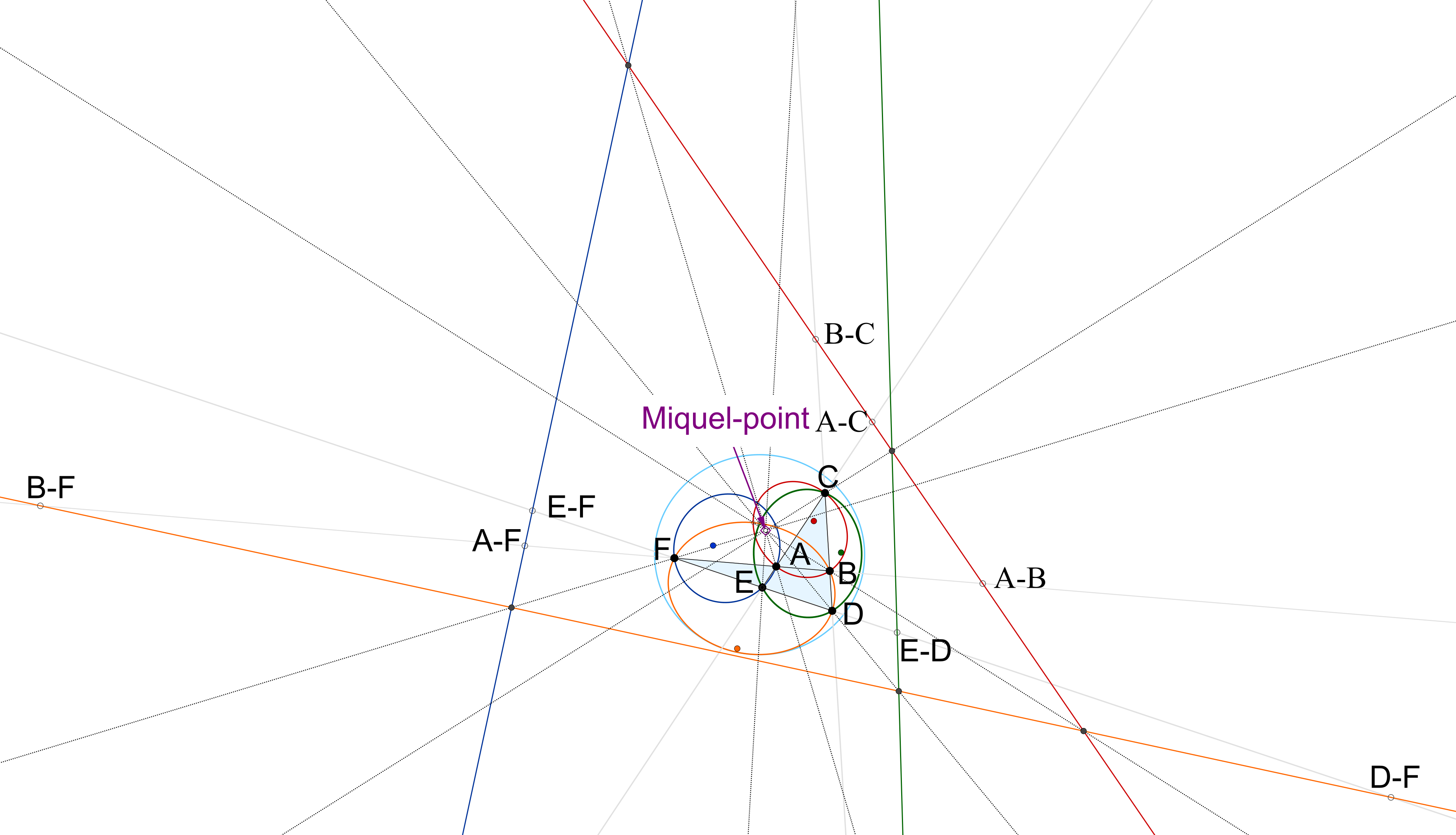
Quadri-Figures in Cayley-Klein Planes II: The Miquel-Steiner Theorem
The Miquel-Steiner theorem for a quadrilateral in the Euclidean plane states that the circumcircles of the four component triangles intersect at a single point, which now is called the Miquel-Steiner point of the quadrilateral. In elliptic and in hyperbolic planes, the Miquel-Steiner theorem does not hold in this form. Instead, a weaker version applies: The circumcircles of the four component triangles of a quadrilateral have a common radical center, which we will also call the Miquel-Steiner point. The Miquel-Steiner theorem for Euclidean planes also needs to be modified for Minkowski and Galilean planes: Either the circumcircles of the four component triangles touch each other at a point on the line at infinity, or they intersect transversely at an anisotropic point. For specific quadrilaterals (such as cyclic quadrilaterals), the location of the Miquel-Steiner point can be determined more precisely.
2603.24280Mar 2026
View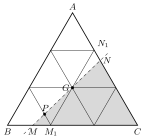
The Perimeter Winternitz Theorem in a Triangle
A variable line through the centroid G of a triangle divides the triangle into two parts each of whose lengths as a fraction of the perimeter fills a closed interval [m,1-m], with m between 0 and 1/2. We show that the range of m taken over all triangles is the interval (3/10,4/9], with 3/10 approached by scales of the triangles approaching the 5-4-1 triangle and their mid-size medians, and 4/9 attained by the equilateral triangles and the lines through G parallel to the sides. This result is the perimeter version of the classical Winternitz theorem for a triangle, asserting that, in the case of area-ratio instead of perimeter-ratio, m=4/9, and this is attained by all triangles and their lines through G and parallel to the sides.
2603.23653Mar 2026
ViewPage 1 of 46