Manifolds, orbifolds, polyhedra, cell complexes, foliations, geometric structures on 3-manifolds, mirror symmetry, global analysis.
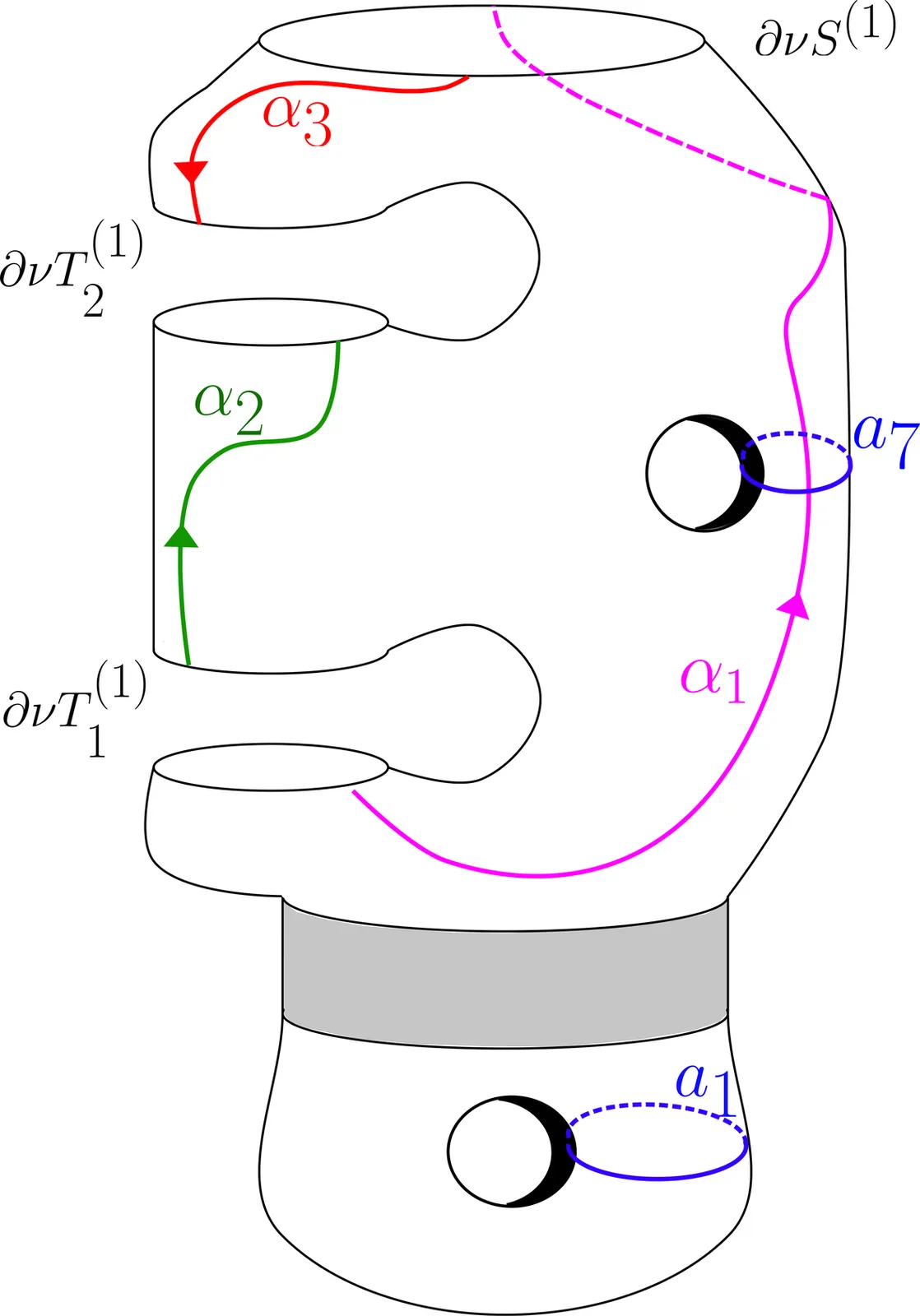
In this paper, we study Morse functions with regular level sets consisting of spheres, tori, or Klein Bottles on $3$-dimensional closed manifolds. We characterize $3$-dimensional manifolds represented by connected sums each of whose summands is the product $S^1 \times S^2$ of the circle $S^1$ and the sphere $S^2$, lens spaces, or non-orientable closed and connected manifolds of genus $1$ by a certain subclass of such Morse functions. This is a kind of extensions of the orientable case, by Saeki, in 2006. This is a variant of its extension by the author for $3$-dimensional orientable manifolds represented by connected sums each of whose summands is the product $S^1 \times S^2$, lens spaces, or torus bundles over $S^1$ by a certain class of Morse-Bott functions. We also classify Morse functions with given regular level sets consisting of $S^2$, $S^1 \times S^1$, or Klein Bottles in a certain sense, generalizing some previous work by the author.
2604.04657For a knot $K\subset S^3$, let $S(K)$ denote the set of knot types represented by simple closed curves on a minimal genus Seifert surface of $K$. We study the directed relation $K\to J$ defined by $J\in S(K)$, which we call the \emph{hosting relation}, and call its symmetric part friendship. This gives a new framework for describing how knots appear on minimal genus Seifert surfaces of other knots. A classical result of Lyon implies that the family of torus knots is a universal host family: every non-trivial knot is hosted by some torus knot. In contrast, a central result of this paper is that no knot is a universal host: for every knot $K$, there exists a knot $J$ such that \[ J\notin S(K). \] Thus universal hosting occurs at the level of families, but never at the level of a single knot. We also study explicit examples of hosting and friendship. In particular, we describe the hosting set of the trefoil in terms of primitive slope classes on its once-punctured torus fiber, and use this description to obtain concrete friendship and non-friendship phenomena. For example, we show that $3_1$ and $8_{19}$ are friends, whereas $3_1$ and $4_1$ are not. These results provide a framework for studying universal host phenomena, hosting, and friendship among knots on minimal genus Seifert surfaces, and suggest further connections with graph-theoretic, rigidity, and categorical aspects of knot theory.

For pseudo-Anosov mapping tori with co-orientable invariant foliations and monodromies reversing their co-orientations, a family of taut foliations was constructed in previous work on Dehn fillings with all rational slopes outside a neighborhood of the degeneracy slope. In this paper, we prove that all such Dehn fillings have left-orderable fundamental groups. We present two approaches, both based on an analysis of the branching behavior from such taut foliations. The first approach produces an $\mathbb{R}$-covered foliation arising from this family for each filling slope, and the second approach shows that, depending on the choice of a suitable system of arcs on $Σ$, one obtains a foliation that either has one-sided branching or is $\mathbb{R}$-covered. Consequently, the second approach associates to each Dehn filling a family of representations of its fundamental group into $\mathcal{G}_\infty$, the group of germs at infinity, whereas the first approach yields an explicit left-invariant order. As an application, combining our results with earlier work in the literature, we verify the L-space conjecture for all surgeries on the $(-2,3,2k+1)$-pretzel knot ($k \geqslant 3$) in $S^3$.
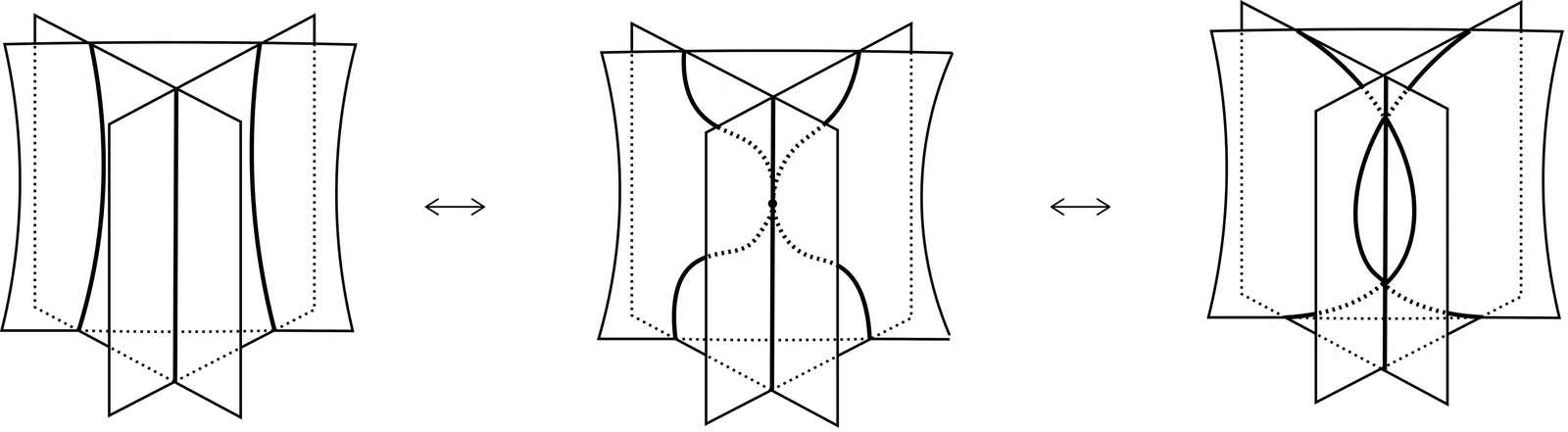
We give an explicit slice formula for a surface invariant of generic immersions in $\mathbb{R}^3$, expressed in terms of curve invariants arising from planar slices. Using a motion-picture viewpoint, we introduce differential measures that record local changes of the curve invariant $St_{(1)}$ and the surface invariant $St_{(2)}$ across singular slice transitions. Our main result shows that, for a quadruple-point event, if $j$ denotes the number of outward coorientations before the event, then the change of the surface invariant satisfies $dSt_{(2)} = 2j - 4$. This yields a computable and combinatorial description of the surface invariant via slice data. In particular, the formula makes explicit the relation between curve-level invariants and finite-order invariants of surface immersions in the sense of Nowik.
2604.03812Let \(M\) be a closed connected oriented topological \(4\)-manifold. We prove that if \(F_1,\dots,F_r\subset M\) are pairwise disjoint connected locally flat topologically embedded nonorientable surfaces with nonorientable genera \(g_i\), same-sign twisted normal Euler numbers \(e_i\), and \( [F_1]+\cdots+[F_r]=0\in H_2(M;\F_2), \) then the normal-Euler excess \( \sum_{i=1}^r \bigl(\abs{e_i}-2g_i\bigr) \) is bounded above by a constant depending only on \(M\). Thus same-sign mod-\(2\)-null families of disjoint nonorientable surfaces in a fixed ambient \(4\)-manifold have uniformly bounded total excess over Massey's \(S^4\) bound. The proof combines a tubing construction with the signature and Euler-characteristic formulas for \(2\)-fold branched covers. As corollaries, every closed oriented topological \(4\)-manifold contains only finitely many pairwise disjoint locally flat topologically embedded copies of \(\RP^2\) with \(\abs{e}>2\), and only finitely many pairwise disjoint tubular neighborhoods modeled on real \(2\)-plane bundles over \(\RP^2\) whose total spaces are orientable and whose twisted Euler numbers have absolute value greater than \(2\). When \(M\) is a homology \(4\)-sphere, the ambient error term vanishes, and the theorem recovers Massey's sharp inequality \(\abs{e(F)}\le 2g(F)\) for nonorientable surfaces in \(S^4\).
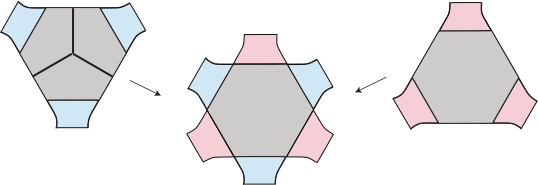
2604.03743We construct an explicit canonical cycle in the top-dimensional homology of the Voronoi complex associated with an arithmetic group. This cycle relates to the cohomology of SL$_n(\mathbb{Z})$ with rational coefficients at the virtual cohomological dimension. This cycle has been previously identified in computational works and conjectured to provide an intrinsic generator. Our approach relies on a geometric rigidity property of Voronoi tessellations. Furthermore, an abstract framework for polyhedral tessellations of convex cones under group actions is established, elucidating the underlying mechanism of the construction of such cycles.
In this paper, we study the self delta-equivalence of pretzel links. If the number of components is 2, then we know the complete invariants in terms of the Conway polynomial for classification. We calculate the values. For pretzel links with more than or equal to 3 components, we give a necessary and sufficient condition to be self delta-equivalent.
We construct infinite families of chirally cosmetic surgeries on chiral hyperbolic knots and purely cosmetic surgeries on hyperbolic manifolds with multiple cusps, disproving conjectures that these phenomena do not appear, including Problem 1.12(d) in the K3 problem list. We also give some hints regarding why chirally cosmetic surgeries appear to be more common than purely cosmetic surgeries on $1$-cusped manifolds.
We define compatible Finsler distances on $1/n$-translation surfaces, we study their geodesics, and construct a Liouville current for each such metric, that is a geodesic current that encodes the information of the length of the closed curves. The construction is based on multi-foliations, a generalization of measured foliations of independent interest.
2604.02099We study the moduli space $B\textrm{Diff}^+(M)$, for $M$ a reducible, oriented 3-manifold with irreducible prime factors $P_1,\ldots,P_n$. A programme of César de Sá-Rourke, Hendriks-Laudenbach, and Hendriks-McCullough studies the homotopy type of $\textrm{Diff}^+(M)$ in terms of the $\textrm{Diff}^+(P_i)$. Inspired by a delooping proposed by Hatcher, we construct a map from $B\textrm{Diff}^+(M)$ to $B\textrm{Diff}^+(P_1 \sqcup \dots \sqcup P_n)$, called the splitting map, that yields a prime decomposition fibre sequence. The fibre $H_g(P_1, \dots, P_n)$ is a space of $1$-handle attachments which we describe geometrically as a homotopy colimit of certain configuration spaces on the $P_i$. Firstly, this allows us to show that for $n>0$ the fibre is equivalent to a finite, connected cell complex. Secondly, this makes the fibre sequence an effective tool for computations, which we illustrate by computing the rational cohomology ring of $B\textrm{Diff}^+\!\left((S^1\times S^2)^{\sharp 2}\right)$.
Let $K$ be a nontrivial knot in $S^3$. We say that an element of the knot group $G(K)$ is \textit{persistent} if it remains nontrivial under all nontrivial Dehn fillings. Such elements exist for every nontrivial knot. Indeed, Property P is equivalent to the statement that the meridian of $K$ is a persistent element, and this represents the first instance of such elements. Building on the solution to the Property P conjecture due to Kronheimer and Mrowka, we show that every nontrivial knot group admits infinitely many persistent elements with pairwise disjoint automorphic orbits, none of which contains a power of the meridian. We then develop this further to show that for a broad class of hyperbolic knots - namely those admitting no surgery whose resulting manifold has torsion in its fundamental group - persistent elements are not rare curiosities, but rather structurally pervasive in $G(K)$. This is reflected in the following two properties: (i) Every subgroup of $G(K)$ that is not contained in the normal closure of a peripheral element contains persistent elements. (ii) Persistent elements exist outside every proper subgroup of $G(K)$.
It is well known that for $m\geq 2$ there are at most two non-equivalent $m$-knots with diffeomorphic exterior. Such pair of knots will be called $\textit{ non-reflexive knot pair}$. A classical problem in topology is to determine all dimensions where such knot pairs exist. In 1976 Cappell and Shaneson gave a method of constructing non-reflexive knot pairs. In the present paper we construct an infinite family of new examples of Cappell-Shaneson knot pairs, and give examples of Cappell-Shaneson knot pairs that have the same Alexander polynomial but are inequivalent.
For a half-unknotted implanted barbell $β$, we construct two specific pseudo-isotopies, both resulting in that barbell diffeomorphism, and compute the Hatcher-Wagoner invariants for both. We further generalize the results to half-unknotted immersed barbell diffeomorphisms and prove that for every $σ\in π_2 M,γ\in π_1 M$, there is a half-unknotted immersed barbell diffeomorphism $φ_β$ with the second induced Hatcher-Wagoner invariant $Θ(φ_β)=(0,σ)\cdot [γ]$.
For arborescent links, we present an efficient method of computing their Alexander polynomials. Applying this method, we express the Alexander polynomials of Montesinos links in terms of certain functions associated to rational tangles which can be computed recursively. Specifically, we deduce explicit closed formulas for all pretzel links.
Let $K\subseteq S^3$ be a knot with exterior $E_K$, and denote by $ρ\colon π_1(E_K)\twoheadrightarrow G$ a quotient of its group. We give a sharp obstruction to the existence of a connected, oriented, smooth surface $F\subseteq B^4$ with $\partial F = K$ over whose exterior $ρ$ extends surjectively. Equivalently, we determine whether the cover of $S^3$ branched over $K$ and induced by $ρ$ bounds a connected cover of $B^4$ branched along such a surface. When $G$ is a dihedral group, we show the obstruction can be computed by evaluating the Seifert form of $K$ on a single curve, a so-called characteristic knot associated to $ρ$. When the dihedral obstruction vanishes, we construct the surface $F$ explicitly.
A combinatorial Morse structure encodes a mapping class for a surface with boundary, and the data may be efficiently represented via a Morse diagram. This diagram determines an open book decomposition of a 3-manifold, and hence, a contact structure on that 3-manifold. We examine how combinatorial Morse structures behave under the connect sum of open books, with particular attention paid to the case of negative stabilisation. This leads to a diagrammatic criterion for detecting overtwisted contact structures. Finally, in the case of open books with one-holed torus pages, we classify all the Morse diagrams associated to a fixed open book decomposition.
We explicitly describe unitary representations of mixed braid groups on the cohomology of Abelian branched covers of $\mathbf{CP}^1$ . We show that the image of the representation is generated by complex reflections and relate it to the multivariate Burau representation.
2603.29838We classify which of the 672 oriented diffeomorphism types of closed, simply-connected spin 7-manifolds with the cohomology ring of $S^2\times S^5$ admit a free circle action. In addition, we show that whenever such an action exists, there exist infinitely many pairwise non-equivalent free circle actions. Finally, in almost all cases where such an action exists, we construct invariant Riemannian metrics of positive Ricci curvature.
We show that any topological, closed, oriented, non-spin $4$-manifold with fundamental group $\mathbb{Z}_{4k}$ and $\min(b_2^+, b_2^-)\geq 15$, has either none or infinitely many distinct smooth structures. Furthermore, we construct infinitely many non-diffeomorphic, irreducible, smooth structures on manifolds with signature zero, $b_2^+$ even and fundamental group $\mathbb{Z}_2\times G$, for any finite group $G$. This extends the results of Baykur-Stipsicz-Szabó.
We construct smooth embeddings of spherical quandles into conjugation quandles of Lie groups, where the ambient Lie groups can be taken to be orthogonal, Spin, or Pin groups. Moreover, in dimensions $1$ and $3$, we compare our embeddings with those due to Bergman and Akita.