Functional Analysis
arXiv:math.FA
Banach spaces, function spaces, real functions, integral transforms, theory of distributions, measure theory.
Looking for a broader view? This category is part of:
Banach spaces, function spaces, real functions, integral transforms, theory of distributions, measure theory.
Looking for a broader view? This category is part of:
 2601.01900
We establish dimension-free Talagrand-type variance inequalities on the quantum Boolean cube $M_{2}(\mathbb C)^{\otimes n}$. Motivated by the splitting of the local carré du champ into a conditional-variance term and a pointwise-derivative term, we introduce an $α$-interpolated local gradient $|\nabla_j^αA|$ that bridges $\mathrm{Var}_j(A)$ and $|d_jA|^{2}$. For $p\in[1,2],q\in[1,2)$ and $α\in[0,1]$, we prove a Talagrand-type inequality of the form $$\|A\|_\infty^{2-p}\,\bigl\||\nabla^αA|\bigr\|_{p}^{p}\ \gtrsim\mathrm{Var}(A)\cdot \max\left\{1, \mathcal{R}(A,q)^{p/2}\right\},$$ where $\mathcal{R}(A,q)$ is a logarithmic ratio quantifying how small either $A-τ(A)$ or the gradient vector $(d_jA)_j$ is in $L^{q}$ compared to $\mathrm{Var}(A)^{1/2}$. As consequences we derive a quantum Eldan--Gross inequality in terms of the squared $\ell_2$-mass of geometric influences, a quantum Cordero-Erausquin--Eskenazis $L^{p}$-$L^{q}$ inequality, and Talagrand-type $L^{p}$-isoperimetric bounds. We further develop a high-order theory by introducing the local variance functional $$V_J(A)=\int_0^\infty 2\mathrm{Inf}^{2}_{J}(P_tA) dt.$$ For $|J|=k$ we prove a local high-order Talagrand inequality relating $\mathrm{Inf}^{p}_{J}[A]$ to $V_J(A)$, with a Talagrand-type logarithmic term when $\mathrm{Inf}^{q}_{J}[A]$ is small. This yields $L^{p}$-$L^{q}$ influence inequalities and partial isoperimetric bounds for high-order influences. Our proofs are purely semigroup-based, relying on an improved Lipschitz smoothing estimate for $|\nabla^αP_tA|$ obtained from a sharp noncommutative Khintchine inequality and hypercontractivity.
2601.00403We study nonlinear determination problems in Hilbert spaces in which inner products are observed up to prescribed rotations in the complex plane. Given a Hilbert space $H$ and a subset $Θ$ of the unit circle $\mathbb{T}$, we say that a system $\mathbf{G}\subseteq H$ does $Θ$-phase retrieval ($Θ$-PR) if for all $f,h\in H$ the condition that for every $g\in\mathbf{G}$ there exists $θ_g\inΘ$ with $\langle f,g\rangle=θ_g\langle h,g\rangle$ forces $f=θh$ for some $θ\inΘ$. This framework unifies classical phase retrieval ($Θ=\mathbb{T}$) and sign retrieval ($Θ=\{1,-1\}$). For every countable $Θ$ we give a complete characterization of $Θ$-PR in terms of covers of $\mathbf{G}$ and geometric relations among vectors in the corresponding orthogonal complements, extending the complement-property characterization of Cahill, Casazza, and Daubechies. For cyclic phase sets we show that $Θ$-PR is equivalent to the existence of specific second-order recurrence relations. We apply this to obtain a sharp lattice density criterion for $Θ$-PR of exponential systems. For uncountable $Θ$ we obtain a topological dichotomy in the Fourier determination setting, showing that $Θ$-PR is characterized in terms of connectedness of $Θ$. We further develop a Möbius-invariant framework, proving that $Θ$-PR is preserved under circle automorphisms and is governed by projective invariants such as the cross ratio. Finally, in $\mathbb{C}^d$ we determine sharp impossibility thresholds and prove that for countable $Θ$ the property is generic once one passes the failure regime, yielding the minimal number of vectors required for $Θ$-PR.
2601.00319Pisier's celebrated counterexample to Halmos's similarity-to-contractions problem was based on $2 \times 2$ upper triangular block operator matrices involving three classical operators: forward and backward shifts on the diagonal and Hankel operators in the off-diagonal entry. Together with another classical object, namely Toeplitz operators, one can formulate another $2^3 -1 = 7$ types of $2 \times 2$ upper triangular block operator matrices, which we refer to as Foguel-type operators. In this paper, we give a complete characterization of all the seven Foguel-type operators being similar to contractions.
2512.24575Convolution admits a natural formulation as a functional operation on matrices. Motivated by the functional and entrywise calculi, this leads to a framework in which convolution defines a matrix transform that preserves positivity. Within this setting, we establish results parallel to the classical theories of Pólya--Szegő, Schoenberg, Rudin, Loewner, and Horn in the context of entrywise calculus. The structure of our transform is governed by a Cayley--Hamilton-type theory valid in commutative rings of characteristic zero, together with a novel polynomial-matrix identity specific to convolution. Beyond these analytic aspects, we uncover an intrinsic connection between convolution and the Bruhat order on the symmetric group, illuminating the combinatorial aspect of this functional operation. This work extends the classical theory of entrywise positivity preservers and operator monotone functions into the convolutional setting.
2512.23414In arXiv:2405.04947, it was shown that the GNS spectral gap of a Gaussian quantum Markovian generator is strictly positive if and only if there exists a maximal number of linearly independent noise operators, under the assumption that the generated semigroup admits a unique faithful normal invariant state. In this paper, we provide a necessary and sufficient condition for the existence of the KMS spectral gap, which also depends only on the noise operators of the generator. We further show that the existence of the GNS spectral gap implies the existence of the KMS spectral gap.
2512.22584For any closed $K\subseteq\mathbb{R}^n$, in [P.\ J.\ di\,Dio, K.\ Schmüdgen: $K$-Positivity Preserver and their Generators, SIAM J.\ Appl.\ Algebra Geom.\ 9 (2025), 794--824] all $K$-positivity preserver have been characterized, i.e., all linear maps $T:\mathbb{R}[x_1,\dots,x_n]\to\mathbb{R}[x_1,\dots,x_n]$ such that $Tp\geq 0$ on $K$ for all $p\geq 0$ on $K$. An important extension of polynomials $\mathbb{R}[x_1,\dots,x_n]$ with real coefficients are polynomials $\mathbb{R}^{m\times m}[x_1,\dots,x_n]$ with matrix coefficients. Non-negativity on $K$ for matrix polynomials with Hermitian coefficients $\mathrm{Herm}_m$ is then $p(x)\succeq 0$ for all $x\in K$. In the current work, we investigate linear maps $T:\mathrm{Herm}_m[x_1,\dots,x_n]\to\mathrm{Herm}_m[x_1,\dots,x_n]$. We focus on matrix $K$-positivity preserver, i.e., $Tp\succeq 0$ on $K$ for all $p\succeq 0$ on $K$. For $K=\mathbb{R}^n$ and compact sets $K\subseteq\mathrm{R}^n$, we give characterizations of matrix $K$-positivity preservers. We discuss the difference between the real and the matrix coefficient case and where our proof fails for general sets $K\subseteq\mathbb{R}^n$ with $K\neq \mathbb{R}^n$ and $K$ non-compact.
2512.21664We construct a probability measure annihilating all finite-dimensional subspaces on an arbitrary infinite-dimensional Banach space.
2512.20979This chapter surveys the advances of the past decade arising from the contributions of Indian mathematicians in the broad areas of operator algebras and operator theory. It brings together the work of twenty mathematicians and their collaborators, each writing from the perspective of their respective research fields and beyond. Several problems highlighted here are expected to shape the future development of the subject at a global level.
2601.00824We study positive subunital maps on ordered effect spaces and introduce the defect $d(T) = u - T(u)$, which satisfies a cocycle identity under composition. Using only this identity and elementary order-theoretic arguments -- requiring no spectral decomposition or dimension-dependent techniques -- we prove that in any finite composition-closed family of positive subunital maps, defects are eventually annihilated under iteration (Theorem 4.1), with an explicit bound linear in the family size. Under a persistence hypothesis (nonzero positive elements map to nonzero positive elements), we establish that all maps in such families must be unital. For completely positive maps on finite-dimensional matrix algebras, we then prove a sharp dimension-dependent bound: the stabilization index satisfies $n_T \le d$ where $d$ is the Hilbert space dimension, independent of the family size. This bound is achieved by a shift channel construction. These results provide a structural explanation for why finite operational repertoires in process theories cannot sustain systematic information loss, with applications to quantum foundations and categorical probability.
2512.18324Energy bounds for Kantorovich transport distances are developed for convex cost functions. The main results extend estimates due to M. Ledoux for the Kantorovich distances $W_p$.
2512.17237Recently, Haddad, Jiménez, and Montenegro introduced the affine $p$-Laplace operator, $p>1$, and studied associated affine versions of the isoperimetric inequalities for the first eigenvalue of the affine $p$-Laplace operator, including the affine Faber-Krahn inequality and affine Talenti inequality. In this work, we introduce the $m$th-order $p$-Laplace operator $Δ_{Q,p}^\mathcal{A} f$, which recovers the affine $p$-Laplace operator when $m=1$ and $Q$ is a symmetric interval. Given $n,m \in \mathbb{N}$, a sufficiently smooth convex body $Q \subset \mathbb{R}^m$, a bounded, open set $Ω\subset \mathbb{R}^n$ and $p >1$, we investigate the eigenvalue problem \[\begin{cases} Δ_{Q,p}^\mathcal{A} f = λ_{1,p}^\mathcal{A}(Q,Ω) |f|^{p-2} f &\text{ in } Ω; \\ f=0 & \text{ on } \partial Ω, \end{cases} \] for $f \in W^{1,p}_0(Ω)$. Finally, we establish $m$th-order extensions of the affine Talenti inequality and affine Faber-Krahn inequality, which, upon choosing $m=1$, yield new, asymmetric versions of those aforementioned inequalities.
2512.15594Let $A$ and $B$ be sectorial operators in a Banach space $X$ of angles $ω_A$ and $ω_B$, respectively, where $ω_A+ω_B<π$. We present a simple and common approach to results on closedness of the operator sum $A+B$, based on Littlewood-Paley type norms and tools from several interpolation theories. This allows us to give short proofs for the well-known results due to Da~Prato-Grisvard and Kalton-Weis. We prove a new result in $\ell^q$-interpolation spaces and illustrate it with a maximal regularity result for abstract parabolic equations. Our approach also yields a new proof for the Dore-Venni result.
2512.15354We consider evolutionary equations as introduced by R.\ Picard in 2009 and develop a general theory for approximation which can be seen as a theoretical foundation for numerical analysis for evolutionary equations. To demonstrate the approximation result, we apply it to a spatial discretisation of the heat equation using spectral methods.
2512.12865Barycentric algebras are an abstraction of the notion of convex sets, defined by a set of equations. We study semitopological and topological barycentric algebras, in the spirit of a previous study by Klaus Keimel on semitopological and topological cones (2008), which are special cases of semitopological and topological barycentric algebras.
2512.11408We study a uniform version of the strong diameter two property. In particular, we find a characterisation that does not involve ultrafilters and we use it to provide some examples of spaces with this uniform property that do not follow from previously known results.
2512.11386We analyze the properties of weakly compact sets in Lipschitz free spaces. Prior research has established that, for a complete metric space $M$, weakly precompact sets in the Lipschitz free space $\mathcal F(M)$ are tight. In this paper, we prove that these sets actually exhibit a stronger property, which we call uniform regularity. However, this condition alone is not sufficient to characterize weakly compact sets, except in the case of scattered metric spaces. On the other hand, if $T$ is an $\mathbb R$-tree, we leverage Godard's isometry between $\mathcal F(T)$ and $L^1(λ_T)$ to obtain an intrinsic characterization of weakly compact sets in $\mathcal F(T)$. This approach allows us to identify conditions that may describe weak compactness across a wider range of spaces. In particular, we provide a characterization of norm-compactness in terms of sums of "large molecules'', while we show that sums of "small molecules'' contain an $\ell_1$-basis.
2512.11208We investigate $ρ$-orthogonality and its local symmetry in the space of bounded linear operators. A characterization of Hilbert space operators with symmetric numerical range is established in terms of $ρ$-orthogonality. Further, we provide characterizations of $ρ$-left and $ρ$-right symmetric operators on finite-dimensional Hilbert spaces. In the two-dimensional real case, we show that the only nonzero $ρ$-left (or $ρ$-right) symmetric operators are scalar multiples of orthogonal matrices. However, in any finite-dimensional Hilbert space of dimension greater than two, an operator is $ρ$-left (or $ρ$-right) symmetric if and only if it is the zero operator. For infinite-dimensional spaces, we show that within a large class of operators, the zero operator remains the only example of $ρ$-left and $ρ$-right symmetric operators.
2512.13719This paper investigates new properties of $q$-numerical ranges for compact normal operators and establishes refined upper bounds for the $q$-numerical radius of Hilbert space operators. We first prove that for a compact normal operator $T$ with $0 \in W_q(T)$, the $q$-numerical range $W_q(T)$ is a closed convex set containing the origin in its interior. We then explore the behavior of $q$-numerical ranges under complex symmetry, deriving inclusion relations between $W_q(T)$ and $W_q(T^*)$ for complex symmetric operators. For hyponormal operators similar to their adjoints, we provide conditions under which $T$ is self-adjoint and $W_q(T)$ is a real interval. We also study the continuity of $q$-numerical ranges under norm convergence and examine the effect of the Aluthge transform on $W_q(T)$. In the second part, we derive several new and sharp upper bounds for the $q$-numerical radius, incorporating the operator norm, numerical radius, transcendental radius, and the infimum of $\|Tx\|$ over the unit sphere. These bounds unify and improve upon existing results in the literature, offering a comprehensive framework for estimating $q$-numerical radii across the entire parameter range $q \in [0,1]$. Each result is illustrated with detailed examples and comparisons with prior work.
2512.10646We establish an eigenfunctional theorem for positive operators, evocative of the Krein--Rutman theorem. A more general version gives a joint eigenfunctional for commuting operators.
2512.10645Let $\mathcal H$ be a complex Hilbert space and $\mathcal F_s (\mathcal H)$ the real vector space of all self-adjoint finite rank bounded operators on $\mathcal H$. We generalize the famous Wigner's theorem by characterizing linear maps on $\mathcal F_s (\mathcal H)$ which preserve the set of all rank $k$ projections. In order to do this, we first characterize linear maps on the real vector space $\mathcal H_{0, 2k}$ of trace zero $(2k) \times (2k)$ hermitian matrices which preserve the subset of unitary matrices in $\mathcal H_{0, 2k}$. We also study linear maps from $\mathcal F_s (\mathcal H)$ to $\mathcal F_s (\mathcal K)$ sending projections of rank $k$ to finite rank projections. We prove some properties of such maps, e.g. that they send rank $k$ projections to projections of a fixed rank. We give the complete description of such maps in the case $\dim \mathcal H = 2$. We give several examples which show that in the general case the problem to describe all such maps seems to be complicated.
2512.24575Convolution admits a natural formulation as a functional operation on matrices. Motivated by the functional and entrywise calculi, this leads to a framework in which convolution defines a matrix transform that preserves positivity. Within this setting, we establish results parallel to the classical theories of Pólya--Szegő, Schoenberg, Rudin, Loewner, and Horn in the context of entrywise calculus. The structure of our transform is governed by a Cayley--Hamilton-type theory valid in commutative rings of characteristic zero, together with a novel polynomial-matrix identity specific to convolution. Beyond these analytic aspects, we uncover an intrinsic connection between convolution and the Bruhat order on the symmetric group, illuminating the combinatorial aspect of this functional operation. This work extends the classical theory of entrywise positivity preservers and operator monotone functions into the convolutional setting.
2512.10646We establish an eigenfunctional theorem for positive operators, evocative of the Krein--Rutman theorem. A more general version gives a joint eigenfunctional for commuting operators.
2512.08806Phase retrieval using a frame for a finite-dimensional Hilbert space is known to always be Lipschitz stable. However, phase retrieval using a frame or a continuous frame for an infinite-dimensional Hilbert space is always unstable. In order to bridge the gap between the finite and infinite dimensional phenomena, Cahill-Casazza-Daubechies (Trans.Amer.Math.Soc. 2016) gave a construction of a family of nonlinear subsets of an infinite-dimensional Hilbert space where phase retrieval could be performed with a Hölder stability estimate. They then posed the question of whether these subsets satisfied Lipschitz stable phase retrieval. We solve this problem both by giving examples which fail Lipschitz stability and by giving examples which satisfy Lipschitz stability.
2512.05708We consider the measure algebra of a Chébli-\!Trimèche hypergroup (in particular, double coset spaces of classical Lie groups) and study the corresponding Arens products on its second dual. The behaviour turns out to be different to the group case investigated in [LNPS]. For this, we study more closely properties of the multiplication and generalized translation in a Chébli-\!Trimèche hypergroup and the asymptotic behaviour.
2512.01397In analogy to a recent result by V. Fonf, M. Lin, and P. Wojtaszczyk, we prove the following characterizations of a Banach space $X$ with a basis. (i) $X$ is finite-dimensional if and only if every bounded, uniformly continuous, mean ergodic semigroup on $X$ is uniformly mean ergodic. (ii) $X$ is reflexive if and only if every bounded strongly continuous semigroup is mean ergodic if and only if every bounded uniformly continuous semigroup on $X$ is mean ergodic.
2512.00817This book discusses the interactions between the (nonlinear) metric structure of Banach spaces and their linear asymptotic behavior. The overarching problem is to understand how the various linear structures of a Banach space are preserved under certain nonlinear maps. The first chapters contain what are by now classical results to study the most basic and fundamental rigidity problems: the Lipschitz or uniform classification of Banach spaces. The other chapters form the main contribution of this book. The intended goal is to cover the work of many researchers, in particular their discoveries from the past 25 years, trying to understand how asymptotic properties of Banach spaces are preserved under several essential notions of nonlinear (bi-Lipschitz, coarse-Lipschitz, coarse or uniform) embeddings. This is part of a broader program called the Kalton program. This program, inspired by the Ribe program, seeks to uncover purely metric characterizations of asymptotic properties of Banach spaces. Many of these charaterizations are closely connected to the geometry of families of metric graphs (trees, Hamming graphs, diamond graphs, interlacing graphs) thus this book is also about the geometric structure of those graphs.
2512.00184We discuss variants of construction of measurable subgradients for multivariate convex functions and the problem of characterization of the $Δ_2$-condition in terms of their directional derivatives. Furthermore we study related basic properties of Luxemburg and Orlicz pseudo-norms for vector-valued functions.
2512.00167This paper investigates an iterative rank-one decomposition scheme for positive operators on a Hilbert space based on a residual-weighted congruence update. At each step the operator is compressed along a chosen unit vector while remaining inside the positive cone, and the resulting map defines a monotone dynamical system on the cone of positive operators. We prove that the associated residuals admit a canonical telescoping decomposition into rank-one terms and a limiting positive operator, and we identify this limit together with an exact energy identity expressing the defect between the initial and limiting operators as a convergent series of rank-one contributions. In the case where the iteration exhausts the operator, the residual directions form a Parseval frame for the natural range space, yielding a constructive procedure that produces Parseval frames without spectral calculus. We further solve the inverse problem by characterizing those decreasing chains with rank-one steps that arise from such dynamics via an intrinsic normalization condition involving the Moore-Penrose inverse. For trace-class operators we obtain a scalar energy identity and show that mild greedy or density conditions on the chosen directions guarantee exhaustion. An application to reproducing kernel Hilbert spaces illustrates the abstract results.
2511.22339Extending a method developed by Koszmider and Laustsen for constructing $C(K)$-spaces we produce families of $C(K)$-spaces with few operators relative to a partially ordered set $\mathcal{P}$. Using these spaces, we construct new $C(K)$-spaces whose closed operator ideals can be completely classified. Additionally, we use these spaces to resolve some questions regarding automatic continuity.
2511.18620We study complete interpolating sequences in two types of small Fock spaces, $\mathcal{F}^p_{α+}$ and $\mathcal{F}^p_α$, for $0 < p \le \infty$. One-sided small Fock spaces $\mathcal{F}^p_{α+}$ are well-studied spaces of entire functions with sub-exponential growth, while $\mathcal{F}^p_α$ are their two-sided analogue with a symmetric singularity at the origin. For one-sided small Fock spaces $\mathcal{F}^p_{α+}$, we provide a streamlined, perturbation-type description of complete interpolating sequences that unifies and extends earlier results for $1 \le p \le \infty$ to the full range $0 < p \le \infty$. For two-sided small Fock spaces $\mathcal{F}^p_α$, we establish a parallel characterization, revealing a curious periodicity phenomenon: complete interpolating sequences for $\mathcal{F}^p_α$ coincide exactly for $p = 1$, $p = 2$, and $p = \infty$, but differ for other $p \ge 1$.

We study fractal sets $Γ\subset \mathbb{R}^n$ with non-empty interior $Ω$, that are attractors of iterated function systems (IFSs) of contracting similarities satisfying the open set condition. Examples for $n=2$ are the closures of the Koch snowflake domain and the Gosper island domain. Our first result is that $Ω$ is thick in the sense of Triebel. A consequence is that $C_0^\infty(Ω)$ is dense in the Sobolev space $H^s_Γ:= \{φ\in H^s(\mathbb{R}^n): \mathrm{supp}(φ)\subset Γ\}$ for all $s\in\mathbb{R}$. Our second result, accompanied by results on pointwise multiplication by characteristic functions and uniform extension operators, is that the spaces $\{H^s(Ω)\}_{s\in \mathbb{R}}$, where $H^s(Ω):=\{φ|_Ω: u\in H^s(\mathbb{R}^n)\}$, form an interpolation scale. This is established as a special case of new extension and interpolation results for Besov and Triebel-Lizorkin spaces, applying to large classes of domains $Ω$ that are thick and have boundary with Assouad dimension $<n$. Our third contribution is to prove best approximation error estimates in fractional negative-order Sobolev spaces for piecewise constant approximations on a ``fractal mesh'' of $Γ$, generated by the IFS, in which the mesh elements are self-similar copies of $Γ$. As an application we study sound-soft acoustic scattering in $\mathbb{R}^{n+1}$ by the fractal screen $Γ\times \{0\}$. Using our density result we prove that the standard PDE formulation of this problem is equivalent to the standard first kind boundary integral equation in which the boundary condition is imposed by restriction to the (relative) interior of the screen. To solve this equation we consider a piecewise-constant Galerkin boundary element method on a fractal mesh, and, using our best approximation error estimates, we prove convergence rates for the Galerkin approximation.
2511.08528The notion of an LB-space was introduced by Grothendieck in his 1953 thèse, referring to a countable colimit of Banach spaces taken within the category of locally convex topological vector spaces, and refining prior work done by Dieudonné, Schwartz and Köthe. Recently, two different notions of `bornological LB-spaces' emerged: one, given by Stempfhuber, refers to countable colimits of Banach spaces as well, but now taken in the category of bornological vector spaces. The other one, given by Bambozzi, Ben-Bassat and Kremnizer, refers to bornologifications of regular LB-spaces, i.e., of LB-spaces in the Grothendieck sense having the additional property that every bounded subset of the colimit is contained and bounded in one of its Banach steps. In this note, we show that the two notions are distinct, but nevertheless closely related. This involves, in particular, an intimate study of the idempotent adjunction of the bornologification and topologification functors.
2511.03435We present several results providing lower bounds for the Banach-Mazur distance \[d_{BM}(C(K), C(L))\] between Banach spaces of continuous functions on compact spaces. The main focus is on the case where $C(L)$ represents the classical Banach space $c$ of convergent sequences. In particular, we obtain generalizations and refinements of recent results from \cite{GP24} and \cite{MP25}. Currently, it seems that one of the most interesting questions is when $K = [0, ω]$ is a convergent sequence with a limit and $L = [0,ω]\times 3$ consists of three convergent sequences. In this case, we obtain \[3.53125 \leq d_{BM}(C([0,ω]\times 3),C[0,ω]) \leq 3.87513\]
2511.01944Utilising the notion of measures of non-compactness and Kamke function of order $α$, we address the question of solvability of fractional differential equations in Banach spaces. In particular, we provide sufficient conditions ensuring the existence of a local solution. Our main existence theorem is then applied on countable systems of fractional differential equations arising from semi-discretisation of fractional PDEs with $p$-Laplacian.
2510.24555A subset of $\mathbb{C}^7$ (respectively, of $\mathbb{C}^5$) associated with the structured singular value $μ_E$, defined on $3 \times 3$ matrices, is denoted by $G_{E(3;3;1,1,1)}$ (respectively, by $G_{E(3;2;1,2)}$). In control engineering, the structured singular value $μ_E$ plays a crucial role in analyzing the robustness and performance of linear feedback systems. We characterize the domain $G_{E(3;3;1,1,1)}$ and its closure $Γ_{E(3;3;1,1,1)}$, and employ realization formulas to describe both. The domain $G_{E(3;3;1,1,1)}$ and its closure are neither circular nor convex; however, they are simply connected. We provide an alternative proof of the polynomial and linear convexity of $Γ_{E(3;3;1,1,1)}$. Furthermore, we establish necessary conditions for a Schwarz lemma on the domains $G_{E(3;3;1,1,1)}$ and $G_{E(3;2;1,2)}$, and describe the relationships between these two domains as well as between their closed boundaries.
2510.22578Compressed sensing has demonstrated that a general signal $\boldsymbol{x} \in \mathbb{F}^n$ ($\mathbb{F}\in \{\mathbb{R},\mathbb{C}\}$) can be estimated from few linear measurements with an error {proportional to} the best $k$-term approximation error, a property known as instance optimality. In this paper, we investigate instance optimality in the context of phaseless measurements using the $\ell_p$-minimization decoder, where $p \in (0, 1]$, for both real and complex cases. More specifically, we prove that $(2,1)$ and $(1,1)$-instance optimality of order $k$ can be achieved with $m =O(k \log(n/k))$ phaseless measurements, paralleling results from linear measurements. These results imply that one can stably recover approximately $k$-sparse signals from $m = O(k \log(n/k))$ phaseless measurements. Our approach leverages the phaseless bi-Lipschitz condition. Additionally, we present a non-uniform version of $(2,2)$-instance optimality result in probability applicable to any fixed vector $\boldsymbol{x} \in \mathbb{F}^n$. These findings reveal striking parallels between compressive phase retrieval and classical compressed sensing, enhancing our understanding of both phase retrieval and instance optimality.
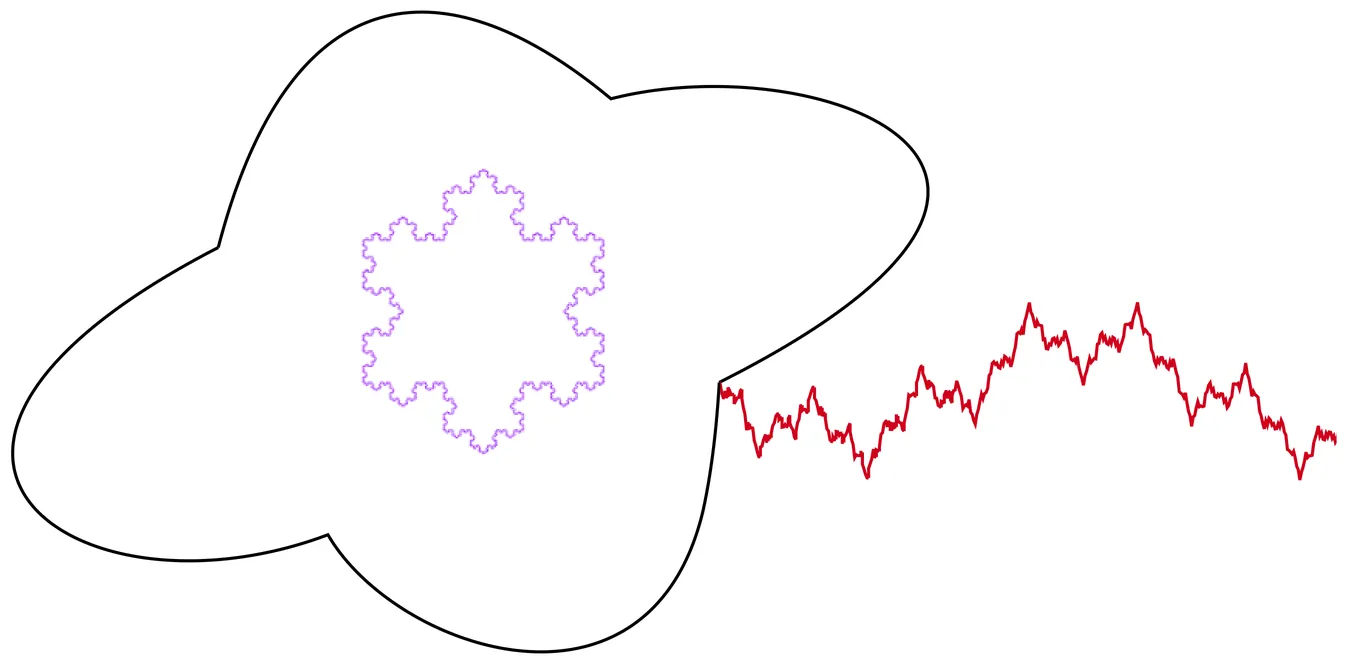
Let $f, g^1, \dots, g^d : \mathbb{R}^d \longrightarrow \mathbb{R}$ be Hölder continuous functions. If the Hölder exponents of these functions are less than $1$ but sufficiently large, we use the integral introduced by Züst to construct a distribution, denoted by $f \, \mathrm{d}g^1 \wedge \dots \wedge \, \mathrm{d}g^d$ which depends continuously on the functions $f, g^1, \dots, g^d$ in a sense that we shall specify, and which coincides with the function $f\det(\, \mathrm{d} g)$ when the functions $g^i$ are Lipschitz. We show that this distribution is entirely characterized by these properties and determine its Hölder regularity. We use this distribution to define the integral $ \int_Ω f \, \mathrm{d}g^1 \wedge \dots \wedge \, \mathrm{d}g^d$ by duality, for general domains $Ω\subset \mathbb{R}^d$. When $Ω$ is a rectangle, this integral coincides with Züst's construction. We then establish a new criterion on the domain $Ω$ ensuring that the integral is well defined. This criterion allows to recover a condition of Bouafia on the perimeter of the domain, and in the case when $d = 2$, the condition of Alberti-Stepanov-Trevisan on the upper box dimension of the boundary.
2510.19998For a Polish space $X$, we define the Shape space $\mathcal{S}_p(X)$ to be the Wasserstein space $W_p(X)$ modulo the action of a subgroup $G$ of the isometry group $ISO(X)$ of $X$, where the action is given by the pushforward of measures. The Wasserstein distance can then naturally be transformed into a \emph{Shape distance} on Shape space if $X$ and the action of $G$ are proper. This is shown for example to be the case for complete connected Riemannian manifolds with $G$ being equipped with the compact-open topology. Before finally proposing a notion for tangent spaces on the Shape space $\mathcal{S}_2(\mathbb{R}^n)$, it is shown that $\mathcal{S}_p(X)$ is Polish as well in case $X$ and the action of $G$ are indeed proper. Also, the metric geodesics in $\mathcal{S}_p(X)$ are put in relation to the ones in $W_p(X)$.
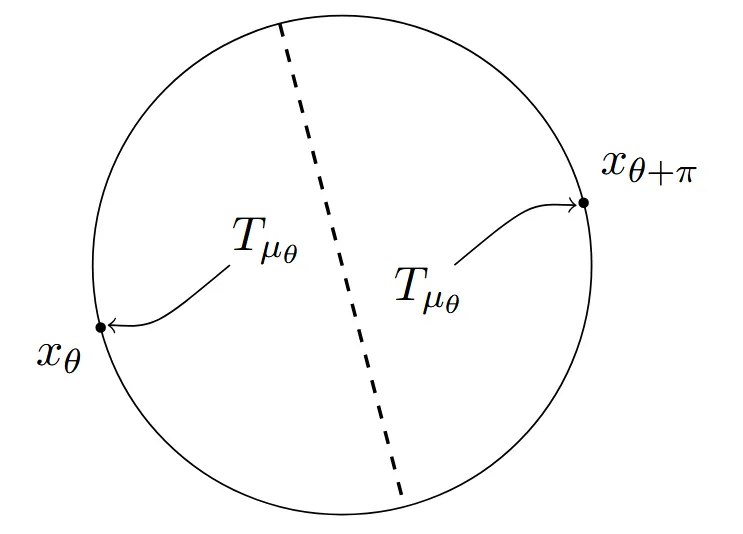
This work investigates several aspects related to quantitative stability in optimal transport, as well as uniqueness of the dual transport problem. Our main contributions are as follows. Chapter 1: Observations regarding the quantitative stability of optimal transport plans with respect to Wasserstein distance on the product space. Chapter 2: Extention of strong convexity inequalities for the Kantorovich functional to a larger class of source measures, using glueing arguments recently used for the quantitative stability of optimal transport maps. Chapters 3/4: A qualitative description of the behaviour of the fully discrete transport problem under perturbation of the support positions, as well as quantitative stability under uniqueness assumptions. Chapter 5: Extention of known uniqueness criteria for the dual transport problem. We show that when one marginal measure has Lipschitz-path connected support and the other has bounded support, the values of dual optimisers are unique up to a constant for a large family of costs, including $p$-costs for all $p>1$.
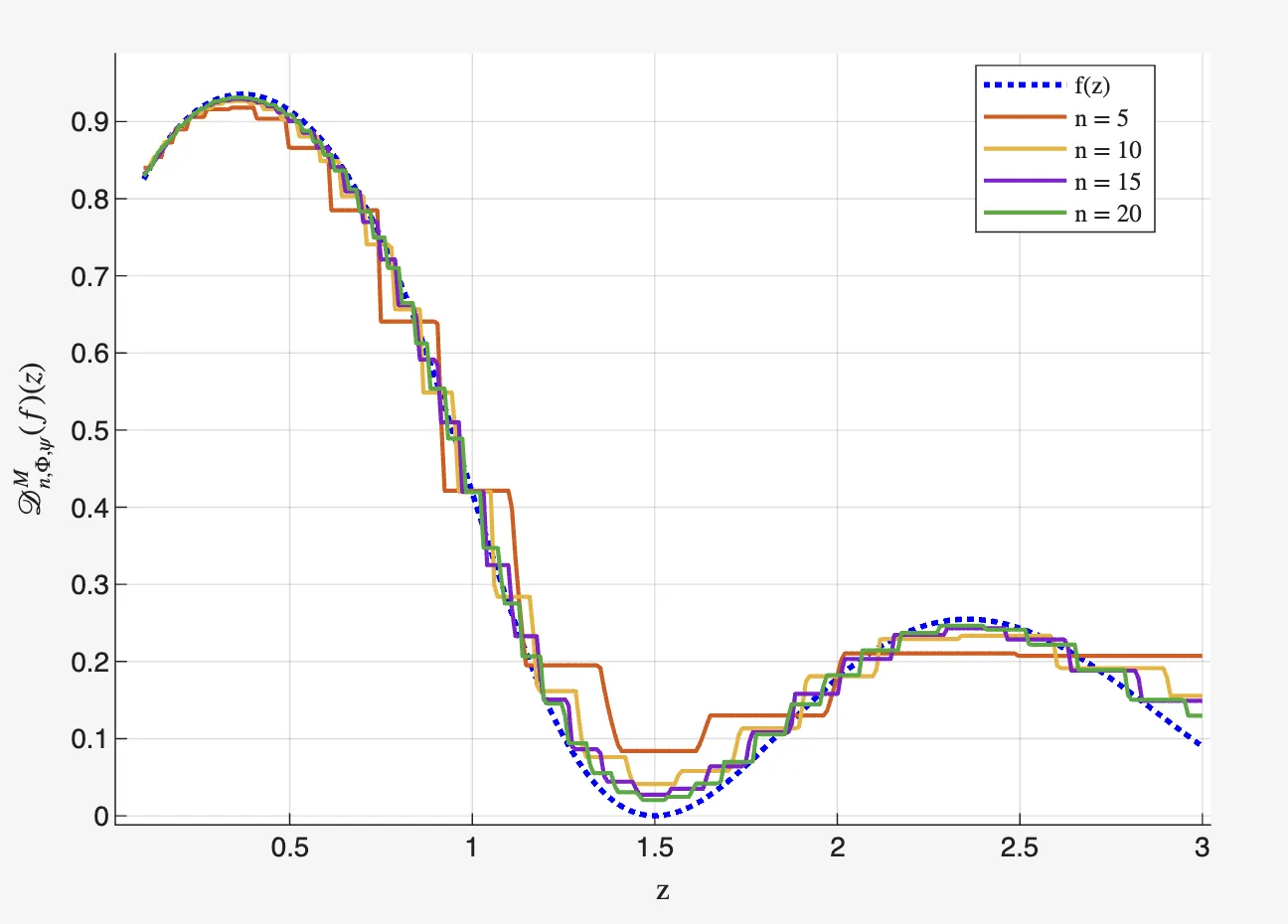
This article discusses the convergence properties of the Max Product and Max Min variants of Durrmeyer type exponential sampling series. We first establish pointwise and uniform convergence of both operators in the space of log uniformly continuous and bounded functions. The rates of convergence are then analyzed in terms of the logarithmic modulus of continuity. Additionally, the approximation errors of the proposed operators are examined using a variety of kernel functions. Finally, graphical illustrations are provided to demonstrate the convergence behavior of both operators.