Complex Variables
arXiv:math.CV
Holomorphic functions, automorphic group actions and forms, pseudoconvexity, complex geometry, analytic spaces, analytic sheaves.
Holomorphic functions, automorphic group actions and forms, pseudoconvexity, complex geometry, analytic spaces, analytic sheaves.

Milnor's fibration theorem and its generalizations play a central role in the study of singularities of complex and real analytic maps. In the complex analytic case, the Milnor fibration on the sphere is always given by the normalized map $f/|f|$. In contrast, for real analytic maps the existence of such a normalized Milnor fibration generally fails, even when a Milnor--Le fibration exists on a tube. For locally surjective real analytic maps $f:(R^n,0)->(R^k,0)$ with isolated critical value, the existence of a Milnor--Le fibration on a tube is guaranteed under a transversality condition. However, the associated fibration on the sphere need not be given by the normalized map $f/||f||$, unless an additional regularity condition (d-regularity) is imposed. In this paper we show that this apparent obstruction is not intrinsic. More precisely, we prove that for any such map satisfying the transversality property, there exists a homeomorphism $h:(R^k,0)->(R^k,0)$ of the target space such that the composition $h^{-1}f$ becomes d-regular. As a consequence, the normalized map $(h^{-1}f)/||h^{-1}f||$ defines a smooth locally trivial fibration on the sphere, which is equivalent to both the Milnor--Le fibration on the tube and the Milnor fibration on the sphere. Our result reveals a closer topological parallel between real and complex analytic singularities than previously recognized, without changing the topological type of the singularity.
 2601.03529
In this paper we establish duality theorems relating Bott-Chern and Aeppli cohomology, both with and without compact support, on non-compact complex manifolds under suitable pseudoconvexity assumptions. In particular, on Stein manifolds we obtain a full Bott-Chern-Aeppli duality extending Serre duality for Dolbeault cohomology. We also show that these results fail in general without pseudoconvexity assumptions by constructing explicit counterexamples on non-compact complex surfaces.
2601.02768In this paper, we determine the automorphism groups of generalized Kausz compactifications $\mathcal T_{s,p,n}$. By establishing the (semi-)positivity of the anticanonical bundles of $\mathcal T_{s,p,n}$, we also determine the automorphism groups of generalized spaces of complete collineations $\mathcal M_{s,p,n}$. The results in this paper are partially taken from the author's earlier arxiv post (Canonical blow-ups of grassmann manifolds, arxiv:2007.06200).
2601.01474We recently characterized the separated determinantal point processes $Λ_φ$ associated with Fock spaces $\mathcal F_φ$ in the plane with doubling weight $φ$. We also showed that, as expected, a more restrictive condition is required to characterize the separated Poisson processes with the same first intensities as $Λ_φ$. To gain further insight into this different behavior, we center our attention to radial weights $φ(z)$ and introduce a hybrid process $Λ_φ^M=\{r_k e^{iθ_k}\}_{k=1}^\infty$, where the moduli $r_k$ are taken from $Λ_φ$, while the arguments $θ_k$ are chosen independently and uniformly in $[0,2π)$. Our main result is that $Λ_φ^M$ is almost surely separated if and only if its first intensity satisfies the same condition as in the Poisson case.
2601.01396The present paper studies the existence of valuative interpolation on the local ring of an irreducible analytic subvariety at singular points. We firstly develop the concepts and methods of Zhou weights and Tian functions near singular points of irreducible analytic subvarieties. By applying these tools, we establish the necessary and sufficient conditions for the existence of valuative interpolations on the rings of germs of holomorphic functions and weakly holomorphic functions at a singular point. As applications, we characterize the existence of valuative interpolations on the quotient ring of the ring of convergent power series in real variables. We also present separated necessary and sufficient conditions for the existence of valuative interpolations on the quotient ring of polynomial rings with complex coefficients and real coefficients. Furthermore, we show that the conditions become both necessary and sufficient under certain conditions on the zero set of the given polynomials.
Let $Γ$ be a bounded Jordan curve and $Ω_i,Ω_e$ its two complementary components. For $1<p<\infty,\,s\in(0,1)$ we define $\mathcal{B}_{p,p}^s(Ω_{i,e})$ as the set of functions $f:Γ\to \mathbb C$ having harmonic extension $u$ respectively in $Ω_i$ and $Ω_e$ such that $$ \iint_{Ω_{i,e}} |\nabla u(z)|^p d(z,Γ)^{(1-s)p-1} dxdy<+\infty.$$ If $Γ$ is further assumed to be rectifiable we define $B_{p,p}^s(Γ)$ as the space of functions $f\in L^p(Γ)$ such that $$\iint_{Γ\times Γ}\frac{|f(z)-f(ζ)|^p}{|z-ζ|^{1+ps}} |dz||dζ|<+\infty.$$ When $Γ$ is the unit circle these three spaces coincide with the homogeneous fractional Besov-Sobolev space. For a general rectifiable curve these spaces need not coincide and our first goal is to investigate the cases of equality: while the chord-arc property is the necessary and sufficient condition for equality in the classical case of $s=1/p,\, p\ge 2$, this is no longer the case for general $s\in (0,1)$. We show however that equality holds for radial-Lipschitz curves. In the general (possibly non-rectifiable) case we study boundary values of functions in $\mathcal{B}_{p,p}^s(Ω_{i,e})$ and give conditions for equality of these trace-spaces that we then call $\mathcal{B}^s_{p,p}(Γ)$. Using Plemelj-Calderón property we further identify $\mathcal{B}^s_{p,p}(Γ)$ with the space of restrictions of a weighted Sobolev space of the plane. Finally we re-interpretate some of our results as the "almost"-Dirichlet principle in the spirit of Maz'ya.
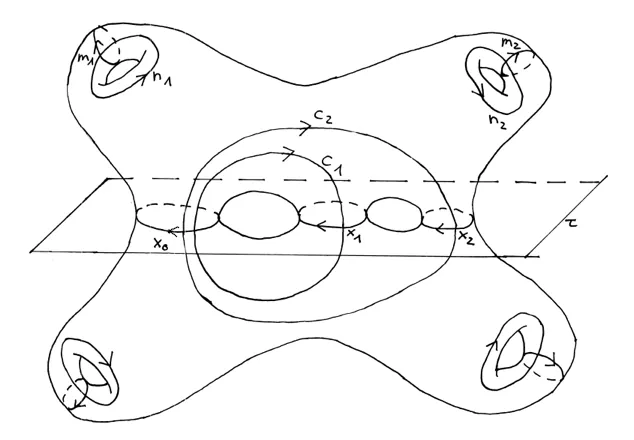
This paper develops a discrete theory of real Riemann surfaces based on quadrilateral cellular decompositions (quad-graphs) and a linear discretization of the Cauchy-Riemann equations. We construct a discrete analogue of an antiholomorphic involution and classify the topological types of discrete real Riemann surfaces, recovering the classical results on the number of real ovals and the separation of the surface. Central to our approach is the construction of a symplectic homology basis adapted to the discrete involution. Using this basis, we prove that the discrete period matrix admits the same canonical decomposition $Π= \frac{1}{2} H + i T$ as in the smooth setting, where $H$ encodes the topological type and $T$ is purely imaginary. This structural result bridges the gap between combinatorial models and the classical theory of real algebraic curves.
2512.19284We investigate deformation properties of balanced hyperbolicity, with particular emphasis on degenerate balanced manifolds and their behavior under modifications. In this context, we introduce two new notions of hyperbolicity for compact non-Kähler manifolds $X$ of complex dimension $\dim_{\mathbb{C}}X=n$ in degree $1 \leq p \leq n-1$, inspired by the work of F. Haggui and S. Marouani on $p$-Kähler hyperbolicity. The first notion, called \emph{p-SKT hyperbolicity}, generalizes the notions of SKT hyperbolicity and Gauduchon hyperbolicity introduced by S. Marouani. The second notion, called \emph{p-HS hyperbolicity}, extends the notion of sG hyperbolicity defined by Y. Ma. We investigate the relationship between these notions of analytic nature and their geometric counterparts, namely Kobayashi hyperbolicity and \emph{p-cyclic hyperbolicity} for $2 \leq p \leq n-1$, and we examine the openness under holomorphic deformations of both $p$-HS hyperbolicity and $p$-Kähler hyperbolicity.
2512.18106We study reciprocity laws involving complex line bundles on fibrations in oriented circles. In particularly, we prove the following reciprocity law. Let $B$ be a complex manifold and $π_i : M_i \to B$ be a fibration in oriented circles, where $i$ runs through a finite set. Let $L_i$ and $N_i$ be complex line bundles on every $M_i$. The reciprocity law states that the sum of all $(π_i)_* \left(c_1(L_i) \cup c_1(N_i) \right)$, where $(π_i)_*$ is the Gysin map and $c_1$ is the first Chern class, equals zero in $H^3(B, {\mathbb Z})$ when the disjoint union of all $M_i$ is embedded into a holomorphic family of compact Riemann surfaces over the base $B$ such that in every fiber of this family the disjoint union of the embedded circles is the boundary of an embedded compact Riemann surface with boundary, and all $L_i$ and all $N_i$ are restrictions of holomorphic line bundles on this family.
2512.16506We study the distribution kernel of a Toeplitz operator associated with a classical pseudodifferential operator on a compact, embeddable, strictly pseudoconvex CR manifold. The main result consists of a formula for the values at the diagonal of the second coefficient in the expansion of the symbol of the kernel. We also establish asymptotic expansions for Toeplitz operators on the positive part of a compact not necessary strictly pseudoconvex CR orbifold under certain natural assumptions.
2512.15193In this paper, we consider weighted Bergman spaces $\mathcal{B}_{α,p}$ of log-subharmonic functions on the unit sphere. Using the isoperimetric inequality for the spherical metric we prove certain monotonicity property for super-level sets of $|f(x)|^p\mathcal{W}_n^α(x),$ where $f\in \mathcal{B}_{α,p}$ and $\mathcal{W}_n^α(x)$ is the Bergman weight. As a consequence, we solve a maximization problem for certain Wehrl-type (convex) functionals and concentration estimates. Moreover, we show the stability of these estimates, proving that near-extremizing values are achieved for near-extremizing functions.
2512.11640We study the structure of the spectrum of the algebra of uniformly continuous holomorphic functions on the unit ball of $\ell_p$. Our main focus is the relationship between \emph{Gleason parts} and \emph{fibers}. For every $z \in B_{\ell_p}$ with $1 < p < \infty$, we prove that the fiber over $z$ contains $2^{\mathfrak{c}}$ distinct Gleason parts. We also investigate some of the properties of these Gleason parts and show the existence of many strong boundary points in certain fibers. We then examine the case $p = 1$, where similar results on the abundance of Gleason parts within the fibers hold, although the arguments required are more involved. Our results extend and complete earlier work on the subject, providing answers to previously posed questions.
2512.11523Given a big and semipositive line bundle in the adjoint setting, we show that Donaldson's quantized Monge-Ampere energy associated with any bounded plurisubharmonic weight converges to the Monge-Ampere energy. Our proof refines an argument of Berman and Freixas i Montplet in the ample case by employing a pointwise semiclassical Ohsawa-Takegoshi type extension theorem. As an application, we obtain the weak convergence of adjoint Bergman measures associated with bounded plurisubharmonic weights toward the corresponding non-pluripolar measures.
2512.11349We solve the commutant lifting and interpolation problems in the setting of the Hardy space and Schur functions on the open unit ball of $\mathbb{C}^n$. Our solutions also signify the role of inner functions on the unit ball, objects whose existence was once in doubt and to which Aleksandrov, Rudin, and others made fundamental contributions. Some of our results, particularly those related to inner functions, are new even in the classical, one-variable case.
2512.10852We obtain the asymptotic behavior of hole probability for random holomorphic sections on a compact Riemann surface with respect to the hole size.
2512.10528Given a measure $μ$ on the unit sphere $\partial\mathbb{B}^d$ in $\mathbb{C}^d$ with Lebesgue decomposition ${\rm d} μ= w \, {\rm d} σ+ {\rm d} μ_s$, with respect to the rotation-invariant Lebesgue measure $σ$ on $\partial \mathbb{B}^d$, we introduce notions of orthogonal polynomials $(\varphi_α)_{α\in \mathbb{N}_0^d}$, Verblunsky coefficients $(γ_{α,β})_{α,β\in \mathbb{N}_0^d}$, and an associated Christoffel function $λ_{\infty}^{(d)}(z; {\rm d} μ)$, and we prove a recurrence relation for the orthogonal polynomials involving the Verblunsky coefficients reminiscent of the classical Szegő recurrences, as well as an analogue of Verblunsky's theorem. Moreover, we establish a number of equalities involving the orthogonal polynomials, determinants of moment matrices, and the Christoffel function, and show that if ${\rm supp}\, μ_s$ is discrete, then the aforementioned quantities depend only on the absolutely continuous part of $μ$. If, in addition to ${\rm supp}\, μ_s$ being discrete, one is able to find $f \in H^{\infty}(\mathbb{B}^d)$ such that $f(0) = 1$ and $$\int_{\partial \mathbb{B}^d} |f(ζ)|^2 w(ζ) {\rm d}σ(ζ) \leq \exp\left( \int_{\partial \mathbb{B}^d} \log(w(ζ)) \, {\rm d}σ(ζ) \right),$$ then we establish a $d$-variate Szegő-Verblunsky theorem, namely $$\prod_{α\in \mathbb{N}_0^d} (1 - | γ_{0,α} |^2) = \exp\left(\int_{\partial\mathbb{B}^d} \log( w(ζ)) \, {\rm d}σ(ζ)\right).$$ Finally, we identify several classes of weights where one may construct such an $f$ and highlight an explicit example of a weight $w$, residing outside of these classes, where $\prod_{α\in \mathbb{N}_0^d} (1 - |γ_{0,α} |^2) \neq \exp\left(\int_{\partial\mathbb{B}^d} \log( w(ζ)) \, {\rm d}σ(ζ)\right)$.
2512.10466We extend several geometric quantization results to the setting of big line bundles. More precisely, we prove the asymptotic isometry property for the map that associates to a metric on a big line bundle the corresponding sup-norms on the spaces of holomorphic sections of its tensor powers. Building on this, we show that submultiplicative norms on section rings of big line bundles are asymptotically equivalent to sup-norms. As an application, we show that any bounded submultiplicative filtration on the section ring of a big line bundle naturally gives rise to a Mabuchi geodesic ray, and the speed of this ray encodes the statistical invariants of the filtration.
2512.07098In this paper, we show that for a broad class of pseudoconvex formal-analytic arithmetic surfaces over $\text{Spec}(\mathbb{Z})$, those which admit a nonconstant monic such regular function, that a conjecture of Bost-Charles that the ring of regular functions has continuum cardinality is implied by a purely complex-analytic conjecture. Under the conjecture, a Fekete-Szego-type approximation argument produces a polynomial "large" relative to the regular function, which in turn yields continuum many distinct regular functions. We also introduce a formula for the pushforward by a holomorphic function of the equilibrium Green's functions for our bordered Riemann surface with boundary, a formula which has constant term related to Arakelov degree.
2512.05892We consider each of the three classes of representations of cyclic groups that arise in the study of rational sphere maps. We study the possible number of terms for invariant polynomials with non-negative coefficients that are constant on the appropriate line or hyperplane. Our result provides crucial information about gaps in the possible target dimensions for certain invariant polynomial sphere maps. We interpret our results in terms of sparseness for solutions of certain linear systems.
2512.04379We investigate properties of ($α,β$)-harmonic functions. First, we discuss the the coefficient estimates for ($α,β$)-harmonic functions. In particular, we obtain Heinz's inequality for ($α,β$)-harmonic functions, propose a coefficient bound for normalized univalent ($α,β$)-harmonic functions and prove that this holds for the subclass that consists of starlike functions. Furthermore, by utilizing the relationship between ($α,β$)-harmonic functions and harmonic functions, we obtain Radó's theorem, Koebe type covering theorems and area theorem. Finally, we show growth estimates and distortion estimates for ($α,β$)-harmonic functions by using the $L^p$ norms of the boundary functions.
This paper develops a discrete theory of real Riemann surfaces based on quadrilateral cellular decompositions (quad-graphs) and a linear discretization of the Cauchy-Riemann equations. We construct a discrete analogue of an antiholomorphic involution and classify the topological types of discrete real Riemann surfaces, recovering the classical results on the number of real ovals and the separation of the surface. Central to our approach is the construction of a symplectic homology basis adapted to the discrete involution. Using this basis, we prove that the discrete period matrix admits the same canonical decomposition $Π= \frac{1}{2} H + i T$ as in the smooth setting, where $H$ encodes the topological type and $T$ is purely imaginary. This structural result bridges the gap between combinatorial models and the classical theory of real algebraic curves.
2511.15305We describe the set of inner functions of finite order in a multi-connected domain, then we consider an optimization formulation of the Pick-Nevanlinna interpolation problem, and we generalize it to Hermite type interpolation.
2511.16702Let $\mathcal{A}$ denote the class of analytic functions $f$ on the unit disk $\mathbb{D}=\{z\in\mathbb{C} : |z|<1\}$, normalized by $f(0)=0$ and $f^{\prime}(0)=1$. For $-π/2<α<π/2$, let $\mathcal{S}_α$ be the subclass of $\mathcal{A}$ consisting of functions $f$ that satisfy the relation $\mathrm{Re}\{e^{iα}\left(1+zf^{\prime\prime}(z)/f^{\prime}(z)\right)\}>0$ for $z\in\mathbb{D}$. In this paper, we first give an equivalent characterization for a subclass of Robertson functions; then we present the distortion and growth theorems and obtain the pre-Schwarzian and Schwarzian norms for the subclass $\mathcal{S}_α$. In addition, a sharp upper bound of the Schwarzian norm for the subclass is given in terms of the value $f^{\prime \prime}(0)$.
2511.13903We study the complex-analytic geometry of semi-positive holomorphic line bundles on compact Kähler manifolds. In one of our main results, for a $\mathbb{Q}$-effective line bundle satisfying a natural torsion-type assumption, we show the equivalence between semi-positivity and semi-ampleness. More generally, for an effective nef divisor of numerical dimension one, we characterize the semi-positivity of the associated line bundle in terms of the existence of a certain type of pseudoflat fundamental system of neighborhoods of the support. Furthermore, for an effective semi-positive divisor, we prove a dichotomy: either the divisor is the pull-back of a $\mathbb{Q}$-divisor by a fibration onto a Riemann surface, or the Hartogs extension phenomenon holds on the complement of its support. Our proof is based on a pluripotential method that has previously been used for studying the boundaries of pseudoconvex domains, which allows us to investigate the complex-analytic structure of neighborhoods of the support of the divisor even when the manifold is non-compact.
Let \(X\) be a compact complex manifold possessing the \emph{Runge approximation property on discs}, meaning that every holomorphic map from a closed disc into \(X\) is approximable by a global holomorphic map from \(\mathbb{C}\). We construct an entire curve \(F : \mathbb{C} \to X\) such that the associated family of concentric holomorphic discs \(\{F|_{\overline{\mathbb{D}}_r}\}_{r>0}\) generates all Ahlfors currents on \(X\), thereby settling a conjecture of Sibony.
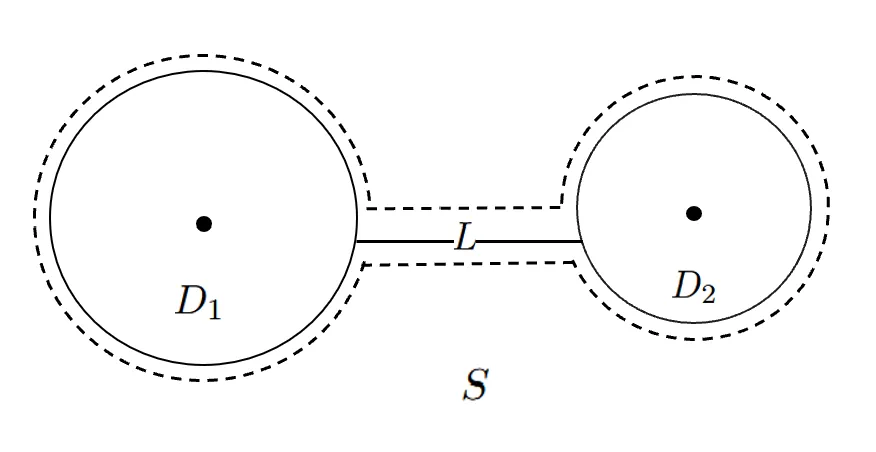
2511.03512A proof of the uniformization theorem of Riemann surface is given with only elementary properties of holomorphic functions and not using the paracompacity of the surface. This proof leans on an holomorphic version of the topological characterization, due to Brown, of the sphere as variety covered by two discs, a generalization of the construction of double of a Riemann surface with boundary and the arithmetic, due to Jordan, of separation in surfaces

In this paper, we study the limit of Teichmüller distance between two points along a pair of Teichmüller rays. We obtain an explicit formula for the limiting Teichmüller distance when the vertical measured foliations of the quadratic differentials are finite sums of weighted simple closed curves and uniquely ergodic measures. The limit is expressed in terms of ratios of the corresponding moduli and the Teichmüller distance between the limit surfaces when the vertical measured foliations are absolutely continuous. Consequently, two Teichmüller rays are asymptotic if and only if their vertical measured foliations are modularly equivalent and their limit surfaces coincide, which implies a main result of Masur on the asymptoticity of Teichmüller rays determined by uniquely ergodic quadratic differentials. Furthermore, we prove that the infimum of the limiting Teichmüller distances can be represented in terms of the distance between the limit surfaces of the Teichmüller rays and the detour metric of their endpoints on the Gardiner-Masur boundary, when the initial points of the rays vary along the Teichmüller geodesics.
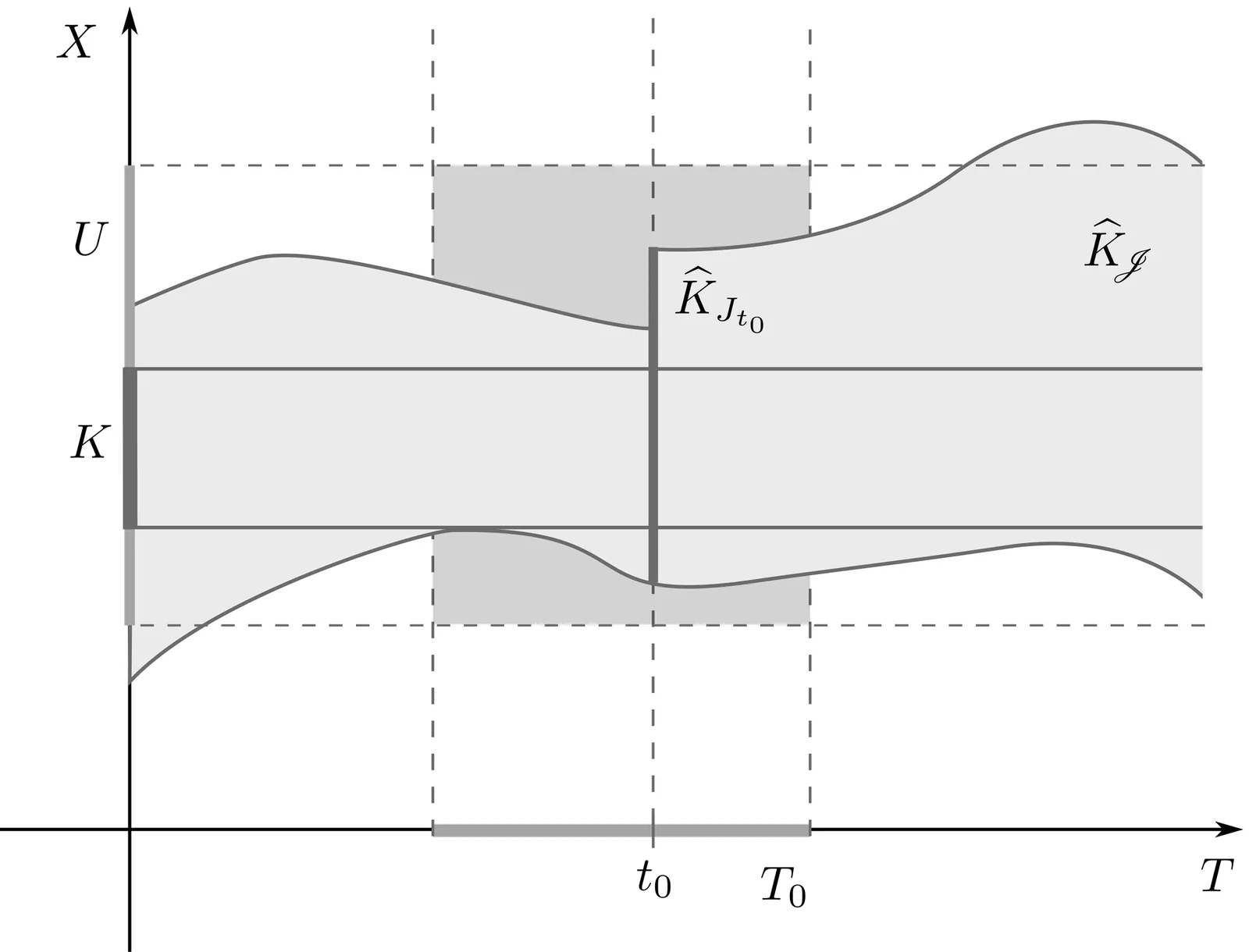
Let $X$ be a smooth open manifold of even dimension, $T$ be a topological space, and $\mathscr{J}=\{J_t\}_{t\in T}$ be a continuous family of smooth integrable Stein structures on $X$. Under suitable additional assumptions on $T$ and $\mathscr{J}$, we prove an Oka principle for continuous families of maps from the family of Stein manifolds $(X,J_t)$, $t\in T$, to any Oka manifold, showing that every family of continuous maps is homotopic to a family of $J_t$-holomorphic maps depending continuously on $t$. We also prove the Oka-Weil theorem for sections of $\mathscr{J}$-holomorphic vector bundles on $Z=T\times X$ and the Oka principle for isomorphism classes of such bundles. The assumption on the family $\mathscr{J}$ is that the $J_t$-convex hulls of any compact set in $X$ are upper semicontinuous with respect to $t\in T$; such a family is said to be tame. For suitable parameter spaces $T$, we characterise tameness by the existence of a continuous family $ρ_t:X\to \mathbb{R}_+=[0,+\infty)$, $t\in T$, of strongly $J_t$-plurisubharmonic exhaustion functions on $X$. Every family of complex structures on an open orientable surface is tame.We give an example of a nontame smooth family of Stein structures $J_t$ on $\R^{2n}$ $(t\in \mathbb{R},\ n>1)$ such that $(\mathbb{R}^{2n},J_t)$ is biholomorphic to $\mathbb{C}^n$ for every $t\in\mathbb{R}$. We show that the Oka principle fails on any nontame family.
2510.20953This paper deals with semigroups of holomorphic self-maps of the upper half-plane that exhibit an extremal (i.e. the slowest possible) rate of convergence to their Denjoy--Wolff point. The main novelty lies in the parabolic case of zero hyperbolic step. We provide several characterizations for such semigroups in terms of the Herglotz representation of their infinitesimal generators, the conformality at the Denjoy--Wolff point of a modification of their associated Koenigs function, and more.
2510.20101We prove that the fiber space consisting of BMOA functions that are the logarithms of derivatives of conformal homeomorphisms of the unit disk onto bounded quasidisks forms a real-analytic disk bundle over the Bers embedding of the BMO Teichmüller space. For the VMO Teichmüller space, we show that the corresponding sub-bundle consisting of VMOA functions is real-analytically trivial.
2510.14690Let $(X,ω)$ be a compact Hermitian manifold of dimension $n$. We derive an $L^\infty$-estimate for bounded solutions to the complex $m$-th Hessian equations on $X$, assuming a positive right-hand side in the Orlicz space $L^{\frac{n}{m}}(\log L)^n(h\circ\log \circ \log L)^n$, where the associated weight satisfies Kołodziej's Condition. Building upon this estimate, we then establish the existence of continuous solutions to the complex Hessian equation under the prescribed assumptions.
This paper explores the asymptotic behaviour of the radii of convexity and uniform convexity for normalized Bessel functions with respect to large order. We provide detailed asymptotic expansions for these radii and establish recurrence relations for the associated coefficients. Additionally, we derive generalized bounds for the radii of convexity and uniform convexity by applying the Euler-Rayleigh inequality and potential polynomials. The asymptotic inversion method and Rayleigh sums are the main tools used in the proofs.
2510.12501This paper investigates the dynamical behaviour of holomorphic self-maps of the upper half-plane. More precisely, we focus on the hyperbolic and parabolic self-maps whose orbits approach the Denjoy--Wolff point with the slowest possible rate. We characterize self-maps of such extremal rate using various tools, like the Herglotz representation, the conformality of the Koenigs function at the Denjoy--Wolff point and the hyperbolic distance.
2510.10678Let $X$ be a general Seifert fibered integral homology $3$-sphere with $r\ge3$ exceptional fibers. For every root of unity $ζ\not=1$, we show that the SU(2) WRT invariant of $X$ evaluated at $ζ$ is (up to an elementary factor) the non-tangential limit at $ζ$ of the GPPV invariant of $X$, thereby generalizing a result from [Andersen-Mistegard 2022]. Based on this result, we apply the quantum modularity results developed in [Han-Li-Sauzin-Sun 2023] to the GPPV invariant of $X$ to prove Witten's asymptotic expansion conjecture [Witten 1989] for the WRT invariant of $X$. We also prove that the GPPV invariant of $X$ induces a higher depth strong quantum modular form. Moreover, when suitably normalized, the GPPV invariant provides an ``analytic incarnation'' of the Habiro invariant.
We analyze the asymptotic properties a special solution of the $(3,4)$ string equation, which appears in the study of the multicritical quartic $2$-matrix model. In particular, we show that in a certain parameter regime, the corresponding $τ$-function has an asymptotic expansion which is `topological' in nature. Consequently, we show that this solution to the string equation with a specific set of Stokes data exists, at least asymptotically. We also demonstrate that, along specific curves in the parameter space, this $τ$-function degenerates to the $τ$-function for a tritronquée solution of Painlevé I (which appears in the critical quartic $1$-matrix model), indicating that there is a `renormalization group flow' between these critical points. This confirms a conjecture from [1]. [1] The Ising model, the Yang-Lee edge singularity, and 2D quantum gravity, C. Crnković, P. Ginsparg, G. Moore. Phys. Lett. B 237 2 (1990)
2507.17387In this paper we show that a holomorphic function, defined on an open subset $D$ of $\mathbb{C}^n$, is a complex Nash function if and only if its real part (or equivalently its imaginary part) is a real Nash function.
We give a survey of computation of the conformal capacity of planar condensers, generalized capacity, and logarithmic capacity with emphasis on our recent work 2020-2025. We also discuss some applications of our method based on the boundary integral equation with the generalized Neumann kernel to the computation of several other conformal invariants: harmonic measure, modulus of a quadrilateral, reduced modulus, hyperbolic capacity, and elliptic capacity. Here the solution of mixed Dirichlet-Neumann boundary value problem for the Laplace equation has a key role. At the end of the paper we give a topicwise structured list to our extensive bibliography on constructive complex analysis and potential theory.
2506.04618If $f=u+iv$ is analytic in the unit disk $\mathbb{D}$, it is known that the integral means $M_p(r,u)$ and $M_p(r,v)$ have the same order of growth. This is false if $f$ is a (complex-valued) harmonic function. However, we prove that the same principle holds if we assume, in addition, that $f$ is $K$-quasiregular in $\mathbb{D}$. The case $0<p<1$ is particularly interesting, and is an extension of the recent Riesz type theorems for harmonic quasiregular mappings by several authors. Further, we proceed to show that the real and imaginary parts of a harmonic quasiregular mapping have the same degree of smoothness on the boundary.
2506.01090In this paper we establish a relationship between the Milnor number, the $χ$-number, and the Tjurina number of a foliation with respect to an effective balanced divisor of separatrices. Moreover, using the Gómez-Mont--Seade--Verjovsky index, we prove that the difference between the multiplicity and the Tjurina number of a foliation with respect to a reduced curve is independent of the foliation. We also derive a local formula for the Tjurina number of a foliation with respect to a reduced curve. From a global point of view, these results lead to the following consequences: we provide a new proof of a global result regarding the multiplicity of a foliation due to Cerveau-Lins Neto and a new proof of a Soares's inequality for the sum of the Milnor number of an invariant curve of a foliation. Additionally, we obtain bounds for the global Tjurina number of a foliation on the complex projective plane. Finally, we provide an answer to the conjecture posed by Alcántara and Mozo-Fernández about foliations on the complex projective plane having a unique singularity.
2505.06812A practical method is presented for determining root and pole cancellation functions of a matrix function $Q(z)$ meromorphic on the extended complex plane $\bar{\mathbb{C}}:=\mathbb{C} \cup \left\{ \infty \right\}$. This method is applied to solve a nonlinear system of $n\in \mathbb{N}$ differential equations of order $l\in \mathbb{N}$ with $n $ unknown functions $u_{i}\left( t \right)$, where $i=1,\, \mathellipsis ,\,n $. For a function $Q\in \mathcal{N}_κ(\mathcal{H}) ,\, κ\in \mathbb{N} \cup \lbrace 0 \rbrace$, posesing a pole at infinity of order $m \in \mathbb{N}$, the following factorization is establish \[ Q(z)=(z-β)^{m}\tilde{Q}(z), \, z\in \mathcal{D}(Q), \] where $β\in \mathbb{R}$ is a regular point of $Q$, and $\tilde{Q}\in \mathcal{N}_{κ'}(\mathcal{H})$ is holomotphic at $\infty$. Unlike the Krein-Langer representation of $Q$, which involves a linear relation $A$, this representation employs a bounded operator $\tilde{A}$ in the Krein-Langer representation of $\tilde{Q}$. The operator $\tilde{A}$ and the relation $A$ have identical spectra, except at $β$ and $\infty$. We demonstrate how to obtain this representation for a given meromorphic function $Q\in \mathcal{N}_κ^{n \times n}$ using the root functions developed in this work.