Trending in Theory & Algorithms
Unit Interval Selection in Random Order Streams
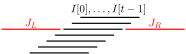
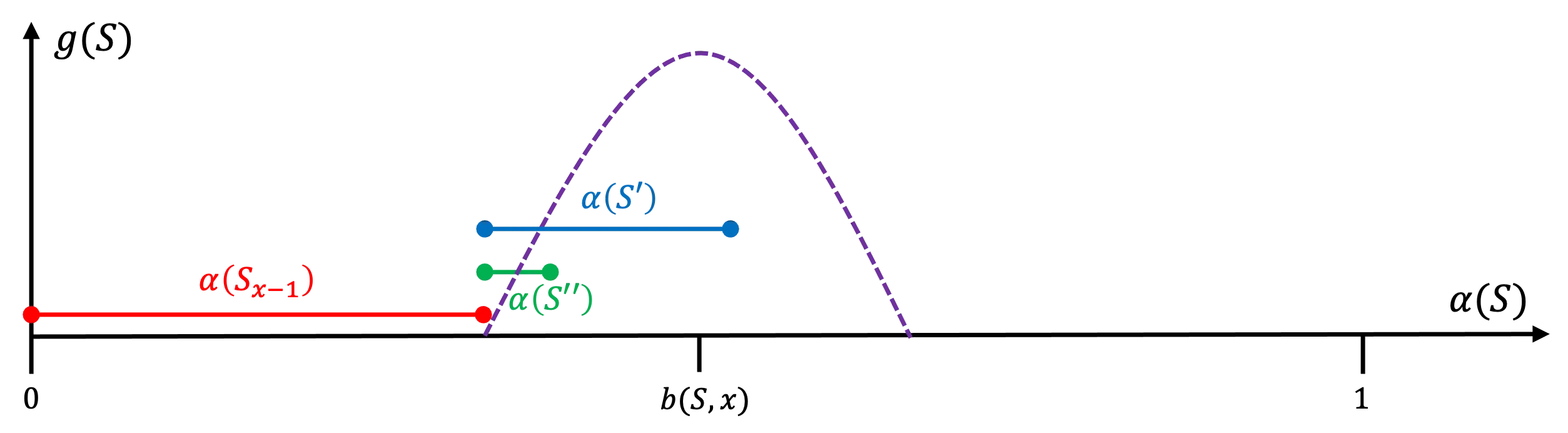
We consider the \textsf{Unit Interval Selection} problem in the one-pass random order streaming model. Here, an algorithm is presented a sequence of $n$ unit-length intervals on the line that arrive in uniform random order, and the objective is to output a largest set of disjoint intervals using space linear in the size of an optimal solution. Previous work only considered adversarially ordered streams and established that, in this space constraint, a $(2/3)$-approximation can be achieved, and this is also best possible, i.e. any improvement requires space $Ω(n)$ [Emek et al., TALG'16]. In this work, we show that an improved expected approximation factor can be achieved if the input stream is in uniform random order, with the expectation taken over the stream order. Specifically, we give a one-pass streaming algorithm with expected approximation factor $0.7401$ using space $O(|OPT|)$, where $OPT$ denotes an optimal solution. We also show that algorithms with expected approximation factor above $8/9$ require space $Ω(n)$, and algorithms that compute a better than $2/3$-approximation with probability above $2/3$ also require $Ω(n)$ space. On a technical note, we design an algorithm for the restricted domain $[0,Δ)$, for some constant $Δ$, and use standard techniques to obtain an algorithm for unrestricted domains. For the restricted domain $[0,Δ)$, we run $O(Δ)$ recursive instances of our algorithm, with each instance targeting the situation where a specific interval from $OPT$ arrives first. We establish the interesting property that our algorithm performs worst when the input stream is precisely a set of independent intervals. We then analyse the algorithm on these instances. Our lower bound is proved via communication complexity arguments, similar in spirit to the robust communication lower bounds by [Chakrabarti et al., Theory Comput. 2016].
2603.089371
Mar 2026Data Structures and Algorithms
The Unit Gap: How Sharing Works in Boolean Circuits
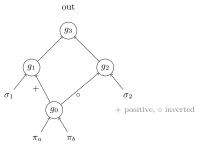
We study the gap between the minimum size of a Boolean circuit (DAG) and the minimum size of a formula (tree circuit) over the And-Inverter Graph (AIG) basis {AND, NOT} with free inversions. We prove that this gap is always 0 or 1 (Unit Gap Theorem), that sharing requires opt(f) >= n essential variables (Threshold Theorem), and that no sharing is needed when opt(f) <= 3 (Tree Theorem). Gate counts in optimal circuits satisfy an exact decomposition formula with a binary sharing term. When the gap equals 1, it arises from exactly one gate with fan-out 2, employing either dual-polarity or same-polarity reuse; we prove that no other sharing structure can produce a unit gap.
2603.080331
Mar 2026Computational Complexity
 2603.04004
Sensible Intersection Type Theories
Finitary/static semantics in the form of intersection type assignments have become a paradigm for analysing the fine structure of all sorts of lambda-models. The key step is the construction of a filter model isomorphic to a given lambda-model. A property of great interest of filter lambda-models is sensibility, i.e. the interpretation of all unsolvable terms is the least element. The flexibility of intersection type assignments derives from their parametrisation on intersection type theories. We construe intersection type theories as special meet-semilattices and show that appropriate morphisms, in the opposite category of meet-semilattices, preserve sensibility of the induced lambda-models. Interestingly the set of saturated sets together with the set of lambda-terms is such a meet-semilattice, thus showing that arguments based on Tait-Girards's computability amount to the construction of a morphism. We characterise two classes of intersection type theories which induce sensible filter models. The first is non-effective while the second is effective and it amounts to the generalisation of Mendler's criterion to intersection types and head normalising terms. The complete characterisation of sensible filter models however still escapes.
2603.040041
Mar 2026Logic in Computer Science
2603.03262Yeo's Theorem for Locally Colored Graphs: the Path to Sequentialization in Linear Logic
We revisit sequentialization proofs associated with the Danos-Regnier correctness criterion in the theory of proof nets of linear logic. Our approach relies on a generalization of Yeo's theorem for graphs, based on colorings of half-edges. This happens to be the appropriate level of abstraction to extract sequentiality information from a proof net without modifying its graph structure. We thus obtain different ways of recovering a sequent calculus derivation from a proof net inductively, by relying on a splitting vertex, which we can impose to be a par-vertex, or a terminal vertex, or a non-axiom vertex, etc., in a modular way. This approach applies in presence of the mix-rules as well as for proof nets of unit-free multiplicative-additive linear logic (through an appropriate further generalization of Yeo's theorem). The proof of our Yeo-style theorem relies on a key lemma that we call cusp minimization. Given a coloring of half-edges, a cusp in a path is a vertex whose adjacent half-edges in the path have the same color. And, given a cycle with at least one cusp and subject to suitable hypotheses, cusp minimization constructs a cycle with strictly less cusps. In the absence of cusp-free cycles, cusp minimization is then enough to ensure the existence of a splitting vertex, i.e. a vertex that is a cusp of any cycle it belongs to. Our theorem subsumes several graph-theoretical results, including some known to be equivalent to Yeo's theorem. The novelty is that they can be derived in a straightforward way, just by defining a dedicated coloring, again without any modification of the underlying graph structure (vertices and edges) -- similar results from the literature required more involved encodings.
2603.032621
Mar 2026Logic in Computer Science

Learning-Augmented Moment Estimation on Time-Decay Models
Motivated by the prevalence and success of machine learning, a line of recent work has studied learning-augmented algorithms in the streaming model. These results have shown that for natural and practical oracles implemented with machine learning models, we can obtain streaming algorithms with improved space efficiency that are otherwise provably impossible. On the other hand, our understanding is much more limited when items are weighted unequally, for example, in the sliding-window model, where older data must be expunged from the dataset, e.g., by privacy regulation laws. In this paper, we utilize an oracle for the heavy-hitters of datasets to give learning-augmented algorithms for a number of fundamental problems, such as norm/moment estimation, frequency estimation, cascaded norms, and rectangular moment estimation, in the time-decay setting. We complement our theoretical results with a number of empirical evaluations that demonstrate the practical efficiency of our algorithms on real and synthetic datasets.
2603.024881
Mar 2026Data Structures and Algorithms
Generalizing Logic-based Explanations for Machine Learning Classifiers via Optimization
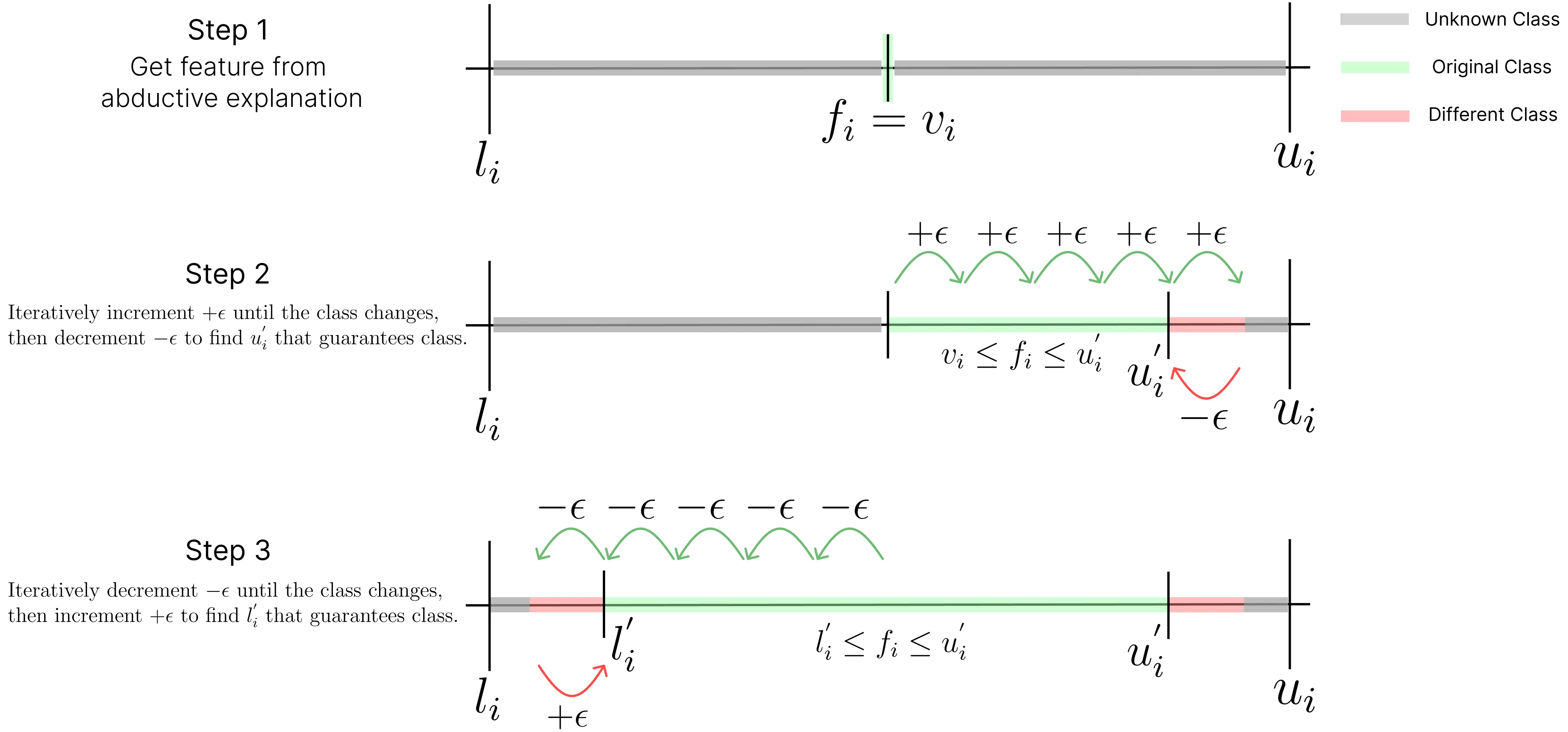
Machine learning models support decision-making, yet the reasons behind their predictions are opaque. Clear and reliable explanations help users make informed decisions and avoid blindly trusting model outputs. However, many existing explanation methods fail to guarantee correctness. Logic-based approaches ensure correctness but often offer overly constrained explanations, limiting coverage. Recent work addresses this by incrementally expanding explanations while maintaining correctness. This process is performed separately for each feature, adjusting both its upper and lower bounds. However, this approach faces a trade-off: smaller increments incur high computational costs, whereas larger ones may lead to explanations covering fewer instances. To overcome this, we propose two novel methods. Onestep builds upon this prior work, generating explanations in a single step for each feature and each bound, eliminating the overhead of an iterative process. \textit{Twostep} takes a gradual approach, improving coverage. Experimental results show that Twostep significantly increases explanation coverage (by up to 72.60\% on average across datasets) compared to Onestep and, consequently, to prior work.
2603.018701
Mar 2026Logic in Computer Science
Impacts of Aggregation on Model Diversity and Consumer Utility
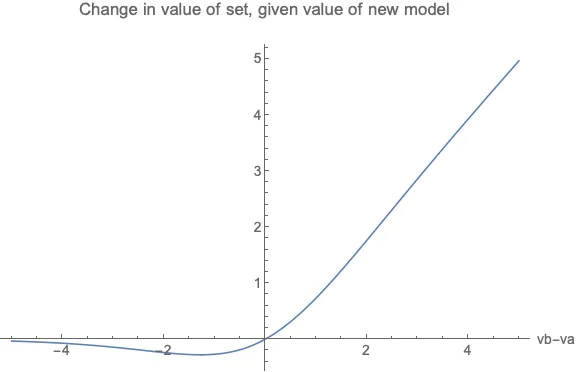
Consider a marketplace of AI tools, each with slightly different strengths and weaknesses. By selecting the right model for the task at hand, a user can do better than simply committing to a single model for everything. Routers operate under a similar principle, where sophisticated model selection can increase overall performance. However, aggregation is often noisy, reflecting in imperfect user choices or routing decisions. This leads to two main questions: first, what does a "healthy marketplace" of models look like for maximizing consumer utility? Secondly, how can we incentivize producers to create such models? Here, we study two types of model changes: market entry (where an entirely new model is created and added to the set of available models), and model replacement (where an existing model has its strengths and weaknesses changed). We show that winrate, a standard benchmark in LLM evaluation, can incentivize model creators to homogenize for both types of model changes, reducing consumer welfare. We propose a new mechanism, weighted winrate, which rewards models for answers that are higher quality, and show that it provably improves incentives for producers to specialize and increases consumer welfare. We conclude by demonstrating that our theoretical results generalize to empirical benchmark datasets and discussing implications for evaluation design.
2602.232931
Feb 2026Computer Science and Game Theory
Frontier Space-Time Algorithms Using Only Full Memory
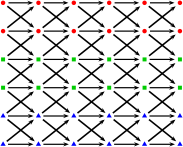
We develop catalytic algorithms for fundamental problems in algorithm design that run in polynomial time, use only $\mathcal{O}(\log(n))$ workspace, and use sublinear catalytic space matching the best-known space bounds of non-catalytic algorithms running in polynomial time. First, we design a polynomial time algorithm for directed $s$-$t$ connectivity using $n \big/ 2^{Θ(\sqrt{\log n})}$ catalytic space, which matches the state-of-the-art time-space bounds in the non-catalytic setting [Barnes et al., 1998], and improves the catalytic space usage of the best known algorithm [Cook and Pyne, 2026]. Furthermore, using only $\mathcal{O}(\log(n))$ random bits we get a randomized algorithm whose running time nearly matches the fastest time bounds known for space-unrestricted algorithms. Second, we design polynomial time algorithms for the problems of computing Edit Distance, Longest Common Subsequence, and the Discrete Fréchet Distance, again using $n \big/ 2^{Θ(\sqrt{\log n})}$ catalytic space. This again matches non-catalytic time-space frontier for Edit Distance and Least Common Subsequence [Kiyomi et al., 2021].
2602.210891
Feb 2026Data Structures and Algorithms
2602.21088A Space-space Trade-off for Directed st-Connectivity
We prove a space-space trade-off for directed $st$-connectivity in the catalytic space model. For any integer $k \leq n$, we give an algorithm that decides directed $st$-connectivity using $O(\log n \cdot \log k+\log n)$ regular workspace and $O\left(\frac{n}{k} \cdot \log^2 n\right)$ bits of catalytic memory. This interpolates between the classical $O(\log^2 n)$-space bound from Savitch's algorithm and a catalytic endpoint with $O(\log n)$ workspace and $O(n\cdot \log^2 n)$ catalytic memory. As a warm-up, we present a catalytic variant of Savitch's algorithm achieving the endpoint above. Up to logarithmic factors, this matches the smallest catalyst size currently known for catalytic logspace algorithms, due to Cook and Pyne (ITCS 2026). Our techniques also extend to counting the number of walks from $s$ to $t$ of a given length $\ell\leq n$.
2602.210881
Feb 2026Data Structures and Algorithms
2602.20833DRESS: A Continuous Framework for Structural Graph Refinement
The Weisfeiler-Lehman (WL) hierarchy is a cornerstone framework for graph isomorphism testing and structural analysis. However, scaling beyond 1-WL to 3-WL and higher requires tensor-based operations that scale as $\mathcal{O}(n^3)$ or $\mathcal{O}(n^4)$, making them computationally prohibitive for large graphs. In this paper, we start from the Original-DRESS equation (Castrillo, León, and Gómez, 2018) -- a parameter-free, continuous dynamical system on edges -- and show that it distinguishes the prism graph from $K_{3,3}$, a pair that 1-WL provably cannot separate. We then generalize it to Motif-DRESS, which replaces triangle neighborhoods with arbitrary structural motifs and converges to a unique fixed point under three sufficient conditions, and further to Generalized-DRESS, an abstract template parameterized by the choice of neighborhood operator, aggregation function and norm. Finally, we introduce $Δ$-DRESS, which runs DRESS on each node-deleted subgraph $G \setminus \{v\}$, connecting the framework to the Kelly--Ulam reconstruction conjecture. Both Motif-DRESS and $Δ$-DRESS empirically distinguish Strongly Regular Graphs (SRGs) -- such as the Rook and Shrikhande graphs -- that confound 3-WL. Our results establish the DRESS family as a highly scalable framework that empirically surpasses both 1-WL and 3-WL on well-known benchmark graphs, without the prohibitive $\mathcal{O}(n^4)$ computational cost.
2602.208331
Feb 2026Data Structures and Algorithms
Embedding arbitrary Boolean circuits into fungal automata with arbitrary update sequences
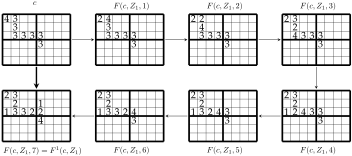
The sandpile automata of Bak, Tang, and Wiesenfeld (Phys. Rev. Lett., 1987) are a simple model for the diffusion of particles in space. A fundamental problem related to the complexity of the model is predicting its evolution in the parallel setting. Despite decades of effort, a classification of this problem for two-dimensional sandpile automata remains outstanding. Fungal automata were recently proposed by Goles et al. (Phys. Lett. A, 2020) as a spin-off of the model in which diffusion occurs either in horizontal $(H)$ or vertical $(V)$ directions according to a so-called update scheme. Goles et al. proved that the prediction problem for this model with the update scheme $H^4V^4$ is $\textbf{P}$-complete. This result was subsequently improved by Modanese and Worsch (Algorithmica, 2024), who showed the problem is $\textbf{P}$-complete also for the simpler updatenscheme $HV$. In this work, we fill in the gaps and prove that the prediction problem is $\textbf{P}$-complete for any update scheme that contains both $H$ and $V$ at least once.
2602.194771
Feb 2026Computational Complexity
Decision Making under Imperfect Recall: Algorithms and Benchmarks
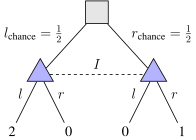
In game theory, imperfect-recall decision problems model situations in which an agent forgets information it held before. They encompass games such as the ``absentminded driver'' and team games with limited communication. In this paper, we introduce the first benchmark suite for imperfect-recall decision problems. Our benchmarks capture a variety of problem types, including ones concerning privacy in AI systems that elicit sensitive information, and AI safety via testing of agents in simulation. Across 61 problem instances generated using this suite, we evaluate the performance of different algorithms for finding first-order optimal strategies in such problems. In particular, we introduce the family of regret matching (RM) algorithms for nonlinear constrained optimization. This class of parameter-free algorithms has enjoyed tremendous success in solving large two-player zero-sum games, but, surprisingly, they were hitherto relatively unexplored beyond that setting. Our key finding is that RM algorithms consistently outperform commonly employed first-order optimizers such as projected gradient descent, often by orders of magnitude. This establishes, for the first time, the RM family as a formidable approach to large-scale constrained optimization problems.
2602.152521
Feb 2026Computer Science and Game Theory
Sublinear-Time Lower Bounds for Approximating Matching Size using Non-Adaptive Queries
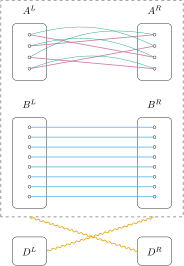
We study the problem of estimating the size of the maximum matching in the sublinear-time setting. This problem has been extensively studied, with several known upper and lower bounds. A notable result by Behnezhad (FOCS 2021) established a 2-approximation in ~O(n) time. However, all known upper and lower bounds are in the adaptive query model, where each query can depend on previous answers. In contrast, non-adaptive query models-where the distribution over all queries must be fixed in advance-are widely studied in property testing, often revealing fundamental gaps between adaptive and non-adaptive complexities. This raises the natural question: is adaptivity also necessary for approximating the maximum matching size in sublinear time? This motivates the goal of achieving a constant or even a polylogarithmic approximation using ~O(n) non-adaptive adjacency list queries, similar to what was done by Behnezhad using adaptive queries. We show that this is not possible by proving that any randomized non-adaptive algorithm achieving an n^{1/3 - gamma}-approximation, for any constant gamma > 0, with probability at least 2/3, must make Omega(n^{1 + eps}) adjacency list queries, for some constant eps > 0 depending on gamma. This result highlights the necessity of adaptivity in achieving strong approximations. However, non-trivial upper bounds are still achievable: we present a simple randomized algorithm that achieves an n^{1/2}-approximation in O(n log^2 n) queries. Moreover, our lower bound also extends to the newly defined variant of the non-adaptive model, where queries are issued according to a fixed query tree, introduced by Azarmehr, Behnezhad, Ghafari, and Sudan (FOCS 2025) in the context of Local Computation Algorithms.
2602.143261
Feb 2026Data Structures and Algorithms
Graph Homomorphisms and Universal Algebra
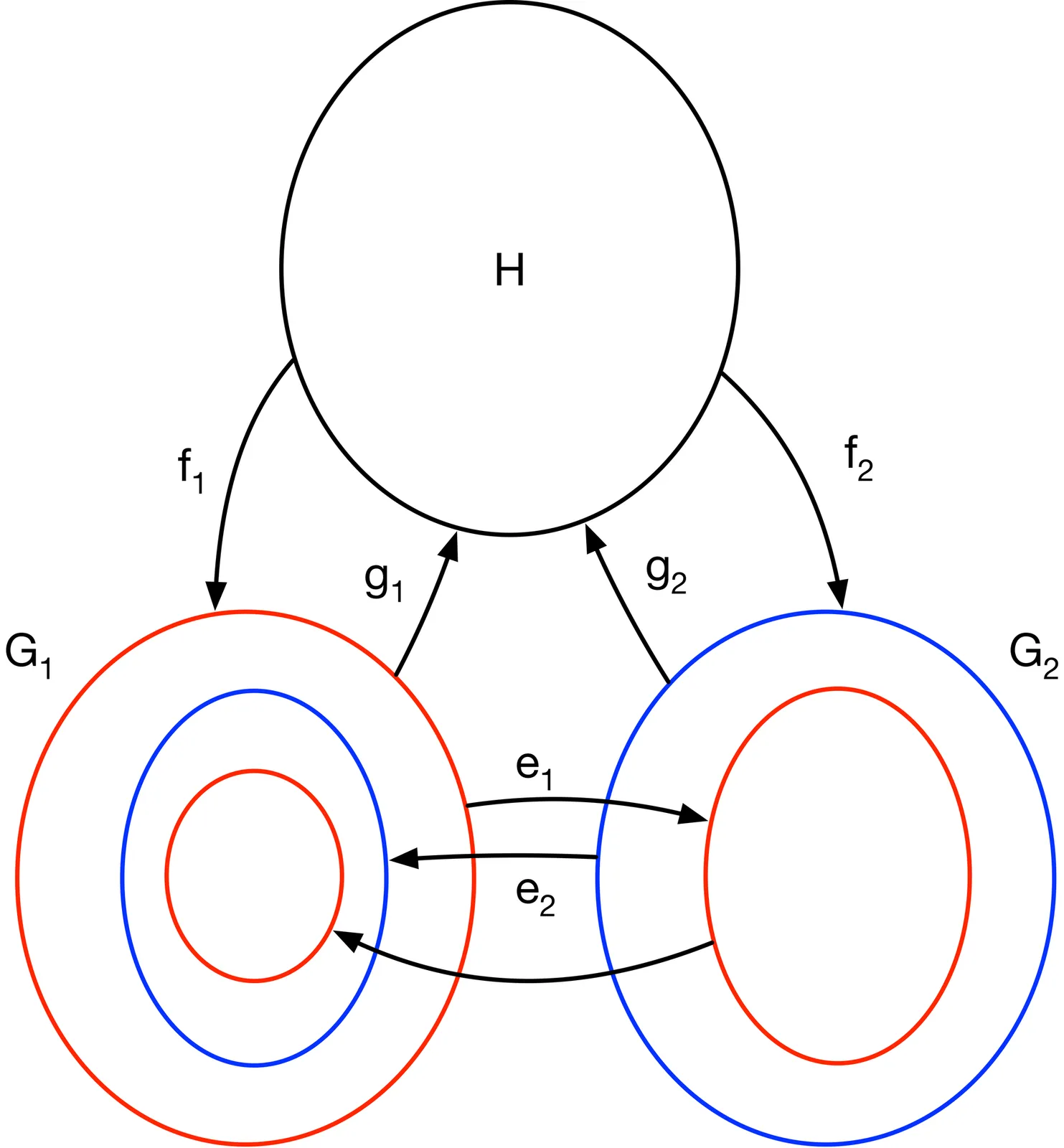
Constraint satisfaction problems are computational problems that naturally appear in many areas of theoretical computer science. One of the central themes is their computational complexity, and in particular the border between polynomial-time tractability and NP-hardness. In this course we introduce the universal-algebraic approach to study the computational complexity of finite-domain CSPs. The course covers in particular the cyclic terms and bounded width theorems. To keep the presentation accessible, we start the course in the tangible setting of directed graphs and graph homomorphism problems.
2602.142431
Feb 2026Computational Complexity
Limits of Kernelization and Parametrization for Phylogenetic Diversity with Dependencies
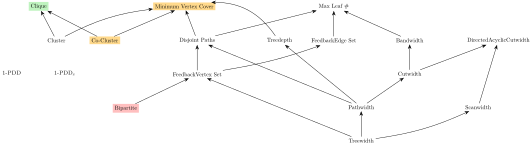
In the Maximize Phylogenetic Diversity problem, we are given a phylogenetic tree that represents the genetic proximity of species, and we are asked to select a subset of species of maximum phylogenetic diversity to be preserved through conservation efforts, subject to budgetary constraints that allow only k species to be saved. This neglects that it is futile to preserve a predatory species if we do not also preserve at least a subset of the prey it feeds on. Thus, in the Optimizing PD with Dependencies ($ε$-PDD) problem, we are additionally given a food web that represents the predator-prey relationships between species. The goal is to save a set of k species of maximum phylogenetic diversity such that for every saved species, at least one of its prey is also saved. This problem is NP-hard even when the phylogenetic tree is a star. The $α$-PDD problem alters PDD by requiring that at least some fraction $α$ of the prey of every saved species are also saved. In this paper, we study the parameterized complexity of $α$-PDD. We prove that the problem is W[1]-hard and in XP when parameterized by the solution size k, the diversity threshold D, or their complements. When parameterized by the vertex cover number of the food web, $α$-PDD is fixed-parameter tractable (FPT). A key measure of the computational difficulty of a problem that is FPT is the size of the smallest kernel that can be obtained. We prove that, when parameterized by the distance to clique, 1-PDD admits a linear kernel. Our main contribution is to prove that $α$-PDD does not admit a polynomial kernel when parameterized by the vertex cover number plus the diversity threshold D, even if the phylogenetic tree is a star. This implies the non-existence of a polynomial kernel for $α$-PDD also when parameterized by a range of structural parameters of the food web, such as its dist[...]
2602.129593
Feb 2026Computational Complexity
Contextual Online Bilateral Trade
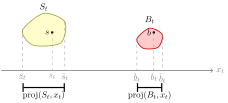
We study repeated bilateral trade when the valuations of the sellers and the buyers are contextual. More precisely, the agents' valuations are given by the inner product of a context vector with two unknown $d$-dimensional vectors -- one for the buyers and one for the sellers. At each time step $t$, the learner receives a context and posts two prices, one for the seller and one for the buyer, and the trade happens if both agents accept their price. We study two objectives for this problem, gain from trade and profit, proving no-regret with respect to a surprisingly strong benchmark: the best omniscient dynamic strategy. In the natural scenario where the learner observes \emph{separately} whether the agents accept their price -- the so-called \emph{two-bit} feedback -- we design algorithms that achieve $O(d\log d)$ regret for gain from trade, and $O(d \log\log T + d\log d)$ regret for profit maximization. Both results are tight, up to the $\log(d)$ factor, and implement per-step budget balance, meaning that the learner never incurs negative profit. In the less informative \emph{one-bit} feedback model, the learner only observes whether a trade happens or not. For this scenario, we show that the tight two-bit regret regimes are still attainable, at the cost of allowing the learner to possibly incur a small negative profit of order $O(d\log d)$, which is notably independent of the time horizon. As a final set of results, we investigate the combination of one-bit feedback and per-step budget balance. There, we design an algorithm for gain from trade that suffers regret independent of the time horizon, but \emph{exponential} in the dimension $d$. For profit maximization, we maintain this exponential dependence on the dimension, which gets multiplied by a $\log T$ factor.
2602.129031
Feb 2026Computer Science and Game Theory
2602.10360Skirting Additive Error Barriers for Private Turnstile Streams
We study differentially private continual release of the number of distinct items in a turnstile stream, where items may be both inserted and deleted. A recent work of Jain, Kalemaj, Raskhodnikova, Sivakumar, and Smith (NeurIPS '23) shows that for streams of length $T$, polynomial additive error of $Ω(T^{1/4})$ is necessary, even without any space restrictions. We show that this additive error lower bound can be circumvented if the algorithm is allowed to output estimates with both additive \emph{and multiplicative} error. We give an algorithm for the continual release of the number of distinct elements with $\text{polylog} (T)$ multiplicative and $\text{polylog}(T)$ additive error. We also show a qualitatively similar phenomenon for estimating the $F_2$ moment of a turnstile stream, where we can obtain $1+o(1)$ multiplicative and $\text{polylog} (T)$ additive error. Both results can be achieved using polylogarithmic space whereas prior approaches use polynomial space. In the sublinear space regime, some multiplicative error is necessary even if privacy is not a consideration. We raise several open questions aimed at better understanding trade-offs between multiplicative and additive error in private continual release.
2602.103601
Feb 2026Data Structures and Algorithms
The Complexity of Bayesian Network Learning: Revisiting the Superstructure
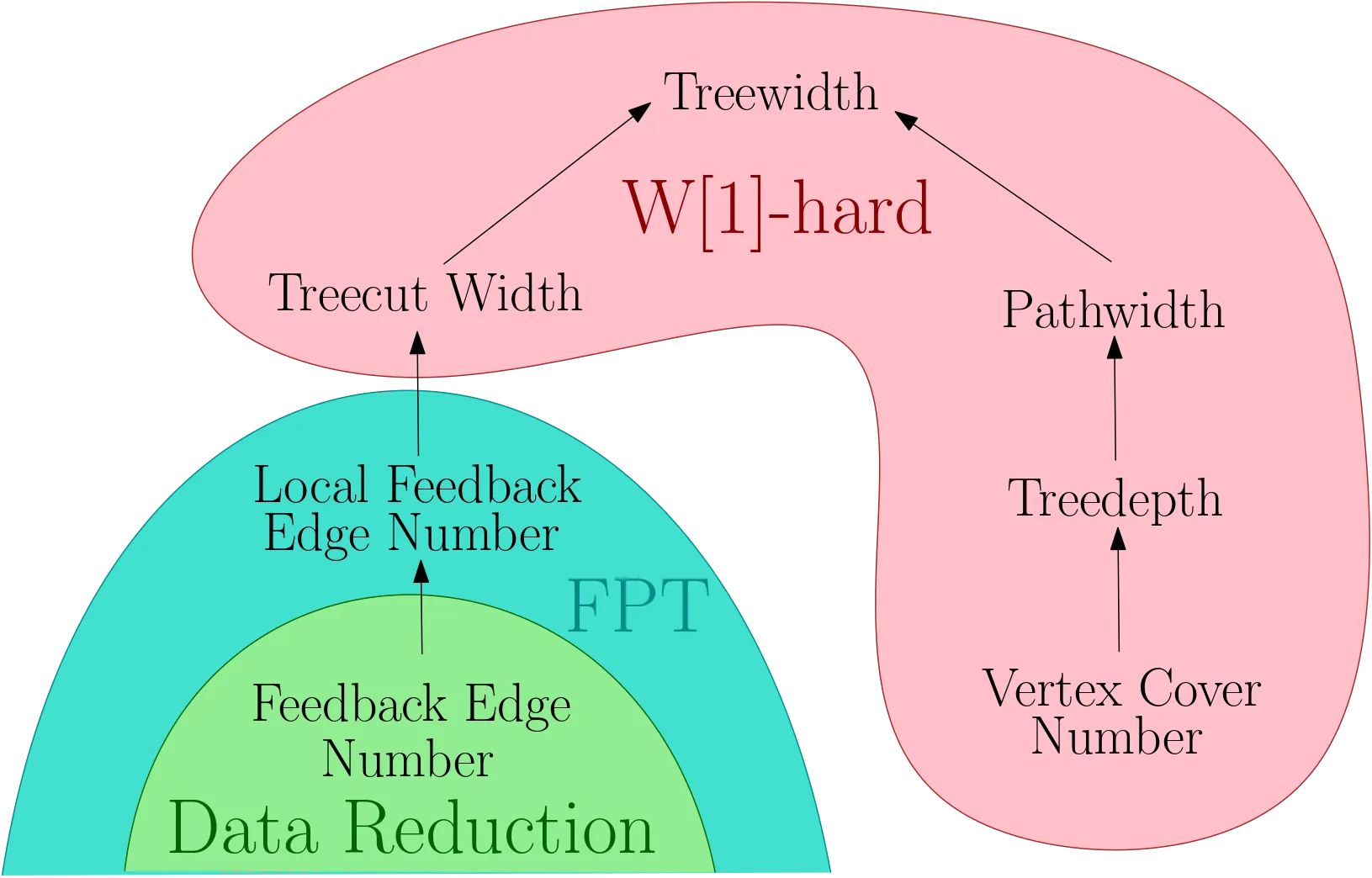
We investigate the parameterized complexity of Bayesian Network Structure Learning (BNSL), a classical problem that has received significant attention in empirical but also purely theoretical studies. We follow up on previous works that have analyzed the complexity of BNSL w.r.t. the so-called superstructure of the input. While known results imply that BNSL is unlikely to be fixed-parameter tractable even when parameterized by the size of a vertex cover in the superstructure, here we show that a different kind of parameterization - notably by the size of a feedback edge set - yields fixed-parameter tractability. We proceed by showing that this result can be strengthened to a localized version of the feedback edge set, and provide corresponding lower bounds that complement previous results to provide a complexity classification of BNSL w.r.t. virtually all well-studied graph parameters. We then analyze how the complexity of BNSL depends on the representation of the input. In particular, while the bulk of past theoretical work on the topic assumed the use of the so-called non-zero representation, here we prove that if an additive representation can be used instead then BNSL becomes fixed-parameter tractable even under significantly milder restrictions to the superstructure, notably when parameterized by the treewidth alone. Last but not least, we show how our results can be extended to the closely related problem of Polytree Learning.
2602.1025330
Feb 2026Data Structures and Algorithms
Online Contract Design
We initiate the study of online contracts, which integrate the game-theoretic considerations of economic contract theory, with the algorithmic and informational challenges of online algorithm design. Our starting point is the classic online setting with preemption of Buchbinder et al. [SODA'15], in which a hiring principal faces a sequence of adversarial agent arrivals. Upon arrival, the principal must decide whether to tentatively accept the agent to their team, and whether to dismiss previous tentative choices. Dismissal is irrevocable, giving the setting its online decision-making flavor. In our setting, the agents are rational players: once the team is finalized, a game is played where the principal offers contracts (performance-based payment schemes), and each agent decides whether or not to work. Working agents reward the principal, and the goal is to choose a team that maximizes the principal's utility. Our main positive result is a 1/2-competitive algorithm when agent rewards are additive, which matches the best-possible competitive ratio. Our algorithm is randomized and this is necessary, as we show that no deterministic algorithm can attain a bounded competitive ratio. Moreover, if agent rewards are allowed to exhibit combinatorial structure known as XOS, even randomized algorithms might fail. En route to our competitive algorithm, we develop the technique of balance points, which can be useful for further exploration of online contracts in the adversarial model.
2602.073851
Feb 2026Computer Science and Game Theory
2602.03701A Formal Analysis of Capacity Scaling Algorithms for Minimum-Cost Flows
We present formalisations of the correctness of executable algorithms to solve minimum-cost flow problems in Isabelle/HOL. Two of the algorithms are based on the technique of scaling, most notably Orlin's algorithm, which has the fastest known running time for solving the problem of minimum-cost flow. We also include a formalisation of the worst-case running time argument for Orlin's algorithm. Our verified implementation of this algorithm, which is derived by the technique of stepwise refinement, is fully executable and was integrated into a reusable formal library on graph algorithms. Because the problems for which Orlin's algorithm works are restricted, we also verified an executable reduction from the general minimum-cost flow problem. We believe we are the first to formally consider the problem of minimum-cost flows and, more generally, any scaling algorithms. Our work has also led to a number of mathematical insights and improvements to proofs as well as theorem statements, compared to all existing expositions.
2602.037012
Feb 2026Logic in Computer Science