Transport, organelles, cytoskeleton, molecular motors, compartments.
Cellular actin structures are continuously turned over while keeping similar sizes. Since they all compete for a shared pool of actin monomers, the question arises how they can coexist in these dynamic steady states. Recently, the coexistence of branched actin networks with different densities growing in a shared and finite pool of purified proteins has been demonstrated in a biomimetic bead assay. However, theoretical work in the context of organelle size regulation has mainly been focused on linear architectures, such as single filaments and bundles, and thus is not able to explain this observation. Here we show theoretically that the local depletion of actin monomers caused by the growth of a branched network naturally gives rise to a negative feedback loop between network density and growth rate, and that this competition is captured by one central equation. A comprehensive bifurcation analysis shows that the theory leads to well-defined steady states even in the case of multiple networks sharing the same pool of monomers, without any need for specific molecular processes. Under increasing competition strength, coexistence is replaced by selection. We also show that our theory is in excellent agreement with spatiotemporal simulations implemented in a finite element framework. In summary, our work suggests that local monomer depletion is the decisive and universal factor controlling growth of branched actin networks.
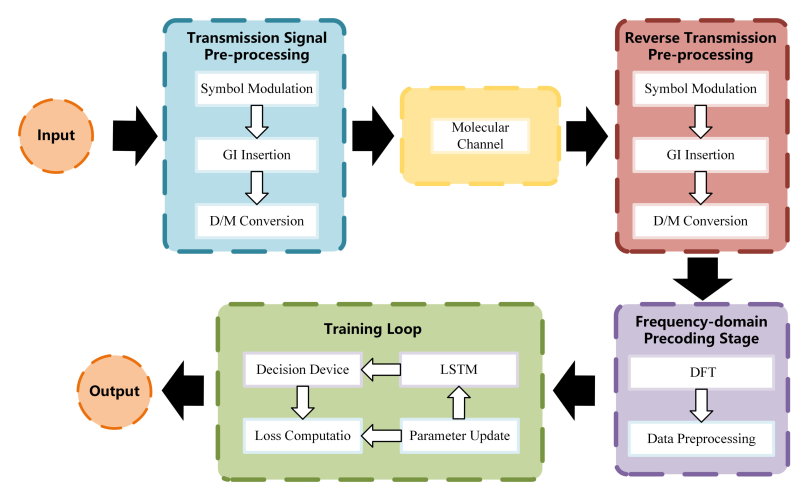
In molecular communications (MC), inter-symbol interference (ISI) and noise are key factors that degrade communication reliability. Although time-domain equalization can effectively mitigate these effects, it often entails high computational complexity concerning the channel memory. In contrast, frequency-domain equalization (FDE) offers greater computational efficiency but typically requires prior knowledge of the channel model. To address this limitation, this letter proposes FDE techniques based on long short-term memory (LSTM) neural networks, enabling temporal correlation modeling in MC channels to improve ISI and noise suppression. To eliminate the reliance on prior channel information in conventional FDE methods, a supervised training strategy is employed for channel-adaptive equalization. Simulation results demonstrate that the proposed LSTM-FDE significantly reduces the bit error rate compared to traditional FDE and feedforward neural network-based equalizers. This performance gain is attributed to the LSTM's temporal modeling capabilities, which enhance noise suppression and accelerate model convergence, while maintaining comparable computational efficiency.
Voltage distribution in sub-cellular micro-domains such as neuronal synapses, small protrusions or dendritic spines regulates the opening and closing of ionic channels, energy production and thus cellular homeostasis and excitability. Yet how voltage changes at such a small scale in vivo remains challenging due to the experimental diffraction limit, large signal fluctuations and the still limited resolution of fast voltage indicators. Here, we study the voltage distribution in nano-compartments using a computational approach based on the Poisson-Nernst-Planck equations for the electro-diffusion motion of ions, where inward and outward fluxes are generated between channels. We report a current-voltage (I-V) logarithmic relationship generalizing Nernst law that reveals how the local membrane curvature modulates the voltage. We further find that an influx current penetrating a cellular electrolyte can lead to perturbations from tens to hundreds of nanometers deep depending on the local channels organization. Finally, we show that the neck resistance of dendritic spines can be completely shunted by the transporters located on the head boundary, facilitating ionic flow. To conclude, we propose that voltage is regulated at a subcellular level by channels organization, membrane curvature and narrow passages.
For the canonical two-state model of transcription, we derive exact analytic expressions for the entropy production rate of transcription at steady state, and assess detailed balance breaking in transcription. Our analytics allow us to easily evaluate the entropy production rate of thousands of genes across seven datasets of two-state model parameters without needing to evaluate the entropy production rate from trajectory-based computation. A data-driven approach then exposes that most genes avoid parameter regimes associated with large entropy production rates, akin to a mesoscopic version of energy expenditure minimization. Importantly, we show that this is not a thermodynamic phenomenon, since the entropy production rate from the two state gene model provides only a weak bound on the housekeeping energy needed to power transcription. Finally, we show that cell-to-cell variability can make mRNA expression seem more or less irreversible than a ``representative cell'' would imply.
Many imaging techniques for biological systems -- like fixation of cells coupled with fluorescence microscopy -- provide sharp spatial resolution in reporting locations of individuals at a single moment in time but also destroy the dynamics they intend to capture. These snapshot observations contain no information about individual trajectories, but still encode information about movement and demographic dynamics, especially when combined with a well-motivated biophysical model. The relationship between spatially evolving populations and single-moment representations of their collective locations is well-established with partial differential equations (PDEs) and their inverse problems. However, experimental data is commonly a set of locations whose number is insufficient to approximate a continuous-in-space PDE solution. Here, motivated by popular subcellular imaging data of gene expression, we embrace the stochastic nature of the data and investigate the mathematical foundations of parametrically inferring demographic rates from snapshots of particles undergoing birth, diffusion, and death in a nuclear or cellular domain. Toward inference, we rigorously derive a connection between individual particle paths and their presentation as a Poisson spatial process. Using this framework, we investigate the properties of the resulting inverse problem and study factors that affect quality of inference. One pervasive feature of this experimental regime is the presence of cell-to-cell heterogeneity. Rather than being a hindrance, we show that cell-to-cell geometric heterogeneity can increase the quality of inference on dynamics for certain parameter regimes. Altogether, the results serve as a basis for more detailed investigations of subcellular spatial patterns of RNA molecules and other stochastically evolving populations that can only be observed for single instants in their time evolution.