188 papers
Effects of Schwarzschild's Black Hole Singularities on Complex Scalar Field
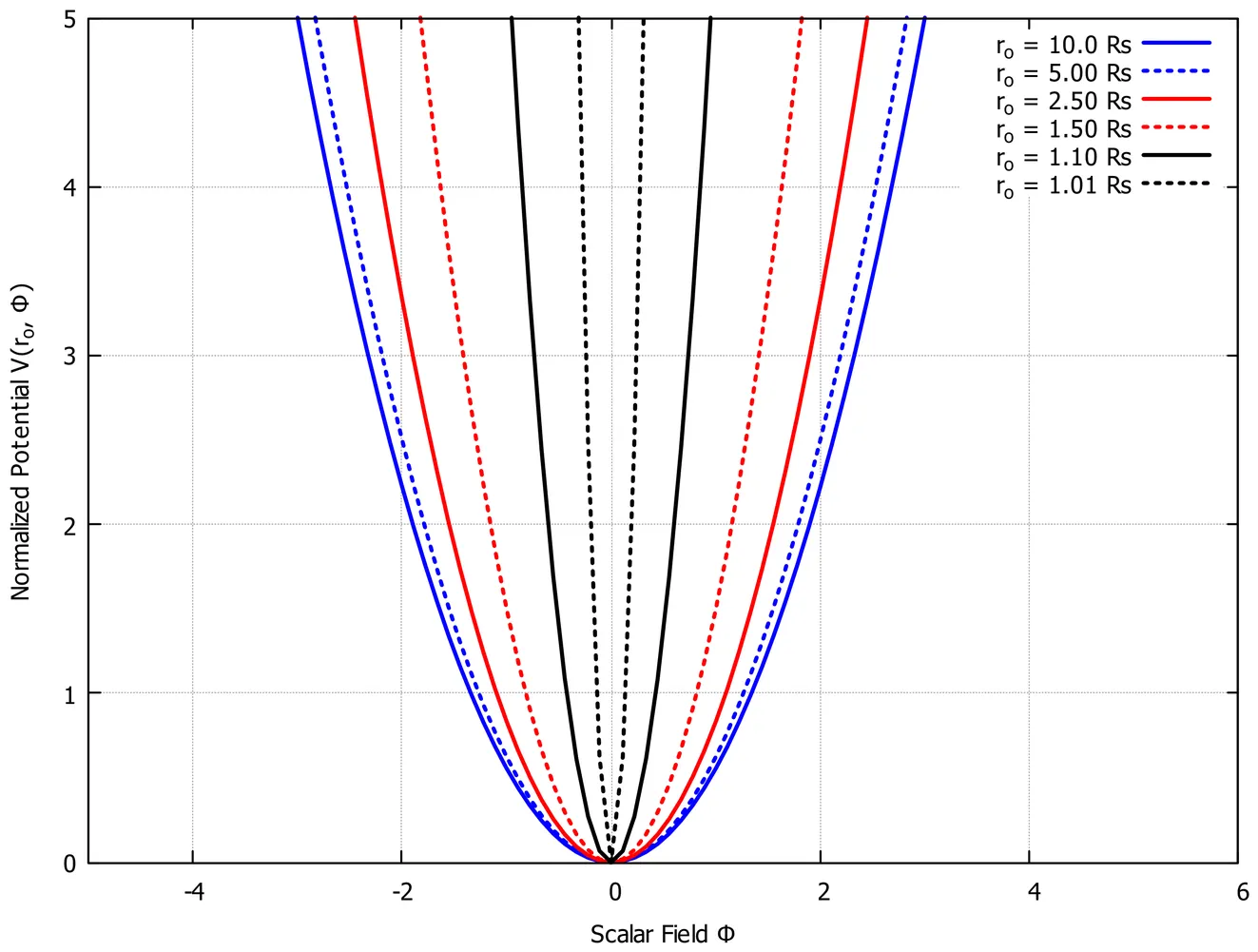
Complex scalar fields described by a novel Klein-Gordon equation derived from gauge and group theories are considered at the Schwarzschild's black hole singularities. It is shown that the field is well-behaved in the vicinity of these singularities and that its value reaches zero at both singularities. The obtained results also demonstrate that the field forms a scalar hair that exists outside of the event horizon, and that the interior field is tachyonic and undergoes a tachyonic condensation to reach its true vacuum at the central singularity. The described field's behavior is very different from that predicted by the Klein-Gordon equation minimally coupled to gravity. Physical implications of these results for the interior structure of black holes are discussed.
2604.01246Mar 2026
View 2603.26986
Scalar-tensor gravity and Aharonov-Bohm electrodynamics with bosons: applications to superconductors
We study a scalar-tensor extension of gravity with two scalar fields coupled to the Aharonov-Bohm extension of electrodynamics, where the scalar mode $S\equiv\partial_μA^μ$ is dynamical. In this framework the trace of the electromagnetic energy-momentum tensor is nonvanishing and the scalar $S$ induces an electro-gravitational coupling that can be enhanced by the vacuum expectation value of the second gravitational scalar. For bosonic matter described by a macroscopic wavefunction (as in superconductors), the coupling to the electromagnetic potential generates $S$ already at the semiclassical level, implying sizable junction-induced discontinuities. Including the scalar-tensor sector yields a nonlinear system for $S$ and a gravitational scalar combination $β$ that admits a bulk saturation solution $S_{\rm sat}^2=(Λλ_L^2)^{-1}$ and a corresponding threshold condition for macroscopic effects. We apply these results to pulsed discharges across normal-superconducting junctions and obtain scaling relations for the onset of anomalous gravitational signals in terms of current density, pulse duration, and superconducting volume, consistent with reported threshold behavior in two independent experimental configurations for a single microscopic parameter. We also present time-dependent propagating solutions in the weak-field regime and derive a class of one-dimensional traveling exact solutions of the nonlinear vacuum Einstein equations.
2603.26986Mar 2026
View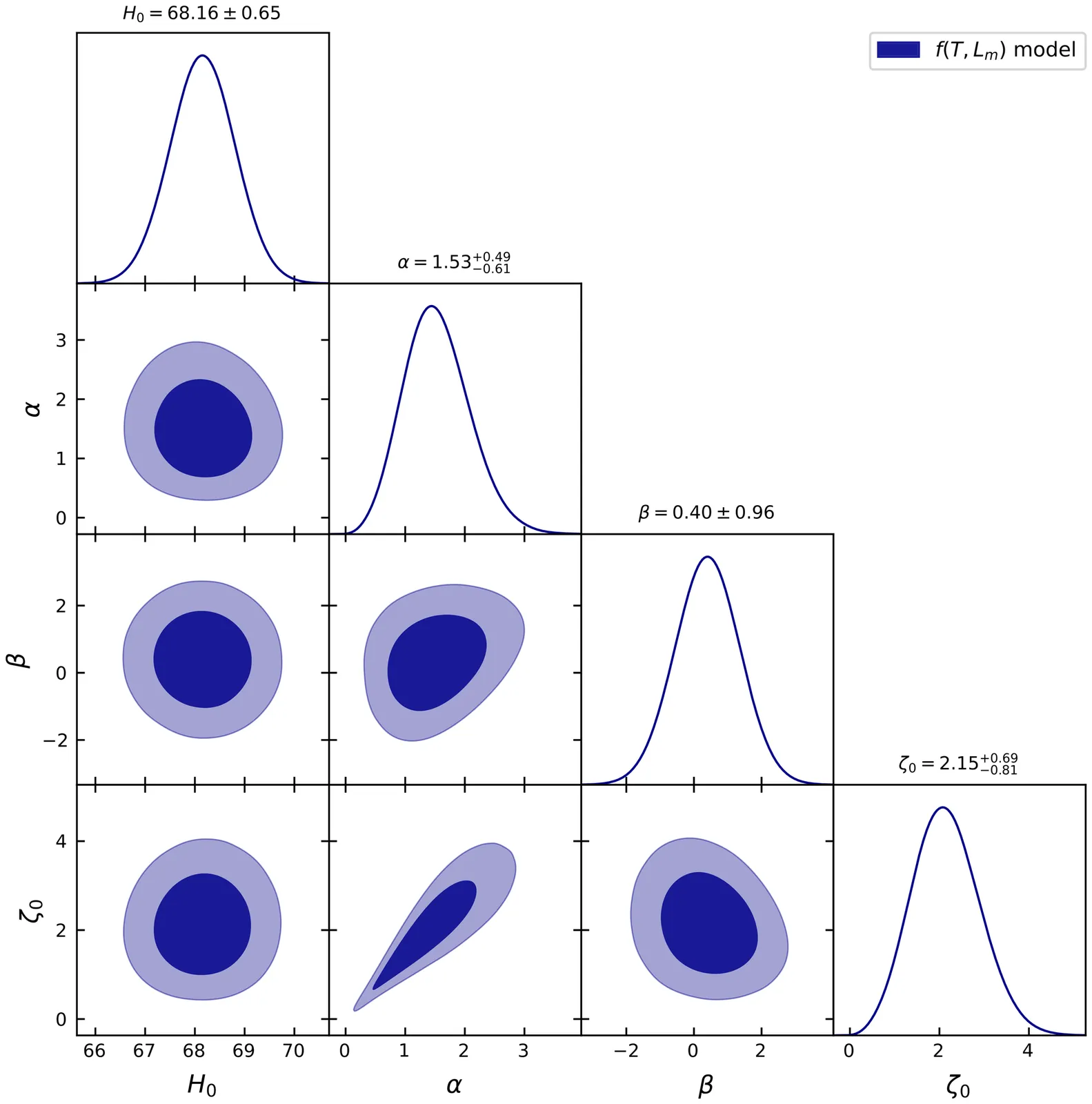
Observational constraints on viscous cosmology in $f(T,L_m)$ gravity
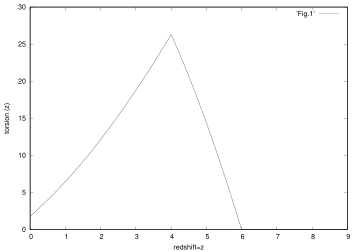
We investigate the late-time cosmic acceleration within the framework of viscous $f(T,L_m)$ gravity, where the gravitational action depends on both the torsion scalar $T$ and the matter Lagrangian $L_m$. In this context, the Universe is modeled as a bulk viscous fluid, allowing for dissipative effects that generate an effective negative pressure capable of driving acceleration without invoking a cosmological constant. We adopt a simple linear model $f(T,L_m) = αT + βL_m$ and assume a constant bulk viscosity coefficient $ζ= ζ_0 > 0$. The model parameters are constrained using a joint analysis of recent observational datasets, including 31 Hubble parameter measurements, the Pantheon+ sample of 1701 Type Ia Supernovae, and the latest baryon acoustic oscillation data from DESI, employing a Markov Chain Monte Carlo (MCMC) approach. The best-fit results, $H_0 = 68.16 \pm 0.65$, $α= 1.53^{+0.49}_{-0.61}$, $β= 0.40 \pm 0.96$, and $ζ_0 = 2.15^{+0.69}_{-0.81}$, are consistent with current cosmological observations and indicate that bulk viscosity plays a significant role in the late-time dynamics. The deceleration parameter $q_0 = -0.33 \pm 0.41$ confirms the current accelerated expansion, while the effective equation of state (EoS) evolves from a matter-like regime at high redshift toward a quintessence phase at late times. The $Om(z)$ diagnostic further supports this behavior, suggesting a mild deviation from $Λ$CDM toward a dynamical dark energy component. Although information criteria ($Δ\mathrm{AIC} = 2.2$, $Δ\mathrm{BIC} = 13.13$) slightly favor the simpler $Λ$CDM model, the viscous $f(T,L_m)$ framework remains a viable and physically motivated alternative capable of explaining cosmic acceleration through the combined effects of torsion-matter coupling and viscosity.
2603.20561Mar 2026
View2604.00030Building an analog simulator of a photonic quantum computer with transparent tape, maple syrup, and cat lasers, and implementing first quantum algorithms in the classroom
This work presents the implementation of single-qubit gates, including $R_x$ and $R_z$ gates realized using transparent adhesive tape, and $R_y$ gates obtained with optically active maple and agave solutions. These gates form the native gate set of a simple photonic system and are subsequently used to construct a Hadamard gate. Two forms of two-qubit gates are introduced using a combination of a calcite crystal and transparent tape. The setups employ both the polarization and the path degree of freedom of a photon as qubits, illustrating how readily accessible materials can be used to manipulate and transform the quantum information they convey. Calculations are performed to determine the birefringence of two different types of tape and to quantify the specific rotations introduced by multiple layers of transparent tape. Finally, simple algorithms and exercises are proposed for students. These experimental setups are designed to facilitate hands-on manipulation of quantum effects while lowering the barrier to accessing quantum systems, with total costs kept below \$50 CAD for the single-qubit gates and below \$100 CAD for all experiments combined. The configurations presented serve as an analog simulator of a photonic quantum computer: although the laser beams used can be described classically, all theoretical considerations and experimental procedures remain valid for quantized systems employing single-photon emitters and single-photon detectors.
2604.00030Mar 2026
View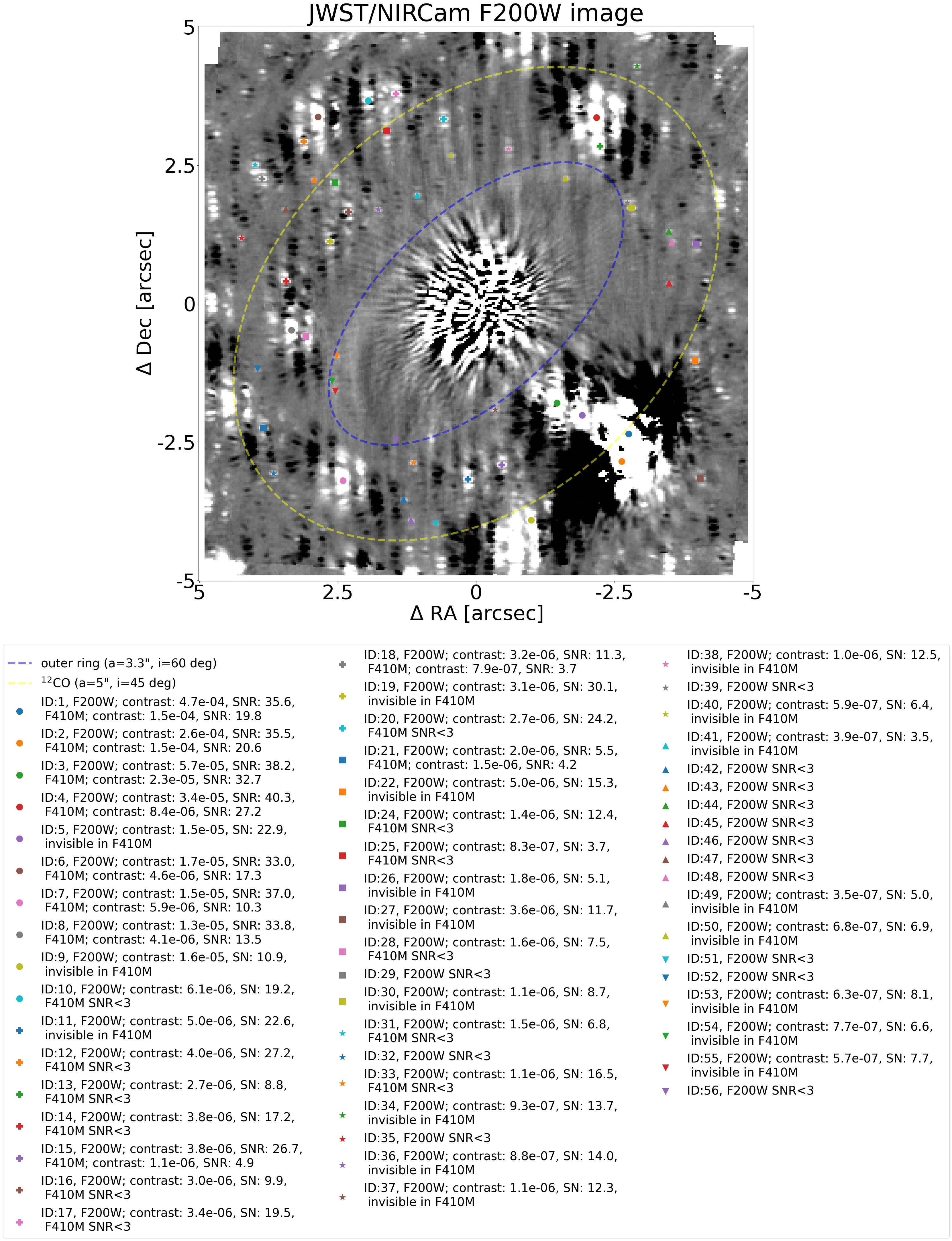
Photometric and Astrometric Information for Sources around HD~163296 Revealed by JWST/NIRCam Coronagraphy
Background stars observed through a circumstellar disk provide valuable benchmarks for investigating the disk's extinction properties. The HD~163296 system is an excellent case study due to its large disk, the clearly visible extinction effects in JWST/NIRCam data, and the presence of numerous background sources within or around its disk. We present the measured contrasts and astrometry of sources surrounding HD~163296 from Cycle~1 JWST/NIRCam coronagraphic observations, which will serve as a useful reference for future studies of the disk's extinction characteristics.
2603.18338Mar 2026
View2603.26694A Kähler and quaternion-Kähler spacetime structure
When real Lorentzian spacetime is embedded into a manifold parametrized by higher division algebras (complex or quaternion with Hermitean metric) and the representation constraints of their symmetry groups are made compatible, a set of quantum numbers is generated that is evocative of those of the standard model of particle physics. This is taken here as a hint that in spacetime there is a pseudo-Kähler or pseudo-quaternion-Kähler structure, real spacetime being a submanifold that inherits the symmetry contraints of the larger ambient manifold.
2603.26694Mar 2026
View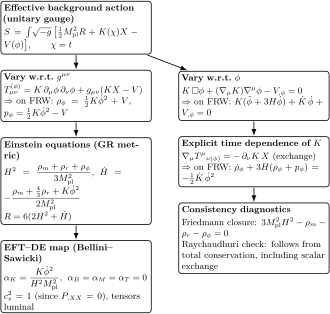
Quantum-Kinetic Dark Energy (QKDE): An effective dark energy framework with a covariantly completed time-dependent scalar kinetic normalization
A minimal effective dark-energy framework - Quantum-Kinetic Dark Energy (QKDE) - is developed in which the scalar kinetic normalization carries a slow background time dependence through a covariantly completed clock field χsuch that K = K(χ) > 0, while the Einstein-Hilbert metric sector remains unmodified. The resulting effective action admits a diffeomorphism-invariant completion, and working in unitary gauge χ= t reproduces the background equations used in the numerical analysis. Within the effective field theory of dark energy (EFT-DE) description the model corresponds to α_K > 0 with α_B = α_M = α_T = α_H = 0, implying luminal tensor propagation and a constant Planck mass. Scalar perturbations propagate with c_s^2 = 1, satisfy Φ= Ψ, and source linear growth through the unmodified Einstein equations. Observable signatures therefore arise solely through the expansion history H(a) and the induced growth D(a). Two realizations of the kinetic normalization are studied: (i) a curvature-motivated form K = 1 + αR/M^2, and (ii) a phenomenological running K = 1 + K_0 (1 + z)^p. A reproducible numerical pipeline and Fisher analysis for H(z), distances, and fσ_8(z) are presented. The framework predicts μ(a,k) = Σ(a,k) = 1, η(a,k) = 0, and c_T^2 = 1 on linear scales, providing clear falsifiable null tests. Earlier drafts circulated under the working title Scalar-Cost Dark Energy (SCDE).
2603.14716Mar 2026
View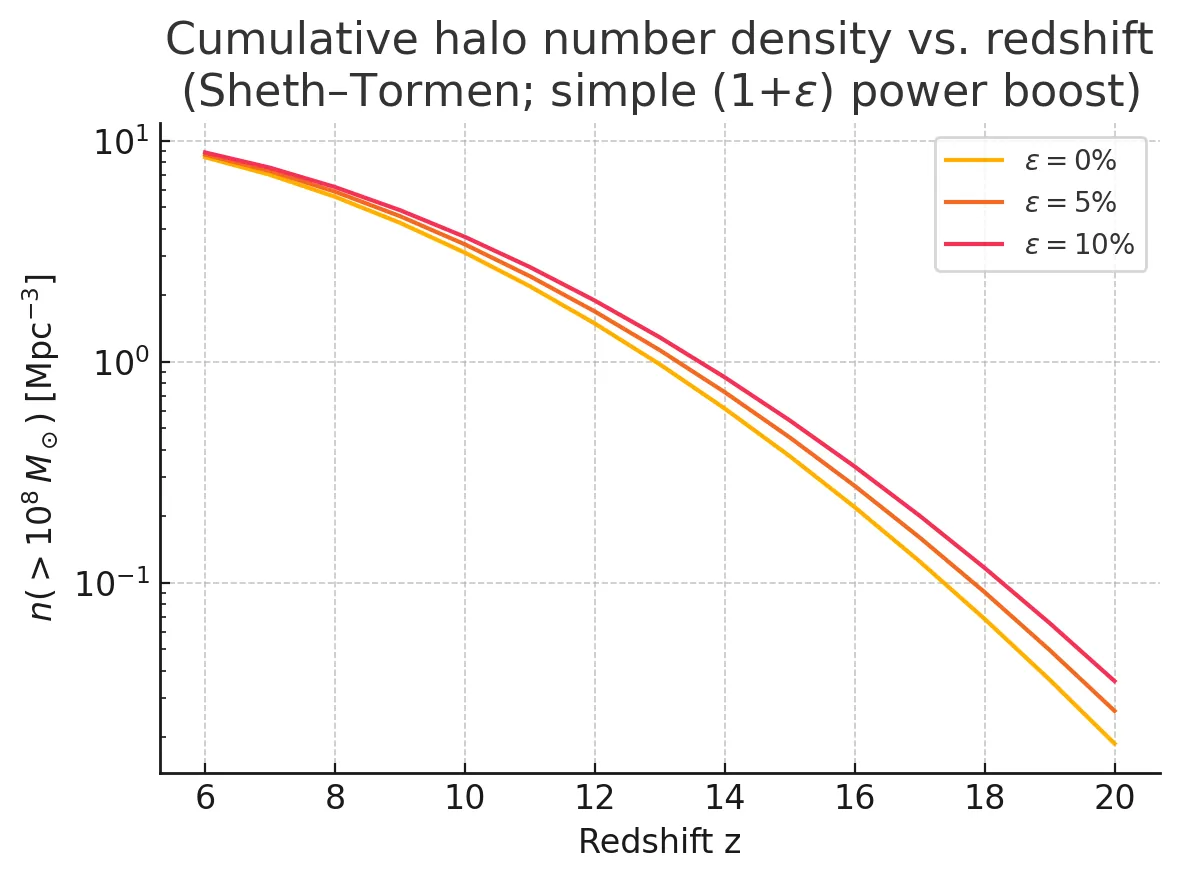
Quantum geometry from commutators: a Heisenberg-picture framework and a toy application to early structure
We develop a Heisenberg-picture \emph{kinematical} framework in which (i) time is treated as a quantum observable, admitting both a relational POVM construction for semibounded spectra and a fully self-adjoint realization on an enlarged (conjugate-energy) Hilbert space enabled by a gravitational conjugation symmetry $\mathcal{C}_g$, and (ii) the generators of spacetime translations need not commute in curved backgrounds. The central postulate, $[\,\hat{x}_μ,\hat{P}_ν\,]=\mathrm{i}\hbar\,\hat g_{μν}(\hat{x})$, makes the spacetime metric a \emph{metric operator} defined by the symmetrized commutator. Jacobi identities close the algebra and imply an operator form of metric compatibility; in a worked FRW example we obtain $[\,\hat{P}_0,\hat{P}_i\,]=2\mathrm{i}\hbar\,N^2(t)\,H(t)\,\hat{P}_i$, which reduces to $2\mathrm{i}\hbar\,H\,\hat{P}_i$ in cosmic-time gauge $N=1$, exhibiting Hubble--controlled non-commuting ``translations.'' A key structural ingredient is the symmetry $\mathcal{C}_g$: an antiunitary map that flips all translation generators, $\hat P_μ\!\to\!-Θ\hat P_μΘ^{-1}$, while covariantly transforming the metric and Lorentz sectors, leaving the canonical commutators and the $[P,P]$ algebra invariant. We discuss uncertainty relations and show how metric-operator fluctuations can rescale primordial amplitudes; an explicitly labeled \emph{toy} propagation of such a rescaling to high-$z$ halo abundances is given in Appendix~$D$.
2603.14533Mar 2026
View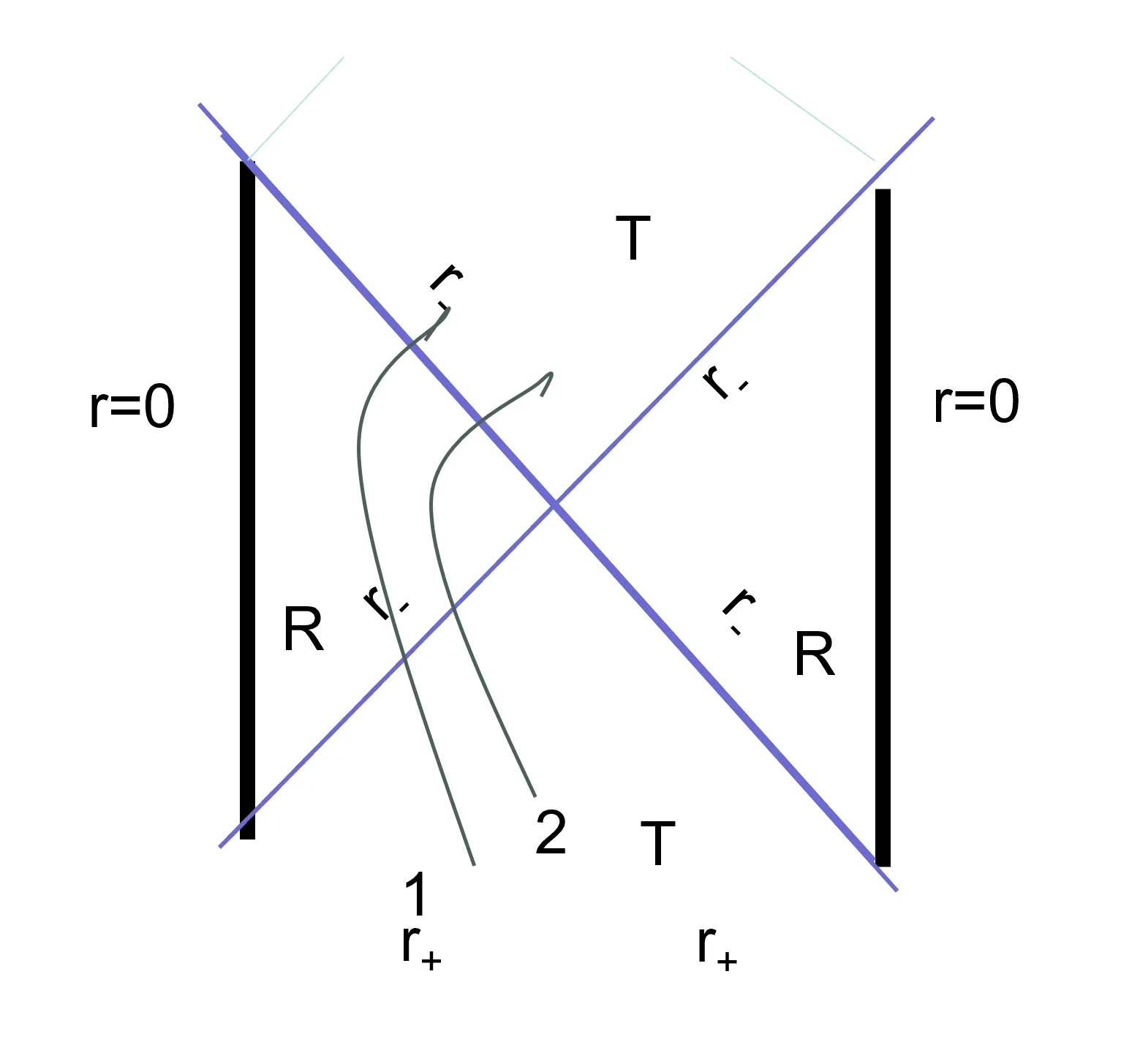
High energy particle collisions under Cauchy horizon
We consider particle collision inside the inner horizon of the Reissner-Nordstrom metric in the so-called R region. We show that there exist scenario in which the enrgy in the center of mass frame grows unbounded. In contrast to the standard scenarios of high energy collisions in black hole background in the R region, fine tuning of particle parameters is not require. The effect found in this work can be considered as a massive particle counterpart of wave processes that contribute to instability of the inner black hole horizon.
2603.20245Mar 2026
View2603.20244Accelerating universes generated by off-diagonal deformations and geometric flows of black holes in Einstein gravity vs $f(R)$ gravity
Over the past two decades, numerous modifications of general relativity (GR) and the standard cosmological paradigm have been proposed to describe both the early inflationary epoch and the late - time accelerating expansion of the Universe, while remaining consistent with updated observational data. In this work, we argue that it is possible to effectively stop the machinery of producing new modified gravity theories and exotic cosmological models, and instead remain within an axiomatic, spacetime-geometric framework of GR closely related to the standard ΛCDM paradigm. To support this claim, we construct new classes of generic off-diagonal solutions in GR and in the relativistic geometric flow theory of nonholonomic Einstein systems. These solutions describe the geometric evolution of black hole configurations into accelerating cosmological universes with effective dark energy fluids. Using the anholonomic frame and connection deformation method, we decouple and integrate, exactly or parametrically, the underlying nonlinear field equations for general off-diagonal metrics and (non)linear connection distortions. The resulting configurations, characterized by generating functions, integration functions, and effective sources, exhibit nonlinear symmetries and running cosmological constants, allowing smooth transformations between black hole and cosmological geometries.
2603.20244Mar 2026
View2603.10064An axially symmetric stationary N-center solution of Einstein's vacuum equations
Using the Euclidon method, a stationary solution of Einstein's vacuum equations was obtained, describing N rotating axially symmetric masses, which in the absence of rotation describes N arbitrary axially symmetric static masses, for example, N Zipoy masses on the axis of symmetry, and in the absence of distortion, N Kerr-NUT solutions.
2603.10064Mar 2026
View2603.08516An implicit restriction in the Dirac quantization
A restriction was found in the mathematics of the Dirac equation for a free neutrino type of particle. The basic assumption here is the equivalence of the four variables of spacetime. A perspective is defined as a metric tensor format. We asked what happens when we add a perspective where a time variable, $\sim ct$ unit [meter], becomes a space variable, unit [meter], and vice versa. A Lorentz invariant mixed metric tensor equation can be set up in an attempt to describe the neutrino in the cross-hairs of two different perspectives. Despite the equivalence of variables, and despite the fact that no single perspective is likely to be preferred, we find that the neutrino is "internally" changed in the cross-hairs of two different perspectives. Of course, if the two perspectives do not go together this conclusion collapses.
2603.08516Mar 2026
View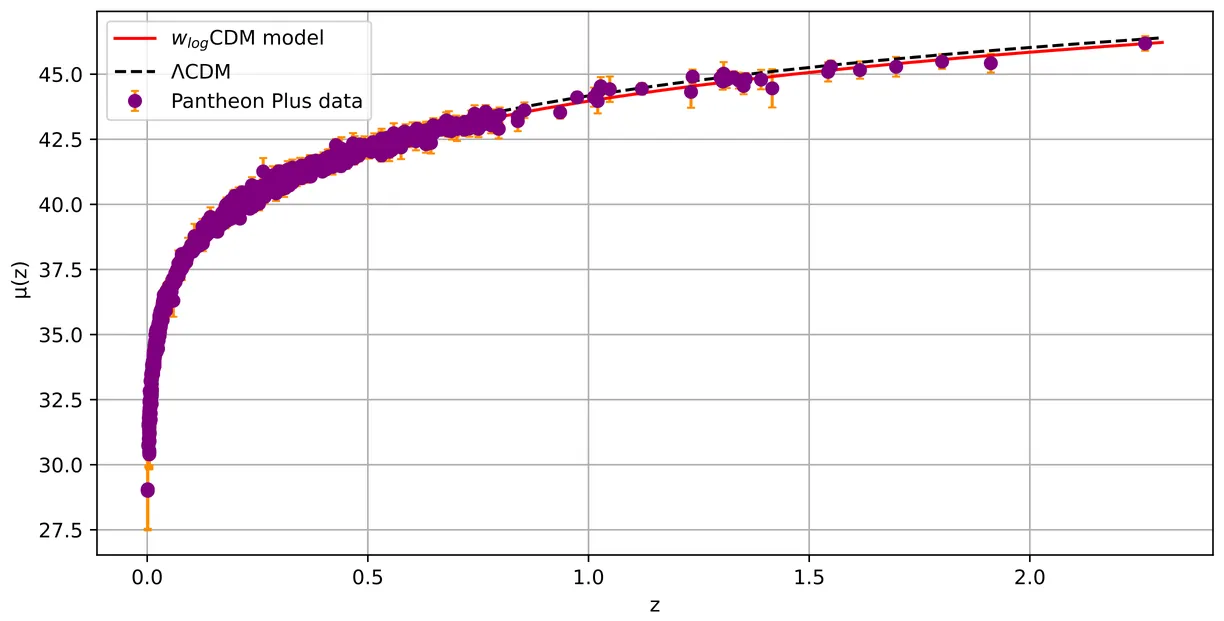
Alleviating the Hubble Tension with Logarithmic Dark Energy: Constraints on the $w_{log}$CDM Model
Observational constraints are considered on a $w_{log}$CDM model of the dark energy equation of state, $w_{d}(z) = w_{0} + w_{a}\left( \frac{\ln(2+z)}{1+z} - \ln 2 \right)$, using the most recent cosmological datasets including DESI Baryon Acoustic Oscillation (BAO) measurements, Big Bang Nucleosynthesis (BBN) priors, Cosmic Chronometer (CC) observations, and Pantheon Plus (PPS) Type Ia supernovae. From the combined DESI BAO+BBN+CC+PPS dataset, we obtain $H_0 = 71.02 \pm 0.66~\text{kms}^{-1}\text{Mpc}^{-1}$, $Ω_m = 0.2863 \pm 0.0080,$ $w_0 = -0.875 \pm 0.066,$ $w_a = -0.69^{+0.37}_{-0.32},$ at the 68\% and 95\% confidence levels, indicating a preference for phantom dark energy with mild evidence for temporal evolution. The Hubble constant obtained from our model is closer to the local SH0ES measurement than the standard $Λ$CDM prediction, partially easing the Hubble tension. We perform extensive parameter-space exploration revealing correlations between $w_0$, $w_a$, and $H_0$, showing that dynamical dark energy models can fit higher values of the Hubble constant. The reconstructed deceleration parameter $q(z)$ shows the transition from deceleration to acceleration at $z \sim 0.6$--$0.7$, while the equation-of-state reconstruction remains consistent with a cosmological constant across the observed redshift range. A model comparison using information criteria indicates that the $w_{log}$CDM model remains statistically competitive with $Λ$CDM.
2603.06686Mar 2026
View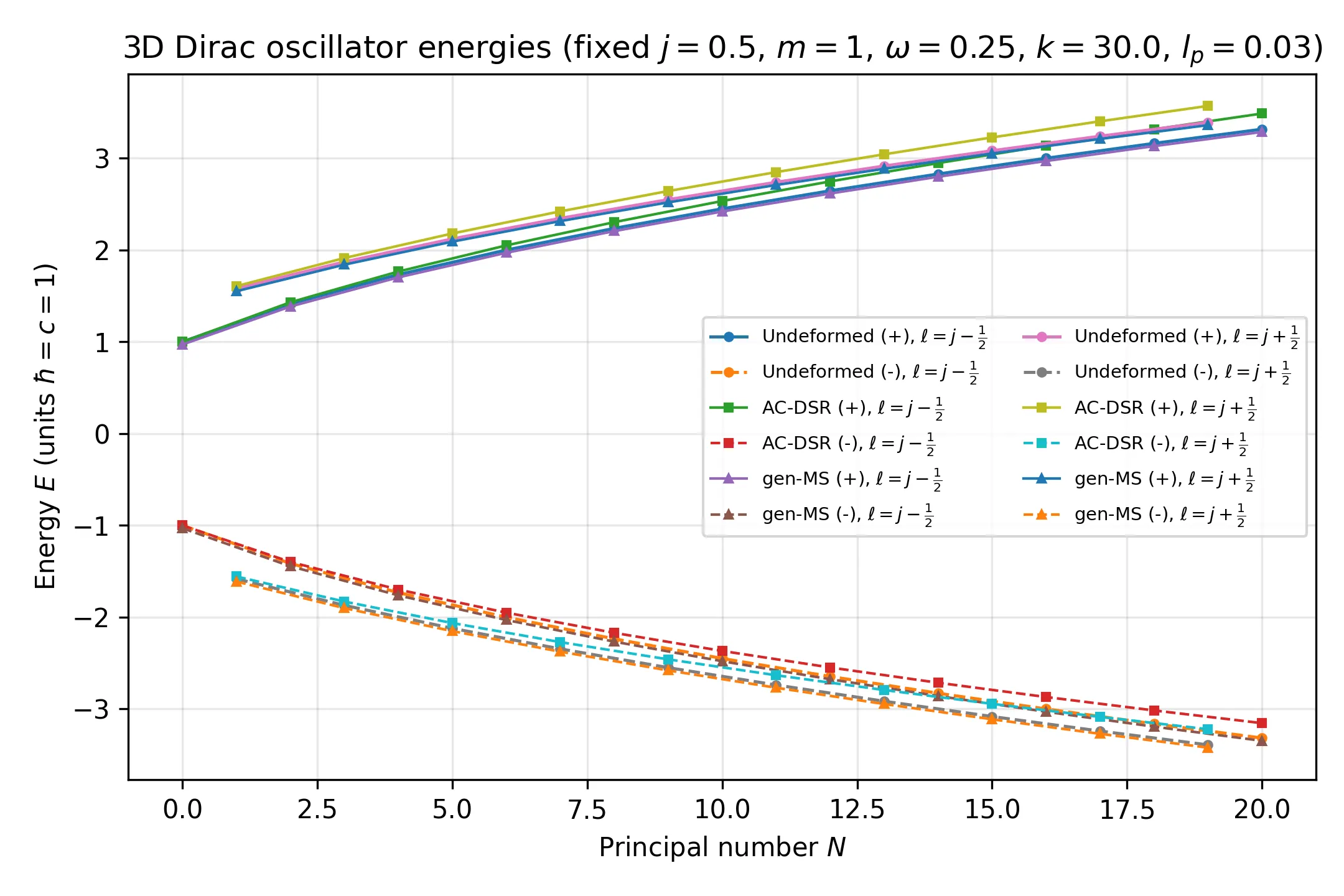
Three-Dimensional Modified Dirac Oscillator in Standard and Generalized Doubly Special Relativity
% Doubly Special Relativity (DSR) introduces, besides the invariant speed of light $c$, an observer-independent high-energy % scale that deforms relativistic kinematics and can be implemented through modified dispersion relations or effective % wave equations with energy-dependent spatial operators. In this work we develop a three-dimensional, exactly solvable % benchmark for such deformations in the spin-$\tfrac12$ sector: the Dirac oscillator. Following the original % construction of Moshinsky and Szczepaniak, the oscillator is introduced through a linear non-minimal momentum coupling, % which preserves Hermiticity and yields, after decoupling the Dirac equation into large and small components, a % three-dimensional isotropic harmonic-oscillator operator supplemented by a strong spin--orbit term. % We then incorporate Planck-scale deformations in two standard DSR realizations (Amelino--Camelia and % Magueijo--Smolin, characterized by an invariant energy scale $k$) and in a generalized DSR framework based on a % first-order expansion in the Planck length $l_p$. In all cases the bound-state eigenfunctions retain the % oscillator-spinor structure dictated by spherical symmetry, while DSR deforms the algebraic relation between quantum % numbers $(N,j,\ell)$ and the relativistic energy, producing branch-dependent shifts for both particle and antiparticle % solutions. The undeformed limit ($k\to\infty$ or $l_p\to0$) is recovered smoothly and the deformation signal increases % with excitation through the oscillator scale and spin--orbit splitting.
2603.15632Feb 2026
View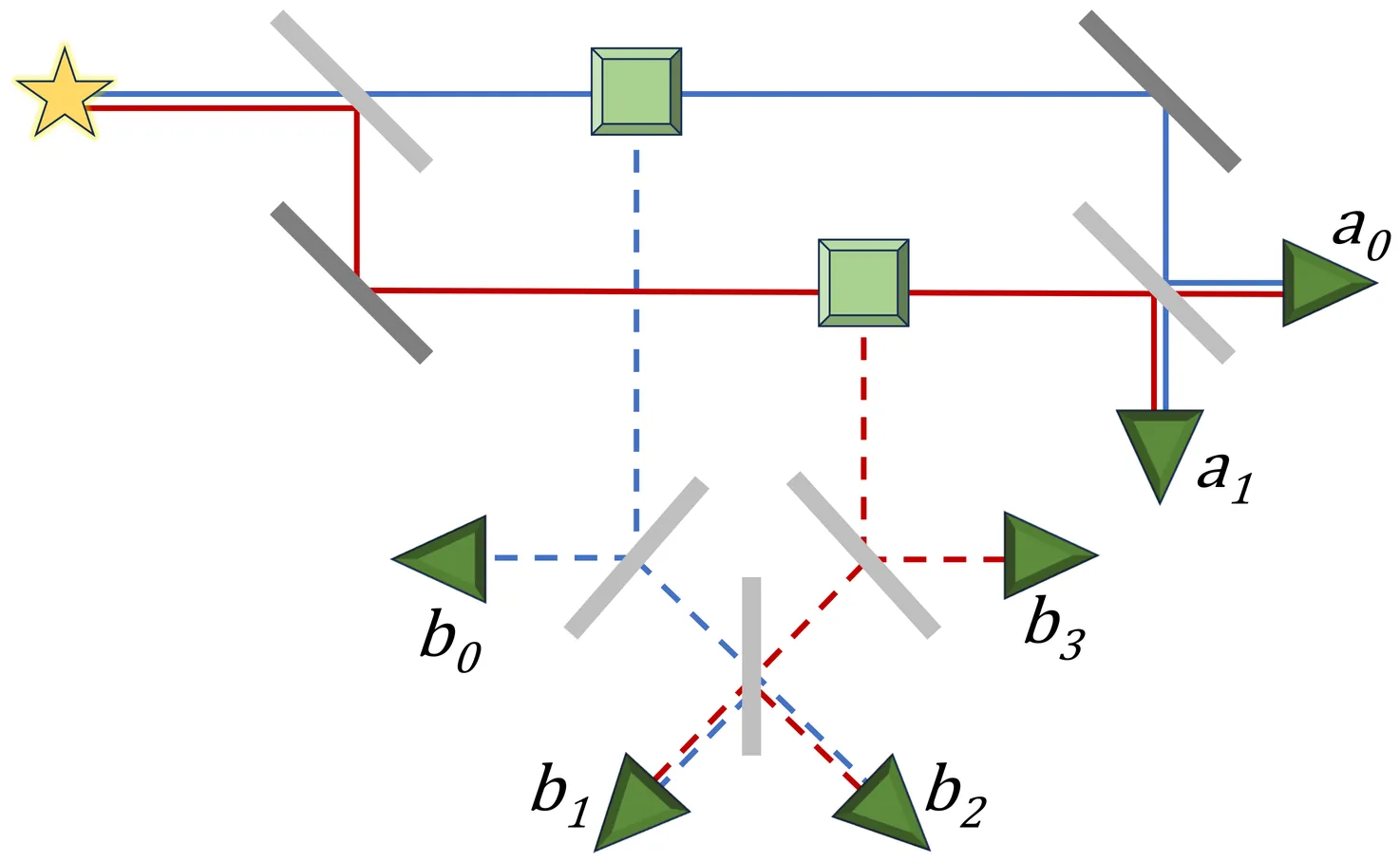
A state chaining-based objective collapse model
The quantum-to-classical transition hinges on the nature of wavefunction collapse, which remains a central controversy in foundational physics. Objective collapse theories aim to modify quantum mechanics by introducing a physical, non-subjective mechanism for irreversible events, but existing models face significant conceptual and empirical challenges. Here, we propose a novel collapse mechanism based on a specific form of quantum correlation termed "chaining", formalized within a new diagrammatic framework (quantum illustrations, or qils). This approach does not rely on system size or environmental complexity, but on the probabilistic occurrence of a collapse event with a fixed, universal probability $1/Σ$ per chaining step. We demonstrate that this model naturally explains the emergence of classicality in paradigmatic scenarios (measurement devices, Schrodinger's cat, spontaneous decay) and makes testable predictions for interference experiments. The theory is shown to be consistent with existing data from delayed-choice quantum eraser and matter-wave interference experiments, yielding an estimate for the fundamental constant $Σ\geq 1.5$. By providing a unified, parameter-sparse mechanism for objective collapse, this work bridges quantum and classical descriptions and has implications for the interpretation of quantum experiments, the design of quantum computers/sensors, and the understanding of decoherence in complex systems.
2603.15628Feb 2026
View2603.19243The extended phase space approach to quantization of gravity and its perspective
The prerequisites of the extended phase space approach to quantization of gravity, which is alternative to the Wheeler-DeWitt one and other existing approaches, are presented. The features of the proposed approach and conclusions from its underlying ideas are discussed.
2603.19243Feb 2026
View2602.21243Quantum and Classical mechanics vs QFT
15 years ago Dmitry Diakonov wrote the paper "Towards lattice-regularized Quantum Gravity", arXiv:1109.0091. In his approach, gravity with metric and tetrads arise from pre-geometric quantum fields leading to unusual dimensions of physical quantities. In particular, particle masses are dimensionless. We are trying to extend the Akama-Diakonov-Wetterich theory by introducing the Planck constants $\hbar$ and ${/\!\!h}=\hbar c$ as elements of the emergent metric. The inverse Planck constant $1/\hbar$ has the dimension of frequency, and, therefore, the mass $M$ of a particle, which has the dimension $\hbarω$, is dimensionless. In this extension, quantum mechanics emerges from the intrinsic quantum fields either in the symmetry breaking mechanism (GUT), or in the opposite mechanism of emergent symmetry in the low-energy corner (anti-GUT). In both cases, quantum mechanics (QM) serves as a bridge between the area of quantum fields (QFT) in the limit $1/\hbar \rightarrow 0$, and the area of classical physics (CM) in the limit $\hbar \rightarrow 0$. In the GUT scheme the inverse Planck constants, $1/\hbar$ and $1/{\\!\!h}$, play the role of the order parameter of the symmetry breaking phase transition from the pre-geometric QFT state to the QM state, in which the quantum mechanics emerges together with the space-time metric. In this phase transition, the integration over field variables in the QFT phase transforms to a path integral formulation of QM, which in turn yields the laws of classical mechanics in the limit $1/\hbar \rightarrow \infty$.
2602.21243Feb 2026
View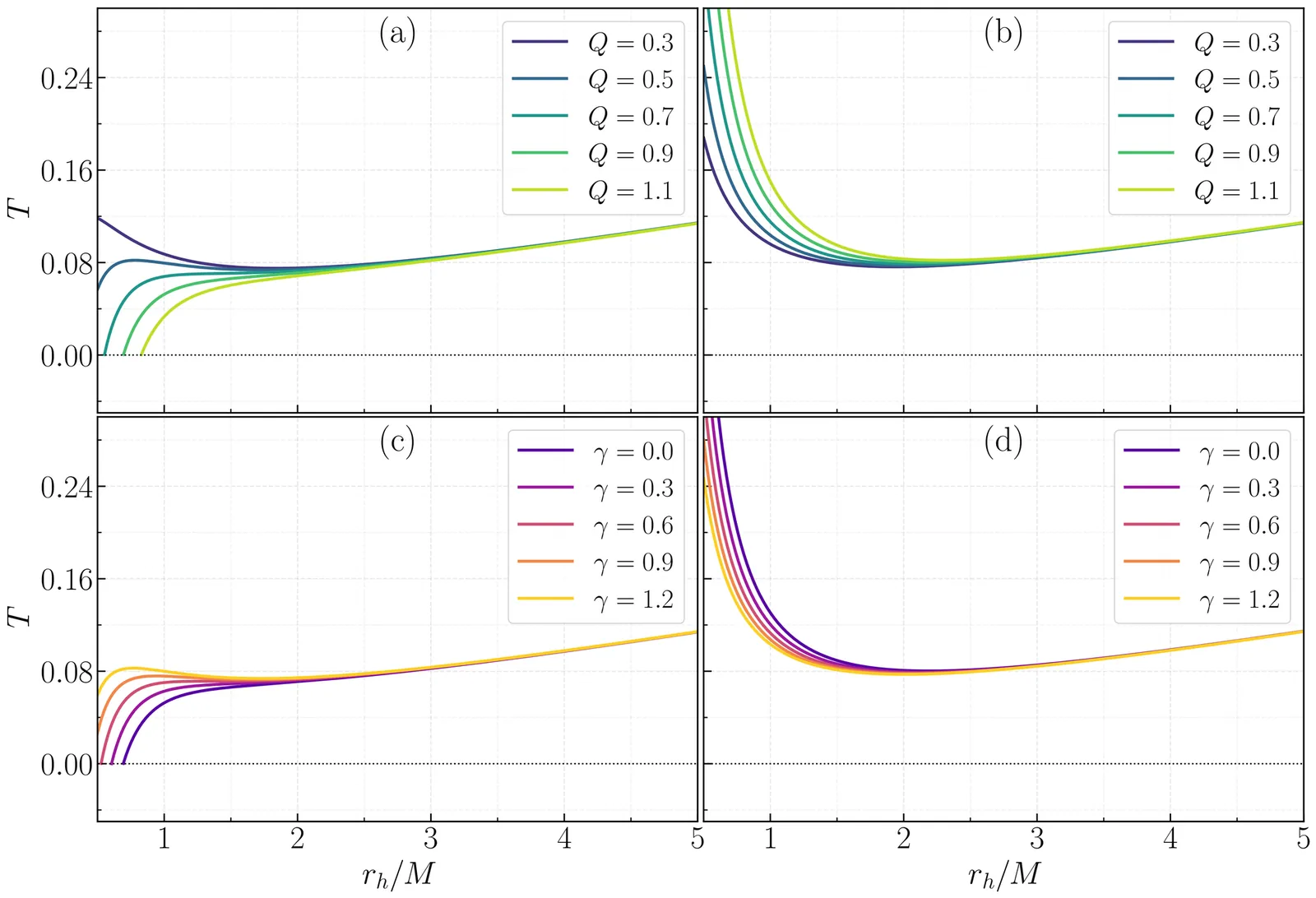
Thermal Analysis, Joule-Thomson Expansion and Hawking Sparsity of Mod(A)Max-AdS Black Hole Immersed in a Cloud of Strings
We investigate the thermodynamic behavior of a spherically symmetric Anti-de Sitter black hole in Mod(A)Max electrodynamics surrounded by a cloud of strings. Within the extended phase-space framework, we treat the cosmological constant as a pressure and interpret the black-hole mass as enthalpy, which enables a unified discussion of local stability, global phase structure, and Joule--Thomson expansion. We analyze the Hawking temperature, Gibbs free energy, and heat capacity, and show how the string-cloud parameter, the Mod(A)Max deformation, and the electric charge reshape the physical domain, the stability windows, and the small/large black-hole transition pattern. We further characterize the critical behavior and demonstrate that a van der Waals--like phase structure arises only in the physical sector, while the alternate branch does not admit a genuine critical point. For the Joule-Thomson process, we determine the inversion curve and the corresponding isenthalpic trajectories, highlighting how the model parameters control the cooling/heating regimes and can generate terminating isenthalpic behavior at sufficiently large charge. Finally, we examine the sparsity of Hawking radiation and discuss how the underlying parameters influence the temporal discreteness of the emitted flux, particularly near extremality and in the large-radius AdS regime.
2602.18488Feb 2026
View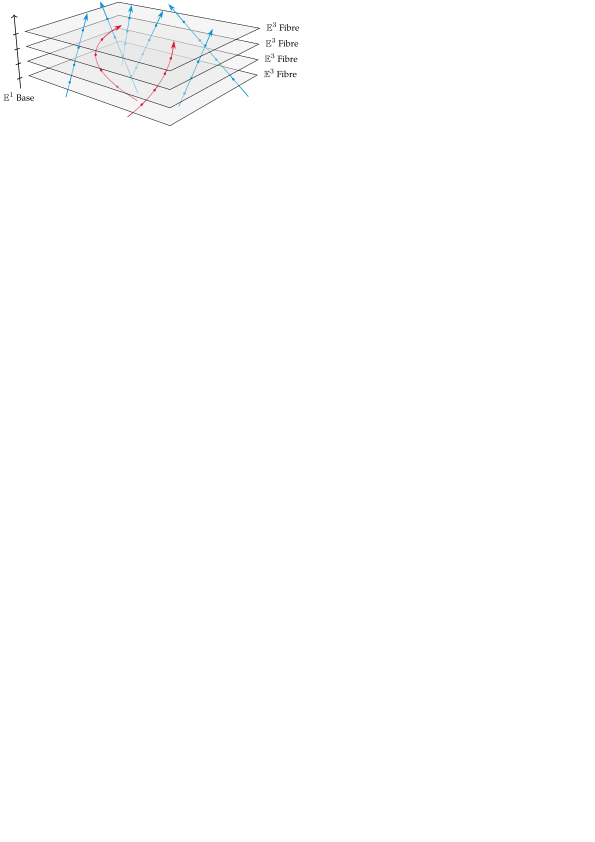
Uncertainty in space, time, and motion on the special Galilean group
Classical mechanics unfolds within absolute time and Euclidean space, yet our knowledge of where events occur, when they occur, and how motion evolves is inherently uncertain. The special Galilean group provides a natural setting for describing classical spacetime, combining absolute time, Euclidean space, and inertial motion within a single Lie group structure. Although this framework is well known, representing and propagating uncertainty on the group has received comparatively little attention. In this work, we bring together existing results on the structure of the Galilean group and use this unified framework to express uncertainty directly on the group manifold. A main contribution is a compact, closed-form expression for the Galilean group Jacobian, which enables principled uncertainty propagation when composing Galilean transformations. We show that uncertainty in spatial position and orientation, temporal displacement, and inertial motion are intrinsically coupled through the underlying group structure. To illustrate the usefulness of the Galilean framework, we consider the problem of estimating a time-varying transformation between inertial frames from noisy observations collected at distinct instants in time. We show that performing estimation directly on the Galilean group yields substantially more statistically consistent estimates than formulations that treat time independently. Together, these results provide a geometric foundation for reasoning about uncertainty in space, time, and motion in classical mechanics, navigation, and robotics.
2602.13327Feb 2026
View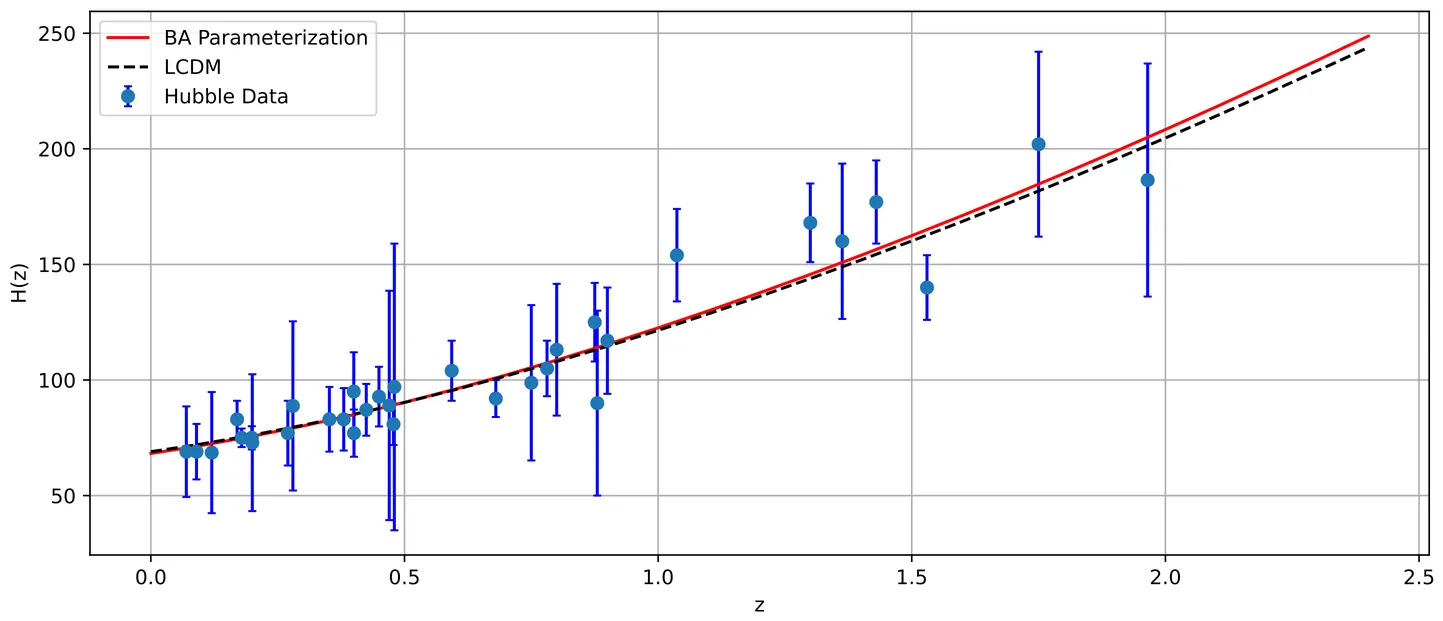
Observational Constraints and Geometric Diagnostics of Barboza-Alcaniz and Logarithmic Dark Energy Parametrizations
This study investigates and compares two prominent two-dimensional dark energy (DE) parameterizations: Barboza-Alcaniz (BA) and Logarithmic forms by comparing them with a comprehensive set of observational data comprising Type Ia Supernovae (SNe Ia) from the Pantheon compilation, Baryon Acoustic Oscillations (DESI BAO), and Cosmic Chronometers (CC). The primary objective was to explore the constraining power and cosmological implications of each parameterization in light of the current data. After formulating the theoretical framework and background equations governing cosmic expansion, we employ Markov Chain Monte Carlo (MCMC) techniques using the emcee Python package to constrain the free parameters of each model. The best-fit values for parameters $ω_0$, $ω_a$, and $H_0$ were extracted for each model using individual and combined datasets. The results include confidence contours at the levels $1σ$ and $2σ$. Our findings demonstrate that both parameterizations are consistent with observational data, with logarithmic parameterization showing slightly better constraints in terms of parameter evolution. Furthermore, we employed a statefinder diagnostic to analyze the geometric behavior of the models, providing an effective distinction between the two DE scenarios. This study contributes to a deeper understanding of DE evolution and its constraints in light of current cosmological data.
2602.09561Feb 2026
ViewPage 1 of 10