217 papers
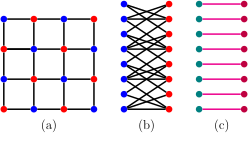
Integrable cellular automata on finite fields of order $2^n$
This paper explores cellular automata (CA) constructed from Yang-Baxter maps over finite fields $F_{2^n}$. We define $R$-matrices using a map $f$ on $F_{2^n}$ and establish necessary and sufficient conditions for $f$ to satisfy the Yang-Baxter equation. We show that these conditions become remarkably streamlined in characteristic two. An exhaustive search for bijective solutions in fields of order 4, 8, and 16 yields 16, 736, and 269,056 maps, respectively. Analysis of the resulting CA under helical boundary conditions reveals a consistent alignment between the temporal period and the field order. We propose the conjecture that this periodic identity holds generally for $F_{2^n}$, supported by analytical proofs for $n=2$ and $n=3$. Our results further indicate that bijectivity is a fundamental requirement for this periodic behavior.
2602.17148Feb 2026
View 2602.16267
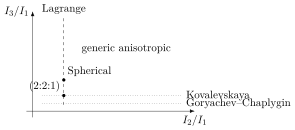
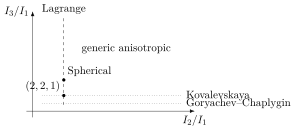
On the Lie noncommutative integrability
The Lie theory of non-commutative integrability is used to reconstruct some integrable systems of ordinary differential equations in three dimensional Eucledian space. The Darboux-Brioschi-Halphen system is an example of the Lie integrable system associated with the simple Lie algebra sl(2,R). Other examples are related with solvable three dimensional real Lie algebras of Bianchi B class.
2602.16267Feb 2026
View2602.14739Compatible pairs of Hamiltonian operators of the first and third orders
We compute general compatibility conditions between a weakly nonlocal homogeneous Hamiltonian operator and a third-order homogeneous Hamiltonian operator. Such operators determine a bi-Hamiltonian structure for many integrable PDEs (Korteweg--De Vries, Camassa--Holm, dispersive water waves, Dym, WDVV and others). Remarkably, the full set of conditions is purely algebraic and the first-order operator is completely determined by commuting systems of conservation laws that are Hamiltonian with respect to a third-order operator. We illustrate the above results with several examples, some of which, concerning WDVV equations, are new.
2602.14739Feb 2026
View2602.13903Integrable open elliptic Toda chain with boundaries
In this letter we discuss the classical integrable elliptic Toda chain proposed by I. Krichever. Our goal is to construct an open elliptic Toda chain with boundary terms. This is achieved using the factorized form of the Lax matrix and gauge equivalence with the XYZ chain.
2602.13903Feb 2026
View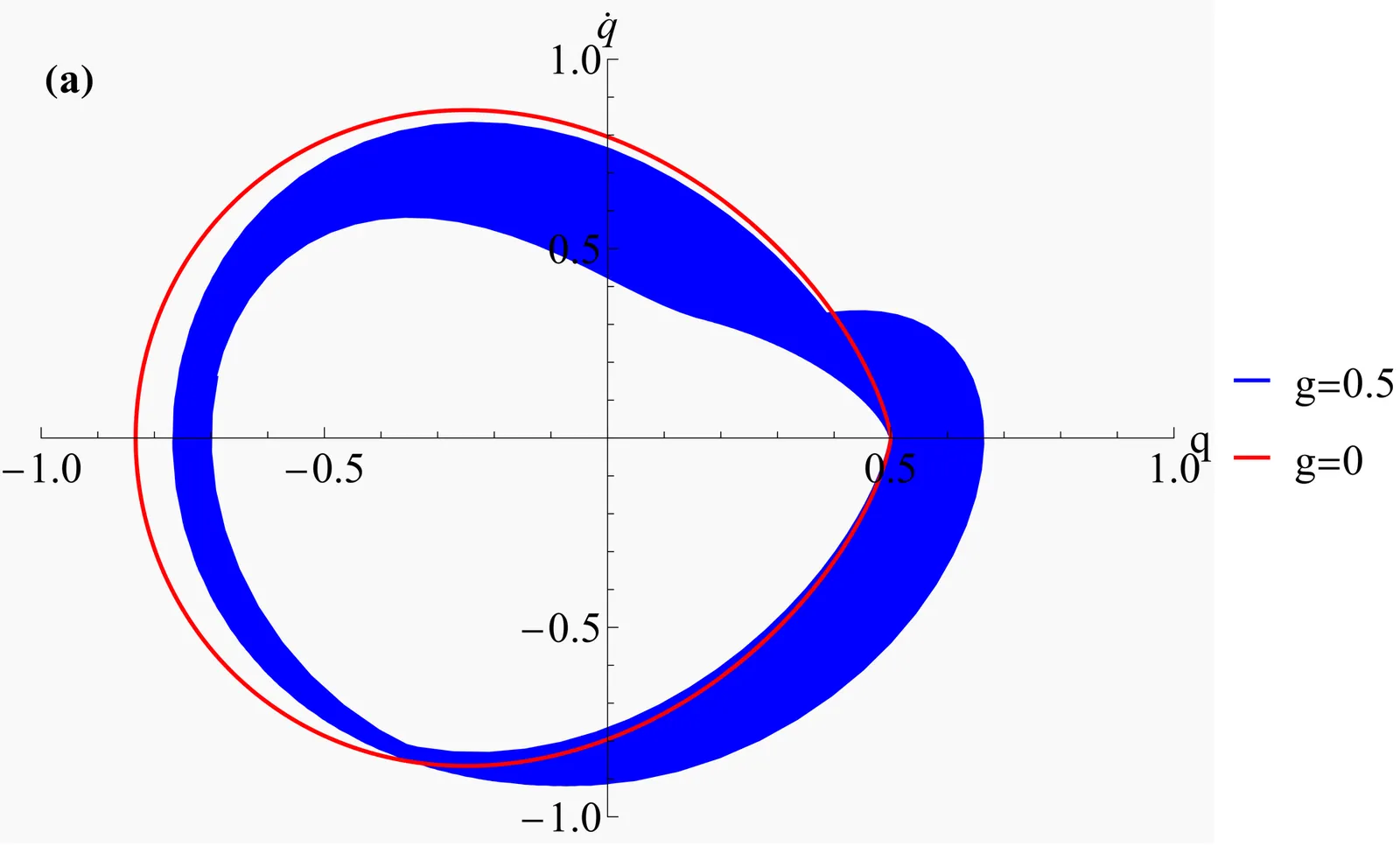
Conformal bi-Hamiltonian structure and integrability of an interacting Pais-Uhlenbeck oscillator
We investigate an interacting Pais-Uhlenbeck oscillator with a Landau-Ginzburg type interaction term and analyse its classical dynamics from a geometric and numerical point of view. We show that the resulting fourth-order equation of motion admits a conformal bi-Hamiltonian formulation, possesses a non-trivial set of Lie symmetries and we demonstrate the existence of bounded and regular trajectories in representative parameter regimes. By establishing an explicit correspondence with an integrable generalised Hénon-Heiles system, we show that the interacting higher-derivative dynamics inherits the integrability properties of the latter. This connection allows us to construct a second conserved Hamiltonian, to clarify the geometric origin of separability, and to obtain explicit classical solutions in terms of elliptic functions. Our results provide a concrete example of an interacting higher-derivative system for which integrability and periodic classical solutions can be established in a fully explicit manner.
2602.12858Feb 2026
View2602.12308Effective dynamics and defect expansions for polynomial PDEs on thin annuli
We develop a geometric and analytic framework for polynomial partial differential equations posed on thin annuli in the plane. Using renormalized Sobolev inner products, we construct Sobolev orthogonal polynomial bases adapted to the thin geometry and use them to define stable Galerkin approximations. We prove a general dimension-reduction theorem for polynomial Hamiltonian and dissipative PDEs, showing that solutions converge to effective one-dimensional dynamics on the limiting circle. Beyond the leading-order limit, we identify transverse defect correctors and derive cell problems describing anisotropic dispersive and homogenized effects. Our framework applies uniformly to integrable models (KdV, modified KdV, nonlinear Schrödinger, sine--Gordon), anisotropic dispersive systems such as Zakharov--Kuznetsov, and non-integrable perturbations including dissipation, forcing, and rapidly oscillating coefficients. We establish stability of the effective dynamics under changes of Sobolev order and of polynomial Hilbert geometry, and show robustness of the associated Galerkin schemes. The results provide a unified geometric perspective on dimension reduction, homogenization, and integrability in thin geometries, and introduce Sobolev orthogonal polynomial methods as a constructive tool for multiscale PDE analysis.
2602.12308Feb 2026
View2602.09756Discrete equations from Bäcklund transformations of the fifth Painlevé equation
In this paper discrete equations are derived from Bäcklund transformations of the fifth Painlevé equation, including a new discrete equation which has ternary symmetry. There are two classes of rational solutions of the fifth Painlevé equation, one expressed in terms of the generalised Laguerre polynomials and the other in terms of the generalised Umemura polynomials, both of which can be expressed as Wronskians of Laguerre polynomials. Hierarchies of rational solutions of the discrete equations are derived in terms of the generalised Laguerre and generalised Umemura polynomials. It is known that there is nonuniqueness of some rational solutions of the fifth Painlevé equation. Pairs of nonunique rational solutions are used to derive distinct hierarchies of rational solutions which satisfy the same discrete equation.
2602.09756Feb 2026
View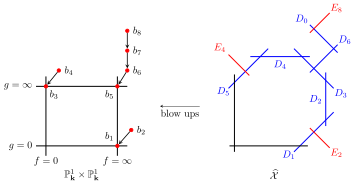
On integrals of non-autonomous dynamical systems in finite characteristic
We use a difference Lax form to construct simultaneous integrals of motion of the fourth Painlevé equation and the difference second Painlevé equation over fields with finite characteristic $p>0$. For $p\neq 3$, we show that the integrals can be normalised to be completely invariant under the corresponding extended affine Weyl group action. We show that components of reducible fibres of integrals correspond to reductions to Riccatti equations. We further describe a method to construct non-rational algebraic solutions in a given positive characteristic. We also discuss a projective reduction of the integrals.
2602.09298Feb 2026
View2602.08143Elliptic Ruijsenaars-Toda and elliptic Toda chains: classical r-matrix structure and relation to XYZ chain
We discuss the classical elliptic Toda chain introduced by Krichever and the elliptic Ruijsenaars-Toda chain introduced by Adler, Shabat and Suris. It is shown that these models can be obtained as particular cases of the elliptic Ruijsenaars chain. We explain how the classical $r$-matrix structures are derived for these chains. Also, as a by-product, we prove that the elliptic Ruijsenaars-Toda chain is gauge equivalent to discrete Landau-Lifshitz model of XYZ type. The elliptic Toda chain is also gauge equivalent to XYZ chain with special values of the Casimir functions at each site.
2602.08143Feb 2026
View2602.06736BKP and CKP hierarchies via orbifold Saito theory
Semisimple Dubrovin-Frobenius manifolds can be used to construct integrable hierarchies, following the work of Dubrovin-Zhang and Buryak. Examples of such hierarchies include the Kac-Wakimoto hierarchies, the KP hierarchy, among others. In all these examples, the Saito theory of isolated singularities played a crucial role. In this note, we show that the BKP and CKP hierarchies can likewise be constructed from Dubrovin-Frobenius manifolds. This new construction, however, utilizes the orbifold version of Saito theory for isolated singularities endowed with a symmetry group.
2602.06736Feb 2026
View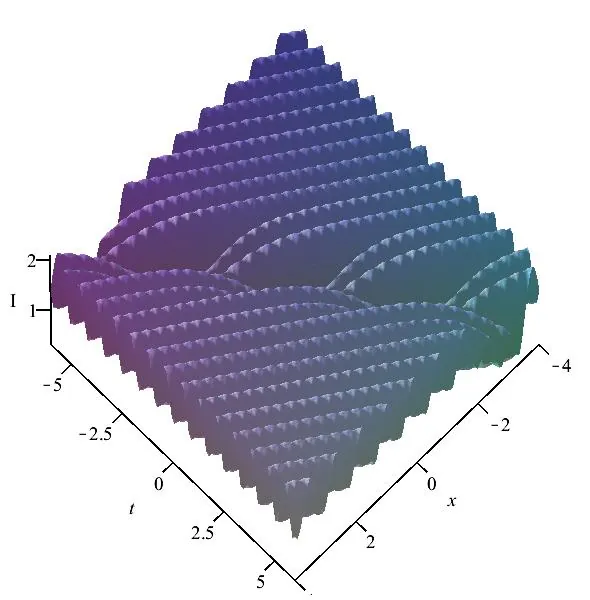
Painleve solitons of AKNS system and irrational algebraic solitons of NLS equations
A novel symmetry decomposition approach is introduced to derive the so-called ``Painleve solitons'' of the Ablowitz-Kaup-Newell-Segur (AKNS) system. These Painleve solitons propagate against a background governed by a Painleve transcendent, establishing a fundamental generalization of the well-known elliptic solitons concept. We demonstrate that while elliptic solitons arise from the combination of translation invariance and square eigenfunction symmetry, a different symmetry combination-scaling invariance, Galilean invariance, and square eigenfunction symmetry-generates ``Painleve IV solitons'' for the AKNS system. This discovery represents a significant theoretical advance in integrable systems theory. By selecting special solutions of the Painleve IV equation, we obtain explicit forms of several previously unknown classes of solutions for the AKNS system and the nonlinear Schrodinger (NLS) equation: irrational algebraic solitons, rational algebraic solitons, and parabolic cylindrical function solitons. These results dramatically expand the known solution landscape of one of the most important integrable models in mathematical physics, with broad implications for nonlinear wave phenomena across multiple physical disciplines including optics, Bose-Einstein condensates, and fluid dynamics.
2602.04498Feb 2026
View2602.04147The trouble with deautonomising higher order maps
The deautonomisation of birational maps that have the singularity confinement property, i.e. the construction of nonautonomous versions of such maps that preserve the singularity properties of the original, has proven crucial in our understanding of the mathematical properties behind the integrability of second order maps. For example, the deautonomisation procedure led directly to the development of a general theory of discrete Painlevé equations, and it seems highly likely it will play a crucial role in any future theory of higher dimensional Painlevé equations as well. Generally speaking however, higher order integrable mappings may have non-confined singularities and it is important to understand if, and how, deautonomisation should work for such mappings. In this paper we explore different deautonomisation scenarios on a series of carefully constructed higher order mappings, integrable as well as non-integrable, that possess non-confined singularities and we challenge some common assumptions regarding the co-dimensionality of the singular loci that might play a role in the deautonomisation process. Along the way we also propose a novel procedure to calculate the growth of the multiplicities of singularities that appear in so-called anticonfined singularity patterns, based on an ultradiscrete version of the mapping.
2602.04147Feb 2026
View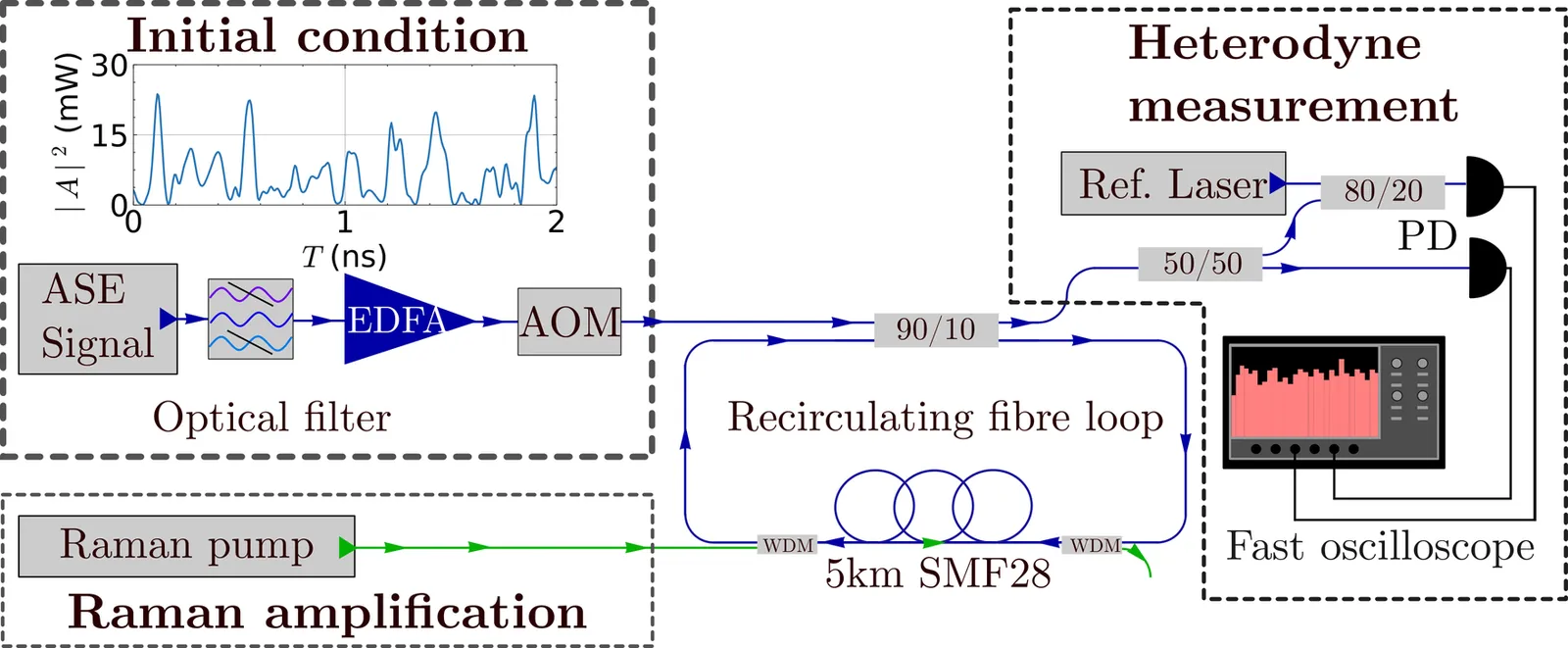
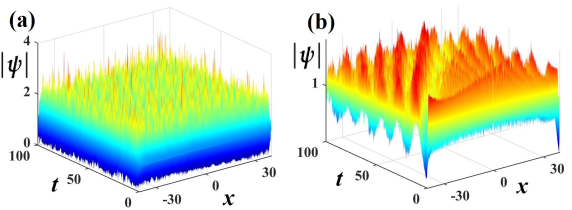
Experimental observation of ballistic correlations in integrable turbulence
Unequal-time correlation functions fundamentally characterize emergent statistical properties in complex systems, yet their direct measurement in experiments is challenging. We report the experimental observation of two-time, ballistic correlations in a photonic platform governed by the focusing nonlinear Schrödinger equation. Using a recirculating optical fiber loop with heterodyne field detection, we acquire the full space-time dynamics of partially coherent optical waves and extract the intensity correlator in stationary states of integrable turbulence. The correlators collapse under ballistic rescaling and quantitatively agree with predictions from Generalized Hydrodynamics evaluated using the density of states obtained via inverse scattering analysis of the recorded fields. Our results provide a direct, parameter-free test of GHD in an integrable waves system.
2601.21085Jan 2026
View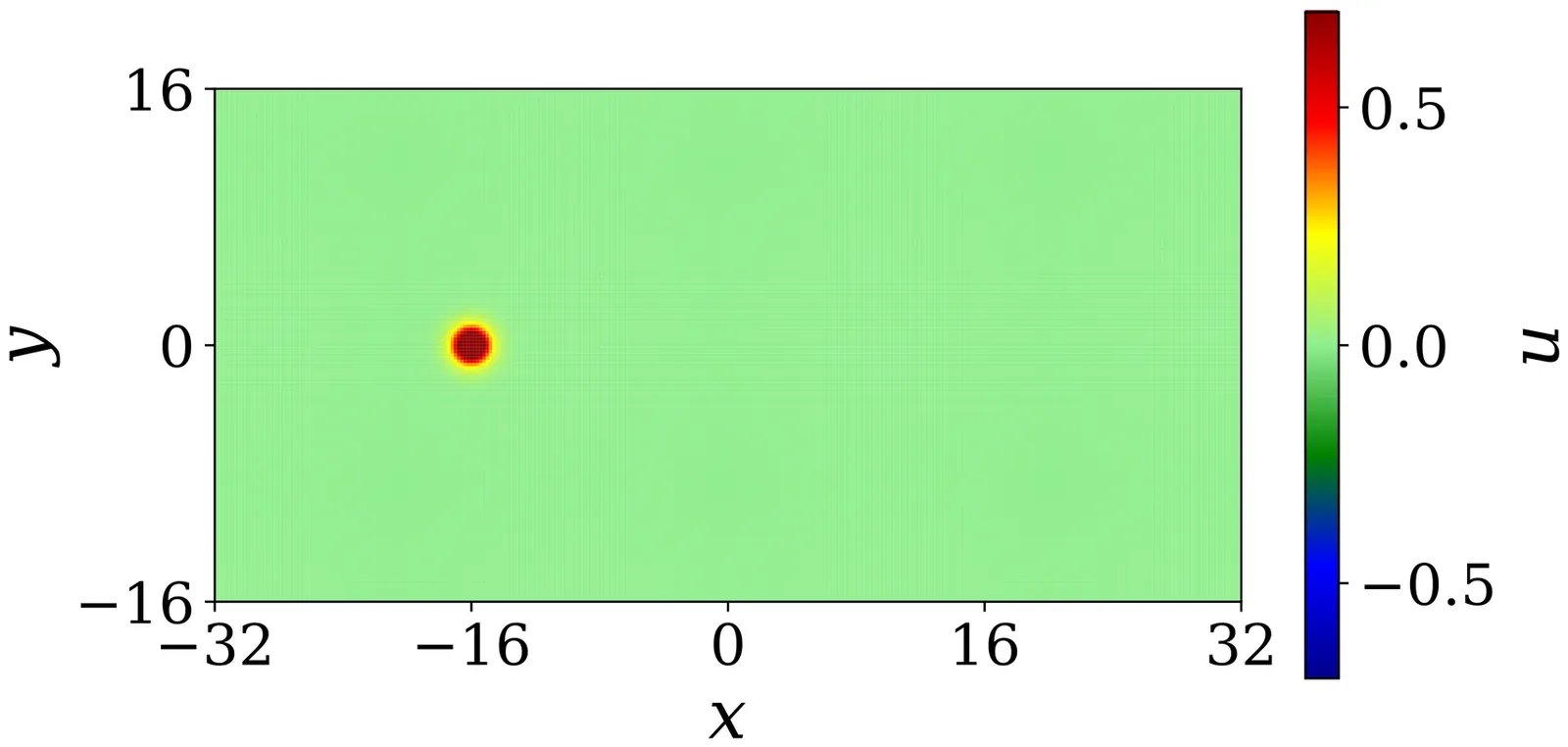
A Modified Center-of-Mass Conservation Law in Finite-Domain Simulations of the Zakharov--Kuznetsov Equation
We investigate conservation laws of the two-dimensional Zakharov-Kuznetsov (ZK) equation, a natural higher-dimensional and non-integrable extension of the Korteweg--de Vries equation. The ZK equation admits three scalar conserved quantities -- mass, momentum, and energy -- represented as $I_1$, $I_2$, and $I_3$, as well as a vector-valued quantity $\bm{I}_4$. In high-accuracy numerical simulations on a finite double-periodic domain, most of these quantities are well preserved, while a systematic temporal drift is observed only in the $x$-component $I_{4x}$. We show that the nontrivial evolution of $I_{4x}$ originates from an explicit boundary-flux contribution, which is induced by fluctuations of the solution and its spatial derivatives at the domain boundaries. We successfully identify the source of the inaccuracy in the numerical solutions. Motivated by this analysis, we define a modified center-of-mass quantity $I_{4x}^{\mathrm{mod}}$ and demonstrate its conservation numerically for single-pulse configurations. The modified quantity thus provides a consistent conservation law for the ZK equation and yields an appropriate description of center-of-mass motion in finite-domain numerical simulations.
2601.15573Jan 2026
View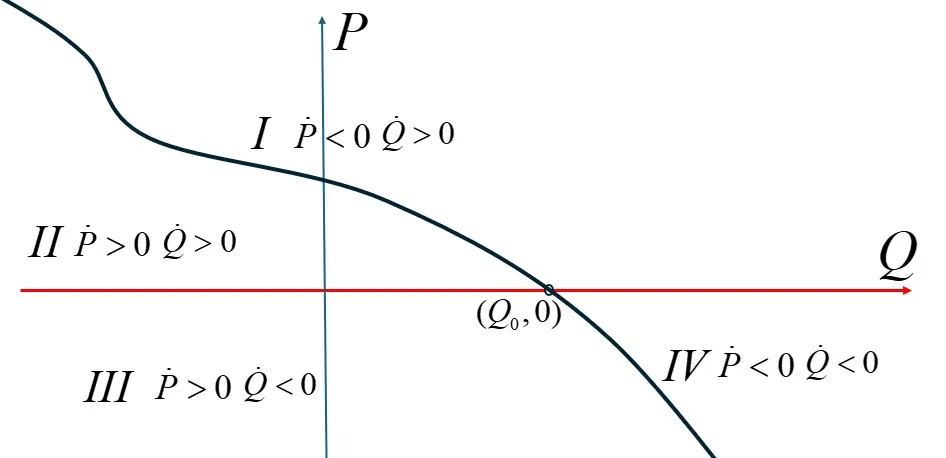
The integrable Volterra system in the case of infinitely manyspecies, either countable or uncountable
In the present paper we derive a further extension of the results contained in two recent articles, both published in Open Communications in Mathematical Physics, where it was shown that the integrable version of the N-species Volterra model, introduced by V. Volterra in 1937, is in fact maximally superintegrable. Here we point out that the superintegrability property applies as well to the case of infinitely many competing species, either countable or uncountable. Analytical and numerical results are given.
2601.15150Jan 2026
View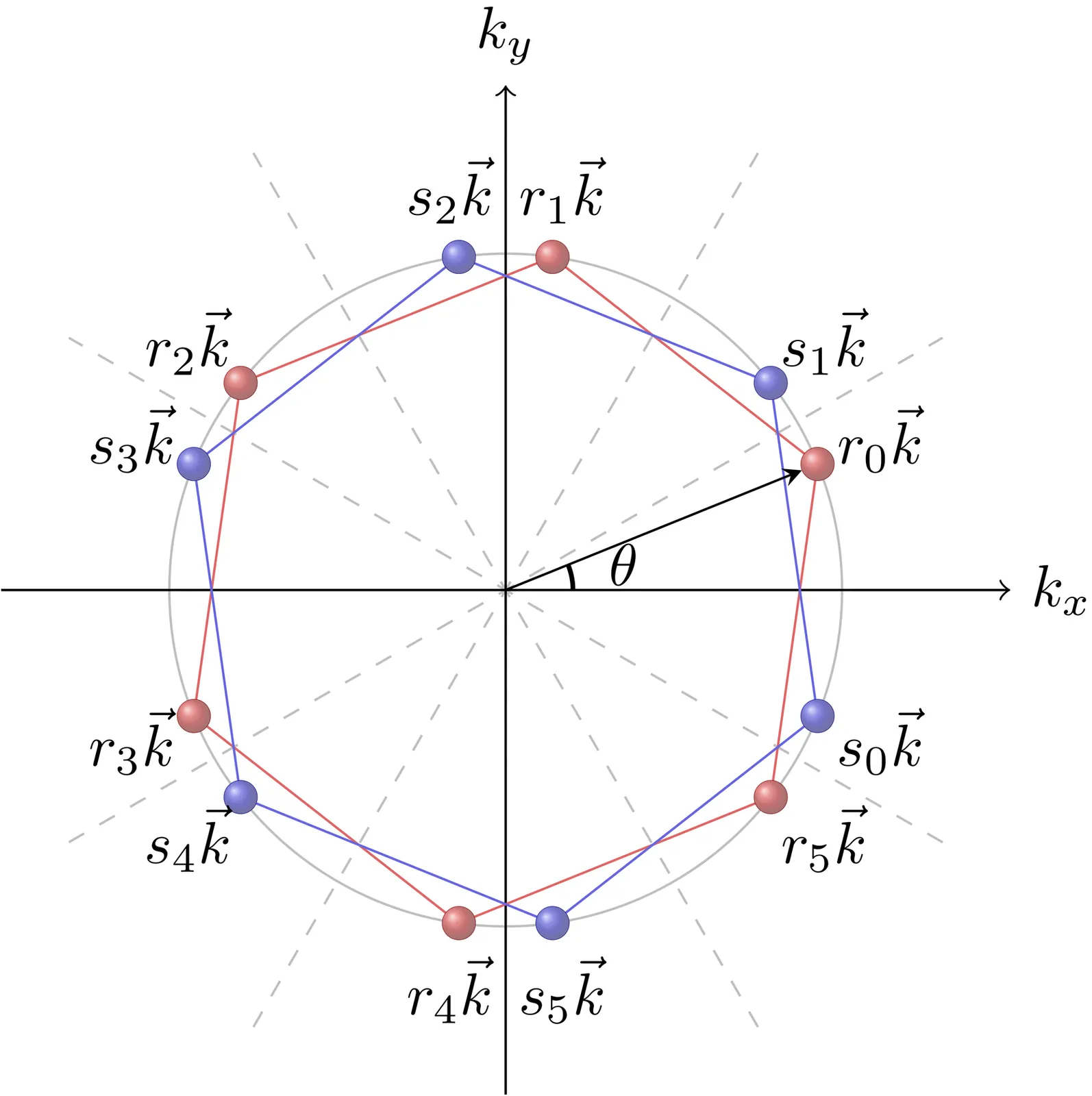
Kaleidoscope Yang-Baxter Equation for Gaudin's Kaleidoscope models
Recently, researchers have proposed the Asymmetric Bethe ansatz method - a theoretical tool that extends the scope of Bethe ansatz-solvable models by "breaking" partial mirror symmetry via the introduction of a fully reflecting boundary. Within this framework, the integrability conditions which were originally put forward by Gaudin have been further generalized. In this work, building on Gaudin's generalized kaleidoscope model, we present a detailed investigation of the relationship between DN symmetry and its integrability. We demonstrate that the mathematical essence of integrability in this class of models is characterized by a newly proposed Kaleidoscope Yang-Baxter Equation. Furthermore, we show that the solvability of a model via the coordinate Bethe ansatz depends not only on the consistency relations satisfied by scattering matrices, but also on the model's boundary conditions and the symmetry of the subspace where solutions are sought. Through finite element method based numerical studies, we further confirm that Bethe ansatz integrability arises in a specific symmetry sector. Finally, by analyzing the algebraic structure of the Kaleidoscope Yang-Baxter Equation, we derive a series of novel quantum algebraic identities within the framework of quantum torus algebra.
2601.13596Jan 2026
View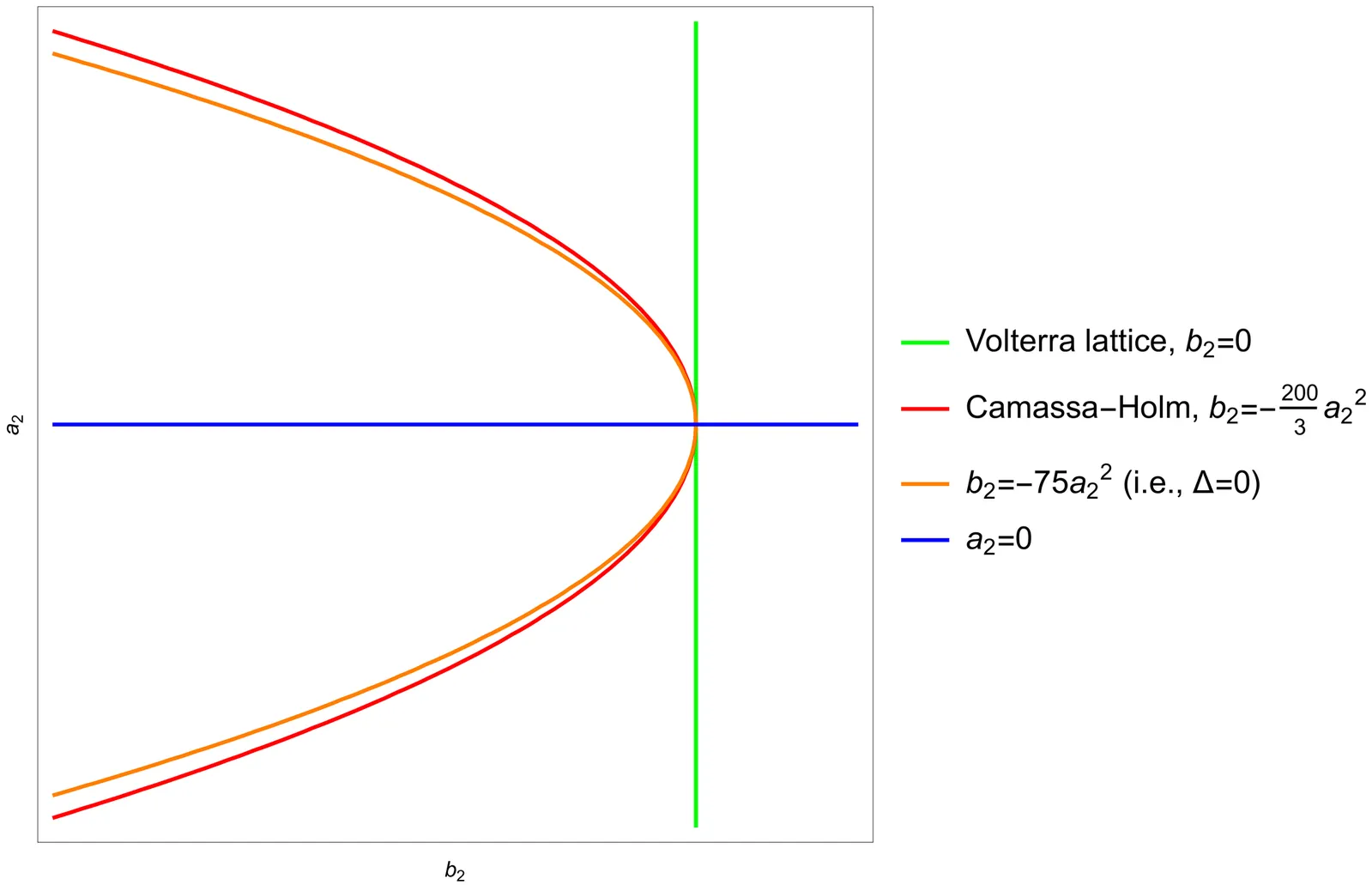
Bihamiltonian tests for integrable systems associated to rank-$1$ F-CohFTs
Double ramification (DR) hierarchies associated to rank-$1$ F-CohFTs are important integrable perturbations of the Riemann--Hopf hierarchy. In this paper, we perform bihamiltonian tests for these DR hierarchies, and conjecture that the ones that are bihamiltonian form a $2$-parameter family. Remarkably, our computations suggest that there is a $1$-parameter subfamily of the rank-$1$ F-CohFTs, where the corresponding DR hierarchy is conjecturally Miura equivalent to the Camassa--Holm hierarchy. We also prove a conjecture regarding bihamiltonian Hodge hierarchies. Finally, we systematically study Miura invariants, and for another $1$-parameter subfamily propose a conjectural relation to the Degasperis--Procesi hierarchy.
2601.13203Jan 2026
View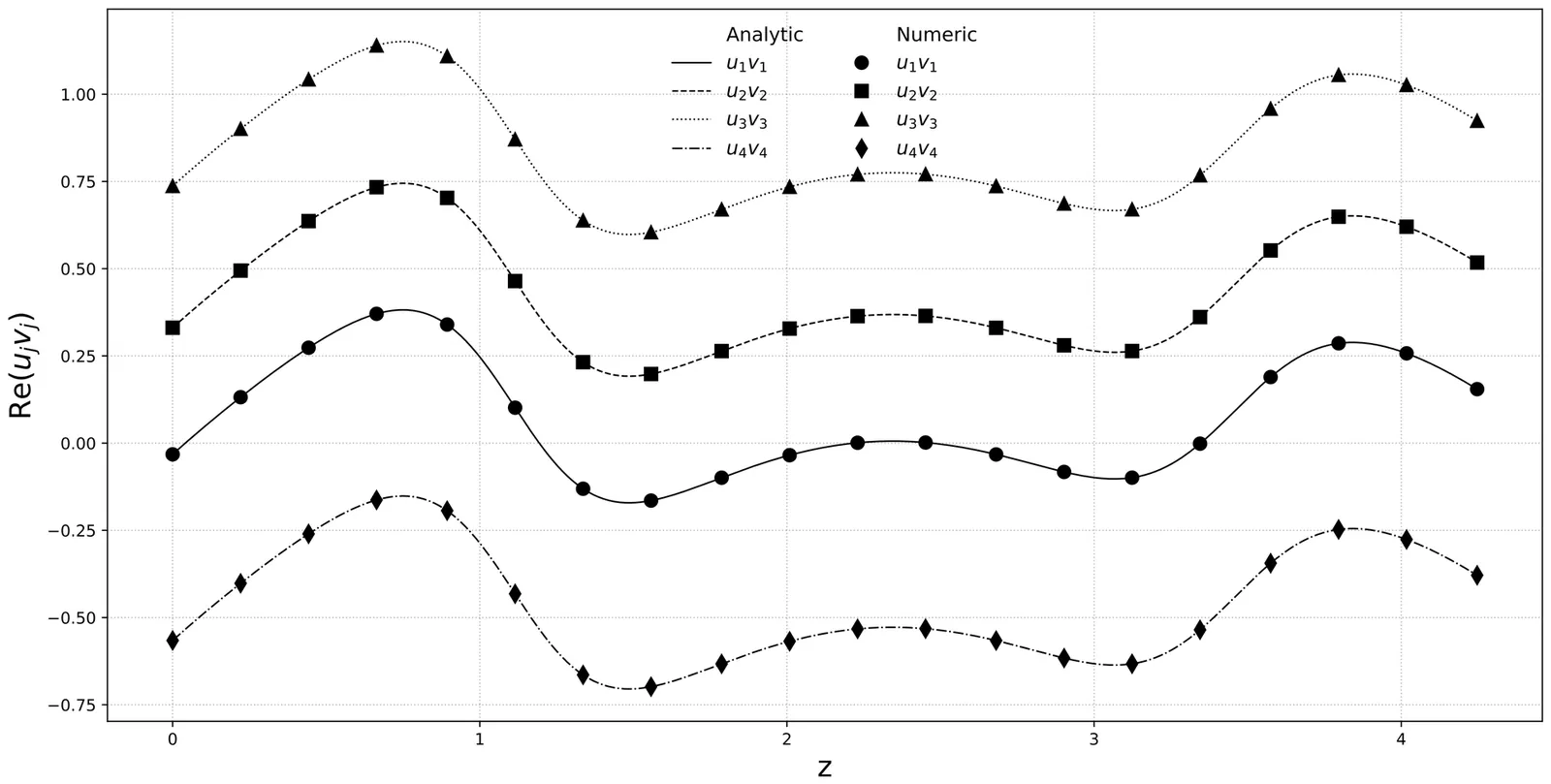
Complete Weierstrass elliptic function solutions and canonical coordinates for four-wave mixing in nonlinear optical fibres
Complete analytic solutions to quasi-continuous-wave four-wave mixing in nonlinear optical fibres are presented in terms of Weierstrass elliptic $\wp$, $ζ$, and $σ$ functions, providing the full complex envelopes for all four waves under arbitrary initial conditions. A sequence of coordinate transformations reveals a canonical form with universal parameter-free structure. Remarkably, these transformations depend explicitly on the propagation variable yet preserve the structural form of the differential equations, an invariance property not previously reported for four-wave mixing. In the canonical coordinates, solutions become single-valued meromorphic Kronecker theta functions, establishing connections with other integrable nonlinear optical systems. The Hamiltonian conservation is shown to arise from the Frobenius-Stickelberger determinant. Numerical validation confirms the solutions using open-source Python libraries.
2601.11740Jan 2026
View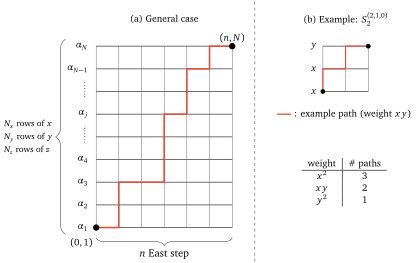
Matrix product operator representations for the local conserved quantities of the spin-$1/2$ XYZ chain
We present explicit matrix product operator (MPO) representations for the local conserved quantities of the spin-$1/2$ XYZ chain. Through these MPO representations, we simplify the coefficients appearing in the local conserved quantities originally derived by one of the authors, and reveal their combinatorial meaning: the coefficients prove to be a polynomial generalization of the Catalan numbers, defined via weighted monotonic lattice paths. Furthermore, we obtain a new simple $3 \times 3$ Lax operator for the XYZ chain that, unlike Baxter's R-matrix, does not involve elliptic functions.
2601.09245Jan 2026
View2601.09206Discretization of the Mikhailov model
In this paper the Mikhailov model is discretized by means of the Cauchy matrix approach. A pair of discrete Miura transformations are constructed. The discrete Mikhailov model is a coupled system, in which one equation comes from the compatibility of the two Miura transformations, the other is transformed from the discrete negative order Ablowitz-Kaup-Newell-Segur system by using the Miura transformations. Explicit solutions, including solitons and multiple-pole solutions, are presented via two Cauchy matrix schemes respectively, namely, the Ablowitz-Kaup-Newell-Segur type and the Kadomtsev-Petviashvili type. By straight continuum limits, semi-discrete and continuous Mikhailov models together with their Cauchy matrix structures and solutions are recovered.
2601.09206Jan 2026
ViewPage 1 of 11