208 papers
A Phase Description of Mutually Coupled Chaotic Oscillators
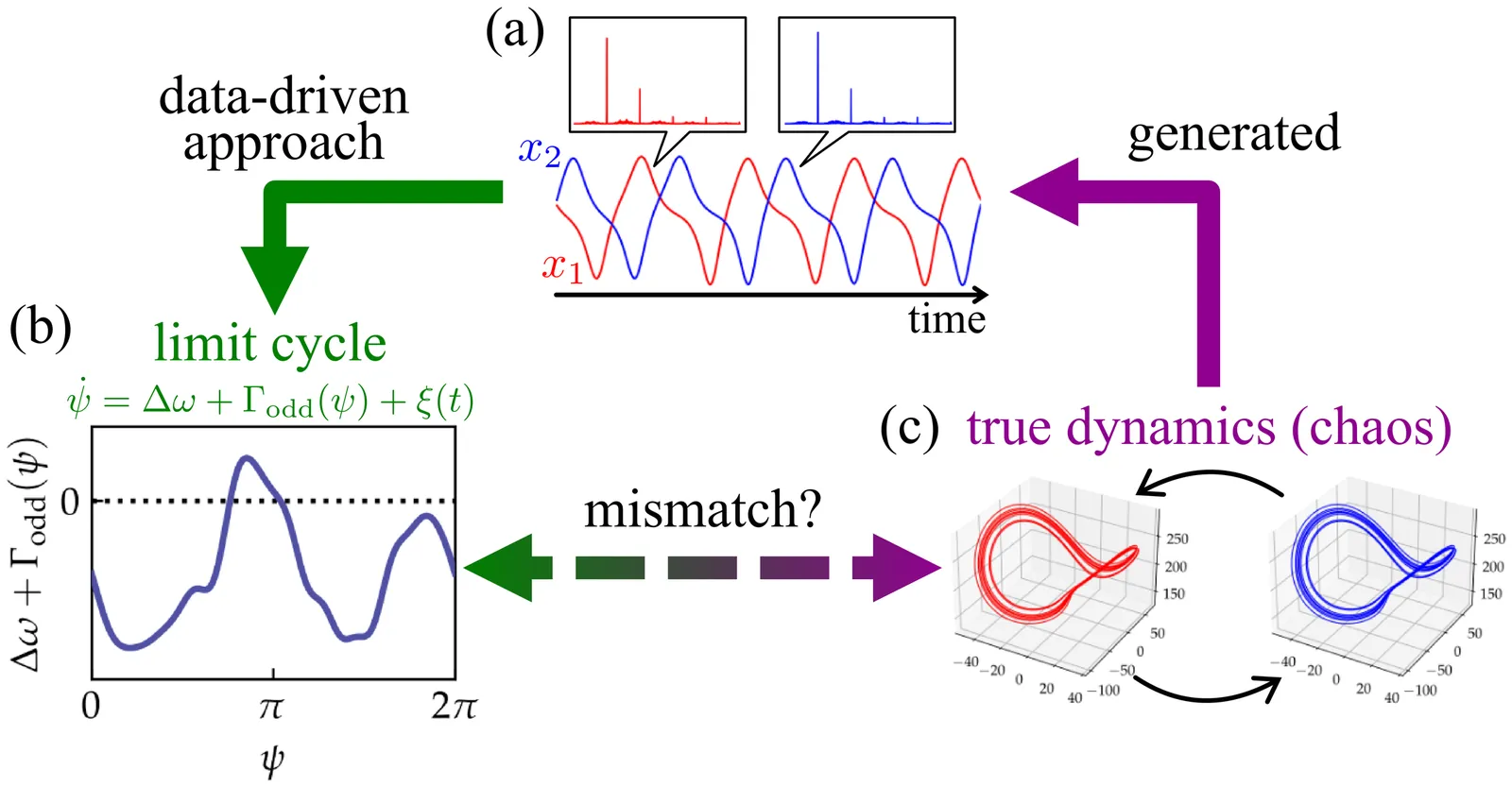
The synchronization of rhythms is ubiquitous in both natural and engineered systems, and the demand for data-driven analysis is growing. When rhythms arise from limit cycles, phase reduction theory shows that their dynamics are universally modeled as coupled phase oscillators under weak coupling. This simple representation enables direct inference of inter-rhythm coupling functions from measured time-series data. However, strongly rhythmic chaos can masquerade as noisy limit cycles. In such cases, standard estimators still return plausible coupling functions even though a phase-oscillator model lacks a priori justification. We therefore extend the phase description to the chaotic oscillators. Specifically, we derive a closed equation for the phase difference by defining the phase on a Poincaré section and averaging the phase dynamics over invariant measures of the induced return maps. Numerically, the derived theoretical functions are in close agreement with those inferred from time-series data. Consequently, our results justify the applicability of phase description to coupled chaotic oscillators and show that data-driven coupling functions retain clear dynamical meaning in the absence of limit cycles.
2602.17519Feb 2026
View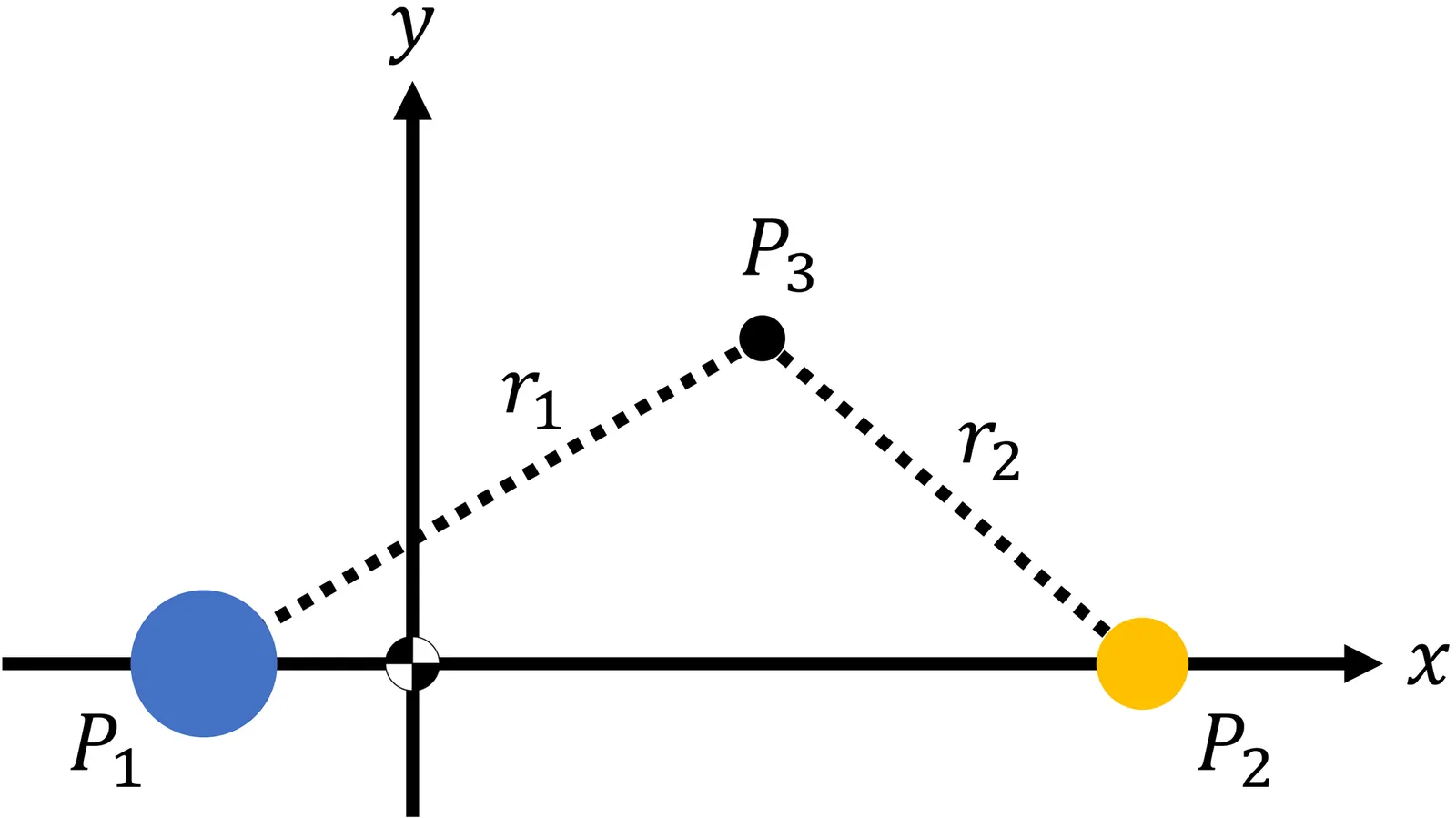
Design of low-energy transfers in cislunar space using sequences of lobe dynamics
Dynamical structures in the circular restricted three-body problem (CR3BP) are fundamental for designing low-energy transfers, as they aid in analyzing phase space transport and designing desirable trajectories. This study focuses on lobe dynamics to exploit local chaotic transport around celestial bodies, and proposes a new method for systematically designing low-energy transfers by combining multiple lobe dynamics. A graph-based framework is constructed to explore possible transfer paths between departure and arrival orbits, reducing the complexity of the combinatorial optimization problem for designing fuel-efficient transfers. Based on this graph, low-energy transfer trajectories are constructed by connecting chaotic orbits within lobes. The resulting optimal trajectory in the Earth--Moon CR3BP is then converted into an optimal transfer in the bicircular restricted four-body problem using multiple shooting. The obtained transfer is compared with existing optimal solutions to demonstrate the effectiveness of the proposed method.
2602.17444Feb 2026
View
Causally constrained reduced-order neural models of complex turbulent dynamical systems
We introduce a flexible framework based on response theory and score matching to suppress spurious, noncausal dependencies in reduced-order neural emulators of turbulent systems, focusing on climate dynamics as a proof-of-concept. We showcase the approach using the stochastic Charney-DeVore model as a relevant prototype for low-frequency atmospheric variability. We show that the resulting causal constraints enhance neural emulators' ability to respond to both weak and strong external forcings, despite being trained exclusively on unforced data. The approach is broadly applicable to modeling complex turbulent dynamical systems in reduced spaces and can be readily integrated into general neural network architectures.
2602.13847Feb 2026
View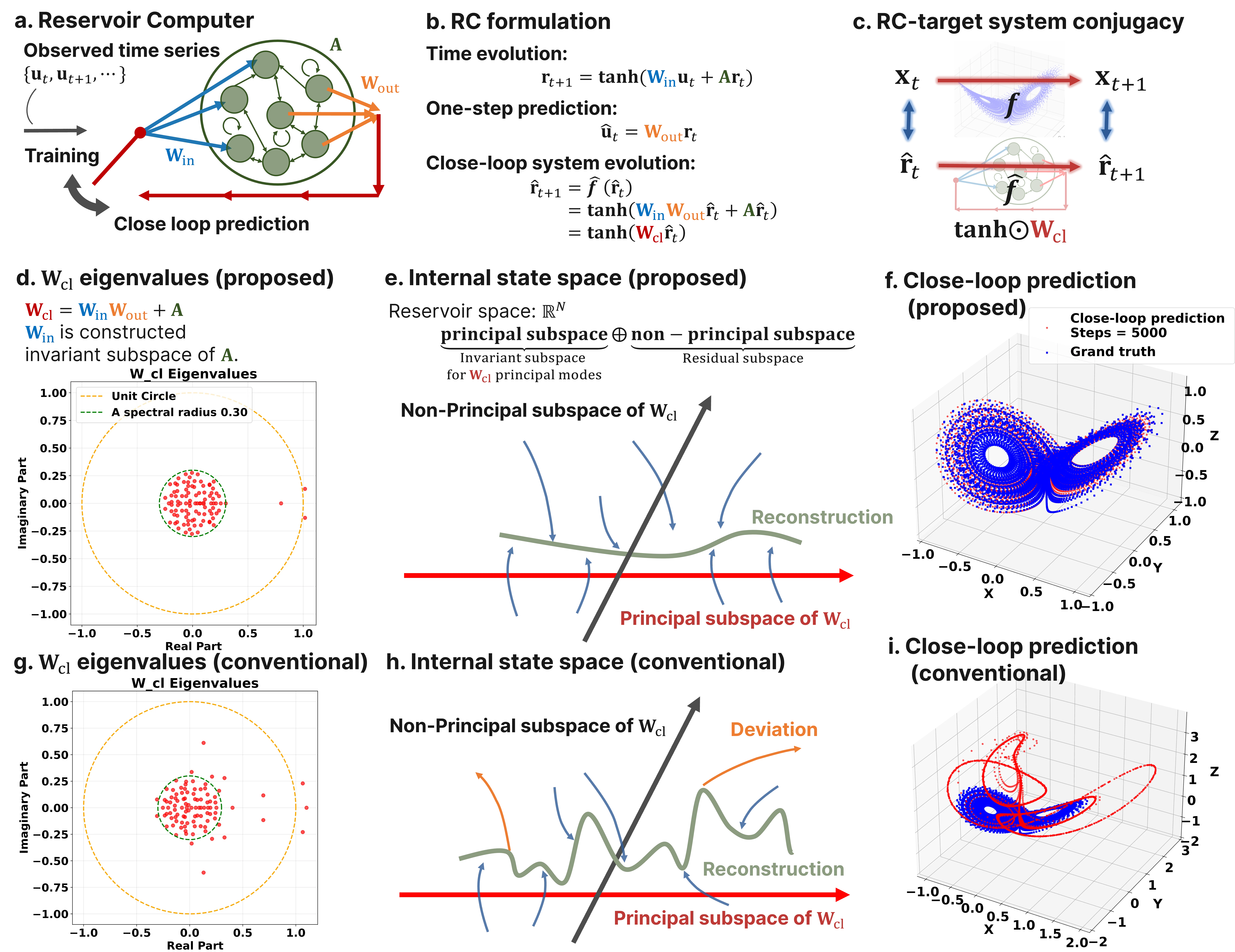
Stabilizing chaotic dynamical system reproduction in reservoir computing
Reservoir Computing (RC), a type of recurrent random neural network, is a powerful framework for modeling complex and chaotic dynamics. However, its autonomous (closed-loop) operation is often plagued by inherent instability. Moreover, performance is highly sensitive to the reservoir's random initialization, leading to vulnerability to noise and/or behaviour that bears no resemblance whatsoever to the target dynamical system. Here we identify a primary cause of this unreliability: the emergence of excessive, spurious unstable or neutral modes in the closed-loop dynamics. We introduce a simple deterministic input layer design principle that directly addresses this vulnerability by structurally suppressing the emergence of these spurious modes a priori (before training). Our approach dramatically improves robustness to both initialization sensitivity and internal noise, doubling the prediction horizon. Furthermore, we demonstrate on chaotic dynamical systems that this design enables robust estimation of the full Lyapunov spectrum (100\% success rate across 50 seeds), signifying that the autonomous RC faithfully emulates the essential properties of the target dynamical system. This work provides a systematic explanation for a common RC failure mode and offers a concrete design guideline, advancing RCs from heuristic trial-and-error tuning toward a reliable tool for modeling complex systems.
2602.11069Feb 2026
View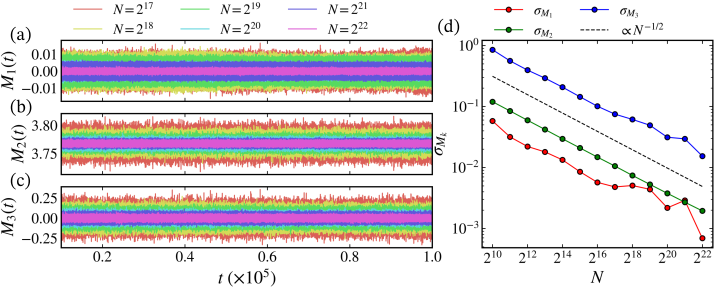
On the dynamical and statistical properties of a quartic mean-field Hamiltonian model
Mean-field systems provide a natural framework in which collective effects persist as the number of degrees of freedom N increases, raising fundamental questions about the emergence of integrability and the nature of chaos in large but finite systems. We investigate the dynamical and statistical properties of a quartic mean-field Hamiltonian model, with particular emphasis on the relation between the thermodynamic limit and finite-size chaotic dynamics. We first analyze the thermodynamic limit of the model within the Vlasov collisionless framework and derive the corresponding self-consistent single-particle description. We identify the conditions under which the mean-field dynamics becomes effectively autonomous and show numerically that fluctuations of the relevant intensive quantities vanish algebraically with N, supporting the emergence of integrability as N goes to infinity. We then study the finite-N dynamics by computing the largest Lyapunov exponent over an exceptionally wide range of N, spanning several orders of magnitude. We find that the largest Lyapunov exponent decays algebraically with N, consistently with the suppression of chaos in the thermodynamic limit for mean-field Hamiltonian models. Using tools from non-extensive statistical mechanics, we further analyze the time evolution of the entropic index q and demonstrate that, although transient values q > 1 may appear at intermediate times, q systematically converges to unity as the observation time increases. This behavior indicates that the finite-N dynamics is strongly chaotic in the asymptotic regime and that previously reported q > 1 values for the present models originate from finite-time effects rather than from a persistent weakly chaotic phase.
2602.10297Feb 2026
View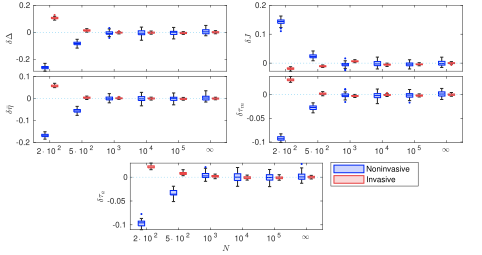
Parameter and hidden-state inference in mean-field models from partial observations of finite-size neural networks
We study large but finite neural networks that, in the thermodynamic limit, admit an exact low-dimensional mean-field description. We assume that the governing mean-field equations describing macroscopic quantities such as the mean firing rate or mean membrane potential are known, while their parameters are not. Moreover, only a single scalar macroscopic observable from the finite network is assumed to be measurable. Using time-series data of this observable, we infer the unknown parameters of the mean-field equations and reconstruct the dynamics of unobserved (hidden) macroscopic variables. Parameter estimation is carried out using the differential evolution algorithm. To remove the dependence of the loss function on the unknown initial conditions of the hidden variables, we synchronize the mean-field model with the finite network throughout the optimization process. We demonstrate the methodology on two networks of quadratic integrate-and-fire neurons: one exhibiting periodic collective oscillations and another displaying chaotic collective dynamics. In both cases, the parameters are recovered with relative errors below $1\%$ for network sizes exceeding 1000 neurons.
2602.09535Feb 2026
View
Chaos, the Critical Phenomenon in Phase Space: Feigenbaum Constants and Critical Exponents
Chaos in both dissipative systems and conservative systems is investigated on the approach of renormalization group. It is found that the chaos is regarded as the critical phenomenon of equilibrium statistics in phase space. The two Feigenbaum constants in the period-doubling bifurcation systems correspond to two independent critical exponents, which are universal and can be adopted to distinguish the classes of chaos. For the conservative systems, due to the critical nature of the chaos, the isolated systems with different parameters are correlated in the phase space, and therefore the isolated system is no longer isolated in the phase space. The information of conservative systems is irreversibly lost over time, which leads to the increase entropy in an isolated system, and the contradiction between the second law of thermodynamics and the reversibility of isolated systems can be resolved.
2602.08895Feb 2026
View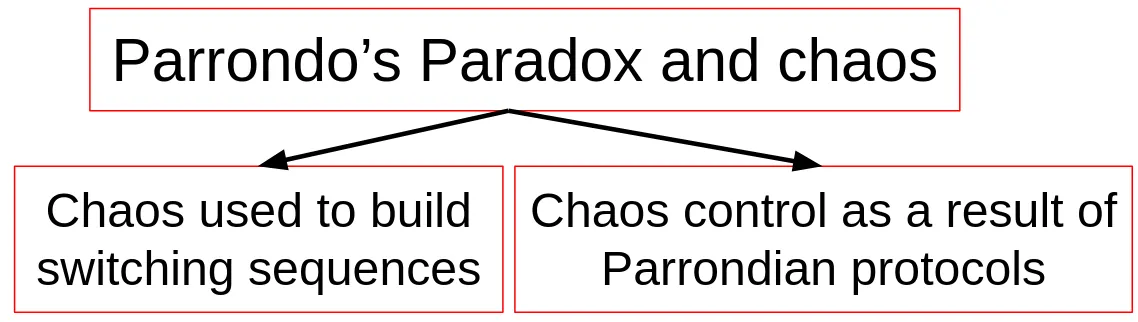
Chaos and Parrondo's paradox: An overview
Parrondo's paradox (PP) is a fundamental principle in nonlinear science where the alternation of individually losing strategies leads to a winning outcome. In this topical review, we provide the first systematic panorama of the synergy between PP and chaos. We observe a bidirectional connection between the two areas. The first direction is the translation of PP into the interplay between Order and Chaos through either Chaos + Chaos $\to$ Order (CCO) or Order + Order $\to$ Chaos (OOC). In this vein, many quantifiers, such as Lyapunov Exponents, $λ$, and entropic measures, are used. Second, we note that chaos can be used to engineer switching protocols that can lead to nontrivial effects in diverse PP cases. Our review clarifies the universality of PP and highlights its robust theoretical and practical applications across several areas of science and technology. Finally, we delineate key open questions, emphasizing the unresolved theoretical limits, the role of high-dimensional maps and continuous flows, and the critical need for more experimental verification of the dynamic PP in chaotic systems. For completeness, we also provide a full Python code that allows the reader to observe the many facets of the PP.
2602.08135Feb 2026
View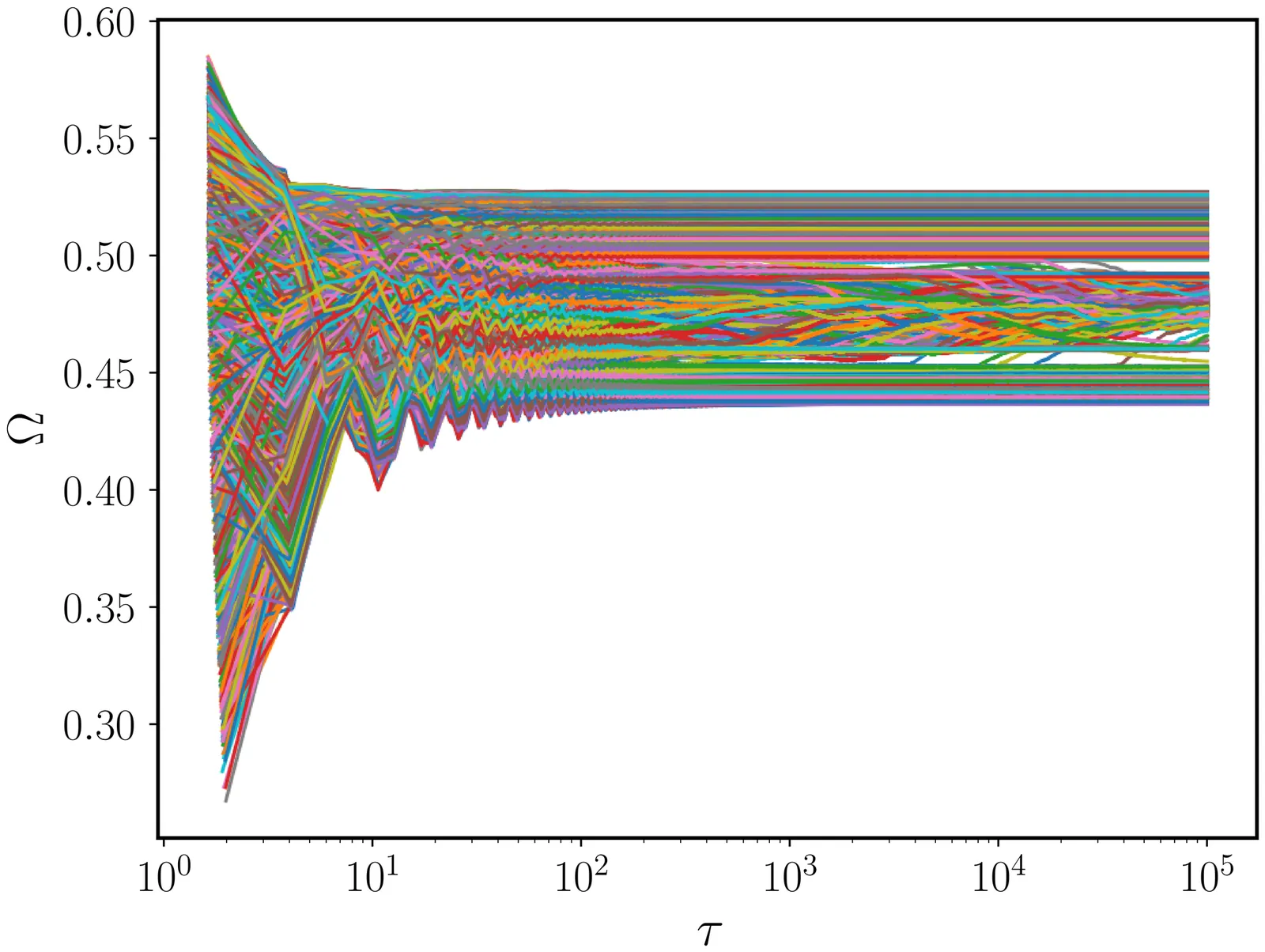
Trajectory arclength reveals chaos
In this paper we demonstrate that the phase space arclength of a trajectory, quantified by the time-averaged Lagrangian descriptor, is a robust and self-contained chaos indicator. By invoking Birkhoff's Ergodic Partition Theorem, we show that this scalar function distinguishes dynamical regimes via its power spectral density: for regular motion it converges to a delta function, whereas for chaotic trajectories the spectrum exhibits an inverse power-law $(1/ω)$ driven by the phenomenon of dynamical stickiness. With this approach, we avoid the computation and simulation of the variational equations and the usage of neighboring orbits, making it the simplest geometrical chaos indicator derivable from Lagrangian descriptors. Its computational efficiency enables the study of high-dimensional systems and allows the generation of large datasets of classified initial conditions, ideal for training Machine Learning models. We validate these findings using the Hénon-Heiles and the Fermi-Pasta-Ulam systems. By linking the geometrical properties of phase space to spectral analysis, this work provides the mathematical justification to establish Lagrangian descriptors as a rigorous, self-sufficient framework for the global analysis of chaos and regularity in Hamiltonian systems.
2602.07660Feb 2026
View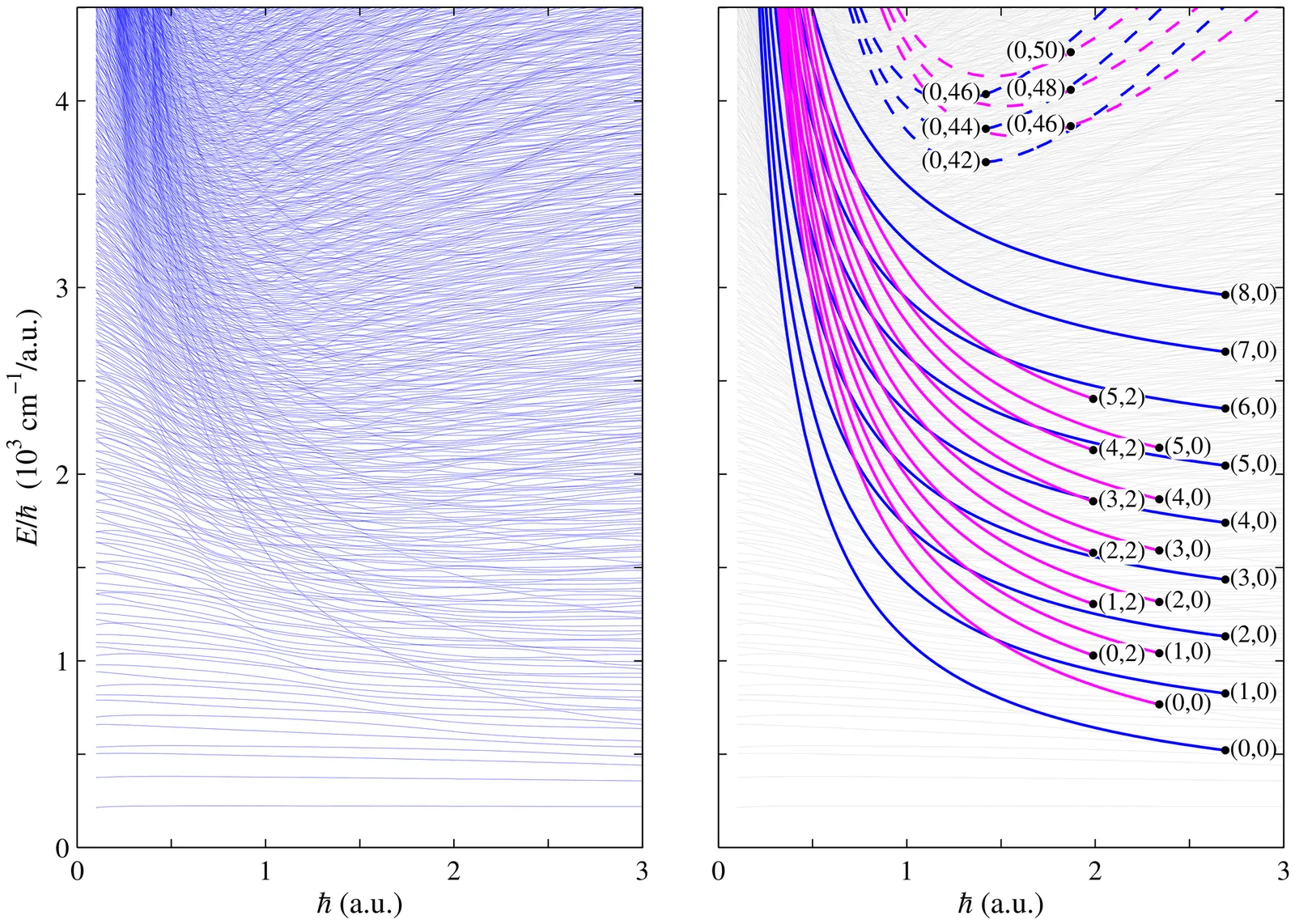
Using correlation diagrams to study the vibrational spectrum of highly nonlinear floppy molecules: The K-CN case
The correlation diagrams of vibrational energy levels considering the Planck constant as a variable parameter have proven as a very useful tool to study vibrational molecular states, and more specifically in relation to the quantum manifestations of chaos in such dynamical systems. In this paper, we consider the highly nonlinear K-CN molecule, showing how the regular classical structures, i.e., Kolmogorov-Arnold-Moser tori, existing in the mixed classical phase space appear in the quantum levels correlation diagram as emerging diabatic states, something that remains hidden when only the actual value of the Planck constant is considered. Additionally, a quantum transition from order to chaos is unveiled with the aid of these correlation diagrams, where it appears as a frontier of scarred functions.
2602.068813Feb 2026
View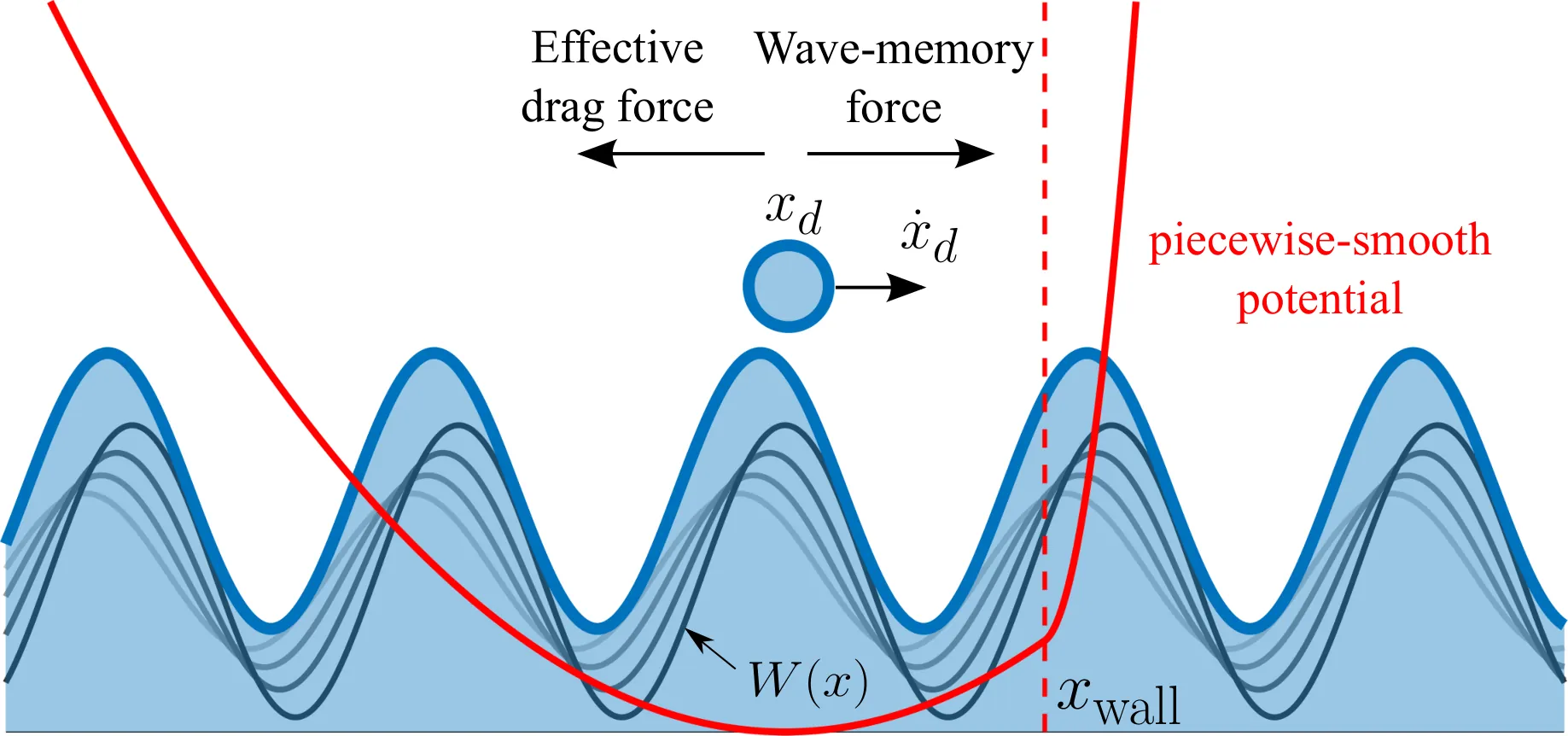
Active Soft-Impact Oscillator: Dynamics of a Walking Droplet in a Non-Smooth Potential
Walking droplets are millimetric fluid drops that propel themselves across a vibrated liquid bath through interaction with their self-generated waves. They constitute classical active wave-particle entities and exhibit a range of hydrodynamic quantum analogs. We investigate an \emph{active soft-impact oscillator} as a minimal model for a walking droplet moving within a piecewise-smooth external potential, analogous to classical mass-spring soft-impact oscillators and recently explored quantum soft-impact oscillators. Our active soft-impact oscillator model couples a non-smooth soft-impact force to the Lorenz-like dynamics arising from the wave-particle entity. Theoretical and numerical exploration of the full parameter space reveals a wide variety of nonlinear behaviors and bifurcations driven by impact and grazing events. These include grazing-induced and impact-induced transitions between periodic and chaotic motion, as well as grazing-mediated attractor switching and impact-free (invisible) attractor switching. The active soft-impact oscillator thus provides a versatile platform for probing nonlinear impact dynamics in active systems and exploring hydrodynamic quantum analogs in non-smooth potentials.
2602.05913Feb 2026
View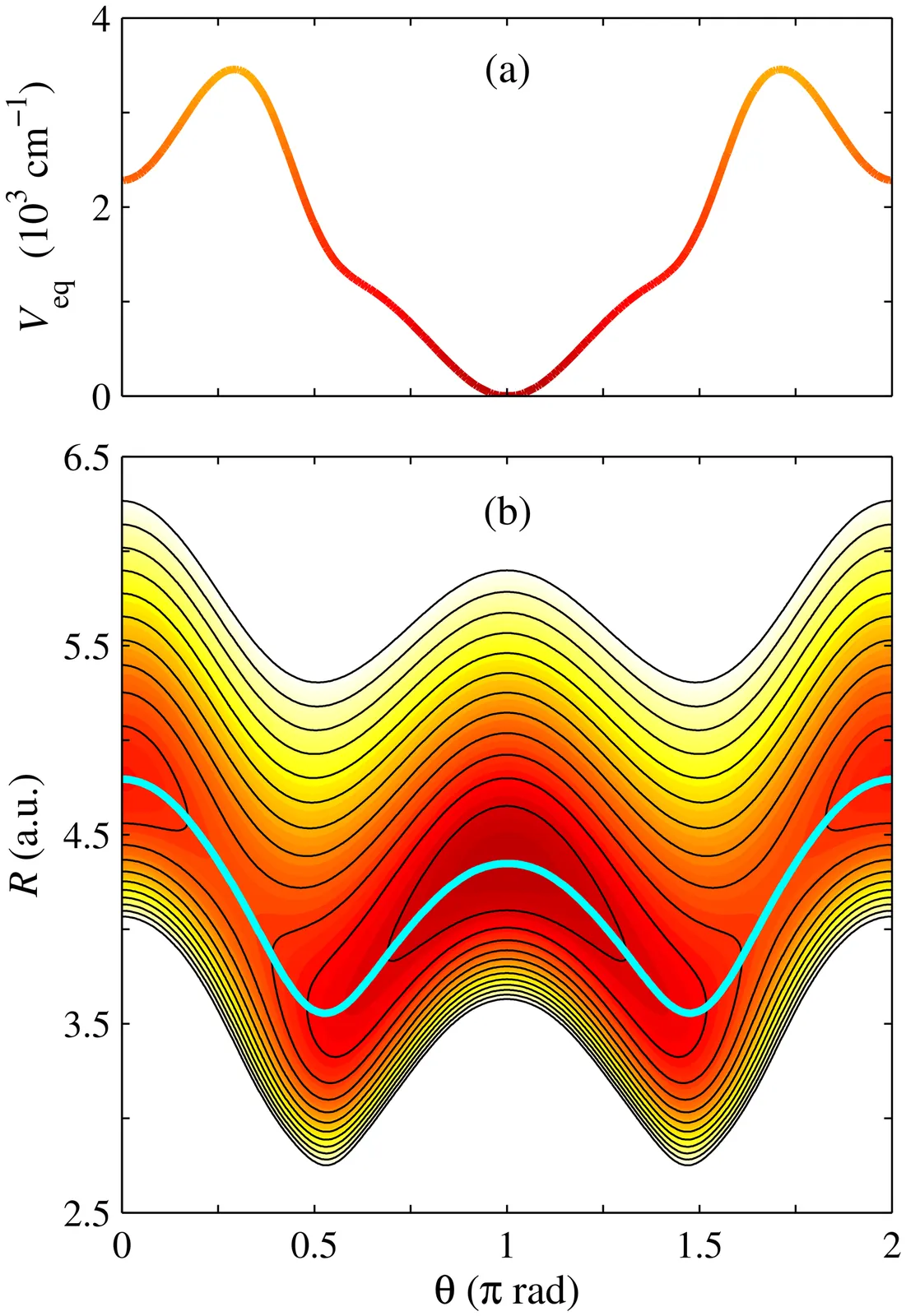
Correspondence between classical and quantum resonances
Bifurcations take place in molecular Hamiltonian nonlinear systems as the excitation energy increases, this leading to the appearance of different classical resonances. In this paper, we study the quantum manifestations of these classical resonances in the isomerizing system CN-Li$\leftrightarrows$Li-CN. By using a correlation diagram of eigenenergies versus Planck constant, we show the existence of different series of avoided crossings, leading to the corresponding series of quantum resonances, which represent the quantum manifestations of the classical resonances. Moreover, the extrapolation of these series to $\hbar=0$ unveils the correspondence between the bifurcation energy of classical resonances and the energy of the series of quantum resonances in the semiclassical limit $\hbar\to0$. Additionally, in order to obtain analytical expressions for our results, a semiclassical theory is developed.
2602.047931Feb 2026
View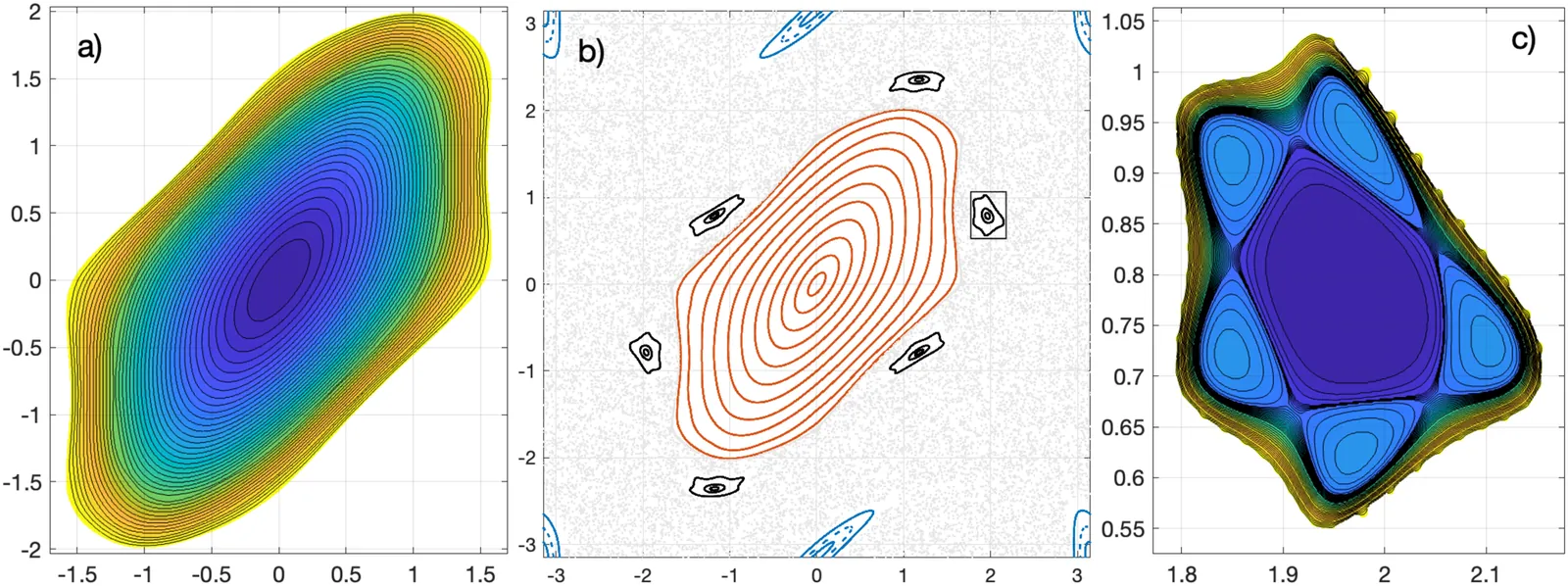
Semiclassical Structure of the Advection--Diffusion Spectrum in Mixed Phase Spaces
We examine the spectral structure of the two-dimensional advection-diffusion operator in flows with mixed phase space at very large Peclet number. Using Fourier discretization combined with symmetry reduction and Krylov-Arnoldi methods, we compute on the order of one hundred leading eigenpairs reliably in the asymptotic, weak-diffusion regime. While the principal eigenvalue is asymptotically diffusive and localized on the largest regular region, the broader spectrum exhibits a rich organization controlled by local Lagrangian phase-space geometry. In particular, exponential mixing in chaotic regions rapidly suppresses correlations, whereas algebraic mixing in integrable regions generates long-lived coherent structures that dominate the slow and intermediate parts of the spectrum. We identify three distinct classes of eigenmodes: advective modes associated with transport on invariant tori, diffusive modes and, within the duffusive branch, tunneling modes arising from weak coupling between dynamically separated regular regions. Drawing on a semiclassical analogy, we assign quantum-number-like labels to these families and predict the appearance, scaling, and ordering of their sub-spectra directly from the Hamiltonian phase-space structure. The coexistence of these families implies that no uniform control of the spectral gap exists across the full spectrum: although the slowest mode is diffusive, arbitrarily small gaps arise between competing families at higher mode numbers. As a result, finite-time advection-diffusion dynamics is generically governed by persistent modal competition rather than single-mode dominance, even at asymptotically large Peclet number.
2602.04730Feb 2026
View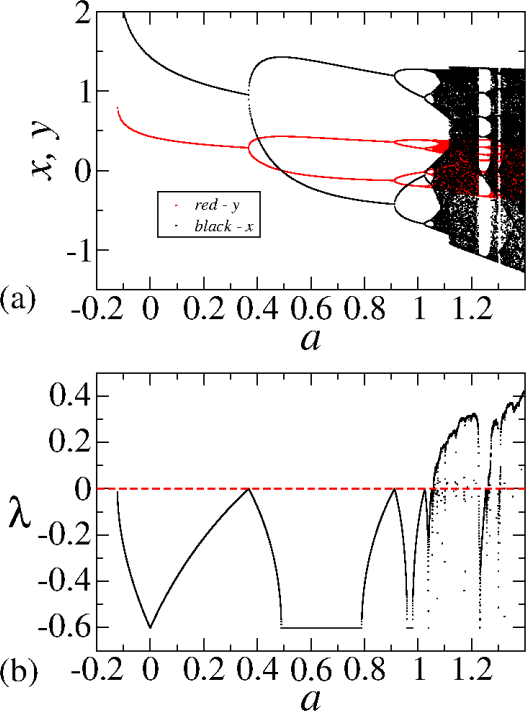
A phenomenological description of critical slowing down at period-doubling bifurcations
We present a phenomenological description of the critical slowing down associated with period-doubling bifurcations in discrete dynamical systems. Starting from a local Taylor expansion around the fixed point and the bifurcation parameter, we derive a reduced description that captures the convergence towards stationary state both at and near criticality. At the bifurcation point, three universal critical exponents are obtained, characterising the short-time behaviour, the asymptotic decay, and the crossover between these regimes. Away from criticality, a fourth exponent governing the relaxation time is identified. We show this phenomenology, well established for one-dimensional maps, extends naturally to two-dimensional mappings. By projecting the dynamics onto the centre manifold, we demonstrate that the local normal form of a two-dimensional period-doubling bifurcation reduces to the same universal structure found in one dimension. The theoretical predictions are validated numerically using the Hénon and Ikeda maps, showing excellent agreement for all scaling laws and critical exponents.
2602.04091Feb 2026
View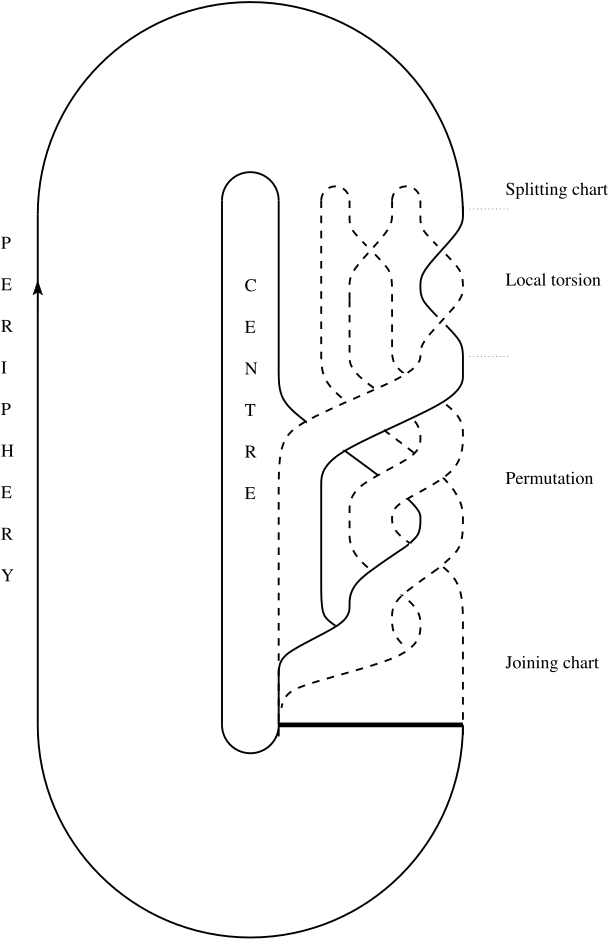
Templex: a bridge between homologies and templates for chaotic attractors
The theory of homologies introduces cell complexes to provide an algebraic description of spaces up to topological equivalence. Attractors in state space can be studied using Branched Manifold Analysis through Homologies: this strategy constructs a cell complex from a cloud of points in state space and uses homology groups to characterize its topology. The approach, however, does not consider the action of the flow on the cell complex. The procedure is here extended to take this fundamental property into account, as done with templates. The goal is achieved endowing the cell complex with a directed graph that prescribes the flow direction between its highest dimensional cells. The tandem of cell complex and directed graph, baptized templex, is shown to allow for a sophisticated characterization of chaotic attractors and for an accurate classification of them. The cases of a few well-known chaotic attractors are investigated -- namely the spiral and funnel Rössler attractors, the Lorenz attractor and the Burke and Shaw attractor. A link is established with their description in terms of templates.
2602.0159213Feb 2026
View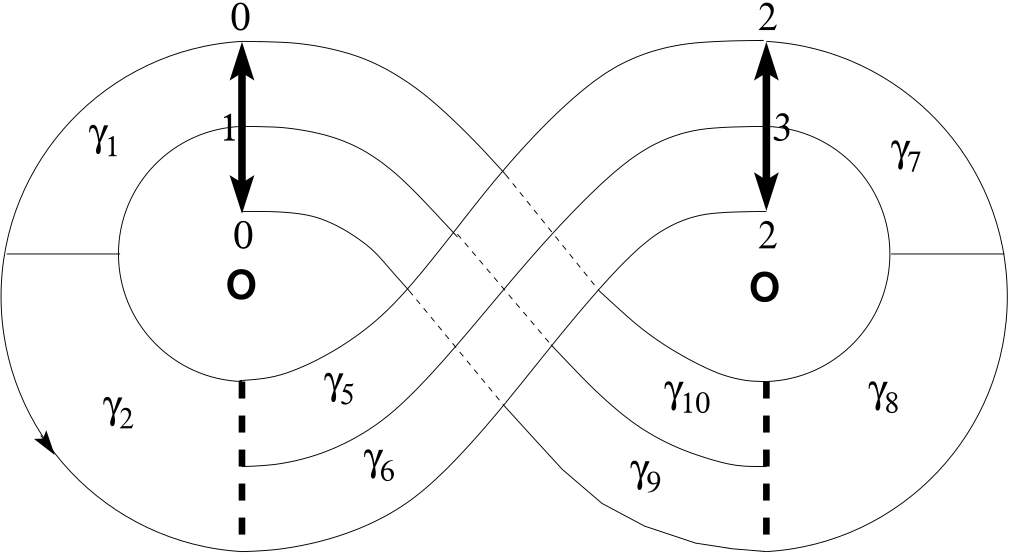
Templex-based dynamical units for a taxonomy of chaos
Discriminating different types of chaos is still a very challenging topic, even for dissipative three-dimensional systems for which the most advanced tool is the template. Nevertheless, getting a template is, by definition, limited to three-dimensional objects, since based on knot theory. To deal with higher-dimensional chaos, we recently introduced the templex combining a flow-oriented {\sc BraMAH} cell complex and a directed graph (a digraph). There is no dimensional limitation in the concept of templex. Here, we show that a templex can be automatically reduced into a ``minimal'' form to provide a comprehensive and synthetic view of the main properties of chaotic attractors. This reduction allows for the development of a taxonomy of chaos in terms of two elementary units: the oscillating unit (O-unit) and the switching unit (S-unit). We apply this approach to various well-known attractors (Rössler, Lorenz, and Burke-Shaw) as well as a non-trivial four-dimensional attractor. A case of toroidal chaos (Deng) is also treated. This work is dedicated to Otto E. Rössler.
2602.015754Feb 2026
View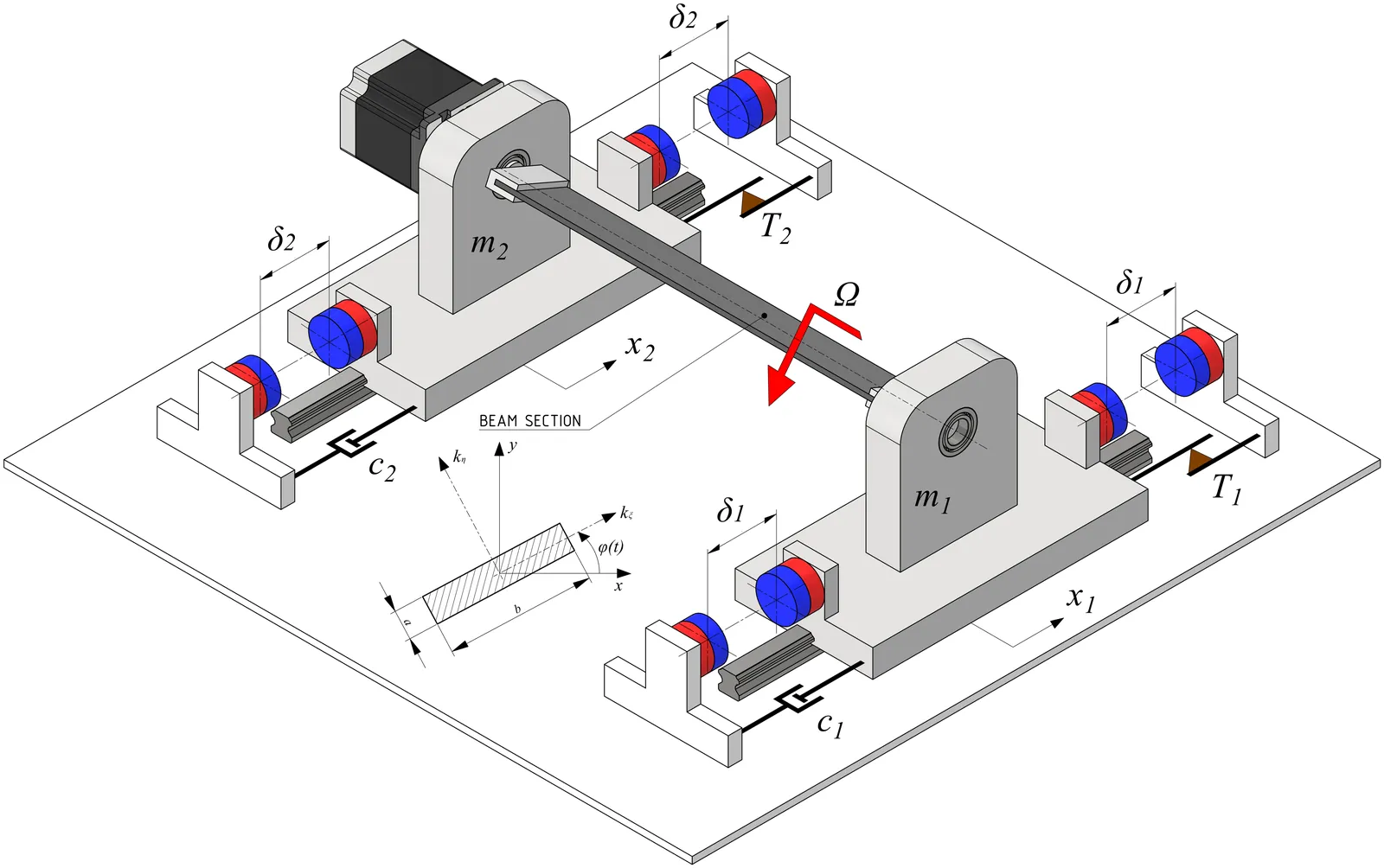
Analytical and numerical study of a parametrically excited 2DOF oscillator with nonlinear restoring magnetic force and rotating rectangular rod
This study investigates a detailed analytical and numerical investigation of a nonlinear two-degree-of-freedom (2DOF) mechanical oscillator subjected to parametric excitation, magnetic stiffness nonlinearities, and dry friction. The considered system consists of two coupled oscillators, both of which are connected to a rotating rectangular beam that induces a time-periodic stiffness variation. The Complex Averaging (CxA) method is employed to derive approximate analytical solutions, which are thoroughly validated through time-domain simulations and bifurcation analyses. The dynamic analysis reveals a rich spectrum of nonlinear behaviors, including periodic, quasi-periodic, and chaotic responses. Detailed bifurcation diagrams, Lyapunov exponent analysis, and Poincaré maps demonstrate the influence of nonlinear stiffness degree, mass symmetry, and frictional effects on system stability and response amplitude. The obtained results give a significant understanding of the dynamic behavior of coupled nonlinear systems and establish a conceptual framework for the development of complex vibration abatement strategies, energy harvesting devices, and advanced mechanical systems.
2602.01402Feb 2026
View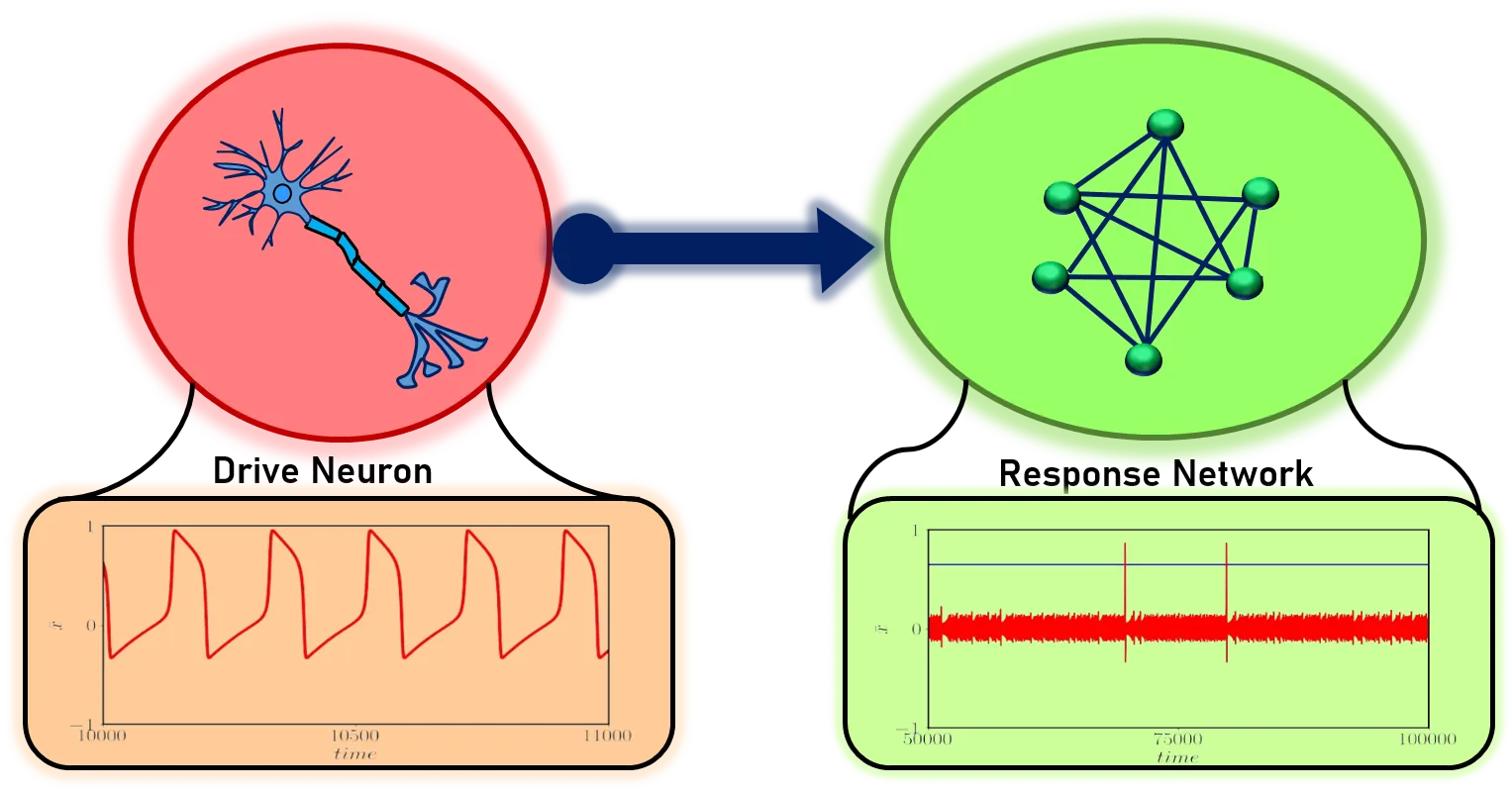
Controlling extreme events in neuronal networks: A single driving signal approach
We show that in a drive-response coupling framework extreme events are suppressed in the response system by the dominance of a single driving signal. We validate this approach across three distinct response network topologies, namely (i) a pair of coupled neurons, (ii) a monolayer network of N coupled neurons and (iii) a two-layer multiplex network each composed of FitzHugh-Nagumo neuronal units. The response networks inherently exhibit extreme events. Our results demonstrate that influencing just one neuron in the response network with an appropriately tuned driving signal is sufficient to control extreme events across all three configurations. In the two-neuron case, suppression of extreme events occurs due to the breaking of phase-locking between the driving neuron and the targeted response neuron. In the case of monolayer and multiplex networks, suppression of extreme events results from the disruption of protoevent frequency dynamics and a subsequent frequency decoupling of the driven neuron from the rest of the network. We also observe that when the size of the neurons in response network connected to the drive increases, the onset of control occurs earlier indicating a scaling advantage of the method.
2602.01234Feb 2026
View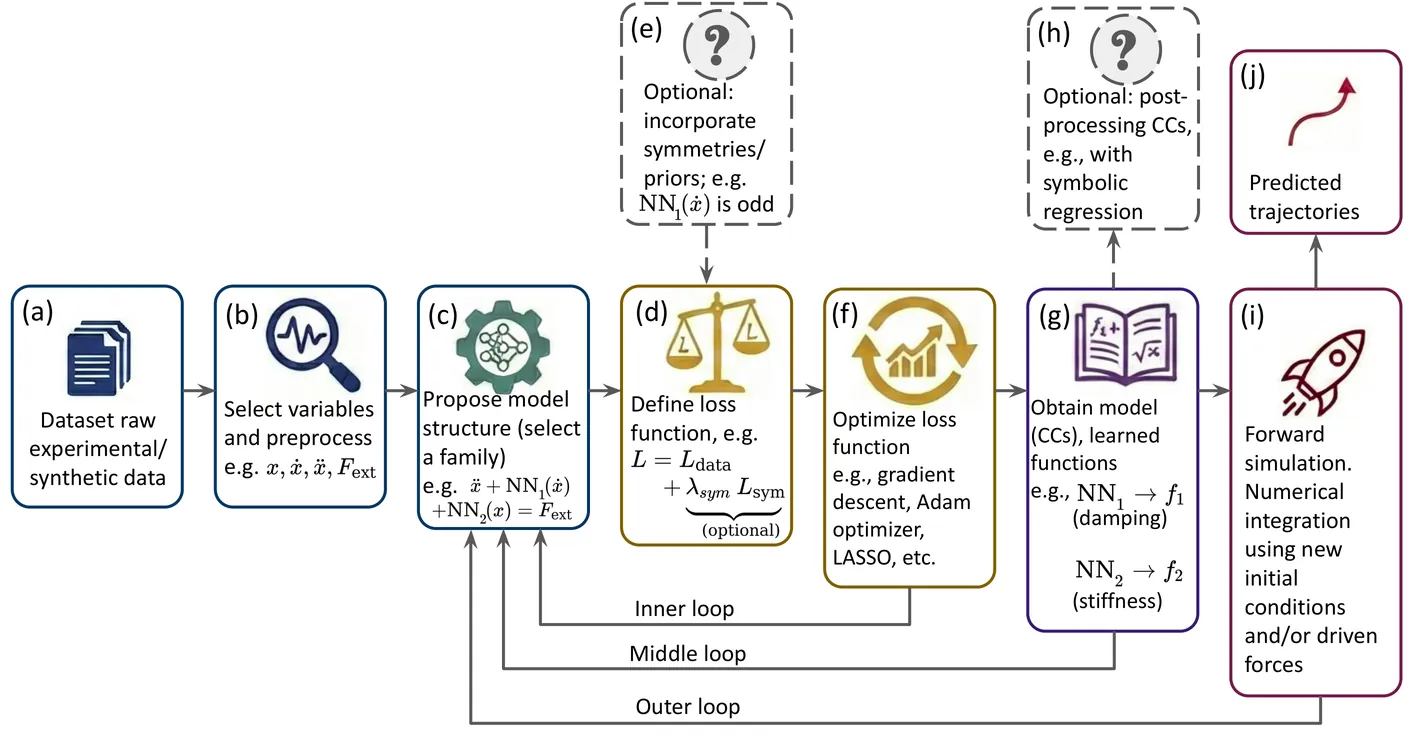
Integrating prior knowledge in equation discovery: Interpretable symmetry-informed neural networks and symbolic regression via characteristic curves
Data-driven equation discovery aims to reconstruct governing equations directly from empirical observations. A fundamental challenge in this domain is the ill-posed nature of the inverse problem, where multiple distinct mathematical models may yield similar errors, thus complicating model selection and failing to guarantee a unique representation of the underlying mechanisms. This issue can be addressed by incorporating inductive biases to constrain the search space and discard the undesirable models. The characteristic curves-based (CCs) framework offers a modular approach ideally suited to this aim. This approach is based on the specification of structural families that possess provable identifiability properties. Crucially, this framework enables practitioners to embed domain expertise directly into the learning process and facilitates the integration of diverse post-processing tools. In this work, we build upon the recent neural network implementation of this formalism (NN-CC), which benefits from the universal approximation capabilities of NNs. Specifically, we extend NN-CC by introducing two inductive biases: (i) symmetry constraints and (ii) post-processing with symbolic regression. Using a chaotic Duffing oscillator and a discontinuous stick-slip model under varying Gaussian noise levels, we show how these extensions systematically improve the discovery process. We also analyze the integration of sparse and symbolic regression (using SINDy and PySR) into the CC-based formalism. These extensions (SINDy-CC and SR-CC) consistently show improvements as prior information is incorporated. By enabling the integration of prior or hypothesized knowledge into the learning and post-processing stages, the CC-based formalism emerges as a promising candidate to address identifiability issues in purely data-driven methods, advancing the goal of interpretable and reliable system identification.
2601.21720Jan 2026
View
From Basins to safe sets: a machine learning perspective on chaotic dynamics
The study of chaos has long relied on computationally intensive methods to quantify unpredictability and design control strategies. Recent advances in machine learning, from convolutional neural networks to transformer architectures, provide new ways to analyze complex phase space structures and enable real time action in chaotic dynamics. In this perspective article, we highlight how data driven approaches can accelerate classical tasks such as estimating basin characterization metrics, or partial control of transient chaos, while opening new possibilities for scalable and robust interventions in chaotic systems. In recent studies, convolutional networks have reproduced classical basin metrics with negligible bias and low computational cost, while transformer based surrogates have computed accurate safety functions within seconds, bypassing the recursive procedures required by traditional methods. We discuss current opportunities, remaining challenges, and future directions at the intersection of nonlinear dynamics and artificial intelligence.
2601.21510Jan 2026
ViewPage 1 of 11