Trending in High Energy Physics
 2605.03474
Toward a Community Roadmap for High Energy Physics and Artificial Intelligence in China and Beyond
Artificial Intelligence (AI) is rapidly transforming scientific research and has become central to many data-intensive disciplines. High Energy Physics (HEP), with its vast data volumes, complex theoretical structures, and precision-driven methodologies, lies at a particularly fertile intersection with modern AI. In this document, we present a community-informed overview of AI+HEP development in China and beyond, motivated in part by discussions at the 2025 Quantum Computing and Machine Learning Workshop in Qingdao, Shandong Province. We briefly review current AI activities across experimental, phenomenological, and theoretical HEP, along with key aspects of the research ecosystem. This work does not aim to represent the entire community, but rather reflects a partial and evolving snapshot informed by discussions and perspectives gathered from members of the broader AI+HEP community. We hope it serves as an initial roadmap to inform future coordinated efforts and to lay the groundwork for a more comprehensive community white paper.
2605.03474
May 2026High Energy Physics - Phenomenology
The Fate of Nucleated Black Holes in de Sitter Quantum Gravity
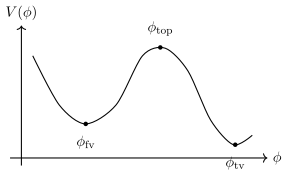
The Euclidean Nariai geometry has long been proposed as the instanton describing the nucleation of maximal-mass black holes in de Sitter space. We place this interpretation on firmer footing by showing that, once an observer is included, the gravitational path integral produces the imaginary phase required for a transition rate. As a warmup, we revisit the Hawking-Moss instanton and, as a byproduct, find that scalar fields can enhance black-hole nucleation, suggesting a quantum-gravity bound on scalar potentials with de Sitter solutions. We then study the subsequent semiclassical evolution of the nucleated black hole. We show that the previously claimed "anti-evaporation" channel is unphysical, arising from a quantum state with singular horizons. In a smooth state, the black hole instead undergoes standard thermal Hawking evaporation. We verify explicit agreement with the no-boundary state and argue that this evaporation is not subject to large quantum-gravity corrections. The nucleated black hole thus evaporates completely back to the maximally-entropic empty de Sitter vacuum, making the full process a Boltzmann fluctuation.
2605.03015
May 2026High Energy Physics - Theory
Emergent strings, holography, and cosmology from four-fermion interactions: a bottom-up derivation of AdS/CFT, dS/CFT, and $w_{1+\infty}$
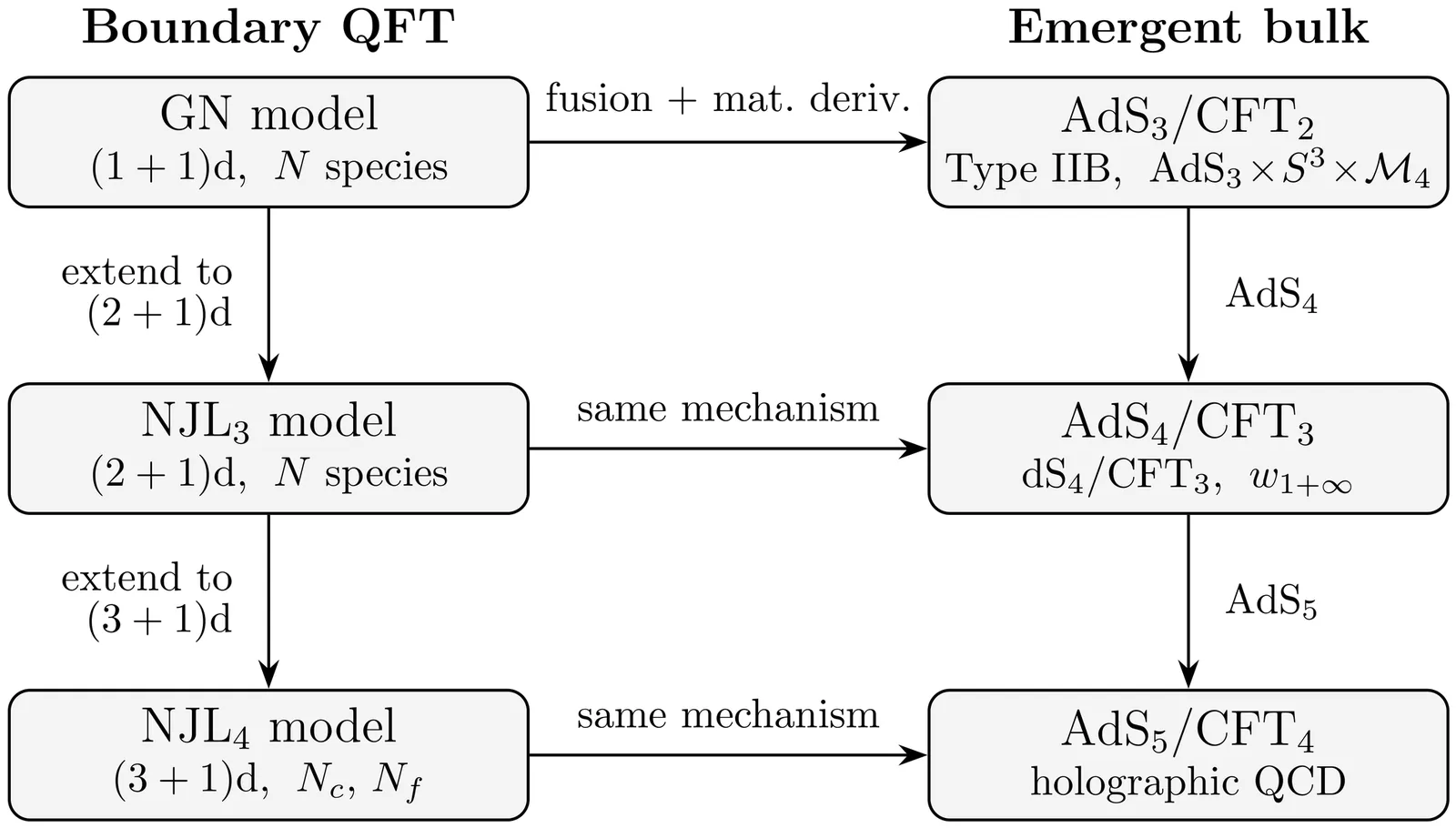
We derive holographic duality from first principles starting from the $(1+1)$-dimensional Gross-Neveu (GN) model with $N$ fermion species and a local quartic interaction, without assuming any string or geometric input. Using a Bargmann-Wigner scheme, the competition between chiral condensation $Δ_0=\langle\barψψ\rangle$ and spin-1 pairing $Δ_1=\langle\barΦ_1Φ_1\rangle$ defines an emergent radial coordinate $z=m^{-1}(Δ_1/Δ_0^2-1)^{1/2}$; local fluctuations of this ratio, tracked by a comoving derivative, generate the AdS$_3$ line element via the enhanced large-$N$ species dispersion; the condensate competition \emph{is} the extra dimension. From this single mechanism the complete AdS$_3$/CFT$_2$ correspondence emerges: Newton's constant, the Virasoro algebra ($c=2N^2$), D1-branes with open strings, open/closed T-duality, the Hagedorn/BKT transition, and the BTZ black hole whose horizon circumference is quantised in Planck units by individual vortex nucleation events. Analytic continuation $z\to iζ$ across the chiral critical point realises the Strominger dS/CFT conjecture microscopically. Six constraints identify the emergent string as Type IIB on AdS$_3\times S^3\times\mathcal{M}_4$, with emergent worldsheet $\mathcal{N}=(1,1)$ supersymmetry, NS/R spectral flow, and GSO projection. Extension to the $(2+1)$d NJL model yields AdS$_4$/CFT$_3$, a dS$_4$/CFT$_3$ realisation, and a structural identification of the $w_{1+\infty}$ celestial algebra. Extension to the $(3+1)$d NJL model yields AdS$_5$/CFT$_4$ and holographic QCD with chiral symmetry breaking and linear Regge trajectories $M_s^2=4(s+1)Λ_\mathrm{QCD}^2$, capturing the correct QCD infrared physics from a four-fermion interaction.
2603.27824
Mar 2026High Energy Physics - Theory
The elliptic three-loop integrals of hadronic vacuum polarization in chiral perturbation theory
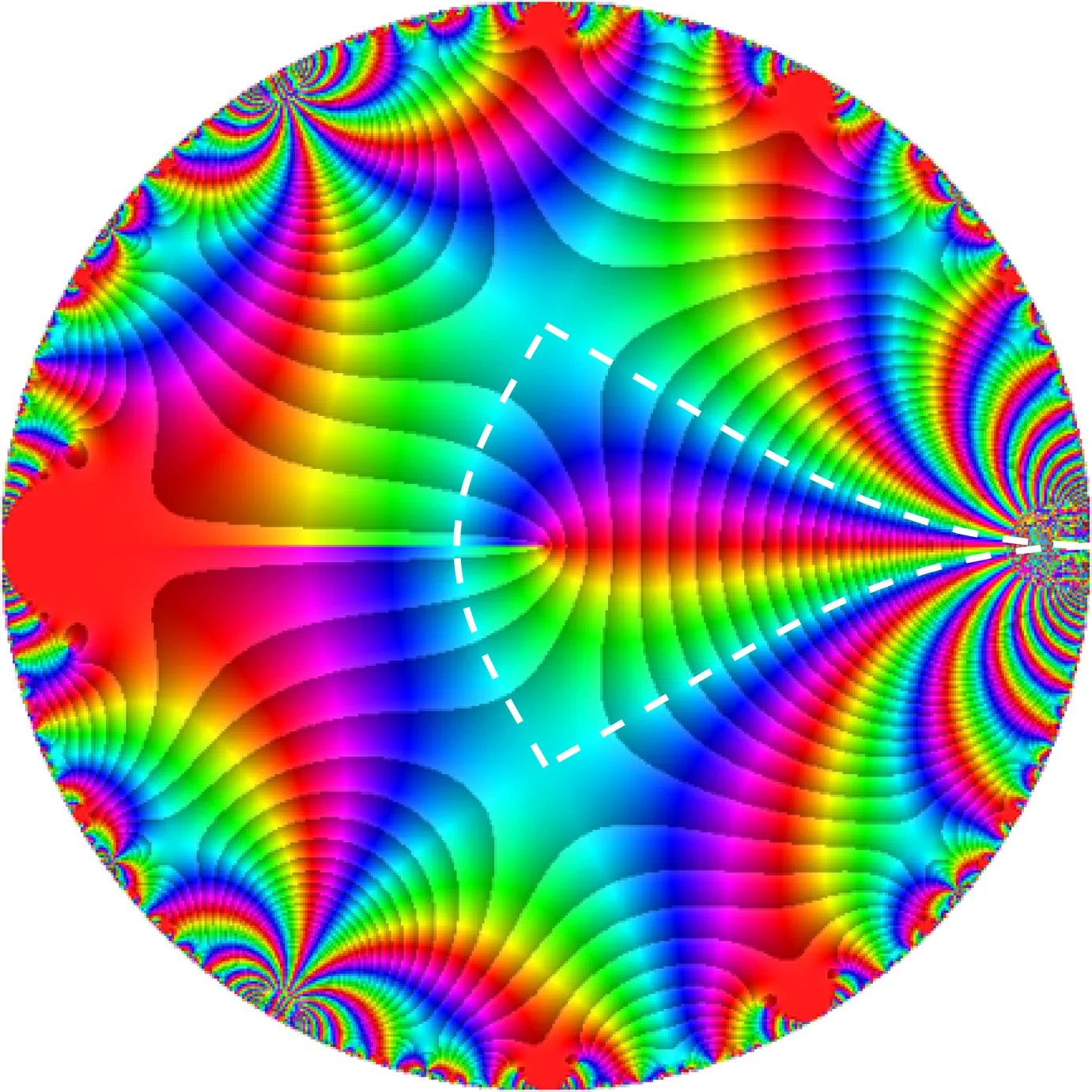
This work presents a detailed account of the Feynman integrals required for the three-loop hadronic vacuum polarization calculation performed in arXiv:2510.12885. We explain how to compute each of the three-loop integrals, and outline the mathematical framework underlying their evaluation. This culminates in a practical numerical implementation that enables fast and accurate evaluation of these integrals for arbitrary complex values of the photon virtuality.
2603.15252
Mar 2026High Energy Physics - Phenomenology
An End-to-end Architecture for Collider Physics and Beyond
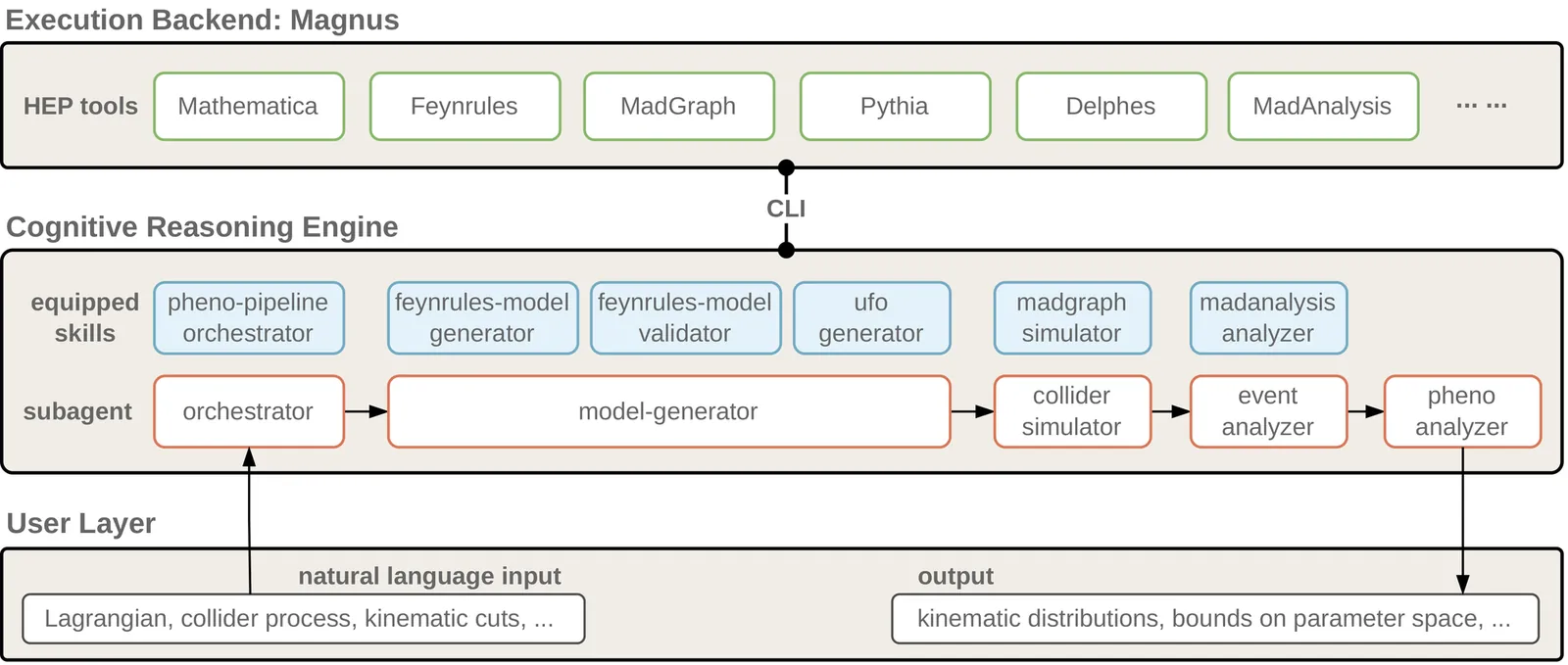
We present, to our knowledge, the first language-driven agent system capable of executing end-to-end collider phenomenology tasks, instantiated within a decoupled, domain-agnostic architecture for autonomous High-Energy Physics phenomenology. Guided only by natural-language prompts supplemented with standard physics notation, ColliderAgent carries out workflows from a theoretical Lagrangian to final phenomenological outputs without relying on package-specific code. In this framework, a hierarchical multi-agent reasoning layer is coupled to Magnus, a unified execution backend for phenomenological calculations and simulation toolchains. We validate the system on representative literature reproductions spanning leptoquark and axion-like-particle scenarios, higher-dimensional effective operators, parton-level and detector-level analyses, and large-scale parameter scans leading to exclusion limits. These results point to a route toward more automated, scalable, and reproducible research in collider physics, cosmology, and physics more broadly.
2603.14553
Mar 2026High Energy Physics - Phenomenology
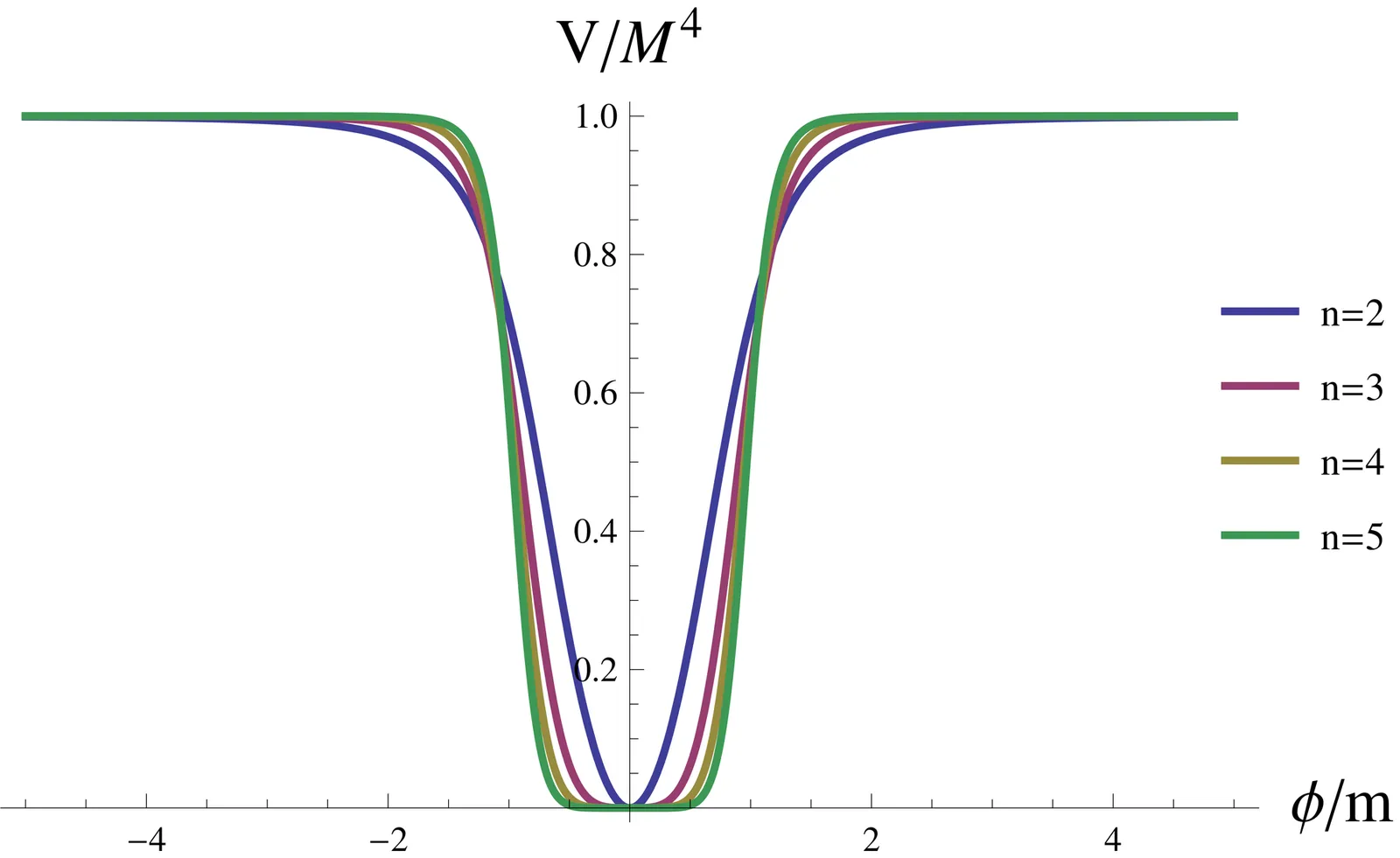
Inflation with the standard and Randall-Sundrum model in the Two-time Physics
We propose a scalar inflationary potential as $V(φ)=M^4φ^{2n-2}(φ^{2n}+m^{2n})^{1/n-1}$. This potetial similar to the shaft inflation one. The potential may come from the Higgs-dilaton potential in the Two-time (2T) physics, especially in the case where $n=3$, this suggests an explanation for the inflationary potential. Therefore, we call it shaft-warm inflation potential for short. The slow-roll scenario is recomputed in the 4-dimension (4D) and Randall-Sundrum II (RSII) frameworks. The tensor-to-scalar ratio in RSII is always higher than in 4D and is in good agreement with the experimental data of BICEP2 and Planck. When compared with Planck data we estimate $M_5$ to be around $[1-2]\times 10^{16}$ GeV. Furthermore, the potential allows much lower scalar field exponents than other potentials, which results in high agreement with experimental data.
2603.15172
Mar 2026High Energy Physics - Phenomenology
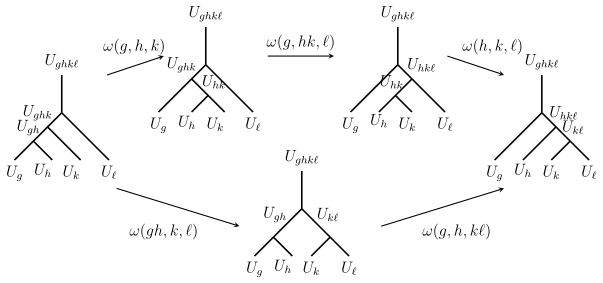
Introduction to Generalized Symmetries
These notes were prepared for a series of intensive lectures delivered at Hokkaido University, Nagoya University, Kyoto University, and Kyushu University. We begin with a brief review of higher-form symmetries, anomalies, and discrete gauge theories, before introducing non-invertible symmetries in $(1+1)$-dimensional systems. The basic structure of fusion categories is then discussed, including a discussion of categorical analogs of discrete gauging and representation theory. We subsequently turn to $(3+1)$-dimensional theories, where several physical applications of non-invertible symmetries are discussed. These notes are intended to be largely self-contained, and require no prior familiarity with subjects such as conformal field theory or lattice models.
2603.08798
Mar 2026High Energy Physics - Theory
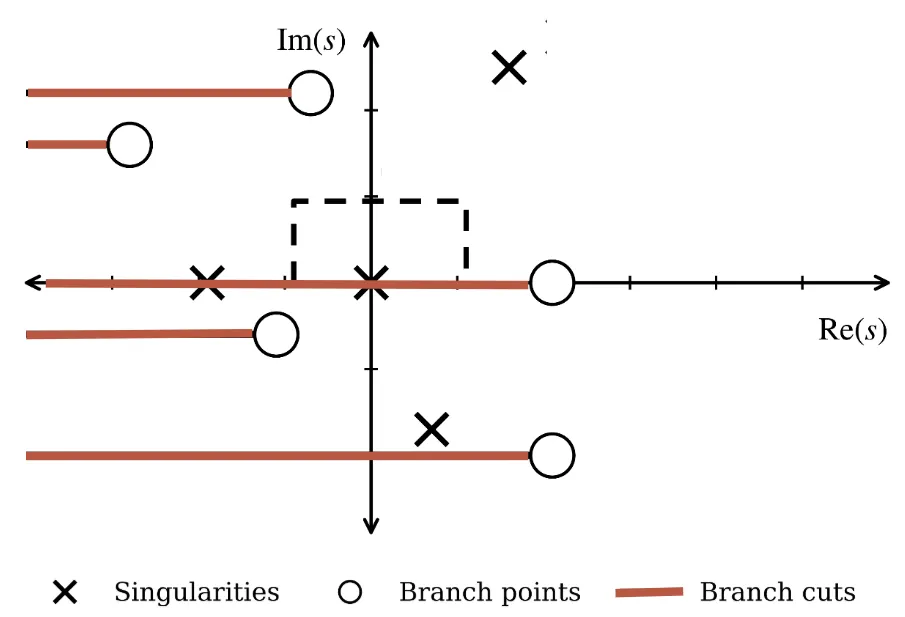
Evaluation of Feynman integrals via numerical integration of differential equations
We revisit the idea of numerically integrating the differential form of Feynman integrals. With a novel approach for the treatment of branch cuts, we develop an integrator capable of evaluating a basis of master integrals in double and quadruple precision, with significantly smaller run times than other tools. This opens the door to evaluating higher complexity Feynman integrals on the fly in Monte Carlo generators, and enables a cheaper and easy to parallelise generation of grids for the topologies with prohibitive computational times. To show its performance, we test one- and two-loop integral families, achieving evaluation times in double precision of milliseconds and hundreds of milliseconds, respectively. We comment on the results and suggest room for improvement.
2603.05336
Mar 2026High Energy Physics - Phenomenology
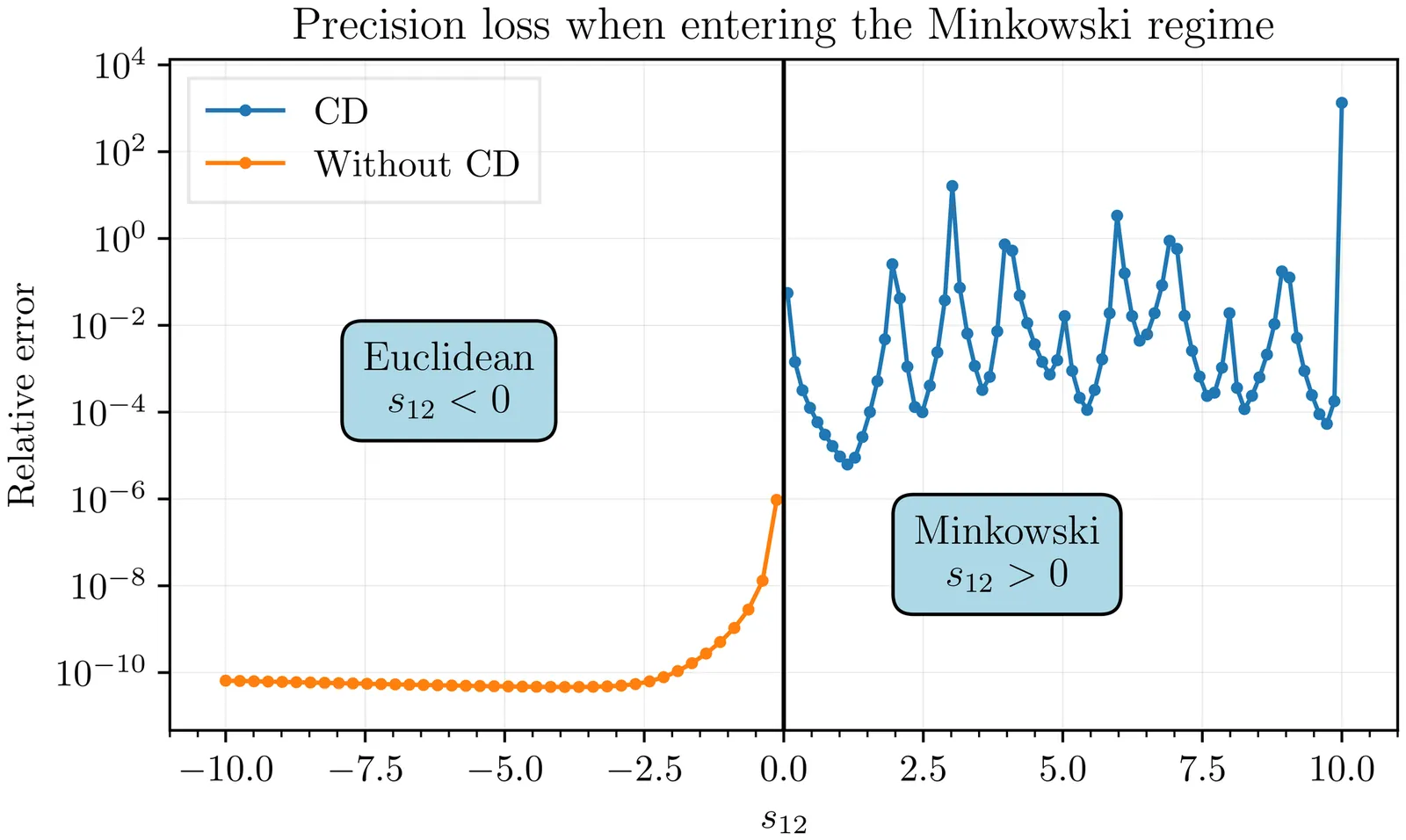
Accelerating Feynman Integral Evaluation by Avoiding Contour Deformation
We describe our method for rewriting dimensionally regulated Feynman parameter integrals in the Minkowski regime as a sum of real, positive integrands multiplied by complex prefactors. This representation eliminates the need for a contour deformation, which is one of the main computational bottlenecks in numerical integration. We demonstrate clearly how the method works on two examples, and benchmark the performance against contour deformation as implemented in pySecDec, where we observe performance gains of up to several orders of magnitude. We describe an improvement in the resolution procedure using the Generic Cylindrical Algebraic Decomposition algorithm, which generalises our method to any Feynman integral, including those with massive propagators.
2603.05444
Mar 2026High Energy Physics - Phenomenology
Introduction to holography
These are course notes for the 'Introduction to holography' Master level course at University of Cologne. The goal of the course is to give a pedogogical introduction to holography. Holography is a popular approach to quantum gravity, in which a theory of gravity can be described by a lower-dimensional boundary theory that itself has no gravity. The most concrete known example of a holographic model is the AdS/CFT correspondence, where the gravitational theory has a negative cosmological constant (the universe is asymptotically Anti-de Sitter) and the boundary theory is a conformal field theory. Symmetry plays a very important role in this duality. We therefore start the course with a review of Poincaré symmetry in quantum field theory, before moving on in the second chapter to conformal symmetry in conformally invariant quantum field theories or CFT's. Then we move to the basics of AdS physics in chapters 3 and 4, which will already reveal hints to the existence of a duality with CFT. After gathering the basic ingredients (CFT and AdS), in the second half of the course we are ready to formulate the AdS/CFT correspondence (chapter 5), including finite temperature AdS/CFT (chapter 6), which involves black holes and their thermodynamics in the gravitational theory (chapter 7). We end the course with an introduction to entanglement in AdS/CFT and the origin of statements that 'gravity emerges from entanglement' in holography.
2603.05186
Mar 2026High Energy Physics - Theory
Where Multipartite Entanglement Localizes: The Junction Law for Genuine Multi-Entropy
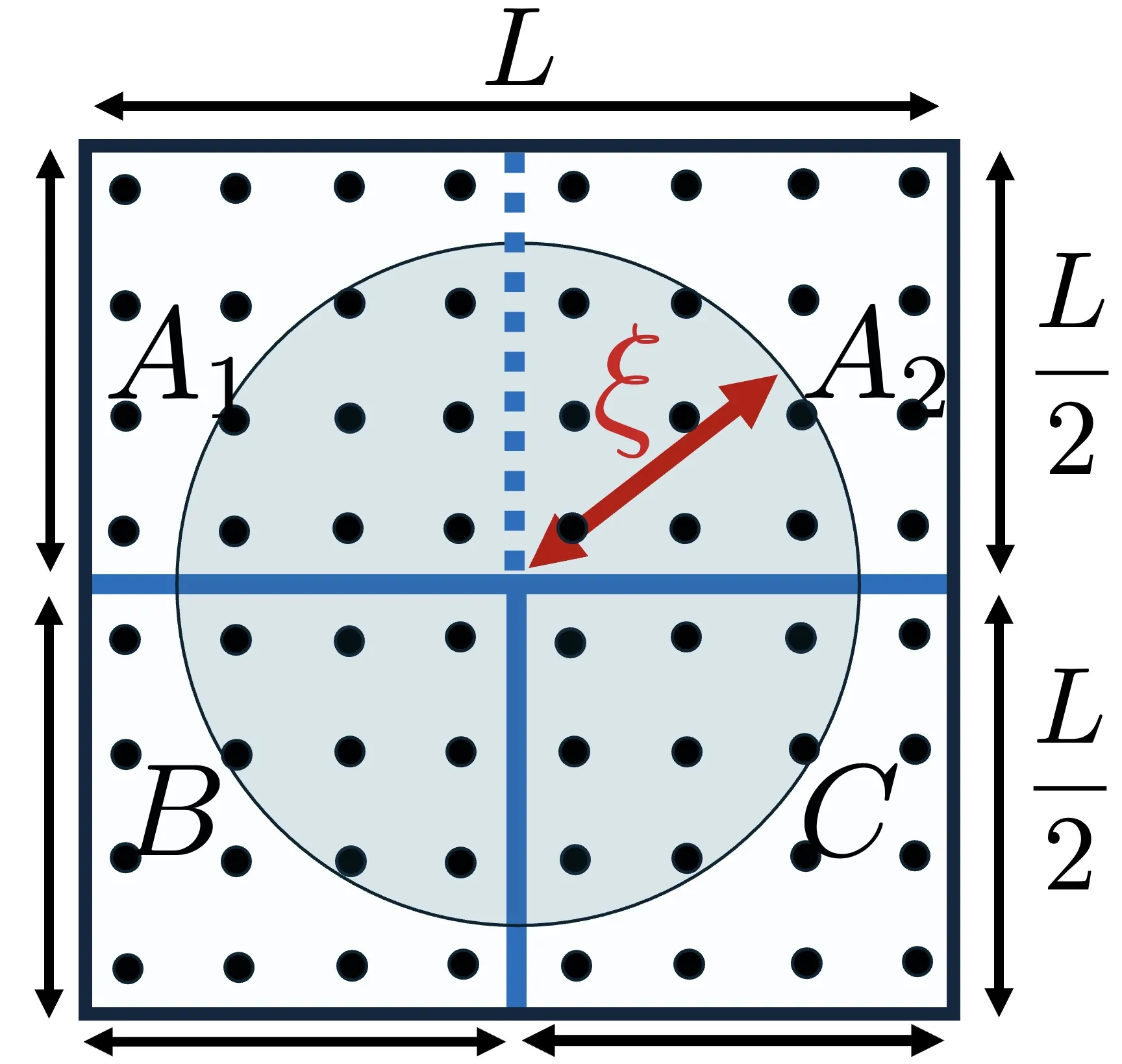
We uncover a "junction law" for genuine multipartite entanglement, suggesting that in gapped local systems multipartite entanglement is controlled and effectively localized near junctions where subsystem boundaries meet. Using the Rényi-2 genuine multi-entropy $\mathrm{GM}^{(\mathtt{q})}_2$ as a diagnostic of genuine $\mathtt{q}$-partite entanglement, we establish this behavior in $(2+1)$-dimensional gapped free-fermion lattices with correlation length $ξ$. For partitions with a single junction, $\mathrm{GM}^{(\mathtt{q})}_2$ exhibits a universal scaling crossover in $L/ξ$, growing for $L\llξ$ and saturating to a $ξ$-dependent constant for $L\ggξ$, up to $\mathcal{O}(e^{-L/ξ})$ corrections. In sharp contrast, for partitions without a junction, $\mathrm{GM}^{(\mathtt{q})}_2$ is exponentially suppressed in $L/ξ$ and drops below numerical resolution once $L\ggξ$. We observe the same pattern for $\mathtt{q}=3$ (tripartite) and $\mathtt{q}=4$ (quadripartite) cases, and further corroborate this localization by translating the junction at fixed system size. We also provide a geometric explanation of the junction law in holography. Altogether, these results show that in this gapped free-fermion setting genuine multipartite entanglement is localized within a correlation-length neighborhood of junctions.
2602.16331
Feb 2026High Energy Physics - Theory
Toward a mathematically consistent theory of semiclassical gravity or, How to have your wormholes and factorize, too
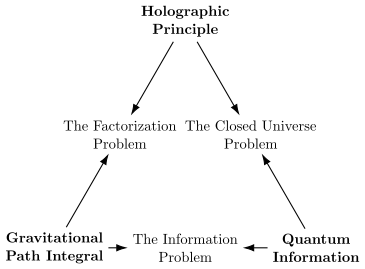
We review three well known inconsistencies in the standard mathematical formulation of semiclassical gravity: the factorization problem, the information problem, and the closed universe problem. Building upon recent work, we explore how modifying the holographic dictionary may provide the necessary freedom to resolve these three problems in a unified manner while maintaining more well established aspects of the standard correspondence. Using the modified holographic dictionary as a scaffolding, we propose a program for constructing an `extended' semiclassical gravitational path integral which (i) is manifestly factorizing, (ii) computes a von Neumann entropy which satisfies the Page curve, and (iii) incorporates new operators that create closed baby universe states. Our construction may be interpreted as imposing a semiclassical version of background independence/a no global symmetry condition, defining a modified large N limit, preparing an ensemble of dual theories, or enforcing observer rules using gravitational degrees of freedom.
2602.15120
Feb 2026High Energy Physics - Theory
2602.12176Single-minus gluon tree amplitudes are nonzero
Single-minus tree-level $n$-gluon scattering amplitudes are reconsidered. Often presumed to vanish, they are shown here to be nonvanishing for certain "half-collinear" configurations existing in Klein space or for complexified momenta. We derive a piecewise-constant closed-form expression for the decay of a single minus-helicity gluon into $n-1$ plus-helicity gluons as a function of their momenta. This formula nontrivially satisfies multiple consistency conditions including Weinberg's soft theorem.
2602.12176
Feb 2026High Energy Physics - Theory
2602.11254Quantum Gravity on AdS$_3\times$S$^3$ from CFT: Bootstrapping $n=21$
We consider the simplest four-point scattering amplitude of $SO(n)$ tensor multiplets in six-dimensional (2,0) supergravity on AdS$_3\times$S$^3$. Using crossing symmetry and the consistency of the operator product expansion in the dual CFT, we explicitly construct the one-loop contribution to the correlator at order $1/c^2$, both in position space and in Mellin space. We show that a strong form of the bootstrap equations imposes constraints on the value of $n$. Remarkably, we find that our bootstrap approach uniquely determines $n=21$, which corresponds to the spectrum of IIB string theory compactified on K3. This stands in sharp contrast to the tree-level correlator for which $n$ is unconstrained. We also analyse the spectrum of unprotected double-trace operators and solve the mixing problem in the first case that involves both tensor and graviton correlators. When $n=21$, the anomalous dimensions rationalise and one of them vanishes. Lastly, we study the flat-space limit of the correlator and find perfect agreement with the one-loop amplitude recently obtained in [arXiv:2510.24558].
2602.11254
Feb 2026High Energy Physics - Theory
Forward-mode automatic differentiation for the tensor renormalization group and its relation to the impurity method
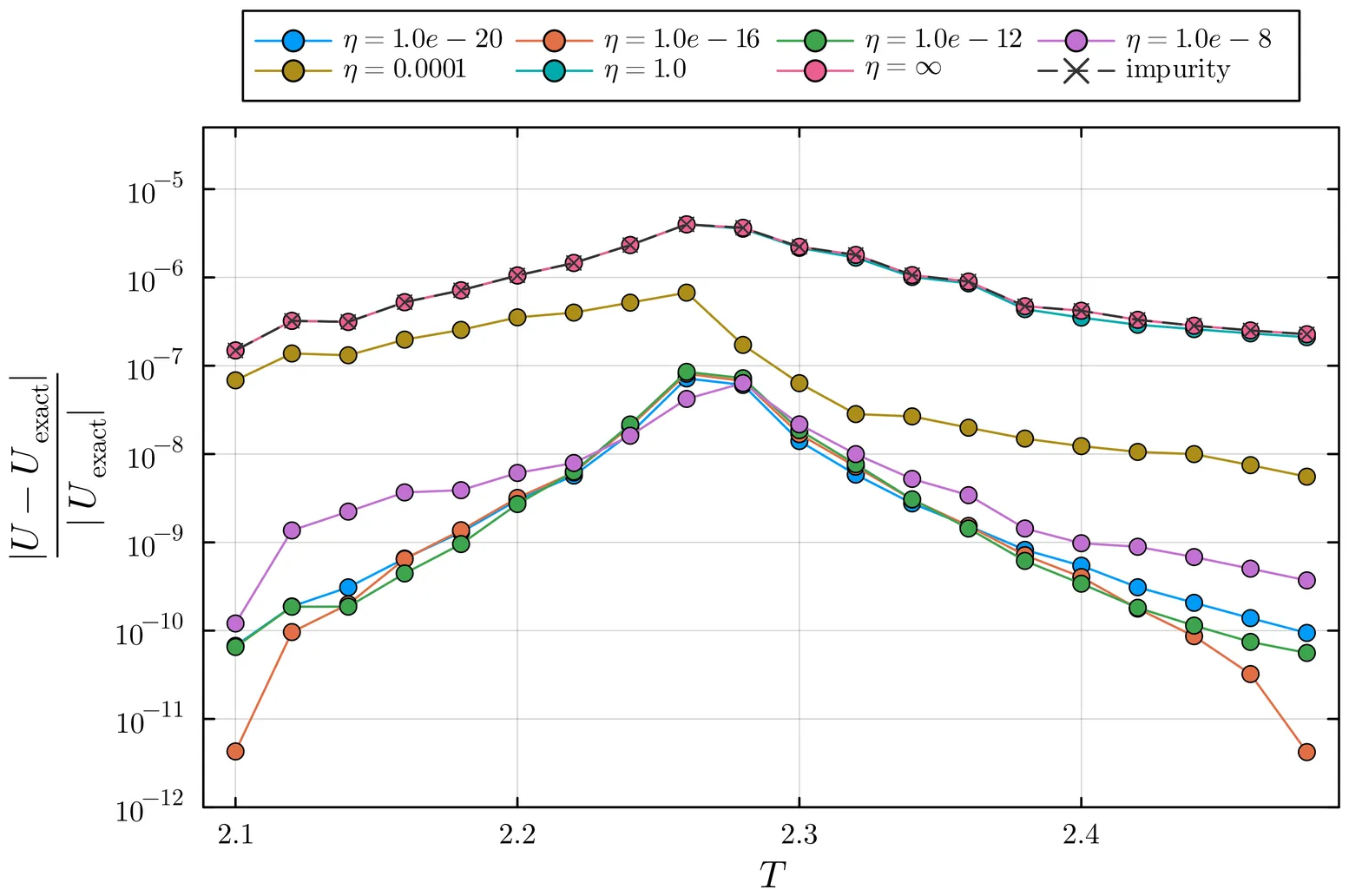
We propose a forward-mode automatic differentiation (AD) framework for tensor renormalization group (TRG) methods. In this approach, evaluating the derivatives of the partition function up to order $k$ increases the matrix-multiplication cost by a factor of $(k+1)(k+2)/2$ compared to computing the free energy alone, while the memory footprint is only $k$ times that of the original calculation. In the limit where the derivatives of the SVD are neglected, we establish a theoretical correspondence between our forward-mode AD and conventional impurity methods. Numerically, we find that the proposed AD algorithm can calculate internal energy and specific heat significantly higher accuracy than the impurity method at comparable computational cost. We also provide a practical procedure to extract critical exponents from derivatives of the renormalized tensor in TRG calculations in both two and three dimensions.
2602.08987
Feb 2026High Energy Physics - Lattice
Probing holographic conformal field theories
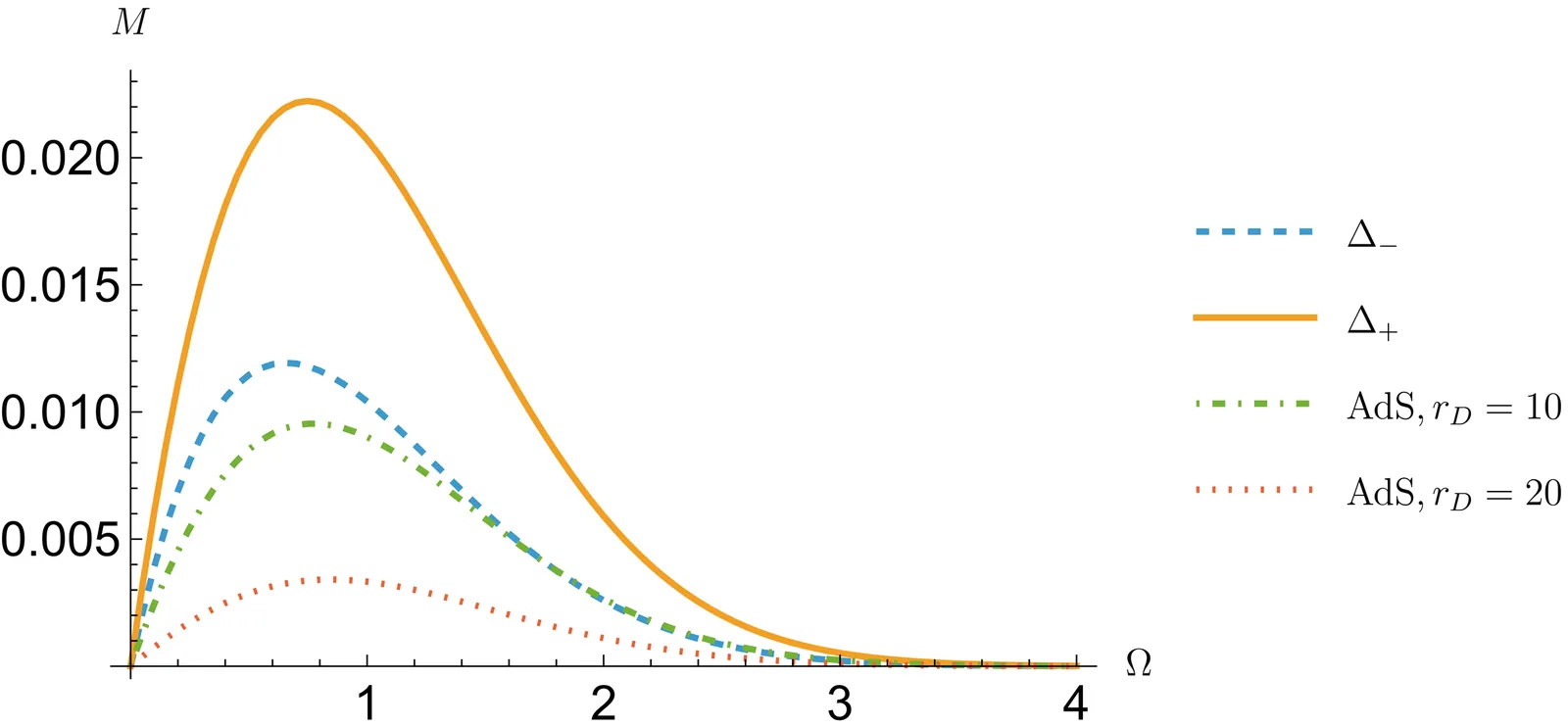
We introduce an operational, boundary-first framework that embeds relativistic quantum-information protocols into anti-de Sitter/Conformal Field Theory (AdS/CFT) by coupling an Unruh--DeWitt detector directly to a local scalar primary operator of a holographic CFT. Using the universal CFT Wightman function, we compute the detector's reduced density operator perturbatively, retaining both excitation probabilities and coherences. As a concrete resource-theoretic application, we implement magic resource (mana) harvesting with a qutrit probe. For a CFT dual to global AdS, we show that the harvested mana sharply distinguishes the two admissible scalar quantizations in the Breitenlohner--Freedman window, with the standard quantization yielding systematically larger mana than the alternate one. Our results provide a viable way of testing holography principle through quantum information resource.
2602.07895
Feb 2026High Energy Physics - Theory
Tensor renormalization group study of cold and dense QCD in the strong coupling limit
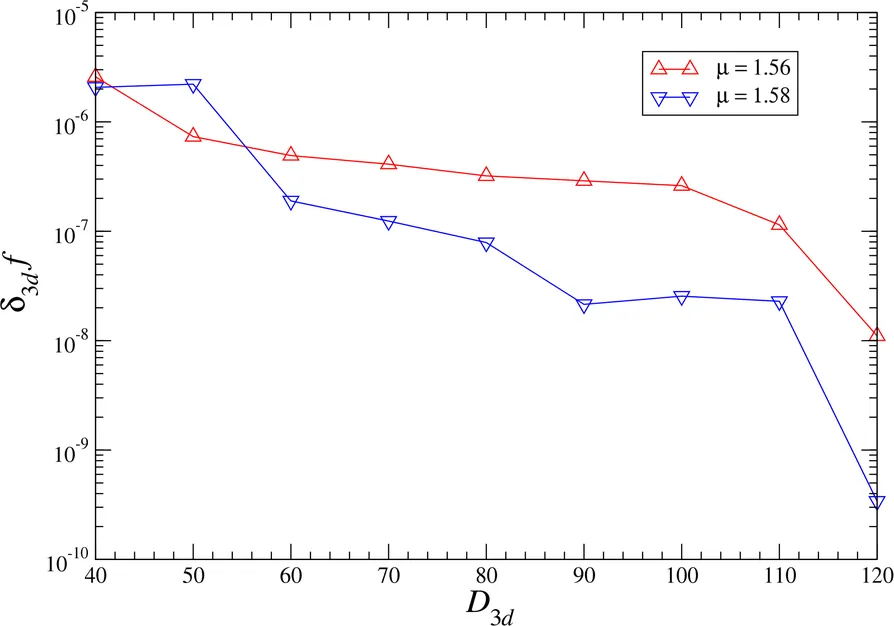
We study the phase structure of the (3+1)-dimensional cold and dense QCD with the Kogut--Susskind quark in the strong coupling limit using the tensor renormalization group method. The chiral and nuclear transitions are investigated by calculating the chiral condensate and the quark number density as a function of the chemical potential. For a fixed temporal extent $N_τ=8$, we determine the critical quark masses $m_c^χ$ and $m_c^{n}$ for the chiral condensate and the quark number density, respectively, at which the first-order phase transition terminates with the vanishing discontinuity in thermodynamic quantities. We find that both quantities at the same quark mass exhibit a discontinuity at the same chemical potential, and the resulting critical quark masses are consistent with each other. We also compare our results for the critical quark masses with those obtained from the Monte Carlo simulation in the dual formulation and from the mean-field analysis. We further confirm the first-order phase transition at finite quark mass on a $1024^4$ lattice, which is essentially in the thermodynamic limit at zero temperature, as expected from the mean-field analysis.
2601.20690
Jan 2026High Energy Physics - Lattice
2601.19982FORM Version 5.0
We present FORM 5, a major release of the symbolic-manipulation system FORM. Version 5 introduces an integrated diagram generator, based on the GRACE graph-generator, to produce Feynman diagrams directly from FORM scripts. This release also adds support for arbitrary precision floating point coefficients, together with statements for the numerical evaluation of common mathematical functions as well as multiple zeta values and Euler sums. In addition, FORM 5 provides an interface to the FLINT library, offering substantially faster polynomial arithmetic. Various further functions and commands have been added alongside these major features, as well as performance improvements for TFORM and improved compression of FORM's temporary files. Compatibility with the previous release, FORM 4.3.1, is retained except where prior behaviour contradicted the manual or was experimental.
2601.19982
Jan 2026High Energy Physics - Phenomenology
Towards a Proof of the Improved Quantum Null Energy Condition
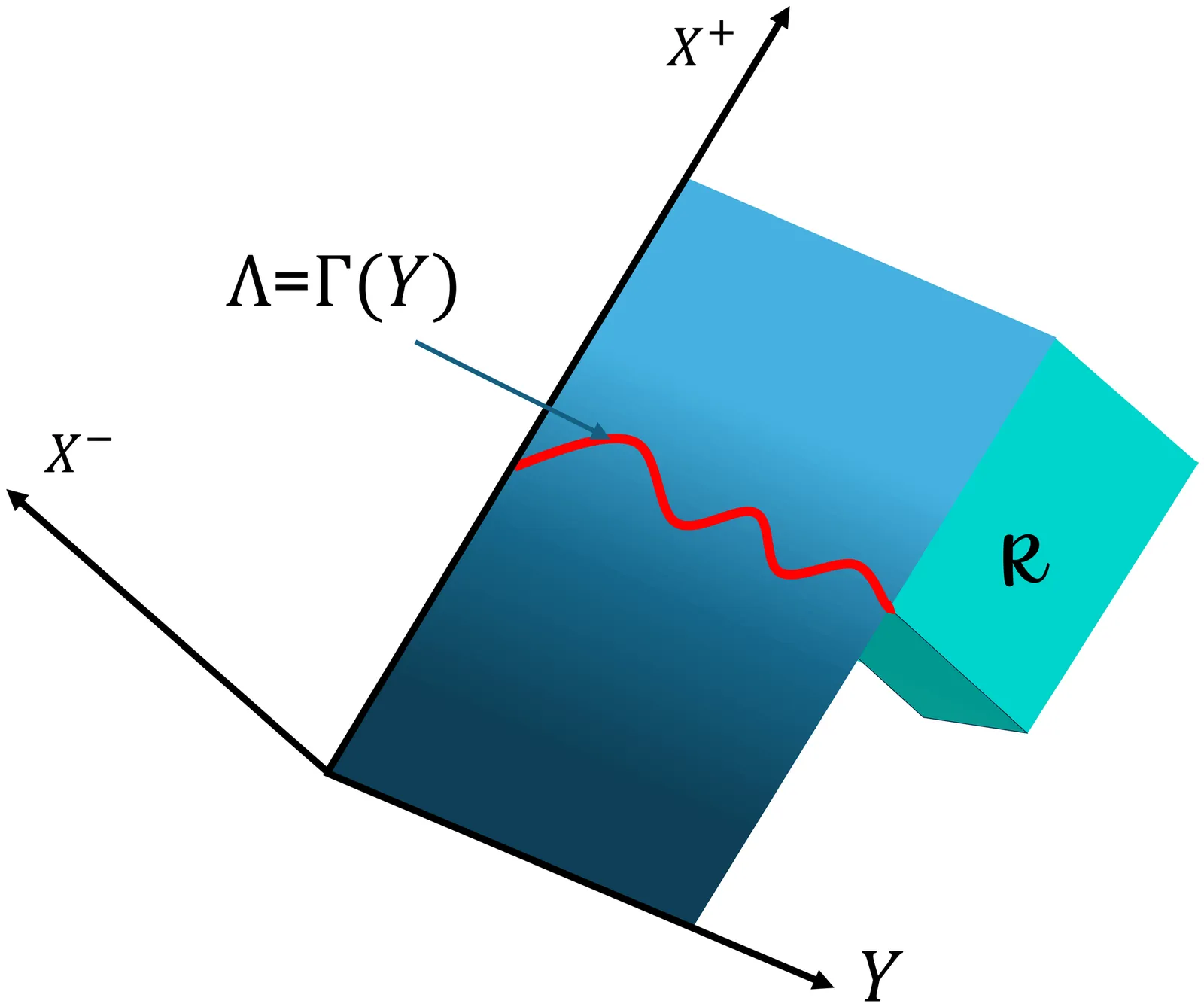
The Improved Quantum Null Energy Condition (INEC) was recently derived from the (restricted) quantum focusing conjecture (QFC), and is a statement about the energy-momentum tensor (EMT) of field theories in Minkowski space-time. It is a stronger condition than the quantum null energy condition (QNEC), and includes the possibility of expanding or contracting geodesics. Using the properties of relative entropy and modular Hamiltonian associated with null deformation of the sphere, we show the INEC holds under an additional assumption relating the EMT to the relative entropy. Furthermore, using the QNEC and INEC as a basis, we briefly speculate about a possible modified Quantum Focusing Conjecture.
2601.18860
Jan 2026High Energy Physics - Theory
Thermoskyrmions
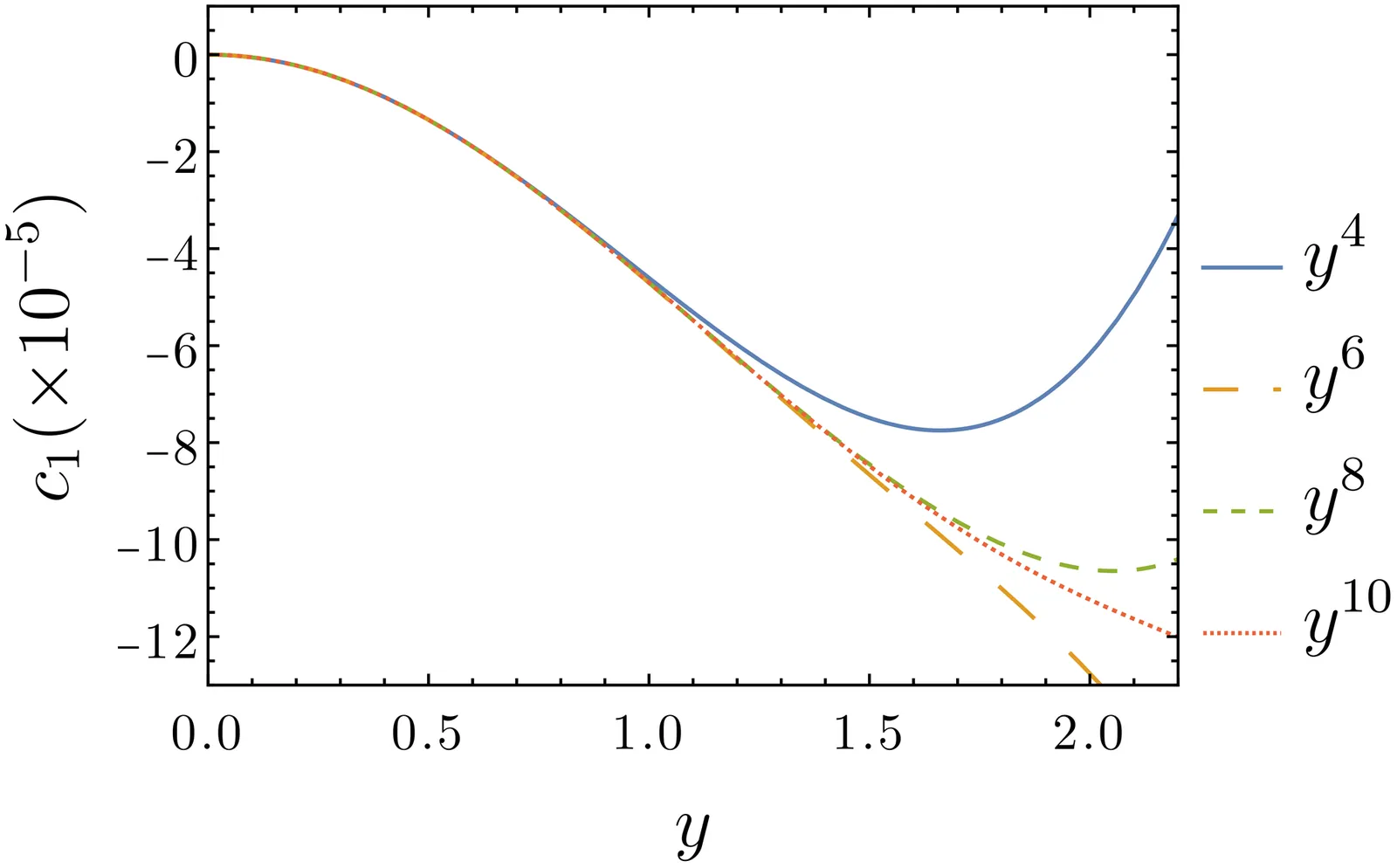
Skyrmions are stable and topologically non-trivial field configurations that behave like localized particles. They appear in the chiral effective theory for pions, where they correspond to the baryon states, and might also exist in the electroweak theory, in the presence of certain effective interactions. In this paper, focusing on toy models that capture different limits of the electroweak sector of the Standard Model (SM), we show that skyrmions not classically stable at zero temperature can be stabilized by thermal effects. This result motivates the study of skyrmions in the quantum effective action of the SM, potentially implying the existence of dark matter without new physics.
2601.18873
Jan 2026High Energy Physics - Phenomenology