Trending in Economics
A Quantitative Model of Non-Marriage and Fertility: Bargaining over Leisure
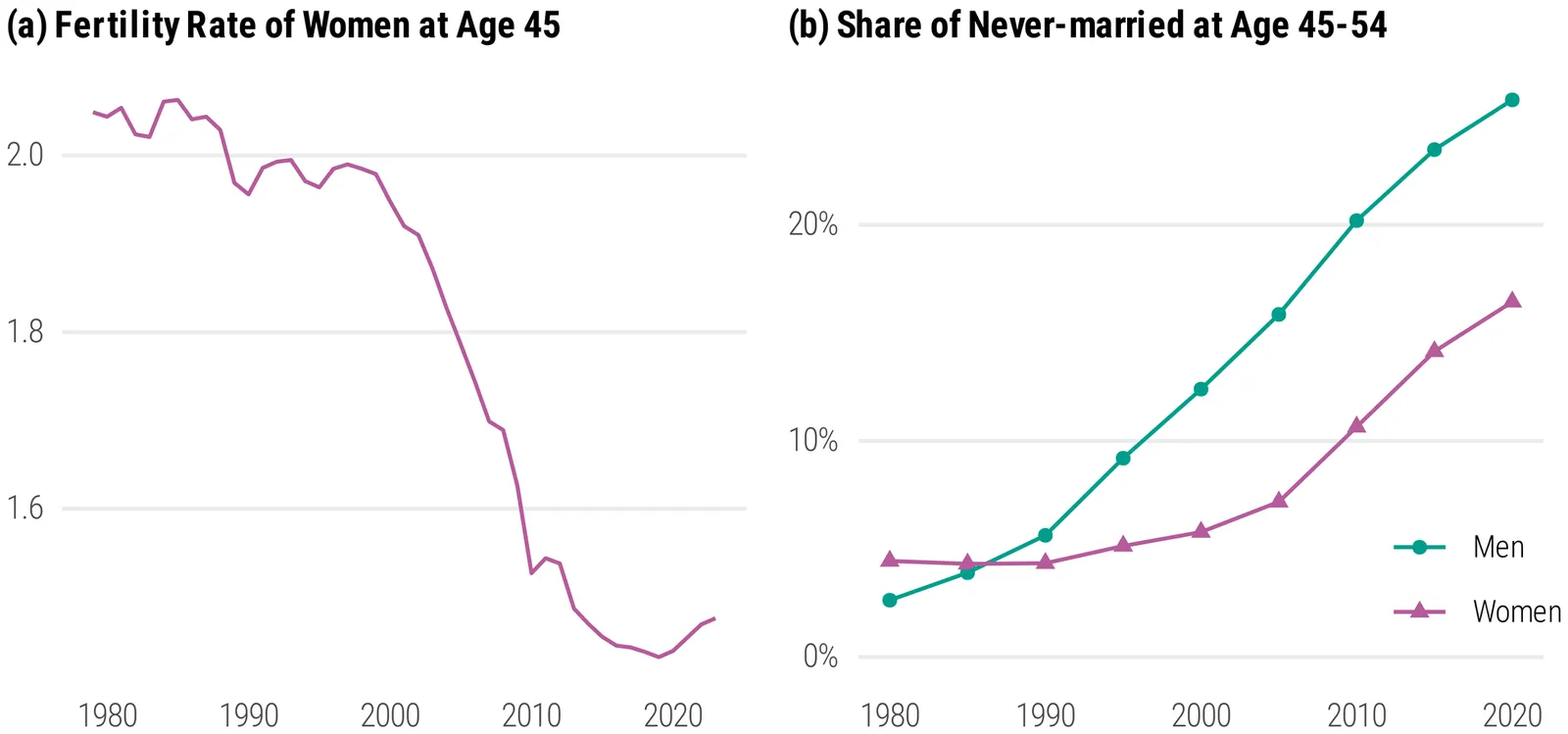
This paper introduces a new factor contributing to the decline in marriage and fertility: the growth of leisure technology. Over recent decades, high-income countries have experienced two notable shifts in household and family dynamics. First, there has been a significant decline in marriage rates and fertility. Second, time has increasingly been allocated to leisure activities. This paper presents a unified model of marriage and fertility, incorporating intra-household bargaining dynamics. The model, calibrated using data from Japan between 2019 and 2023, is employed to assess the impact of leisure technology growth on marriage and fertility during 2005-2009. The findings highlight that leisure technology growth makes single life relatively more appealing compared to marriage and parenthood. The model explains 21.1% of the decline in marriage and 73.1% of the decrease in fertility.
2603.14758
Mar 2026General Economics
Some Simple Economics of AGI
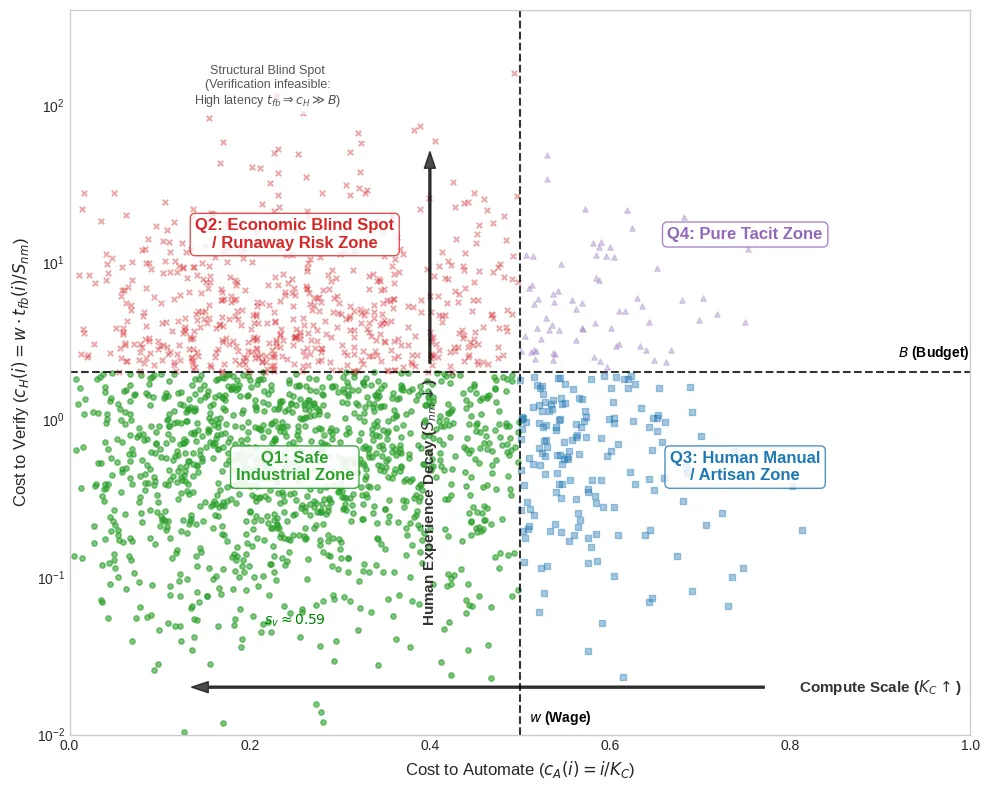
For millennia, human cognition was the primary engine of progress on Earth. As AI decouples cognition from biology, the marginal cost of measurable execution falls to zero, absorbing any labor capturable by metrics--including creative, analytical, and innovative work. The binding constraint on growth is no longer intelligence but human verification bandwidth: the capacity to validate, audit, and underwrite responsibility when execution is abundant. We model the AGI transition as the collision of two racing cost curves: an exponentially decaying Cost to Automate and a biologically bottlenecked Cost to Verify. This structural asymmetry widens a Measurability Gap between what agents can execute and what humans can afford to verify. It also drives a shift from skill-biased to measurability-biased technical change. Rents migrate to verification-grade ground truth, cryptographic provenance, and liability underwriting--the ability to insure outcomes rather than merely generate them. The current human-in-the-loop equilibrium is unstable: eroded from below as apprenticeship collapses (Missing Junior Loop) and from within as experts codify their obsolescence (Codifier's Curse). Unverified deployment becomes privately rational--a Trojan Horse externality. Unmanaged, these forces pull toward a Hollow Economy. Yet by scaling verification alongside agentic capabilities, the forces that threaten collapse become the catalyst for unbounded discovery and experimentation--an Augmented Economy. We derive a practical playbook for individuals, companies, investors, and policymakers. Today's defining challenge is not the race to deploy the most autonomous systems; it is the race to secure the foundations of their oversight. Only by scaling our bandwidth for verification alongside our capacity for execution can we ensure that the intelligence we have summoned preserves the humanity that initiated it.
2602.20946
Feb 2026General Economics
The hidden structure of innovation networks
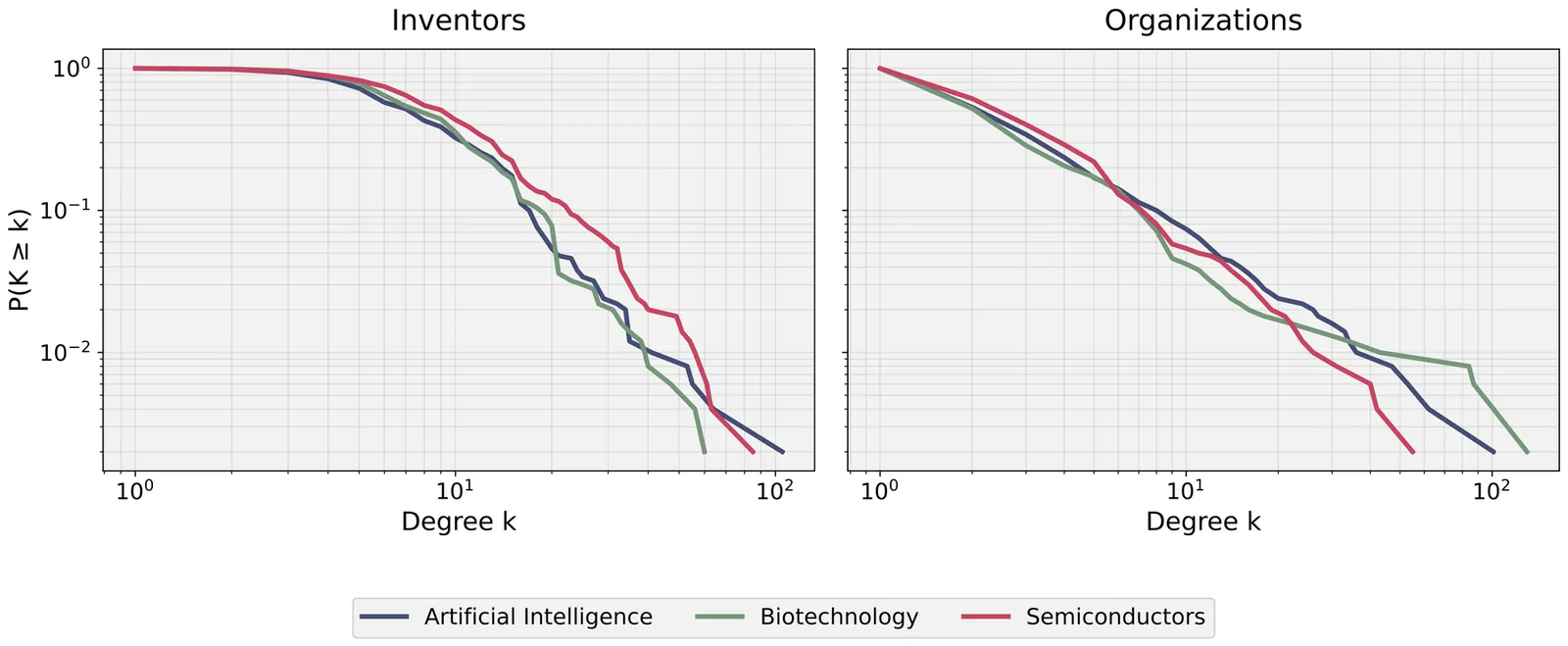
Innovation emerges from complex collaboration patterns - among inventors, firms, or institutions. However, not much is known about the overall mesoscopic structure around which inventive activity self-organizes. Here, we tackle this problem by employing patent data to analyze both individual (\emph{co-inventorship}) and organization (\emph{co-ownership}) networks in three strategic domains (\emph{artificial intelligence}, \emph{biotechnology} and \emph{semiconductors}). We characterize the mesoscale structure (in terms of clusters) of each domain by comparing two alternative methods: a standard baseline - modularity maximization - and one based on the minimization of the Bayesian Information Criterion, within the Stochastic Block Model and its degree-corrected variant. We find that, across sectors, inventor networks are denser and more clustered than organization ones - consistent with the presence of small recurrent teams embedded into broader institutional hierarchies - whereas organization networks have neater hierarchical role-based structures, with few bridging firms coordinating the most peripheral ones. We also find that the discovered meso-structures are connected to innovation output. In particular, Lorenz curves of forward citations show a pervasive inequality in technological influence: across sectors and methods, both inventor (especially) and organization networks consistently show high levels of concentration of citations in a few of the discovered clusters. Our results demonstrate that the baseline modularity-based method may not be capable of fully capturing the way collaborations drive the spreading of inventive impact across technological domains. This is due to the presence of local hierarchies that call for more refined tools based on Bayesian inference.
2601.10224
Jan 2026General Economics
causalfe: Causal Forests with Fixed Effects in Python
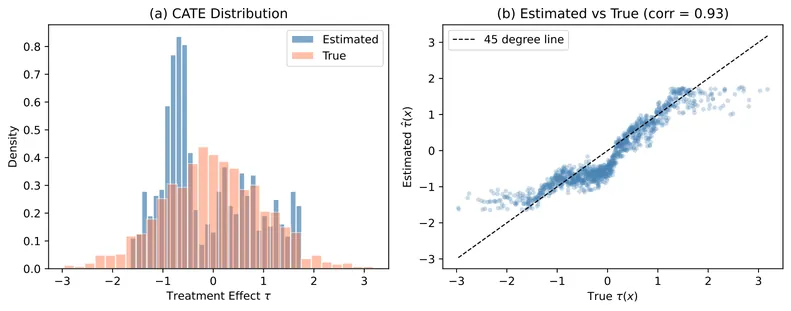
The causalfe package provides a Python implementation of Causal Forests with Fixed Effects (CFFE) for estimating heterogeneous treatment effects in panel data settings. Standard causal forest methods struggle with panel data because unit and time fixed effects induce spurious heterogeneity in treatment effect estimates. The CFFE approach addresses this by performing node-level residualization during tree construction, removing fixed effects within each candidate split rather than globally. This paper describes the methodology, documents the software interface, and demonstrates the package through simulation studies that validate the estimator's performance under various data generating processes.
2601.10555
Jan 2026Econometrics
Estimating Treatment Effects in Panel Data Without Parallel Trends
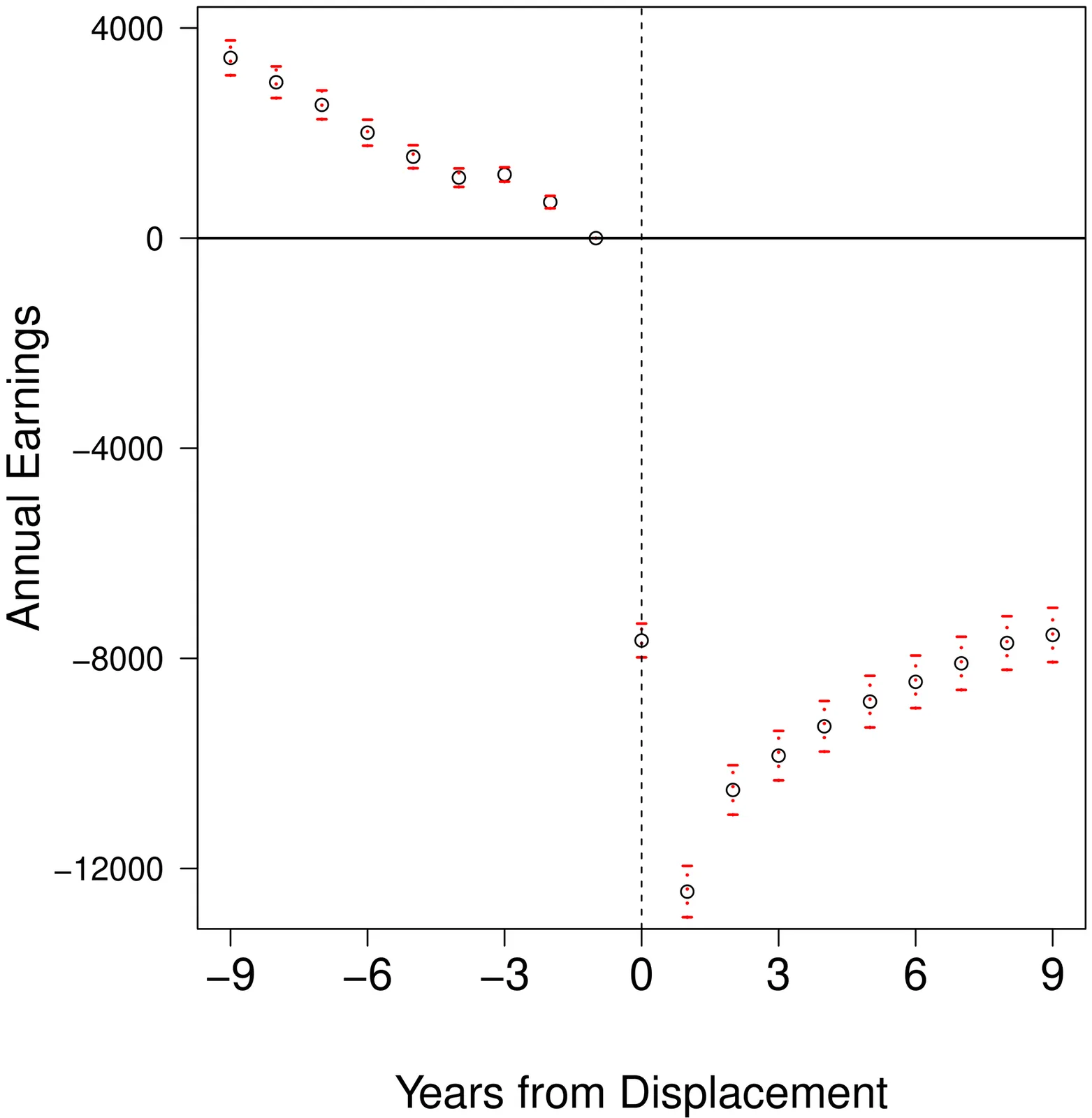
This paper proposes a novel approach for estimating treatment effects in panel data settings, addressing key limitations of the standard difference-in-differences (DID) approach. The standard approach relies on the parallel trends assumption, implicitly requiring that unobservable factors correlated with treatment assignment be unidimensional, time-invariant, and affect untreated potential outcomes in an additively separable manner. This paper introduces a more flexible framework that allows for multidimensional unobservables and non-additive separability, and provides sufficient conditions for identifying the average treatment effect on the treated. An empirical application to job displacement reveals substantially smaller long-run earnings losses compared to the standard DID approach, demonstrating the framework's ability to account for unobserved heterogeneity that manifests as differential outcome trajectories between treated and control groups.
2601.08281
Jan 2026Econometrics