Trending in Programming Languages
ARIS: Autonomous Research via Adversarial Multi-Agent Collaboration
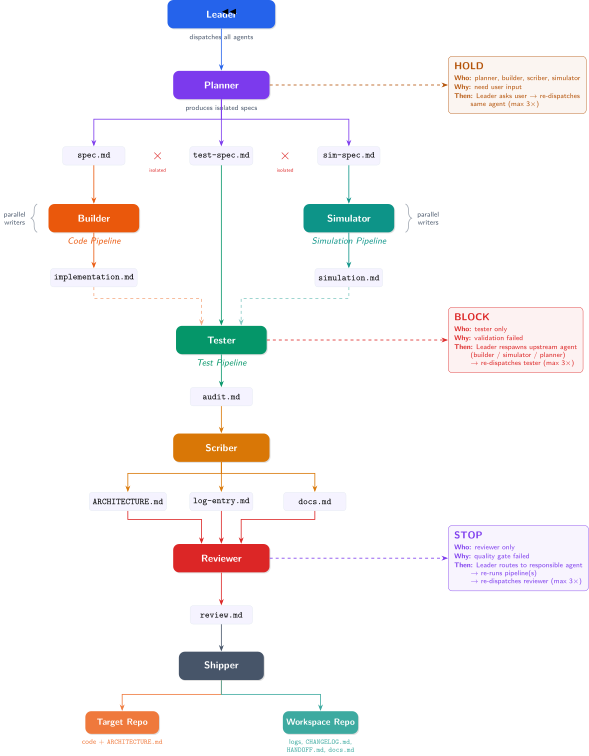
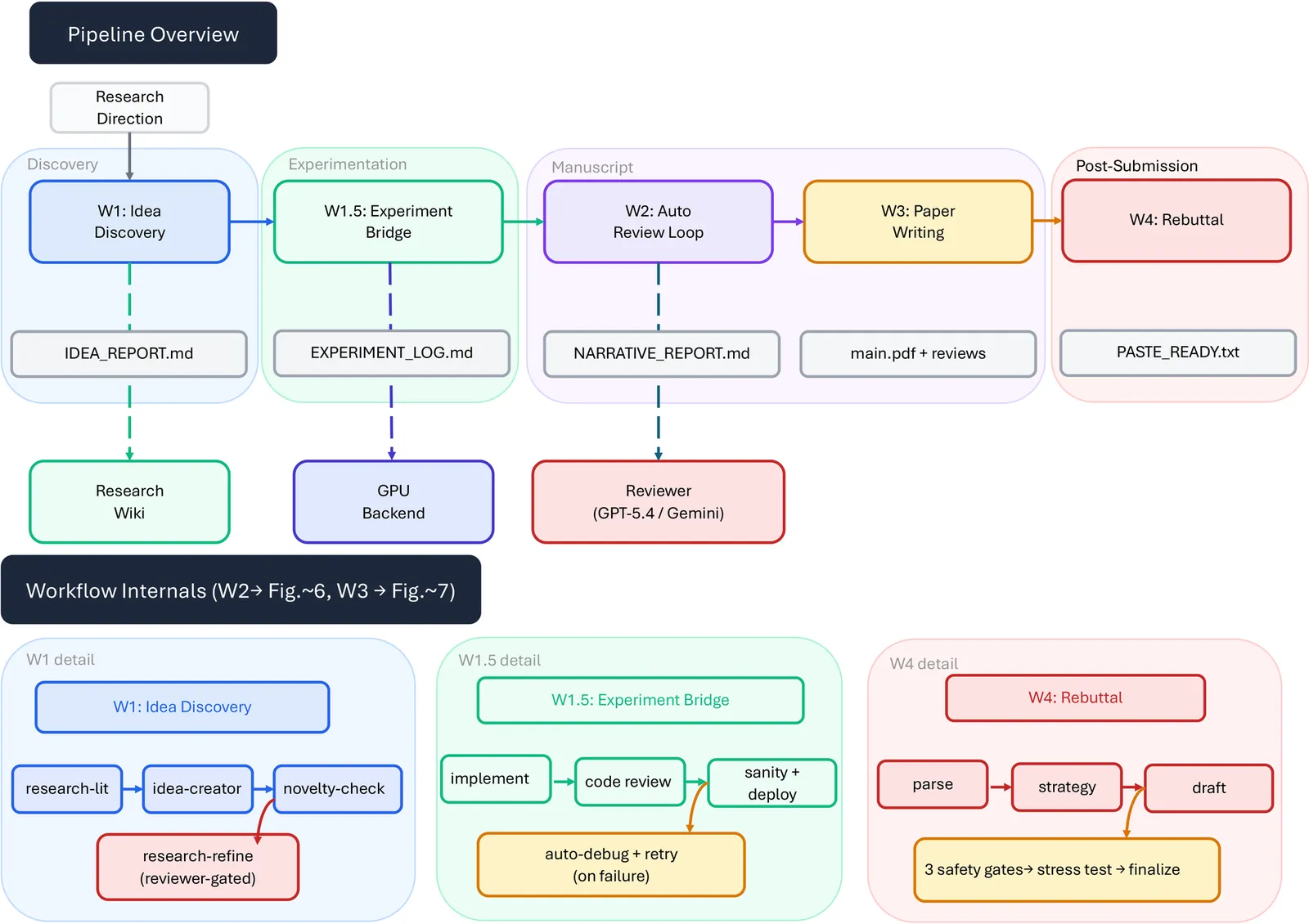
This report describes ARIS (Auto-Research-in-sleep), an open-source research harness for autonomous research, including its architecture, assurance mechanisms, and early deployment experience. The performance of agent systems built on LLMs depends on both the model weights and the harness around them, which governs what information to store, retrieve, and present to the model. For long-horizon research workflows, the central failure mode is not a visible breakdown but a plausible unsupported success: a long-running agent can produce claims whose evidential support is incomplete, misreported, or silently inherited from the executor's framing. Therefore, we present ARIS as a research harness that coordinates machine-learning research workflows through cross-model adversarial collaboration as a default configuration: an executor model drives forward progress while a reviewer from a different model family is recommended to critique intermediate artifacts and request revisions. ARIS has three architectural layers. The execution layer provides more than 65 reusable Markdown-defined skills, model integrations via MCP, a persistent research wiki for iterative reuse of prior findings, and deterministic figure generation. The orchestration layer coordinates five end-to-end workflows with adjustable effort settings and configurable routing to reviewer models. The assurance layer includes a three-stage process for checking whether experimental claims are supported by evidence: integrity verification, result-to-claim mapping, and claim auditing that cross-checks manuscript statements against the claim ledger and raw evidence, as well as a five-pass scientific-editing pipeline, mathematical-proof checks, and visual inspection of the rendered PDF. A prototype self-improvement loop records research traces and proposes harness improvements that are adopted only after reviewer approval.
2605.03042
May 2026Software Engineering
ProgramBench: Can Language Models Rebuild Programs From Scratch?
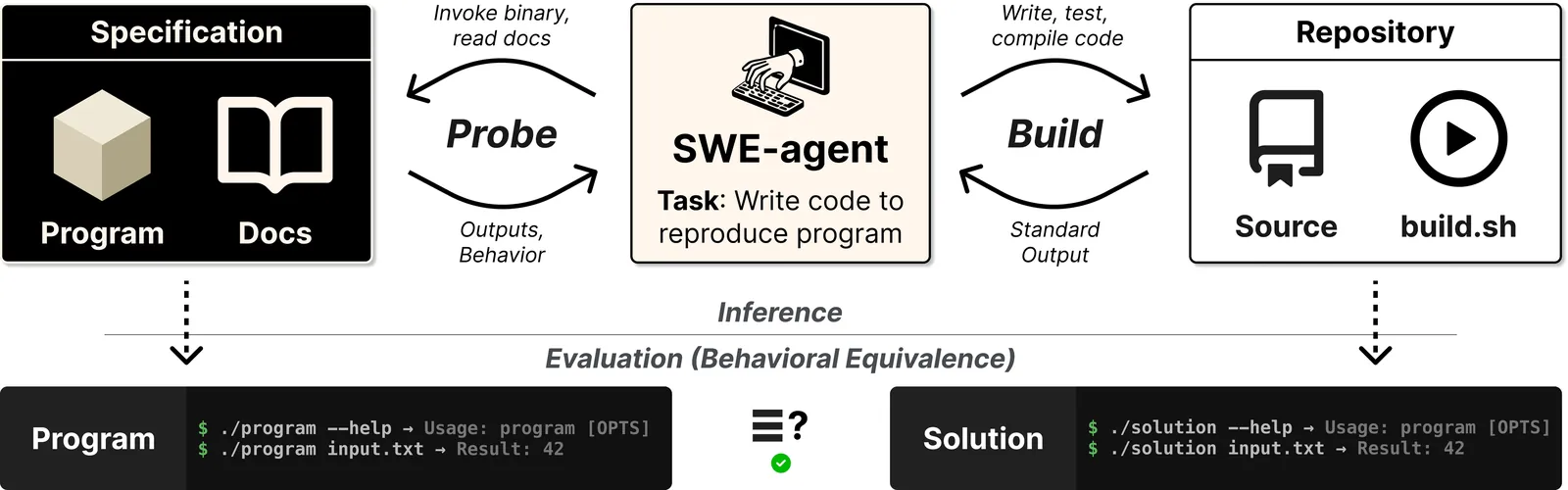
Turning ideas into full software projects from scratch has become a popular use case for language models. Agents are being deployed to seed, maintain, and grow codebases over extended periods with minimal human oversight. Such settings require models to make high-level software architecture decisions. However, existing benchmarks measure focused, limited tasks such as fixing a single bug or developing a single, specified feature. We therefore introduce ProgramBench to measure the ability of software engineering agents to develop software holisitically. In ProgramBench, given only a program and its documentation, agents must architect and implement a codebase that matches the reference executable's behavior. End-to-end behavioral tests are generated via agent-driven fuzzing, enabling evaluation without prescribing implementation structure. Our 200 tasks range from compact CLI tools to widely used software such as FFmpeg, SQLite, and the PHP interpreter. We evaluate 9 LMs and find that none fully resolve any task, with the best model passing 95\% of tests on only 3\% of tasks. Models favor monolithic, single-file implementations that diverge sharply from human-written code.
2605.03546
May 2026Software Engineering
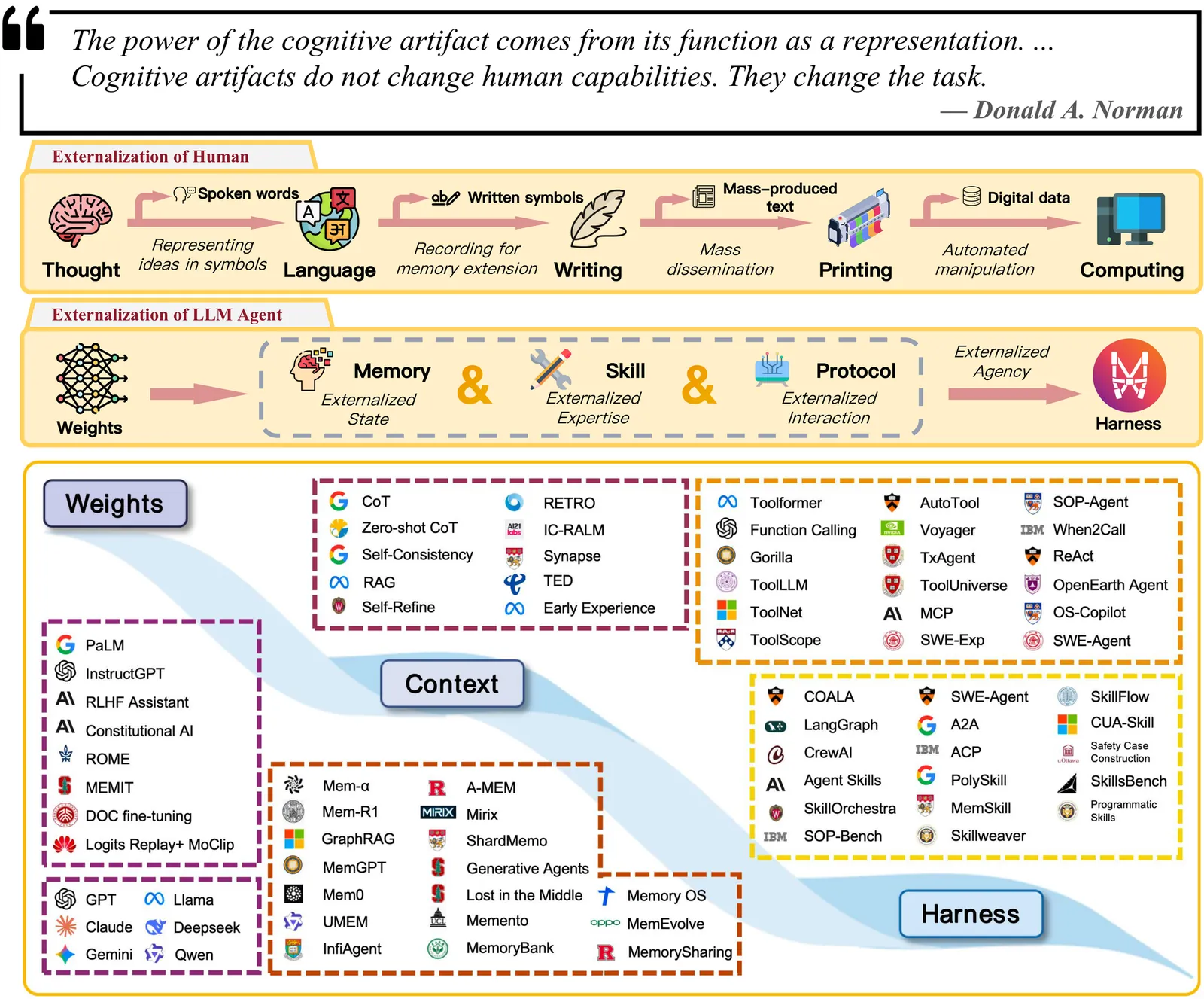
Externalization in LLM Agents: A Unified Review of Memory, Skills, Protocols and Harness Engineering
Large language model (LLM) agents are increasingly built less by changing model weights than by reorganizing the runtime around them. Capabilities that earlier systems expected the model to recover internally are now externalized into memory stores, reusable skills, interaction protocols, and the surrounding harness that makes these modules reliable in practice. This paper reviews that shift through the lens of externalization. Drawing on the idea of cognitive artifacts, we argue that agent infrastructure matters not merely because it adds auxiliary components, but because it transforms hard cognitive burdens into forms that the model can solve more reliably. Under this view, memory externalizes state across time, skills externalize procedural expertise, protocols externalize interaction structure, and harness engineering serves as the unification layer that coordinates them into governed execution. We trace a historical progression from weights to context to harness, analyze memory, skills, and protocols as three distinct but coupled forms of externalization, and examine how they interact inside a larger agent system. We further discuss the trade-off between parametric and externalized capability, identify emerging directions such as self-evolving harnesses and shared agent infrastructure, and discuss open challenges in evaluation, governance, and the long-term co-evolution of models and external infrastructure. The result is a systems-level framework for explaining why practical agent progress increasingly depends not only on stronger models, but on better external cognitive infrastructure.
2604.08224
Apr 2026Software Engineering
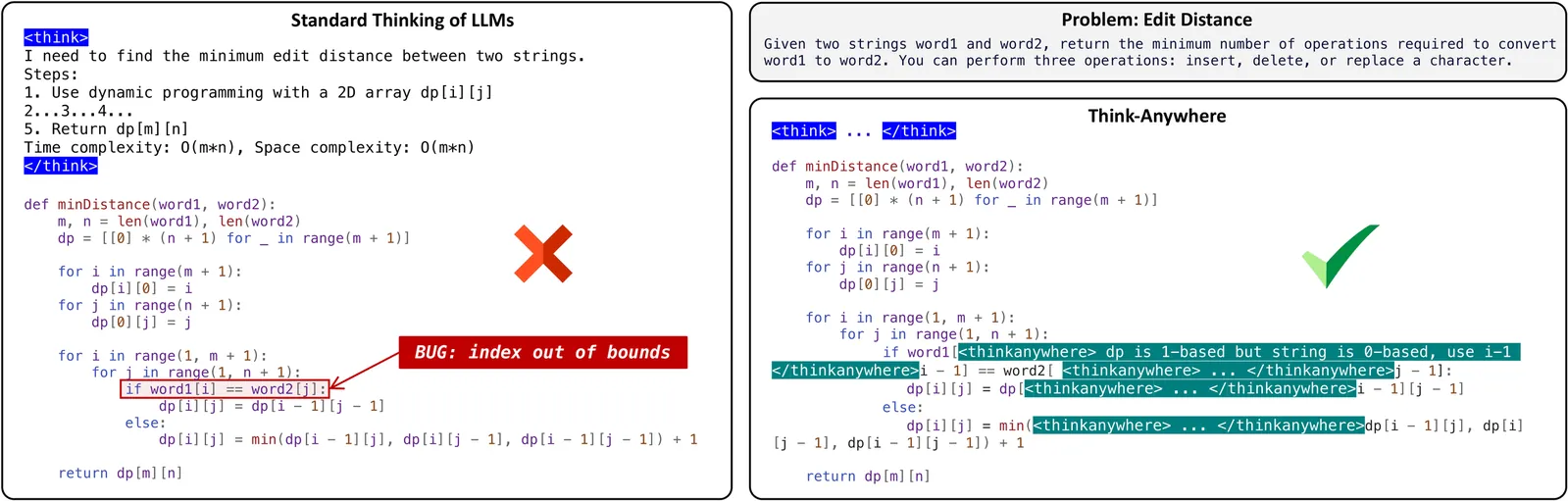
Think Anywhere in Code Generation
Recent advances in reasoning Large Language Models (LLMs) have primarily relied on upfront thinking, where reasoning occurs before final answer. However, this approach suffers from critical limitations in code generation, where upfront thinking is often insufficient as problems' full complexity only reveals itself during code implementation. Moreover, it cannot adaptively allocate reasoning effort throughout the code generation process where difficulty varies significantly. In this paper, we propose Think-Anywhere, a novel reasoning mechanism that enables LLMs to invoke thinking on-demand at any token position during code generation. We achieve Think-Anywhere by first teaching LLMs to imitate the reasoning patterns through cold-start training, then leveraging outcome-based RL rewards to drive the model's autonomous exploration of when and where to invoke reasoning. Extensive experiments on four mainstream code generation benchmarks (i.e., LeetCode, LiveCodeBench, HumanEval, and MBPP) show that Think-Anywhere achieves state-of-the-art performance over both existing reasoning methods and recent post-training approaches, while demonstrating consistent generalization across diverse LLMs. Our analysis further reveals that Think-Anywhere enables the model to adaptively invoke reasoning at high-entropy positions, providing enhanced interpretability.
2603.29957
Mar 2026Software Engineering
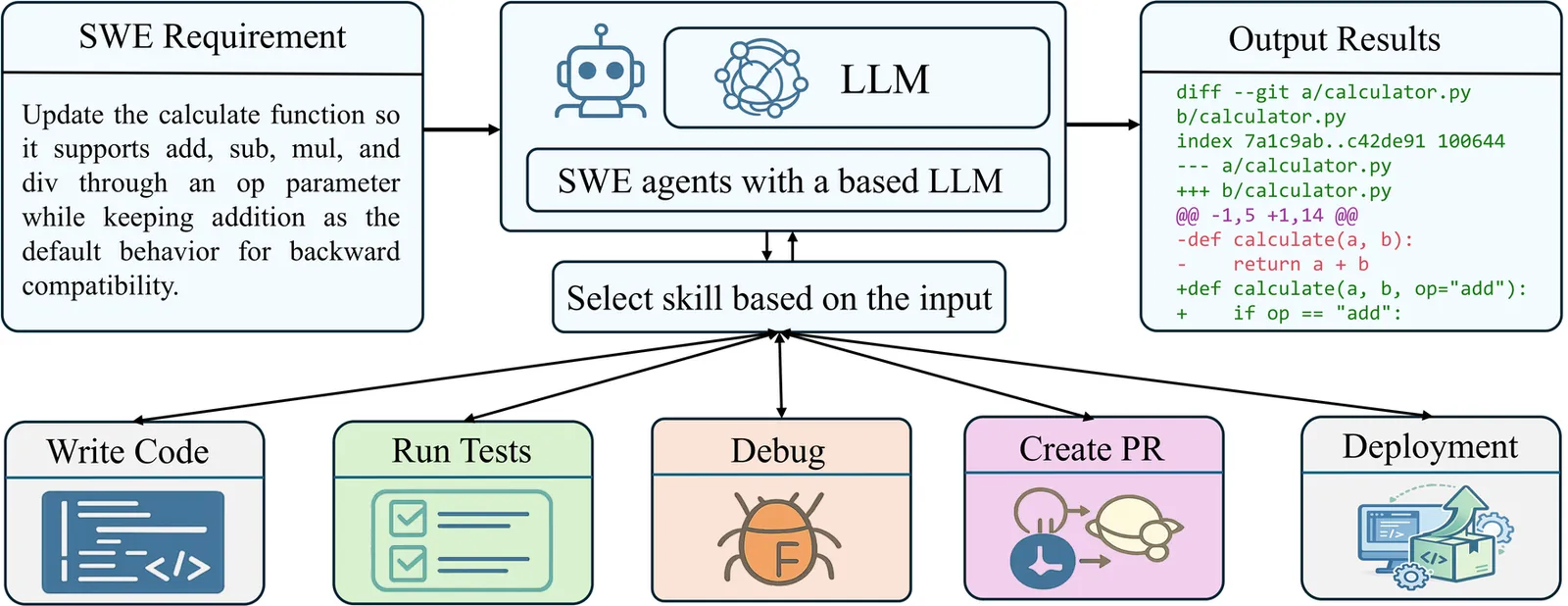
SWE-Skills-Bench: Do Agent Skills Actually Help in Real-World Software Engineering?
Agent skills, structured procedural knowledge packages injected at inference time, are increasingly used to augment LLM agents on software engineering tasks. However, their real utility in end-to-end development settings remains unclear. We present SWE-Skills-Bench, the first requirement-driven benchmark that isolates the marginal utility of agent skills in real-world software engineering (SWE). It pairs 49 public SWE skills with authentic GitHub repositories pinned at fixed commits and requirement documents with explicit acceptance criteria, yielding approximately 565 task instances across six SWE subdomains. We introduce a deterministic verification framework that maps each task's acceptance criteria to execution-based tests, enabling controlled paired evaluation with and without the skill. Our results show that skill injection benefits are far more limited than rapid adoption suggests: 39 of 49 skills yield zero pass-rate improvement, and the average gain is only +1.2%. Token overhead varies from modest savings to a 451% increase while pass rates remain unchanged. Only seven specialized skills produce meaningful gains (up to +30%), while three degrade performance (up to -10%) due to version-mismatched guidance conflicting with project context. These findings suggest that agent skills are a narrow intervention whose utility depends strongly on domain fit, abstraction level, and contextual compatibility. SWE-Skills-Bench provides a testbed for evaluating the design, selection, and deployment of skills in software engineering agents. SWE-Skills-Bench is available at https://github.com/GeniusHTX/SWE-Skills-Bench.
2603.15401
Mar 2026Software Engineering
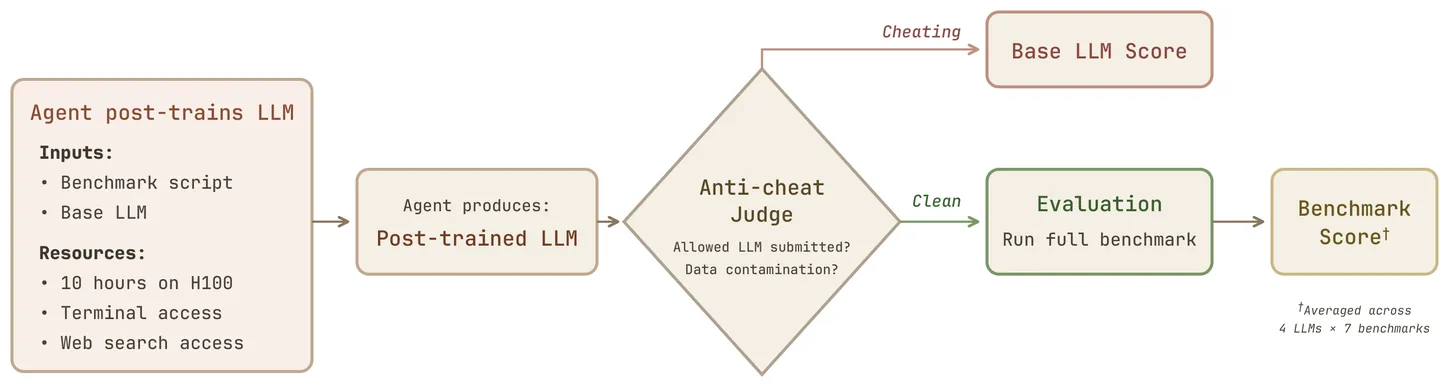
PostTrainBench: Can LLM Agents Automate LLM Post-Training?
AI agents have become surprisingly proficient at software engineering over the past year, largely due to improvements in reasoning capabilities. This raises a deeper question: can these systems extend their capabilities to automate AI research itself? In this paper, we explore post-training, the critical phase that turns base LLMs into useful assistants. We introduce PostTrainBench to benchmark how well LLM agents can perform post-training autonomously under bounded compute constraints (10 hours on one H100 GPU). We ask frontier agents (e.g., Claude Code with Opus 4.6) to optimize the performance of a base LLM on a particular benchmark (e.g., Qwen3-4B on AIME). Importantly, we do not provide any predefined strategies to the agents and instead give them full autonomy to find necessary information on the web, run experiments, and curate data. We find that frontier agents make substantial progress but generally lag behind instruction-tuned LLMs from leading providers: 23.2% for the best agent vs. 51.1% for official instruction-tuned models. However, agents can exceed instruction-tuned models in targeted scenarios: GPT-5.1 Codex Max achieves 89% on BFCL with Gemma-3-4B vs. 67% for the official model. We also observe several failure modes worth flagging. Agents sometimes engage in reward hacking: training on the test set, downloading existing instruction-tuned checkpoints instead of training their own, and using API keys they find to generate synthetic data without authorization. These behaviors are concerning and highlight the importance of careful sandboxing as these systems become more capable. Overall, we hope PostTrainBench will be useful for tracking progress in AI R&D automation and for studying the risks that come with it. Website and code are available at https://posttrainbench.com/.
2603.08640
Mar 2026Software Engineering
SWE-CI: Evaluating Agent Capabilities in Maintaining Codebases via Continuous Integration
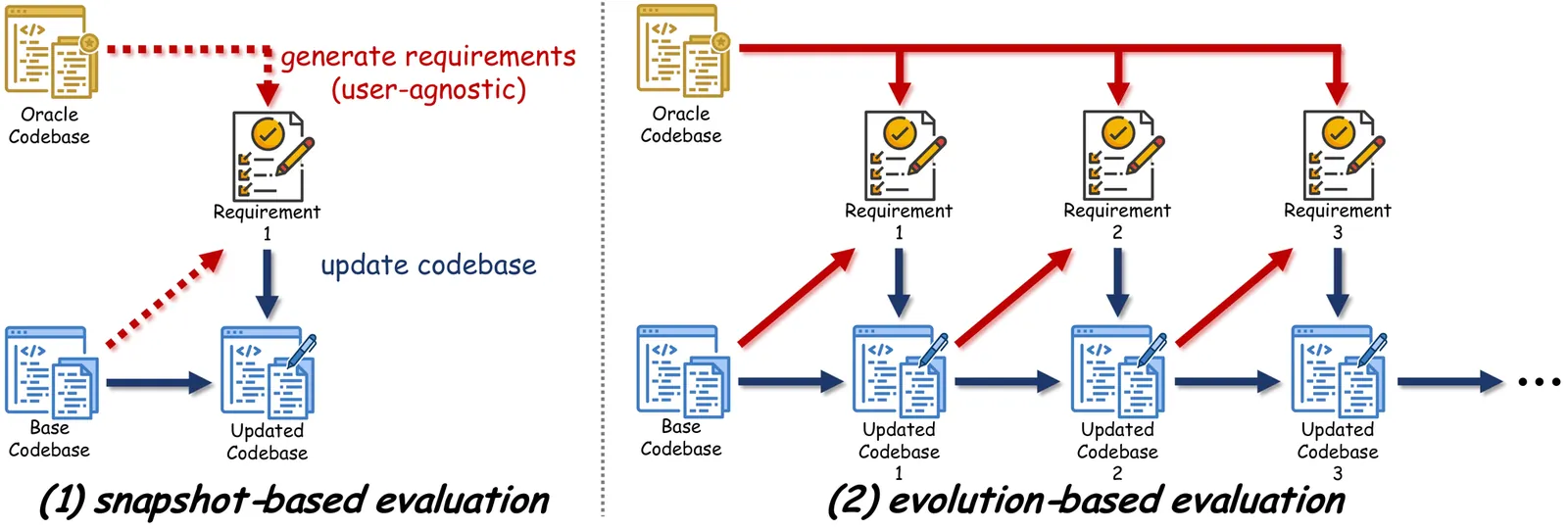
Large language model (LLM)-powered agents have demonstrated strong capabilities in automating software engineering tasks such as static bug fixing, as evidenced by benchmarks like SWE-bench. However, in the real world, the development of mature software is typically predicated on complex requirement changes and long-term feature iterations -- a process that static, one-shot repair paradigms fail to capture. To bridge this gap, we propose \textbf{SWE-CI}, the first repository-level benchmark built upon the Continuous Integration loop, aiming to shift the evaluation paradigm for code generation from static, short-term \textit{functional correctness} toward dynamic, long-term \textit{maintainability}. The benchmark comprises 100 tasks, each corresponding on average to an evolution history spanning 233 days and 71 consecutive commits in a real-world code repository. SWE-CI requires agents to systematically resolve these tasks through dozens of rounds of analysis and coding iterations. SWE-CI provides valuable insights into how well agents can sustain code quality throughout long-term evolution.
2603.03823
Mar 2026Software Engineering
 2603.01896
Agentic Code Reasoning
Can LLM agents explore codebases and reason about code semantics without executing the code? We study this capability, which we call agentic code reasoning, and introduce semi-formal reasoning: a structured prompting methodology that requires agents to construct explicit premises, trace execution paths, and derive formal conclusions. Unlike unstructured chain-of-thought, semi-formal reasoning acts as a certificate: the agent cannot skip cases or make unsupported claims. We evaluate across three tasks (patch equivalence verification, fault localization, and code question answering) and show that semi-formal reasoning consistently improves accuracy on all of them. For patch equivalence, accuracy improves from 78% to 88% on curated examples and reaches 93% on real-world agent-generated patches, approaching the reliability needed for execution-free RL reward signals. For code question answering on RubberDuckBench Mohammad et al. (2026), semi-formal reasoning achieves 87% accuracy. For fault localization on Defects4J Just et al. (2014), semi-formal reasoning improves Top-5 accuracy by 5 percentage points over standard reasoning. These results demonstrate that structured agentic reasoning enables meaningful semantic code analysis without execution, opening practical applications in RL training pipelines, code review, and static program analysis.
2603.01896
Mar 2026Software Engineering
Codified Context: Infrastructure for AI Agents in a Complex Codebase
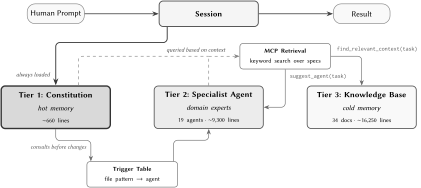
LLM-based agentic coding assistants lack persistent memory: they lose coherence across sessions, forget project conventions, and repeat known mistakes. Recent studies characterize how developers configure agents through manifest files, but an open challenge remains how to scale such configurations for large, multi-agent projects. This paper presents a three-component codified context infrastructure developed during construction of a 108,000-line C# distributed system: (1) a hot-memory constitution encoding conventions, retrieval hooks, and orchestration protocols; (2) 19 specialized domain-expert agents; and (3) a cold-memory knowledge base of 34 on-demand specification documents. Quantitative metrics on infrastructure growth and interaction patterns across 283 development sessions are reported alongside four observational case studies illustrating how codified context propagates across sessions to prevent failures and maintain consistency. The framework is published as an open-source companion repository.
2602.20478
Feb 2026Software Engineering
CL4SE: A Context Learning Benchmark For Software Engineering Tasks
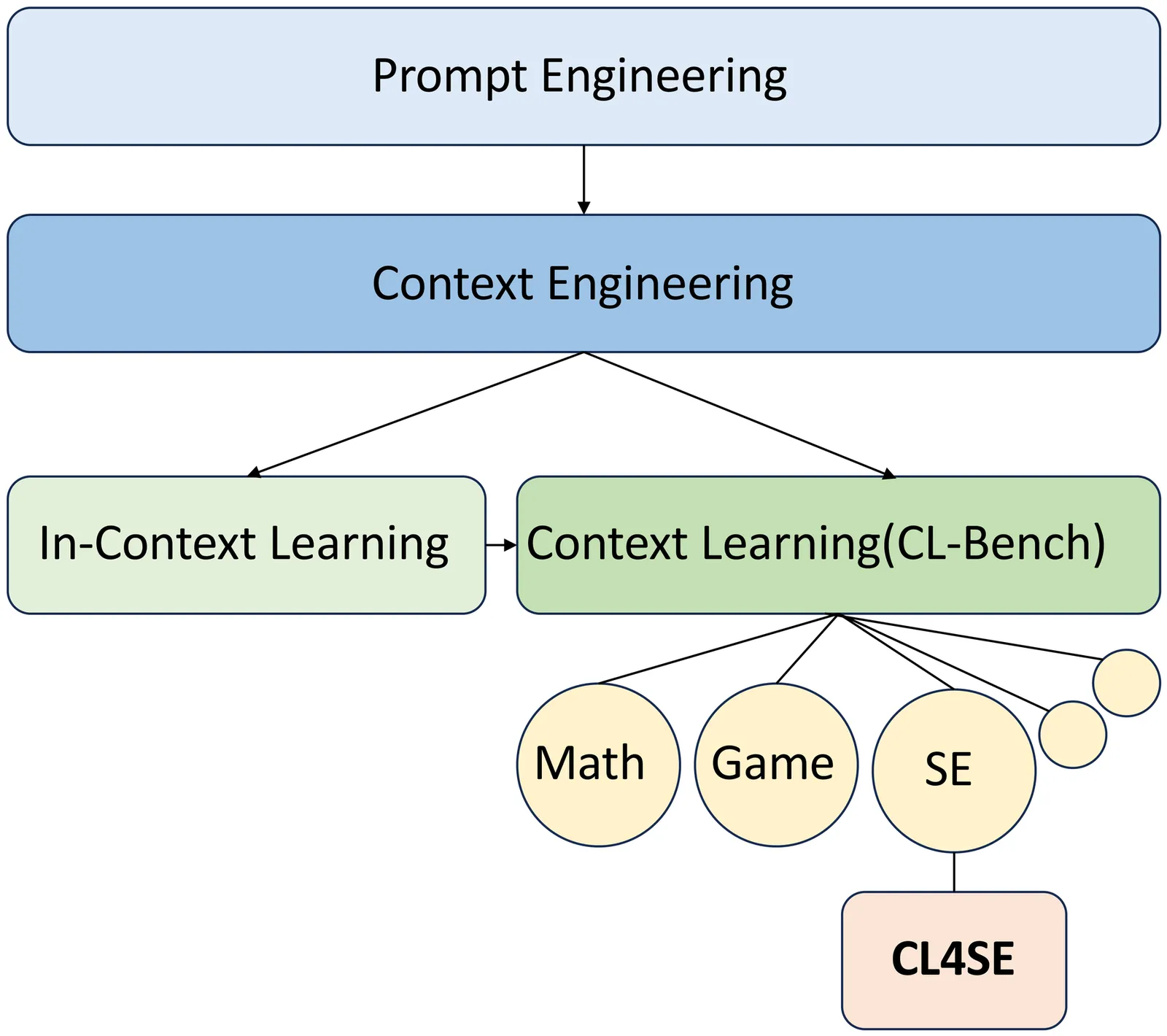
Context engineering has emerged as a pivotal paradigm for unlocking the potential of Large Language Models (LLMs) in Software Engineering (SE) tasks, enabling performance gains at test time without model fine-tuning. Despite its success, existing research lacks a systematic taxonomy of SE-specific context types and a dedicated benchmark to quantify the heterogeneous effects of different contexts across core SE workflows. To address this gap, we propose CL4SE (Context Learning for Software Engineering), a comprehensive benchmark featuring a fine-grained taxonomy of four SE-oriented context types (interpretable examples, project-specific context, procedural decision-making context, and positive & negative context), each mapped to a representative task (code generation, code summarization, code review, and patch correctness assessment). We construct high-quality datasets comprising over 13,000 samples from more than 30 open-source projects and evaluate five mainstream LLMs across nine metrics. Extensive experiments demonstrate that context learning yields an average performance improvement of 24.7% across all tasks. Specifically, procedural context boosts code review performance by up to 33% (Qwen3-Max), mixed positive-negative context improves patch assessment by 30% (DeepSeek-V3), project-specific context increases code summarization BLEU by 14.78% (GPT-Oss-120B), and interpretable examples enhance code generation PASS@1 by 5.72% (DeepSeek-V3). CL4SE establishes the first standardized evaluation framework for SE context learning, provides actionable empirical insights into task-specific context design, and releases a large-scale dataset to facilitate reproducible research in this domain.
2602.23047
Feb 2026Software Engineering
SWE-Universe: Scale Real-World Verifiable Environments to Millions
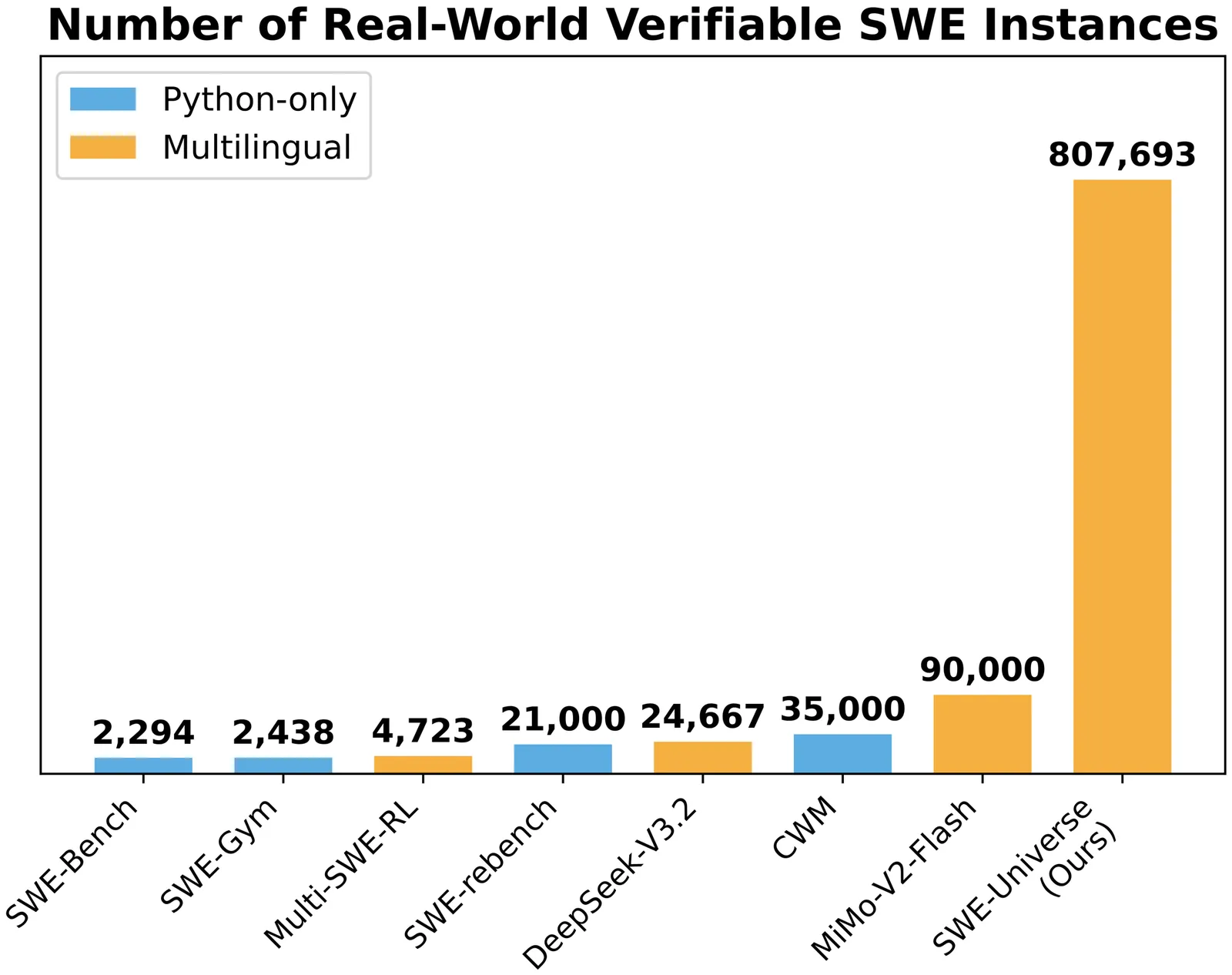
We propose SWE-Universe, a scalable and efficient framework for automatically constructing real-world software engineering (SWE) verifiable environments from GitHub pull requests (PRs). To overcome the prevalent challenges of automatic building, such as low production yield, weak verifiers, and prohibitive cost, our framework utilizes a building agent powered by an efficient custom-trained model. This agent employs iterative self-verification and in-loop hacking detection to ensure the reliable generation of high-fidelity, verifiable tasks. Using this method, we scale the number of real-world multilingual SWE environments to a million scale (807,693). We demonstrate the profound value of our environments through large-scale agentic mid-training and reinforcement learning. Finally, we applied this technique to Qwen3-Max-Thinking and achieved a score of 75.3% on SWE-Bench Verified. Our work provides both a critical resource and a robust methodology to advance the next generation of coding agents.
2602.02361
Feb 2026Software Engineering
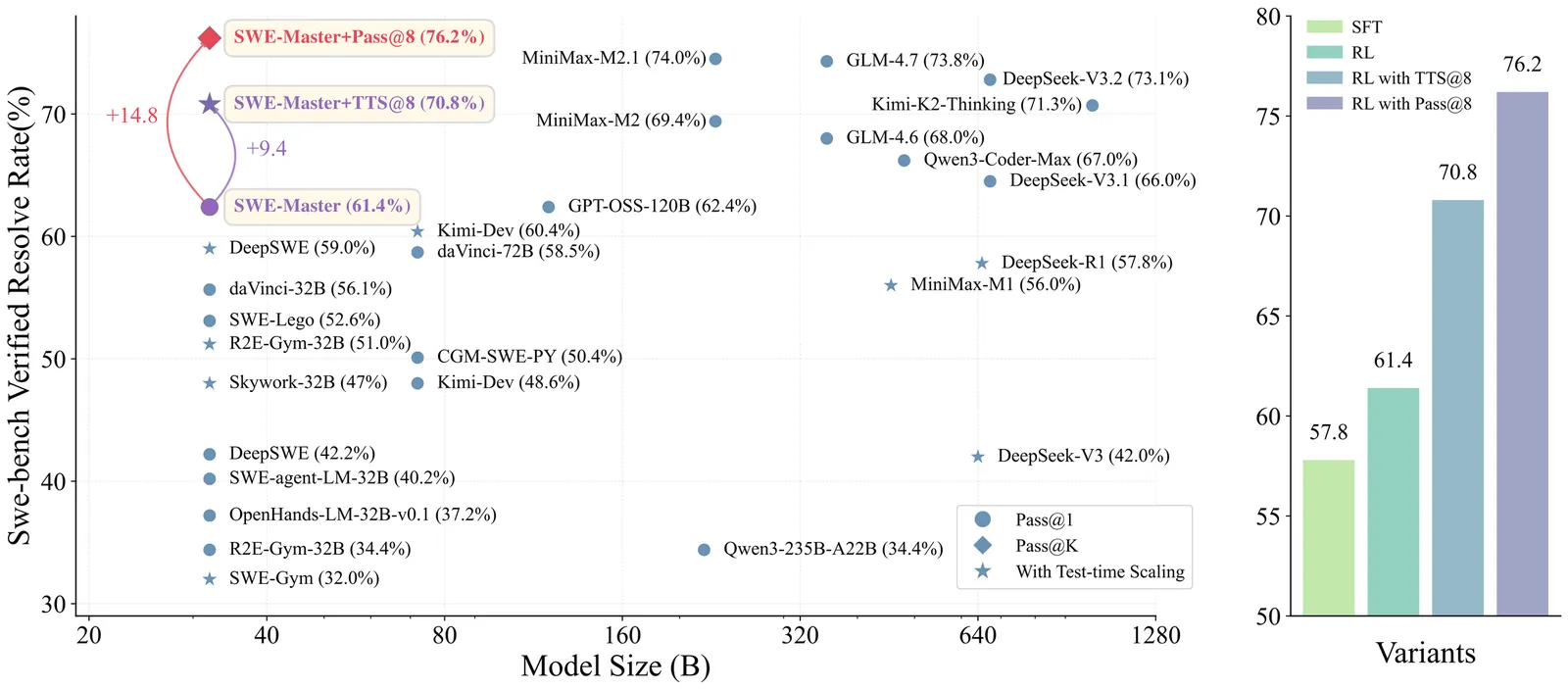
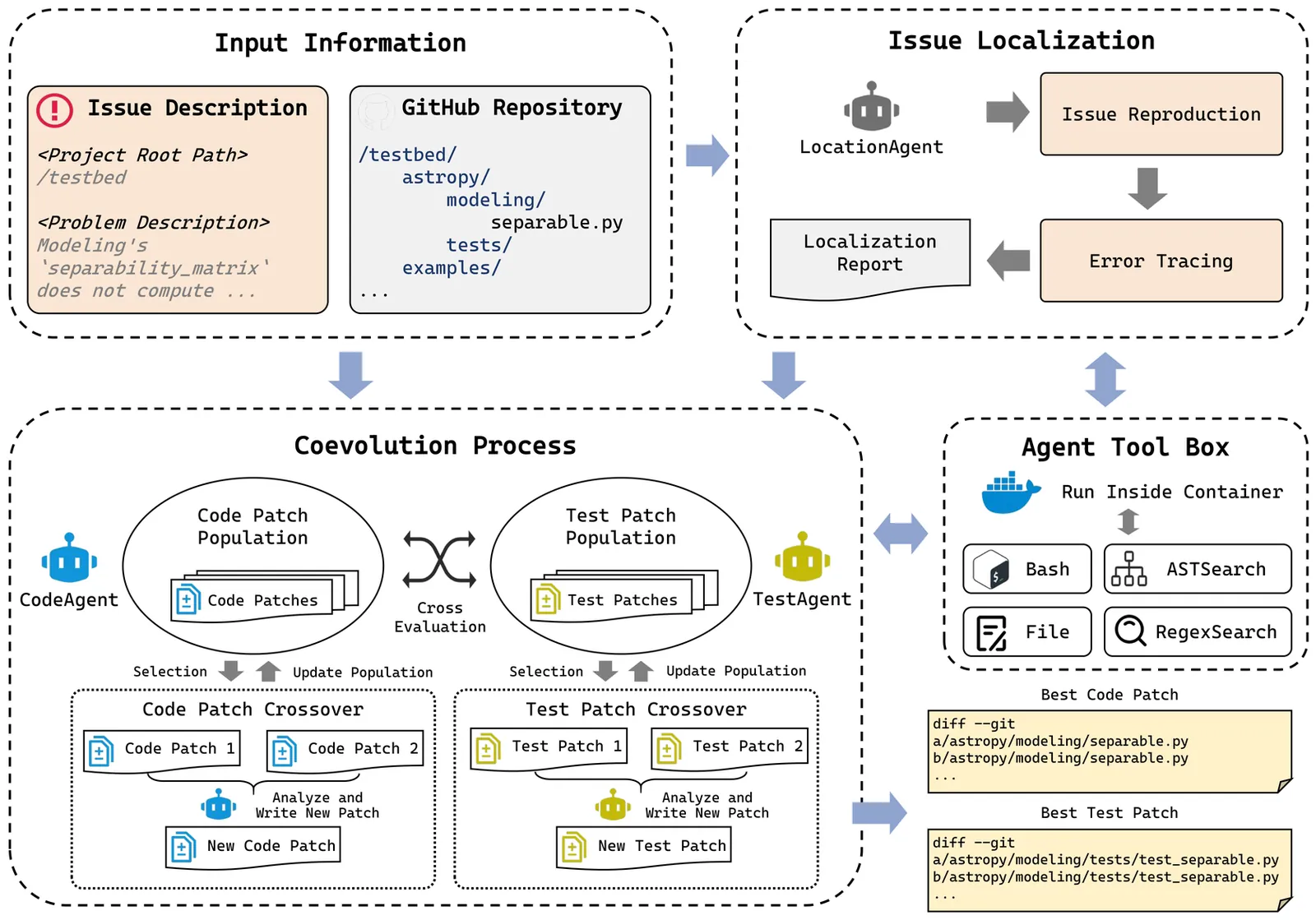
SWE-Master: Unleashing the Potential of Software Engineering Agents via Post-Training
In this technical report, we present SWE-Master, an open-source and fully reproducible post-training framework for building effective software engineering agents. SWE-Master systematically explores the complete agent development pipeline, including teacher-trajectory synthesis and data curation, long-horizon SFT, RL with real execution feedback, and inference framework design. Starting from an open-source base model with limited initial SWE capability, SWE-Master demonstrates how systematical optimization method can elicit strong long-horizon SWE task solving abilities. We evaluate SWE-Master on SWE-bench Verified, a standard benchmark for realistic software engineering tasks. Under identical experimental settings, our approach achieves a resolve rate of 61.4\% with Qwen2.5-Coder-32B, substantially outperforming existing open-source baselines. By further incorporating test-time scaling~(TTS) with LLM-based environment feedback, SWE-Master reaches 70.8\% at TTS@8, demonstrating a strong performance potential. SWE-Master provides a practical and transparent foundation for advancing reproducible research on software engineering agents. The code is available at https://github.com/RUCAIBox/SWE-Master.
2602.03411
Feb 2026Software Engineering
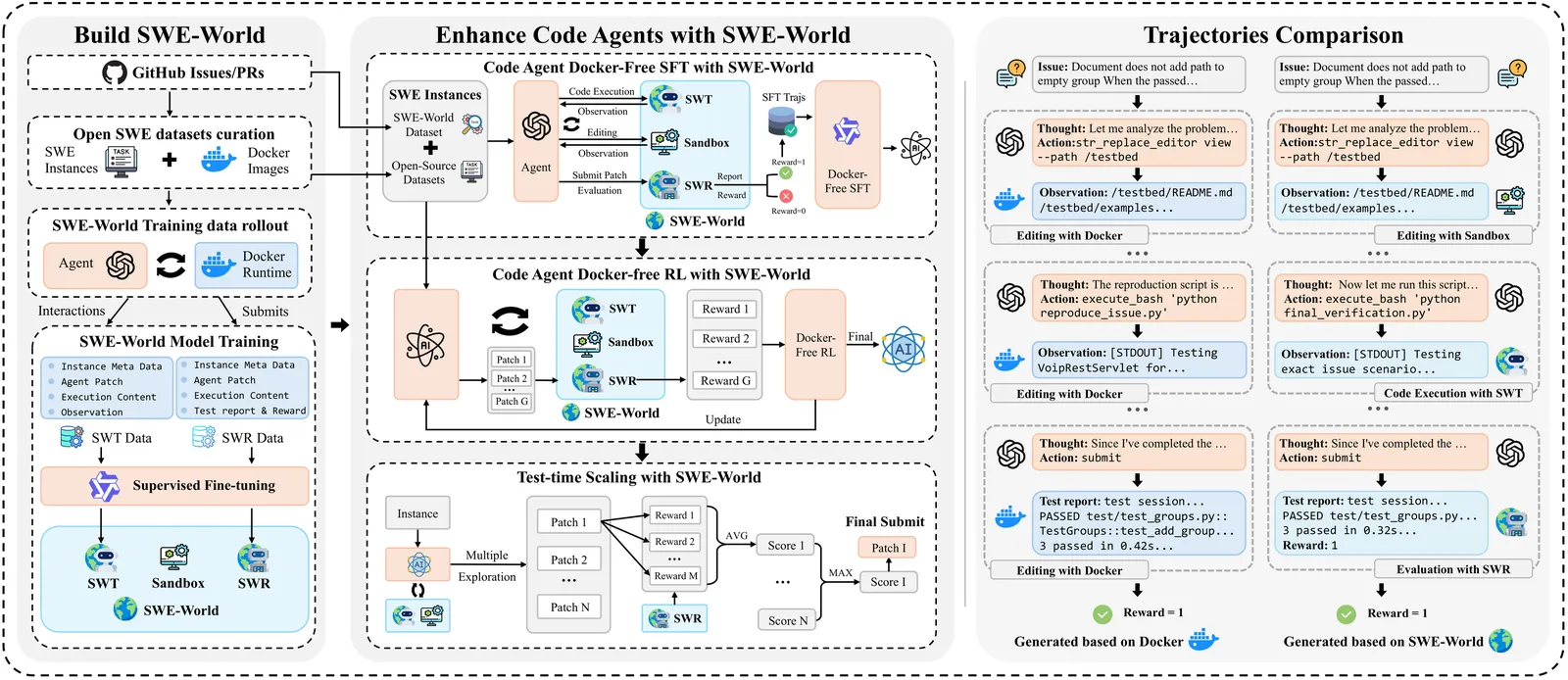
SWE-World: Building Software Engineering Agents in Docker-Free Environments
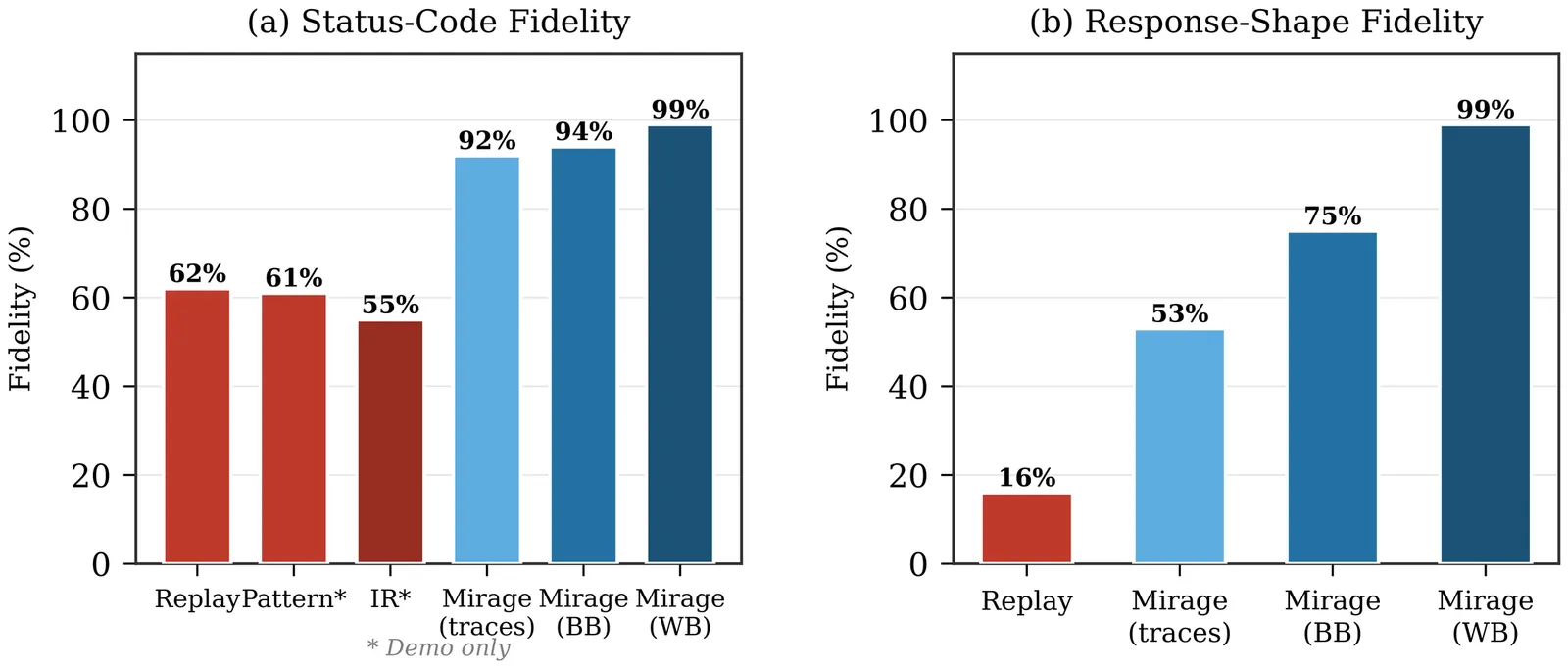
Recent advances in large language models (LLMs) have enabled software engineering agents to tackle complex code modification tasks. Most existing approaches rely on execution feedback from containerized environments, which require dependency-complete setup and physical execution of programs and tests. While effective, this paradigm is resource-intensive and difficult to maintain, substantially complicating agent training and limiting scalability. We propose SWE-World, a Docker-free framework that replaces physical execution environments with a learned surrogate for training and evaluating software engineering agents. SWE-World leverages LLM-based models trained on real agent-environment interaction data to predict intermediate execution outcomes and final test feedback, enabling agents to learn without interacting with physical containerized environments. This design preserves the standard agent-environment interaction loop while eliminating the need for costly environment construction and maintenance during agent optimization and evaluation. Furthermore, because SWE-World can simulate the final evaluation outcomes of candidate trajectories without real submission, it enables selecting the best solution among multiple test-time attempts, thereby facilitating effective test-time scaling (TTS) in software engineering tasks. Experiments on SWE-bench Verified demonstrate that SWE-World raises Qwen2.5-Coder-32B from 6.2\% to 52.0\% via Docker-free SFT, 55.0\% with Docker-free RL, and 68.2\% with further TTS. The code is available at https://github.com/RUCAIBox/SWE-World
2602.034191
Feb 2026Software Engineering
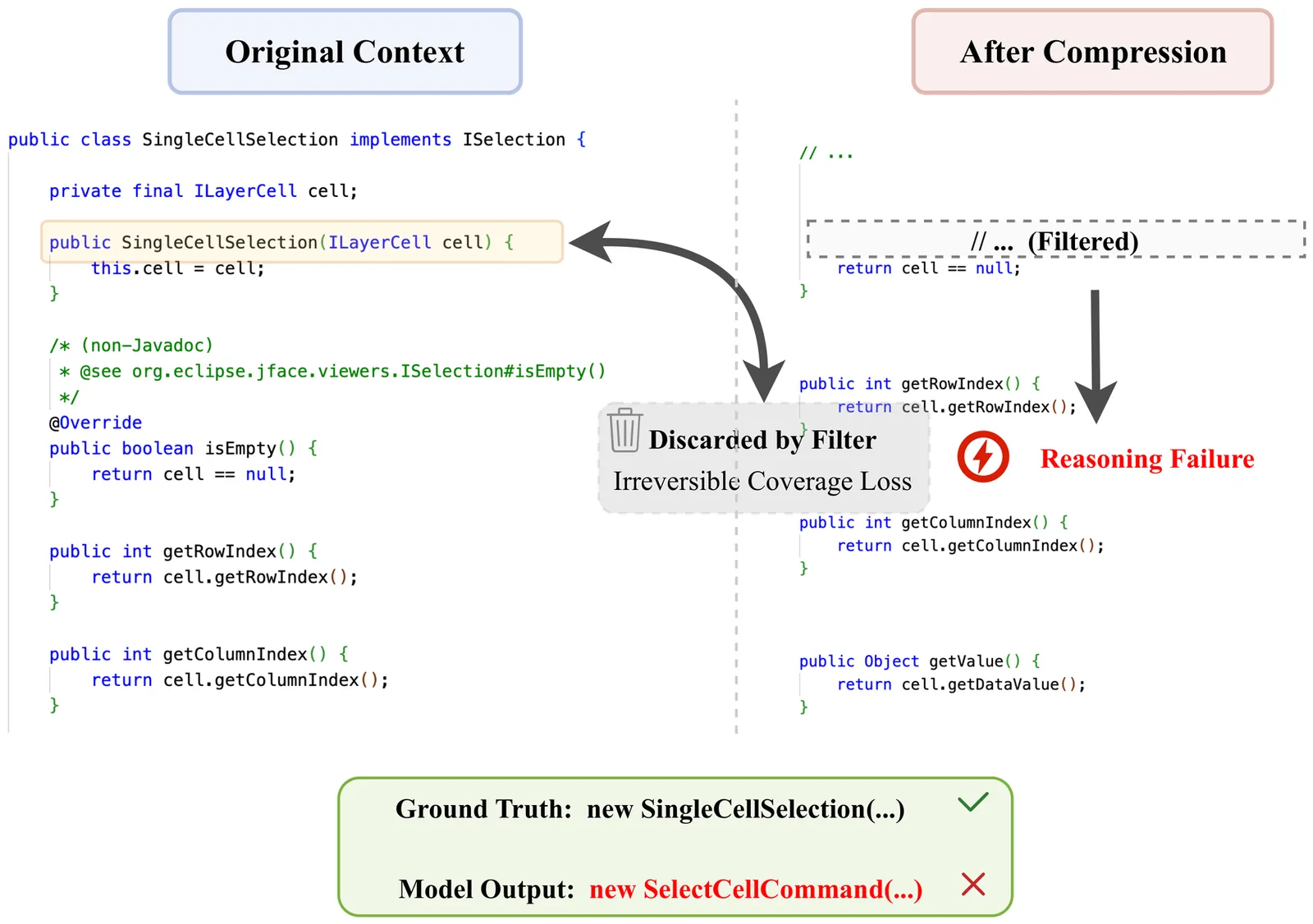
Can Vision-Language Models Handle Long-Context Code? An Empirical Study on Visual Compression
Large Language Models (LLMs) struggle with long-context code due to window limitations. Existing textual code compression methods mitigate this via selective filtering but often disrupt dependency closure, causing semantic fragmentation. To address this, we introduce LongCodeOCR, a visual compression framework that renders code into compressed two-dimensional image sequences for Vision-Language Models (VLMs). By preserving a global view, this approach avoids the dependency breakage inherent in filtering. We systematically evaluate LongCodeOCR against the state-of-the-art LongCodeZip across four benchmarks spanning code summarization, code question answering, and code completion. Our results demonstrate that visual code compression serves as a viable alternative for tasks requiring global understanding. At comparable compression ratios ($\sim$1.7$\times$), LongCodeOCR improves CompScore on Long Module Summarization by 36.85 points over LongCodeZip. At a 1M-token context length with Glyph (a specialized 9B VLM), LongCodeOCR maintains higher accuracy than LongCodeZip while operating at about 4$\times$ higher compression. Moreover, compared with LongCodeZip, LongCodeOCR drastically reduces compression-stage overhead (reducing latency from $\sim$4.3 hours to $\sim$1 minute at 1M tokens). Finally, our results characterize a fundamental coverage--fidelity trade-off: visual code compression retains broader context coverage to support global dependencies, yet faces fidelity bottlenecks on exactness-critical tasks; by contrast, textual code compression preserves symbol-level precision while sacrificing structural coverage.
2602.00746
Jan 2026Software Engineering
2601.18418daVinci-Dev: Agent-native Mid-training for Software Engineering
Recently, the frontier of Large Language Model (LLM) capabilities has shifted from single-turn code generation to agentic software engineering-a paradigm where models autonomously navigate, edit, and test complex repositories. While post-training methods have become the de facto approach for code agents, **agentic mid-training**-mid-training (MT) on large-scale data that mirrors authentic agentic workflows-remains critically underexplored due to substantial resource requirements, despite offering a more scalable path to instilling foundational agentic behaviors than relying solely on expensive reinforcement learning. A central challenge in realizing effective agentic mid-training is the distribution mismatch between static training data and the dynamic, feedback-rich environment of real development. To address this, we present a systematic study of agentic mid-training, establishing both the data synthesis principles and training methodology for effective agent development at scale. Central to our approach is **agent-native data**-supervision comprising two complementary types of trajectories: **contextually-native trajectories** that preserve the complete information flow an agent experiences, offering broad coverage and diversity; and **environmentally-native trajectories** collected from executable repositories where observations stem from actual tool invocations and test executions, providing depth and interaction authenticity. We verify the model's agentic capabilities on `SWE-Bench Verified`. We demonstrate our superiority over the previous open software engineering mid-training recipe `Kimi-Dev` under two post-training settings with an aligned base model and agentic scaffold, while using less than half mid-training tokens (73.1B). Besides relative advantage, our best performing 32B and 72B models achieve **56.1%** and **58.5%** resolution rates, respectively, which are ...
2601.18418
Jan 2026Software Engineering
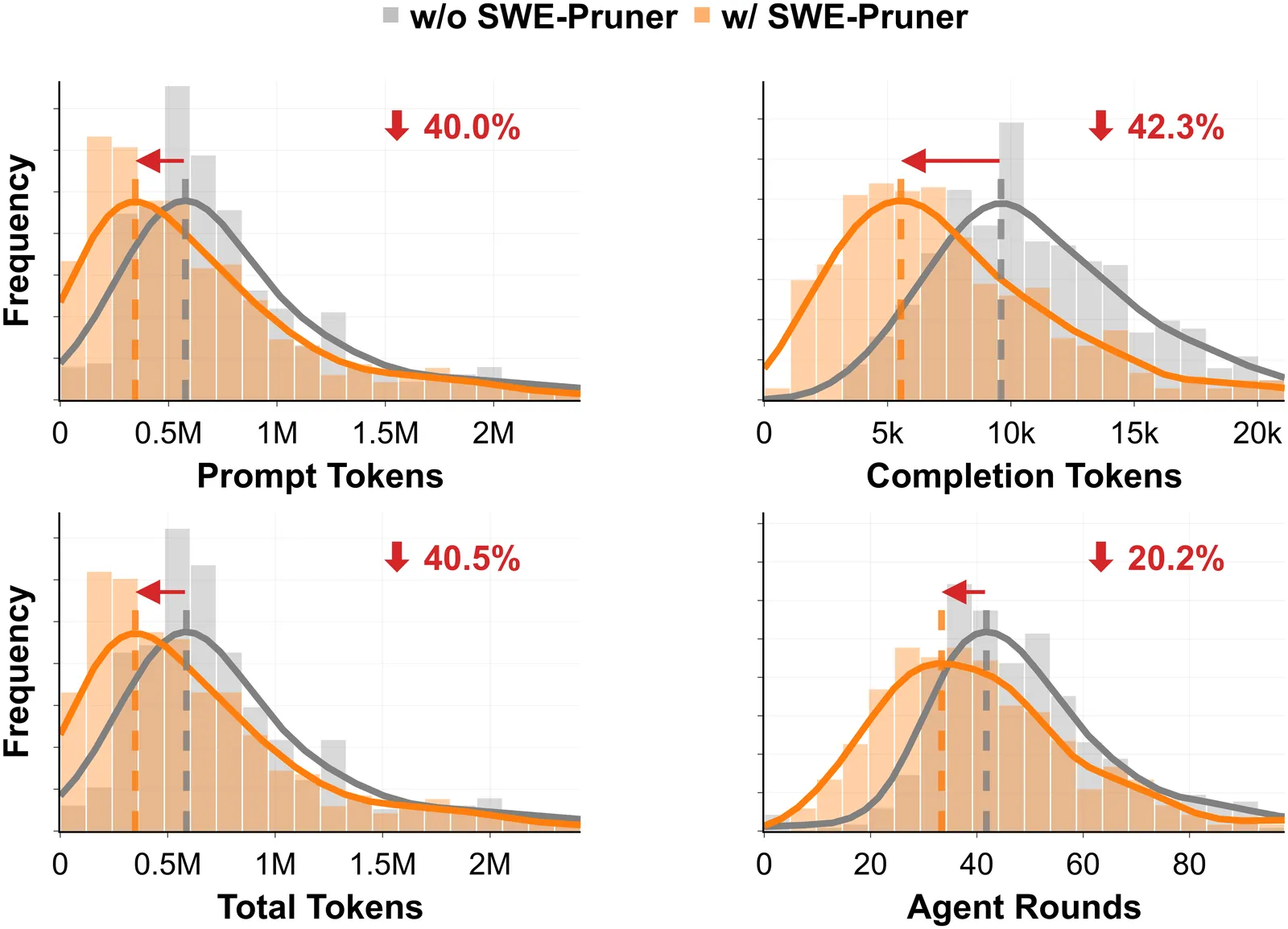
SWE-Pruner: Self-Adaptive Context Pruning for Coding Agents
LLM agents have demonstrated remarkable capabilities in software development, but their performance is hampered by long interaction contexts, which incur high API costs and latency. While various context compression approaches such as LongLLMLingua have emerged to tackle this challenge, they typically rely on fixed metrics such as PPL, ignoring the task-specific nature of code understanding. As a result, they frequently disrupt syntactic and logical structure and fail to retain critical implementation details. In this paper, we propose SWE-Pruner, a self-adaptive context pruning framework tailored for coding agents. Drawing inspiration from how human programmers "selectively skim" source code during development and debugging, SWE-Pruner performs task-aware adaptive pruning for long contexts. Given the current task, the agent formulates an explicit goal (e.g., "focus on error handling") as a hint to guide the pruning targets. A lightweight neural skimmer (0.6B parameters) is trained to dynamically select relevant lines from the surrounding context given the goal. Evaluations across four benchmarks and multiple models validate SWE-Pruner's effectiveness in various scenarios, achieving 23-54% token reduction on agent tasks like SWE-Bench Verified and up to 14.84x compression on single-turn tasks like LongCodeQA with minimal performance impact.
2601.16746
Jan 2026Software Engineering
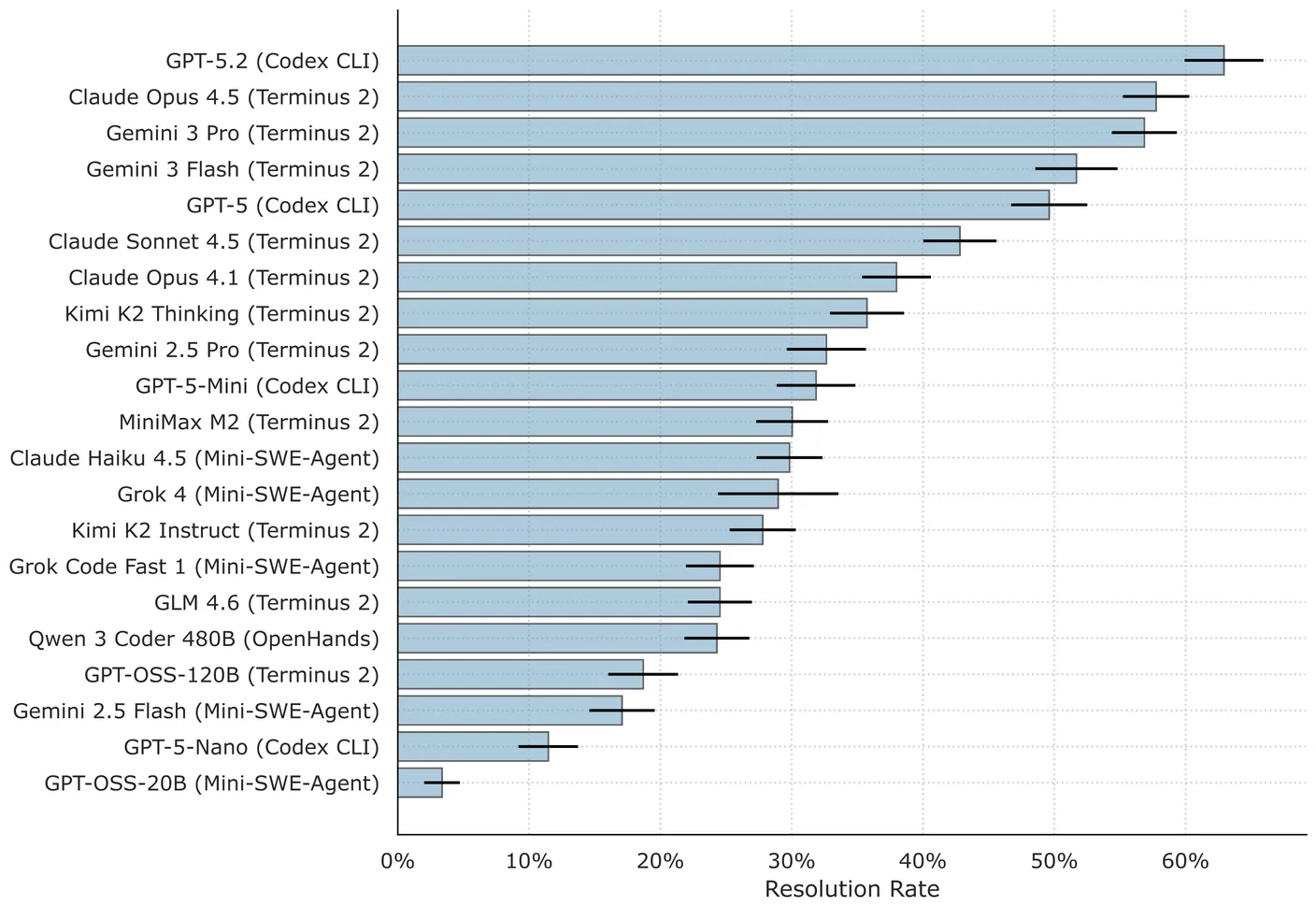
Terminal-Bench: Benchmarking Agents on Hard, Realistic Tasks in Command Line Interfaces
AI agents may soon become capable of autonomously completing valuable, long-horizon tasks in diverse domains. Current benchmarks either do not measure real-world tasks, or are not sufficiently difficult to meaningfully measure frontier models. To this end, we present Terminal-Bench 2.0: a carefully curated hard benchmark composed of 89 tasks in computer terminal environments inspired by problems from real workflows. Each task features a unique environment, human-written solution, and comprehensive tests for verification. We show that frontier models and agents score less than 65\% on the benchmark and conduct an error analysis to identify areas for model and agent improvement. We publish the dataset and evaluation harness to assist developers and researchers in future work at https://www.tbench.ai/ .
2601.11868
Jan 2026Software Engineering
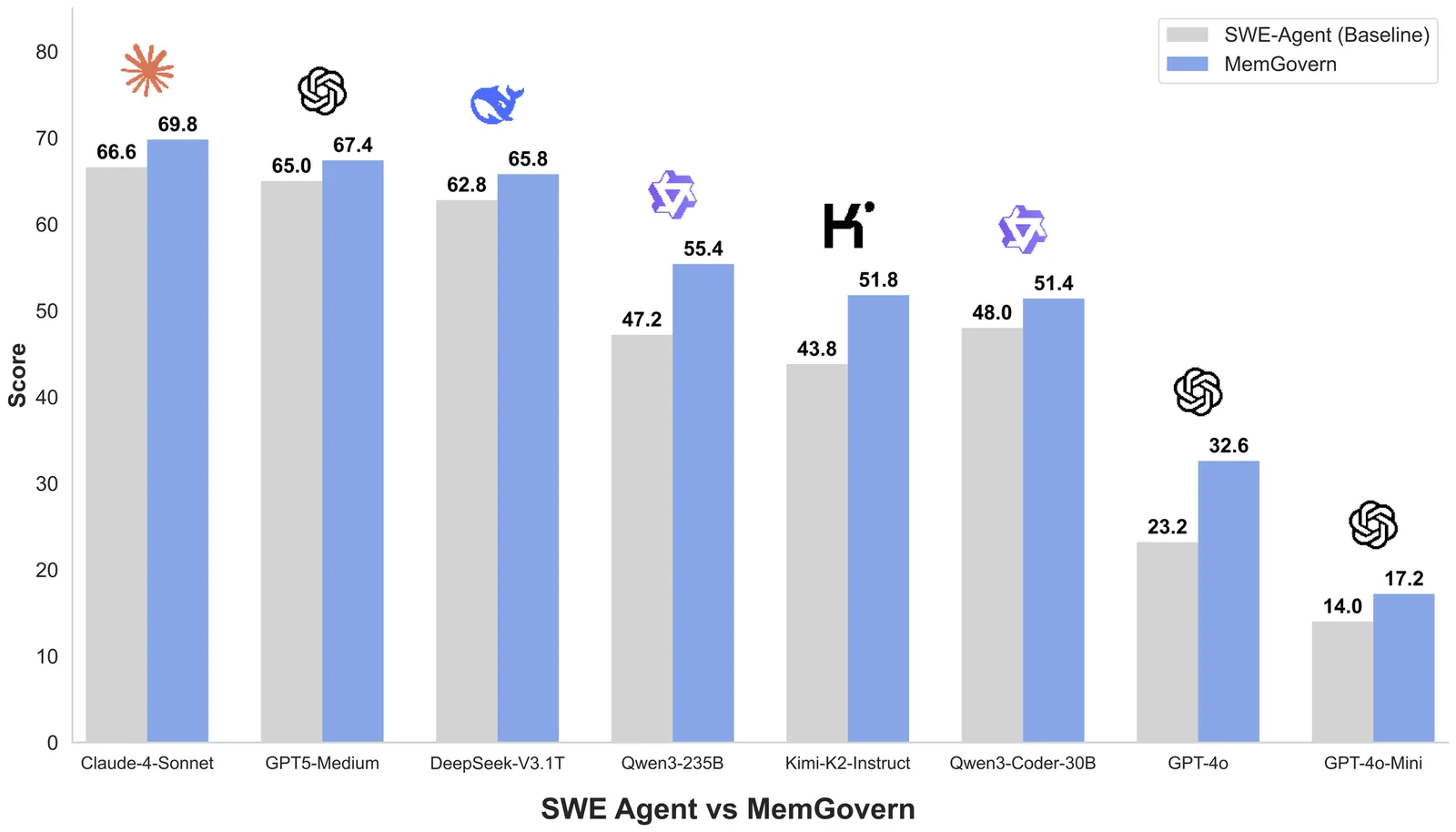
MemGovern: Enhancing Code Agents through Learning from Governed Human Experiences
While autonomous software engineering (SWE) agents are reshaping programming paradigms, they currently suffer from a "closed-world" limitation: they attempt to fix bugs from scratch or solely using local context, ignoring the immense historical human experience available on platforms like GitHub. Accessing this open-world experience is hindered by the unstructured and fragmented nature of real-world issue-tracking data. In this paper, we introduce MemGovern, a framework designed to govern and transform raw GitHub data into actionable experiential memory for agents. MemGovern employs experience governance to convert human experience into agent-friendly experience cards and introduces an agentic experience search strategy that enables logic-driven retrieval of human expertise. By producing 135K governed experience cards, MemGovern achieves a significant performance boost, improving resolution rates on the SWE-bench Verified by 4.65%. As a plug-in approach, MemGovern provides a solution for agent-friendly memory infrastructure.
2601.06789
Jan 2026Software Engineering
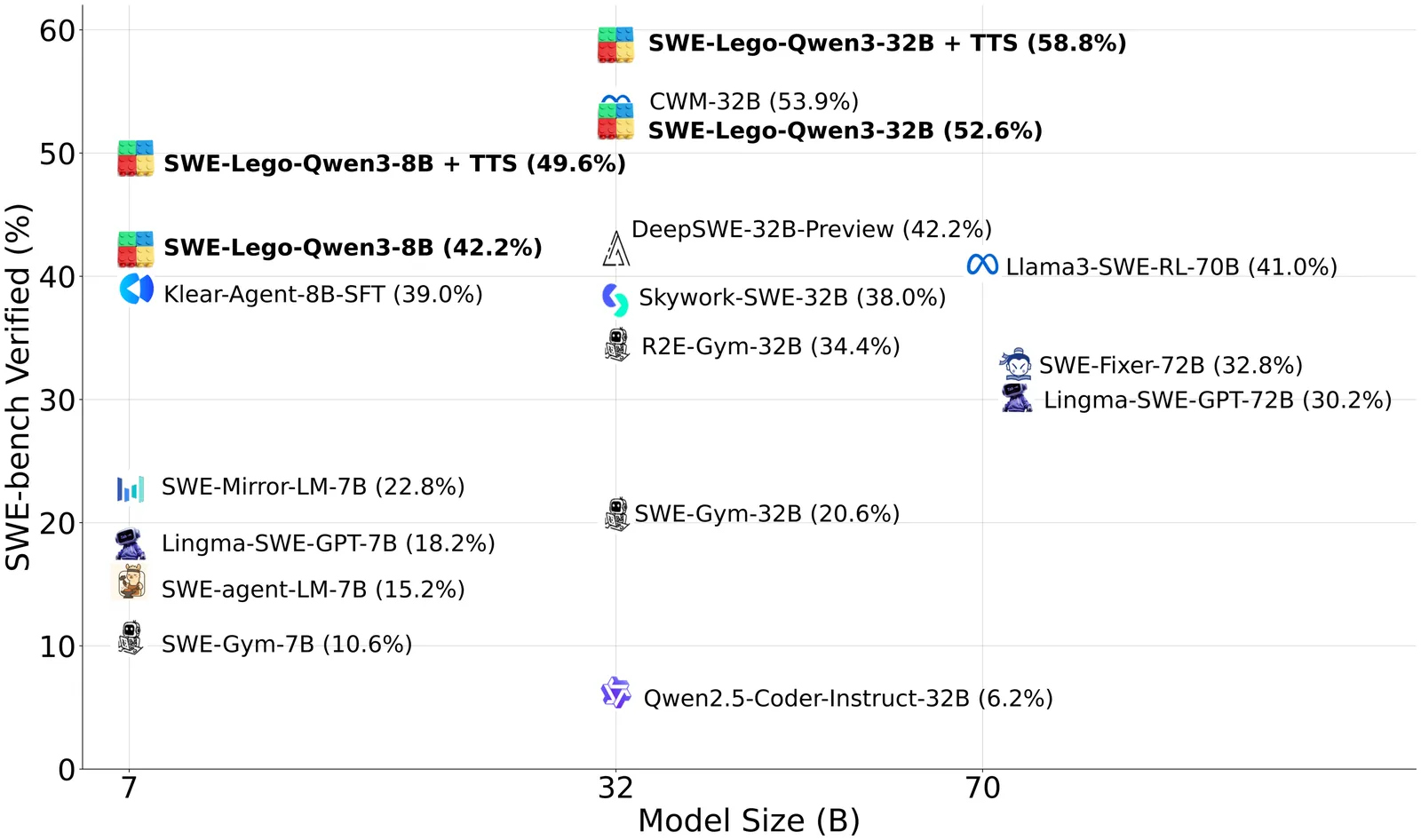
SWE-Lego: Pushing the Limits of Supervised Fine-tuning for Software Issue Resolving
We present SWE-Lego, a supervised fine-tuning (SFT) recipe designed to achieve state-ofthe-art performance in software engineering (SWE) issue resolving. In contrast to prevalent methods that rely on complex training paradigms (e.g., mid-training, SFT, reinforcement learning, and their combinations), we explore how to push the limits of a lightweight SFT-only approach for SWE tasks. SWE-Lego comprises three core building blocks, with key findings summarized as follows: 1) the SWE-Lego dataset, a collection of 32k highquality task instances and 18k validated trajectories, combining real and synthetic data to complement each other in both quality and quantity; 2) a refined SFT procedure with error masking and a difficulty-based curriculum, which demonstrably improves action quality and overall performance. Empirical results show that with these two building bricks alone,the SFT can push SWE-Lego models to state-of-the-art performance among open-source models of comparable size on SWE-bench Verified: SWE-Lego-Qwen3-8B reaches 42.2%, and SWE-Lego-Qwen3-32B attains 52.6%. 3) We further evaluate and improve test-time scaling (TTS) built upon the SFT foundation. Based on a well-trained verifier, SWE-Lego models can be significantly boosted--for example, 42.2% to 49.6% and 52.6% to 58.8% under TTS@16 for the 8B and 32B models, respectively.
2601.01426
Jan 2026Software Engineering
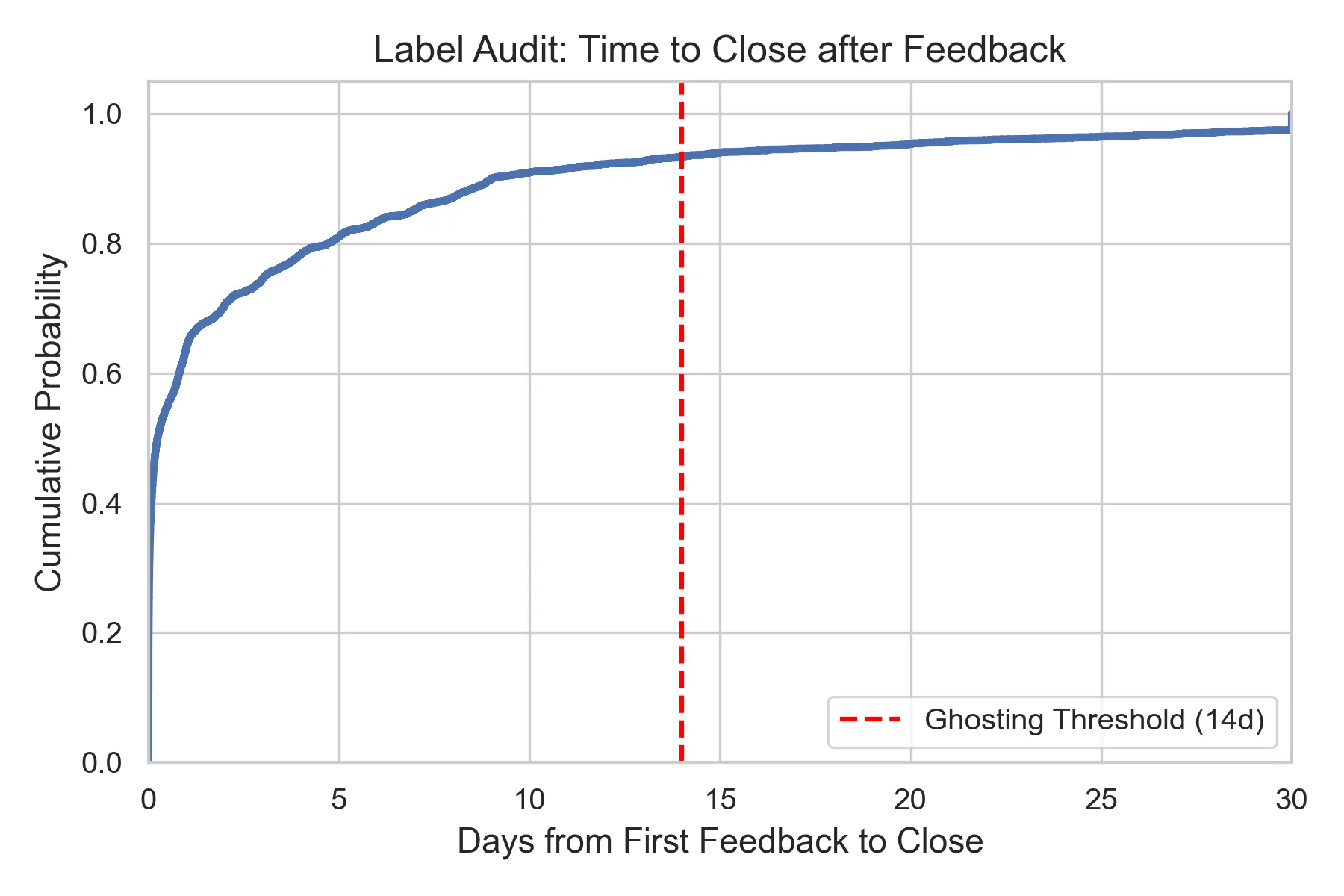
Early-Stage Prediction of Review Effort in AI-Generated Pull Requests
As autonomous AI agents transition from code completion tools to full-fledged teammates capable of opening pull requests (PRs) at scale, software maintainers face a new challenge: not just reviewing code, but managing complex interaction loops with non-human contributors. This paradigm shift raises a critical question: can we predict which agent-generated PRs will consume excessive review effort before any human interaction begins? Analyzing 33,707 agent-authored PRs from the AIDev dataset across 2,807 repositories, we uncover a striking two-regime behavioral pattern that fundamentally distinguishes autonomous agents from human developers. The first regime, representing 28.3 percent of all PRs, consists of instant merges (less than 1 minute), reflecting success on narrow automation tasks. The second regime involves iterative review cycles where agents frequently stall or abandon refinement (ghosting). We propose a Circuit Breaker triage model that predicts high-review-effort PRs (top 20 percent) at creation time using only static structural features. A LightGBM model achieves AUC 0.957 on a temporal split, while semantic text features (TF-IDF, CodeBERT) provide negligible predictive value. At a 20 percent review budget, the model intercepts 69 percent of total review effort, enabling zero-latency governance. Our findings challenge prevailing assumptions in AI-assisted code review: review burden is dictated by what agents touch, not what they say, highlighting the need for structural governance mechanisms in human-AI collaboration.
2601.00753
Jan 2026Software Engineering