Trending in Nuclear Physics
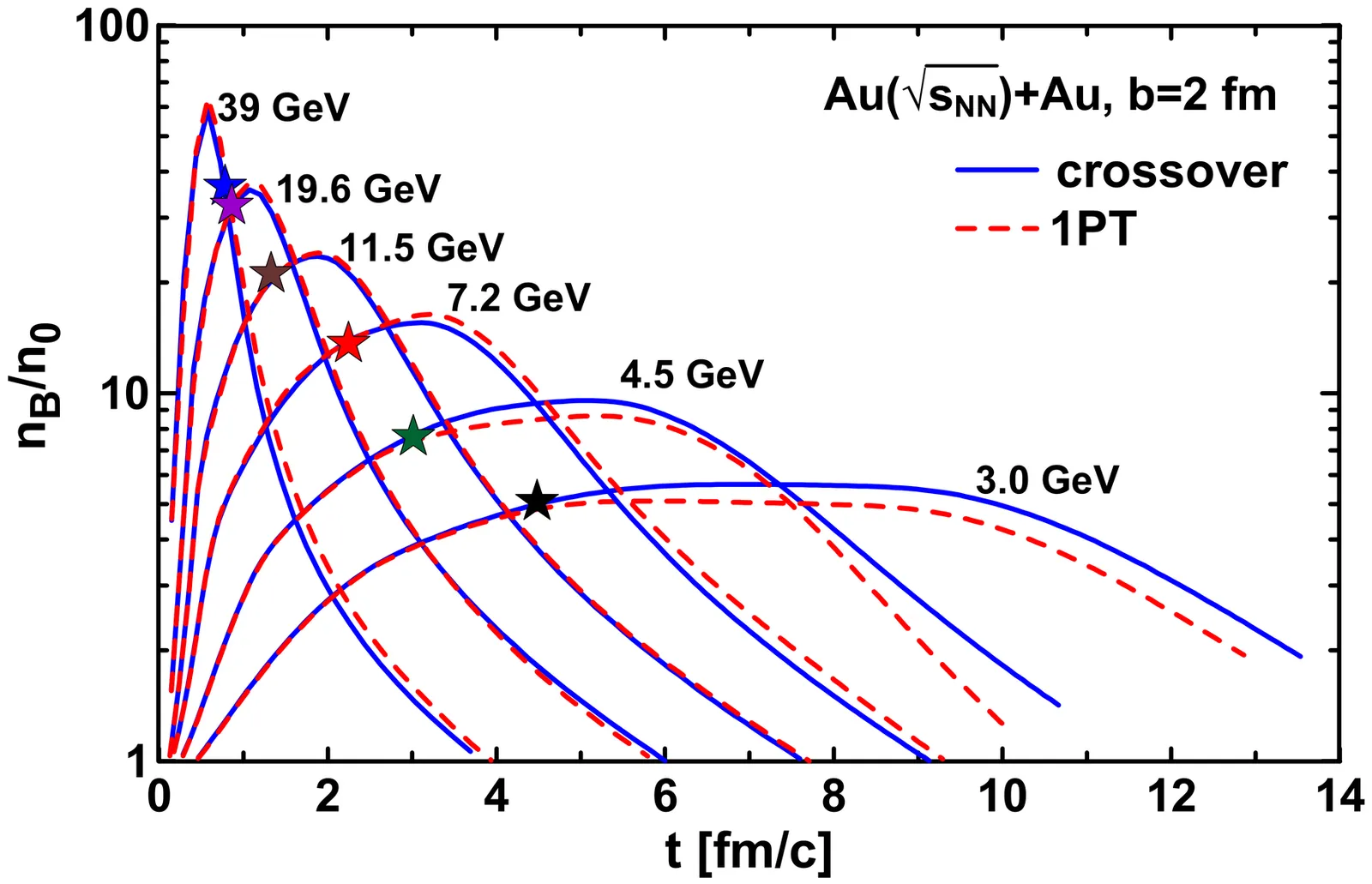
Space-time regions of high baryon density and baryon stopping in heavy-ion collisions
Four-volumes ($V_4=$ spatial-3-volume$\times$lifetime) are calculated within the model of three-fluid dynamics (3FD) and compared with those of the the JET AA Microscopic Transport Model (JAM). The calculations are performed for central Au+Au collisions at energies $\sqrt{s_{NN}}=$ 3 -- 19.6 GeV. These $V_4$ indicate optimal collision-energy ranges for realizing macroscopic high baryon-density matter. It is found that the 3FD four-volumes noticeably exceed those in the JAM, which indicates a stronger baryon stopping in the 3FD model as compared to that JAM. It is argued that this difference in the baryon stopping correlates with stiffness of the EoS implemented in these models. Contrary to JAM, the four-volume, where a baryon density ($n_B$) exceeds three times the normal nuclear density ($n_0$), does not exhibit a maximum as a function of $\sqrt{s_{NN}}$. It decreases monotonically with increasing $\sqrt{s_{NN}}$, remaining at a fairly macroscopic level (i.e. $V_4\geq 5.5^4$ fm$^4$/c). For higher baryon densities, $V_4$ exhibits maxima in its dependence on $\sqrt{s_{NN}}$. The optimal energy range for densities $n_B/n_0>$ 4 is located at $\sqrt{s_{NN}}=$ 3.2--8 GeV. Even for $n_B/n_0>$ 6, the four-volume remains quite macroscopic ($V_4\geq 4^4$ fm$^4$/c) at $\sqrt{s_{NN}}=$ 4.5--9 GeV contrary to the JAM.
2602.22690
Feb 2026Nuclear Theory
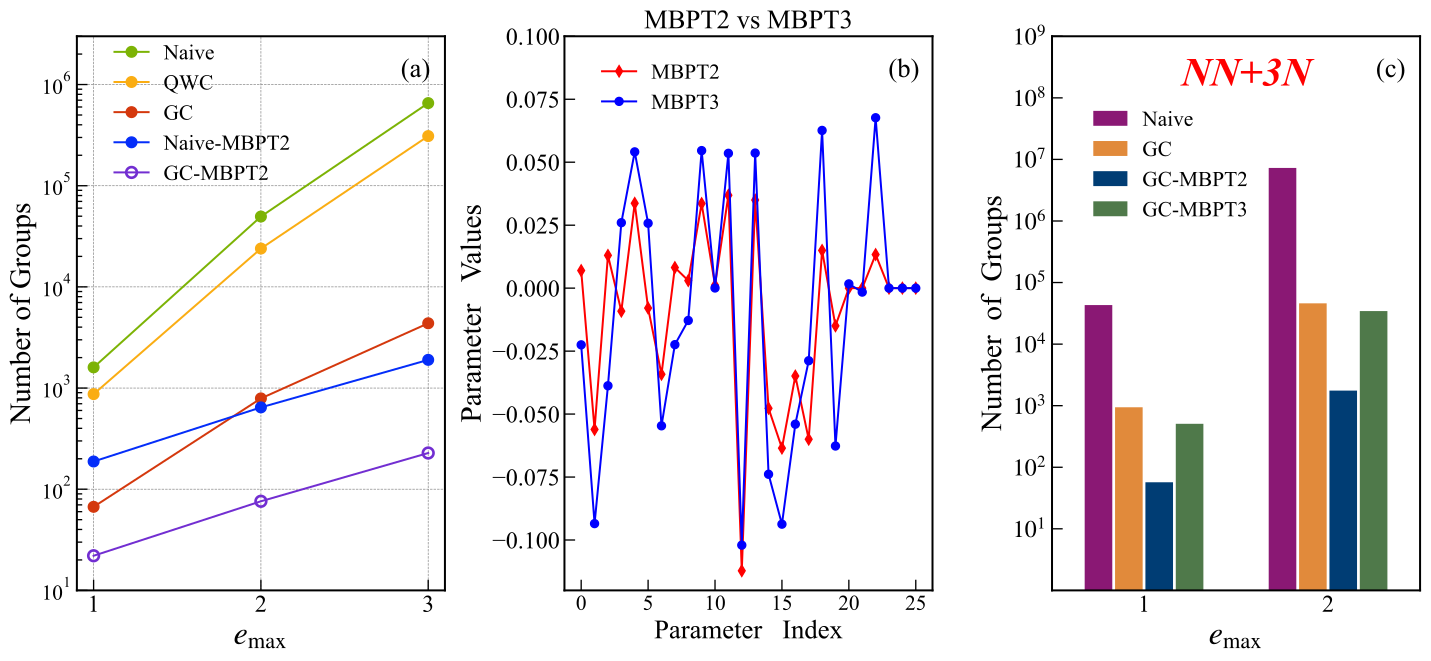
Toward $\textit{Ab Initio}$ Quantum Simulations of Atomic Nuclei Using Noisy Qubits
Quantum computers are expected to provide a ultimate solver for quantum many-body systems, although it is a tremendous challenge to achieve that goal on current noisy quantum devices. This work illustrated quantum simulations of ab initio no-core shell model calculations of $^3$H with chiral two-nucleon and three-nucleon forces. The measurement costs are remarkably reduced by using the general commutativity measurement together with the asymptotic optimization. In addition, the noise causes serious contaminations of configurations with undesired particle numbers, and the accuracies are much improved by applying the particle number projected measurement. By tackling the efficiency and noise issues, this work demonstrated a substantial step toward ab initio quantum computing of atomic nuclei.
2601.00315
Jan 2026Nuclear Theory

Leptophilic Interactions in Nuclear Energy Density Functional Theory
We develop a unified theoretical framework that embeds a light leptophilic vector boson into nuclear energy density functional (EDF) theory. Starting from an underlying leptophilic gauge interaction, the mediator is integrated out in the static limit, yielding an effective current--current interaction that couples proton and lepton densities. This interaction is incorporated self-consistently into relativistic mean-field equations, defining a leptophilic extension of conventional nuclear EDFs. The resulting leptophilic EDF induces correlated modifications of proton and lepton chemical potentials, directly affecting beta equilibrium in dense matter. In uniform matter, these effects lead to percent-level changes in the proton fraction, symmetry energy, and equation of state within phenomenologically allowed parameter ranges. In finite nuclei, the modified proton mean field generates shifts of $10^{-3}$--$10^{-2}\,\mathrm{fm}$ in neutron-skin thicknesses, comparable to current experimental sensitivities. Our results demonstrate that light leptophilic interactions leave coherent and experimentally accessible imprints on both nuclear structure and dense-matter observables. The framework introduced here provides a controlled and realistic extension of nuclear EDF theory, enabling nuclear systems to serve as laboratories for probing new physics in the leptonic sector.
2512.11770
Dec 2025Nuclear Theory