Derivatives pricing, portfolio theory, and financial mathematics
Within a general semimartingale framework, we study the relationship between collective market efficiency and individual rationality. We derive a necessary and sufficient condition for the existence of (possibly zero-sum) exchanges among agents that strictly increase their indirect utilities and characterize this condition in terms of the compatibility between agents' preferences and collective pricing measures. The framework applies to both continuous- and discrete-time models and clarifies when cooperation leads to a strict improvement in each participating agent's indirect utility.
We study a speculative trading problem within the exploratory reinforcement learning (RL) framework of Wang et al. [2020]. The problem is formulated as a sequential optimal stopping problem over entry and exit times under general utility function and price process. We first consider a relaxed version of the problem in which the stopping times are modeled by the jump times of Cox processes driven by bounded, non-randomized intensity controls. Under the exploratory formulation, the agent's randomized control is characterized via the probability measure over the jump intensities, and their objective function is regularized by Shannon's differential entropy. This yields a system of the exploratory HJB equations and Gibbs distributions in closed-form as the optimal policy. Error estimates and convergence of the RL objective to the value function of the original problem are established. Finally, an RL algorithm is designed, and its implementation is showcased in a pairs-trading application.
This paper studies the problem of hedging and pricing a European call option under proportional transaction costs, from two complementary perspectives. We first derive the optimal hedging strategy under CARA utility, following the stochastic control framework of Davis et al. (1993), characterising the no-transaction band via the Hamilton-Jacobi-Bellman Quasi-Variational Inequality (HJBQVI) and the Whalley-Wilmott asymptotic approximation. We then adopt a deep hedging approach, proposing two architectures that build on the No-Transaction Band Network of Imaki et al. (2023): NTBN-Delta, which makes delta-centring explicit, and WW-NTBN, which incorporates the Whalley-Wilmott formula as a structural prior on the bandwidth and replaces the hard clamp with a differentiable soft clamp. Numerical experiments show that WW-NTBN converges faster, matches the stochastic control no-transaction bands more closely, and generalises well across transaction cost regimes. We further apply both frameworks to the bull call spread, documenting the breakdown of price linearity under transaction costs.
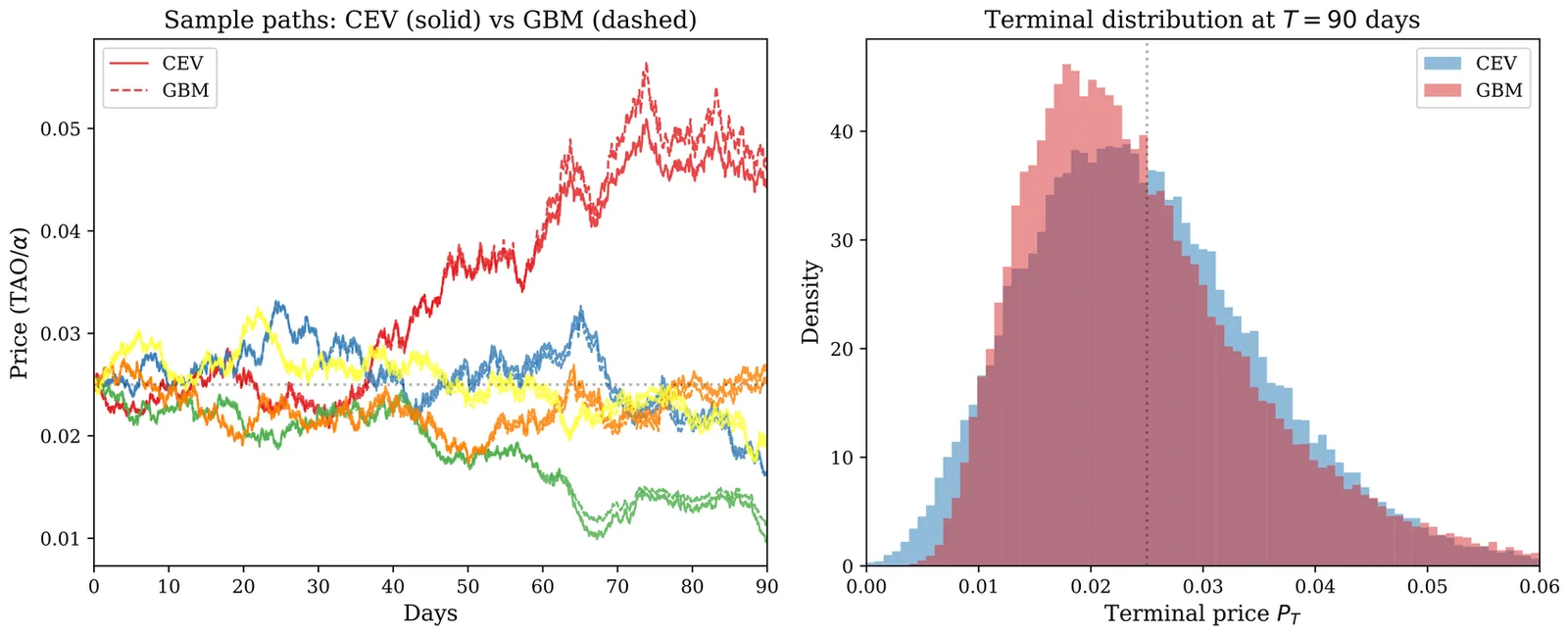
We derive the stochastic price process for tokens whose sole price discovery mechanism is a constant-product automated market maker (AMM). When the net flow into the pool follows a diffusion, the token price follows a constant elasticity of variance (CEV) process, nesting Black-Scholes as the limiting case of infinite liquidity. We obtain closed-form European option prices and introduce liquidity-adjusted Greeks. The CEV structure generates a leverage effect -- volatility rises as price falls -- whose normalized implied volatility skew depends only on the pool's weighting parameter, not on pool depth: Black-Scholes underprices 20%-out-of-the-money puts by roughly 6% in implied volatility terms at every pool depth, while the absolute pricing discrepancy vanishes as pools deepen. Empirically, after controlling for pool depth and flow volatility, realized return variance across 90 Bittensor subnets exhibits a strongly negative price elasticity, decisively rejecting geometric Brownian motion and consistent with the CEV prediction. A complementary delta-hedged backtest across 82 subnets confirms near-identical hedging errors at the money, consistent with the prediction that pricing differences are concentrated in the wings.
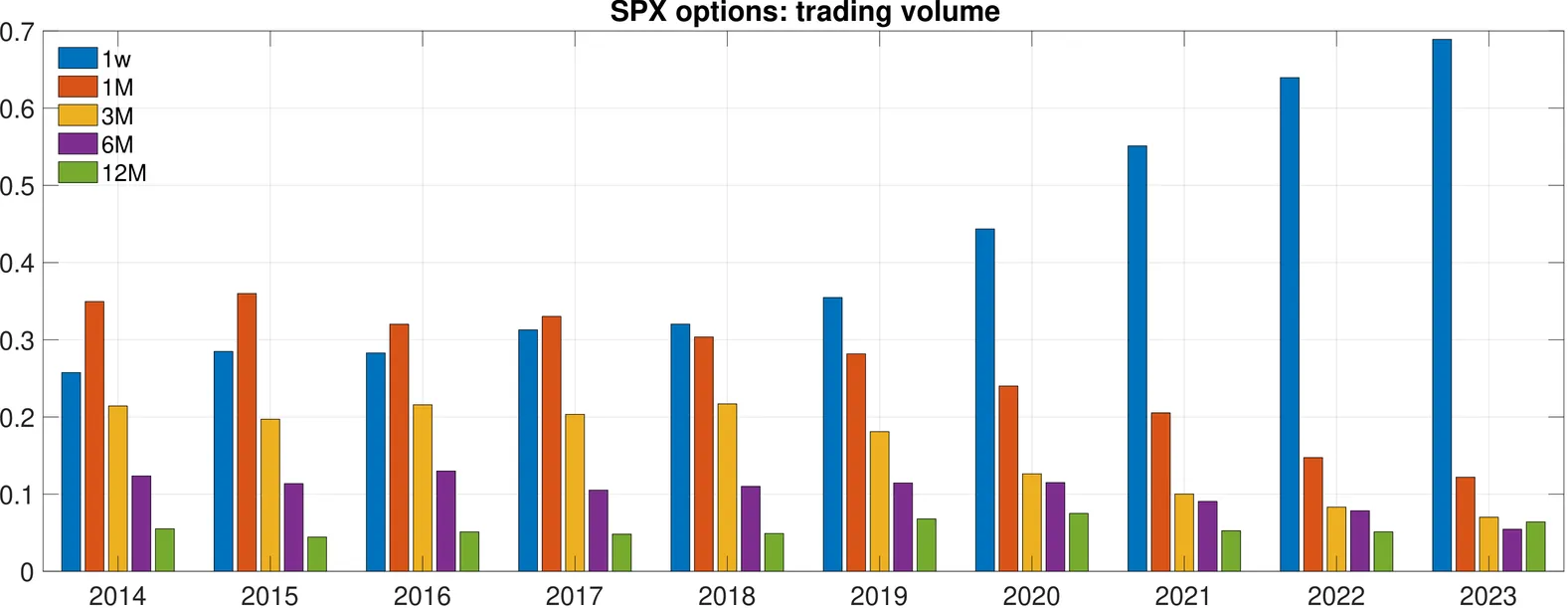
Options with maturities below one week, hereafter "ultra-short-term" options, have seen a sharp increase in trading activity in recent years. Yet, these instruments are difficult to price jointly using classical pricing models due to the pronounced oscillations observed in the at-the-money implied-volatility term structure across ultra-short-term tenors. We propose Edgeworth++, a parsimonious jump-diffusion model featuring a nonparametric stochastic volatility component, which provides flexibility in capturing implied-volatility smiles for each tenor, combined with a deterministic shift extension, which allows the model to fit rich at-the-money implied-volatility shapes across tenors. We derive a local (in tenor) expansion of the process characteristic function suited to value ultra-short-term options. The expansion leads to fast and accurate option pricing in closed form via standard Fourier inversion. We discuss the benefits of the proposed approach relative to benchmarks.
2603.28948We study scaled trinomial models converging to the Black--Scholes model, and analyze exponential certainty-equivalent prices for path-dependent European options. As the number of trading dates $n$ tends to infinity and the risk aversion is scaled as $nl$ for a fixed constant $l>0$, we derive a nontrivial scaling limit. Our analysis is purely probabilistic. Using a duality argument for the certainty equivalent, together with martingale and weak-convergence techniques, we show that the limiting problem takes the form of a volatility control problem with a specific penalty. For European options with Markovian payoffs, we analyze the optimal control problem and show that the corresponding delta-hedging strategy is asymptotically optimal for the primal problem.
2603.28256We study the upper hedging price for contingent claims in market models with strong types of arbitrage: increasing profit, strong arbitrage, and arbitrage of the first kind. The existence of arbitrage may make the price smaller than if it did not exist. For example, when the asset price process has a reflecting boundary, which introduces increasing profit in the market model, the option prices are reduced to those of the corresponding options that knock-out at the boundary. Furthermore, we demonstrate that corporate stock price processes with increasing profit are obtained as a result of corporate stock issuance and repurchase plans.
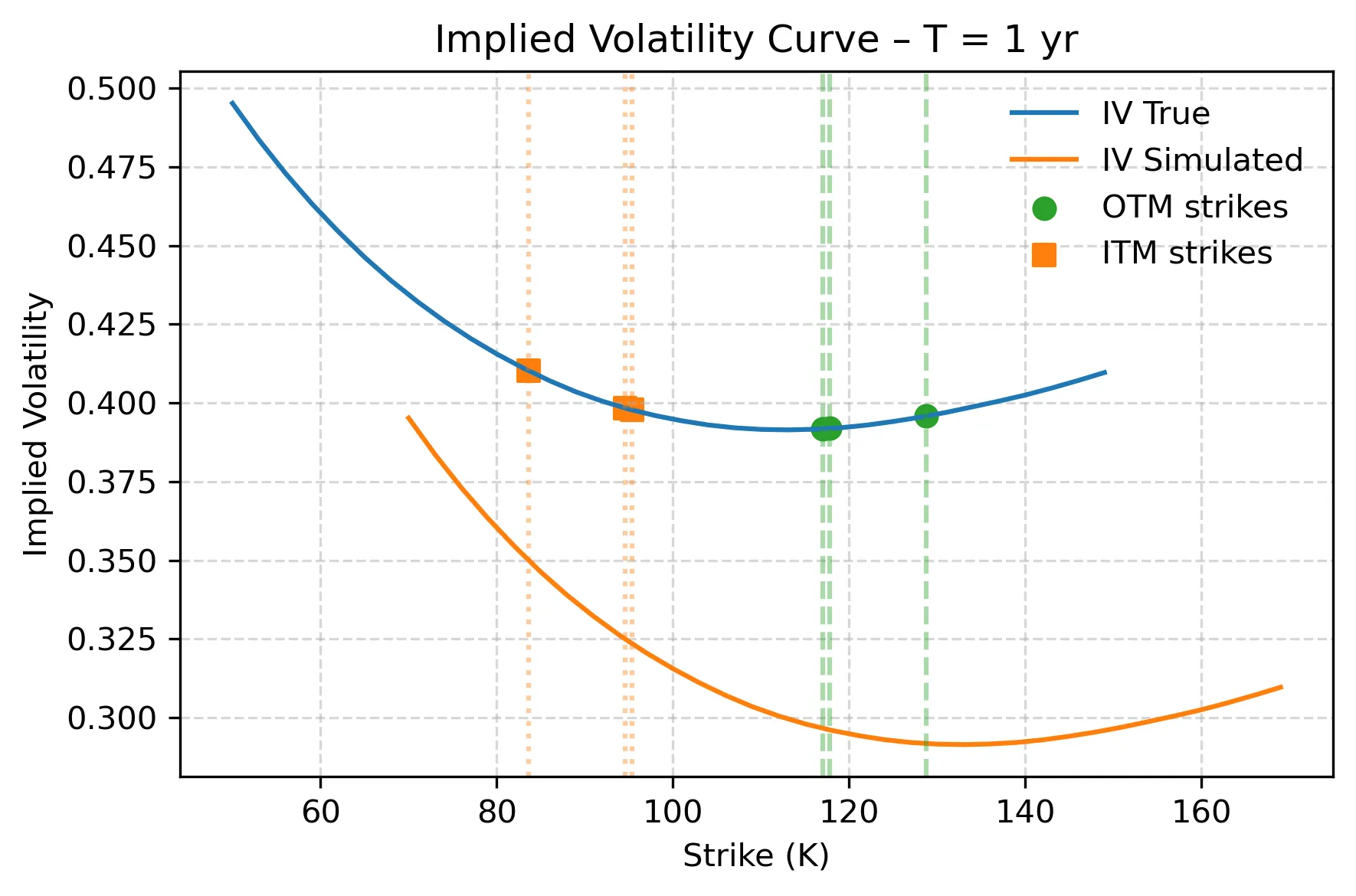
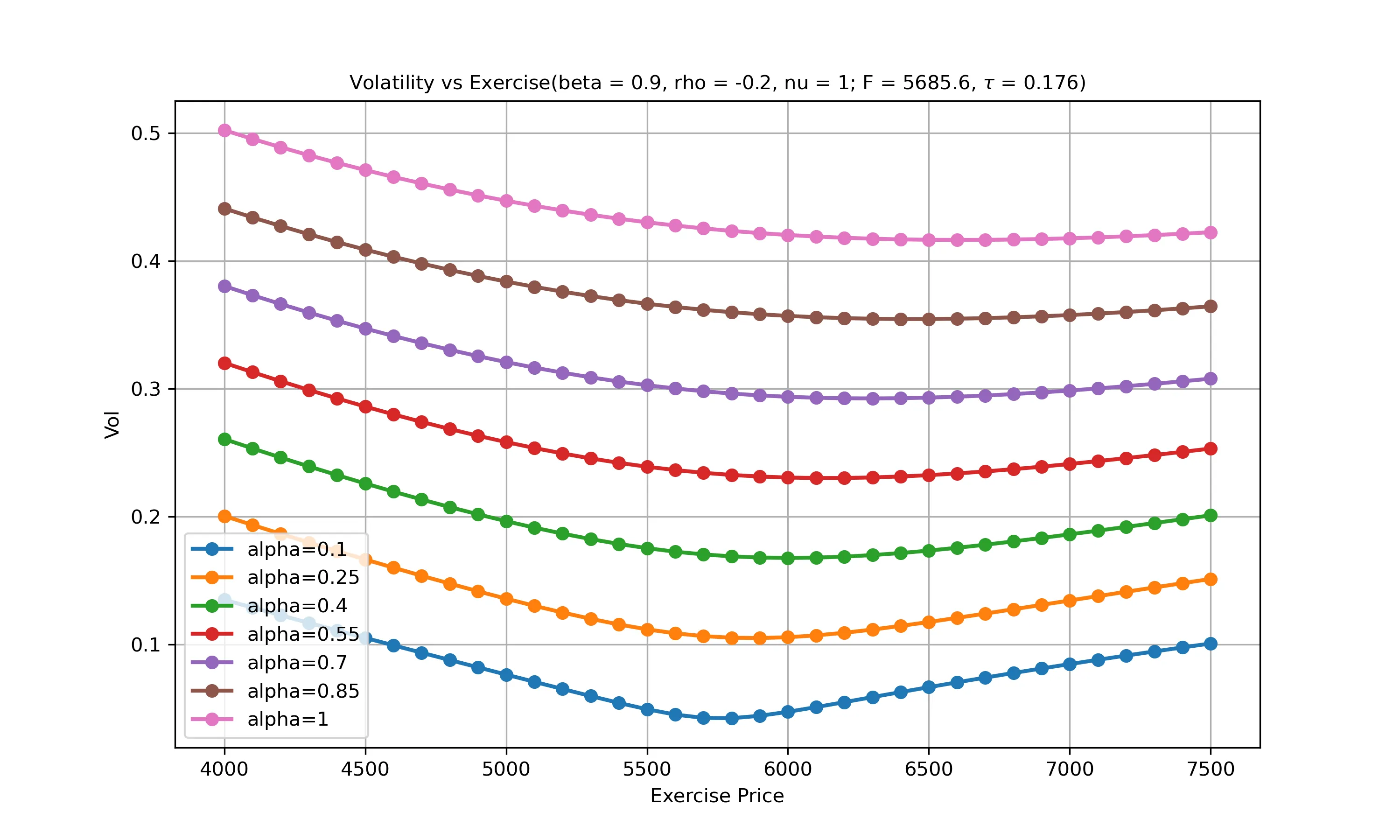
Accurately characterizing the implied volatility curves is a central challenge in option pricing and risk management. The classical SABR model by Hagan et al. has been widely adopted in practice due to its well-defined stochastic volatility structure and its tractable closed-form approximation for Black implied volatility. However, under complex market conditions, its fitting accuracy for implied volatility curves remains limited. To address this issue, this paper proposes an extended model within the SABR framework, referred to as skew-SABR. Specifically, the proposed approach introduces an extension to the stochastic dynamics of the underlying asset price and its variance process, under which a corresponding Black implied volatility expression is derived. By further simplifying and reorganizing the resulting formula, the implied volatility can be expressed in a form that explicitly incorporates a skew parameter, thereby enabling a direct characterization of the asymmetry in the implied volatility curve. The resulting expression preserves the structural simplicity of the Hagan-SABR formula, while significantly enhancing the model's flexibility in capturing complex volatility smile patterns. From a theoretical perspective, the paper provides a systematic analysis of the model specification and the financial interpretation of its parameters. From an empirical perspective, a comprehensive comparison is conducted using data from the Chinese options market over the period 2018--2025. The skew-SABR model is evaluated against the classical Hagan-SABR model, the SVI parameterization, polynomial fitting, and spline-based methods. Numerical results show that, across different market regimes and a wide range of implied volatility curve shapes, the skew-SABR model consistently achieves high and stable fitting accuracy.
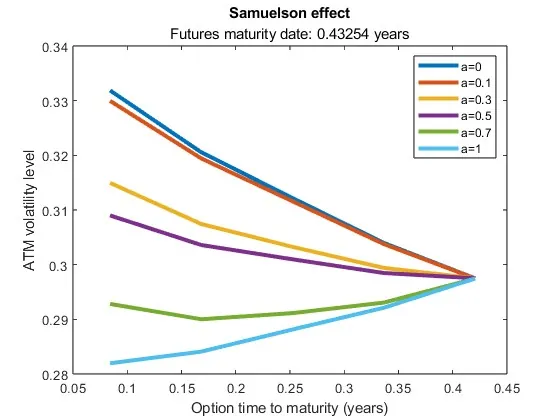
In this paper, we develop a general rough volatility model for commodities that provides an automatic calibration of the initial term structure of the futures prices and an appropriate treatment of the Samuelson effect. After the theoretical analysis of this general model, we focus on the rBergomi and rHeston models and their calibration to market data of vanilla futures options on WTI Crude Oil. Finally, numerical results illustrate the performance of the proposed rough volatility models for commodities pricing.
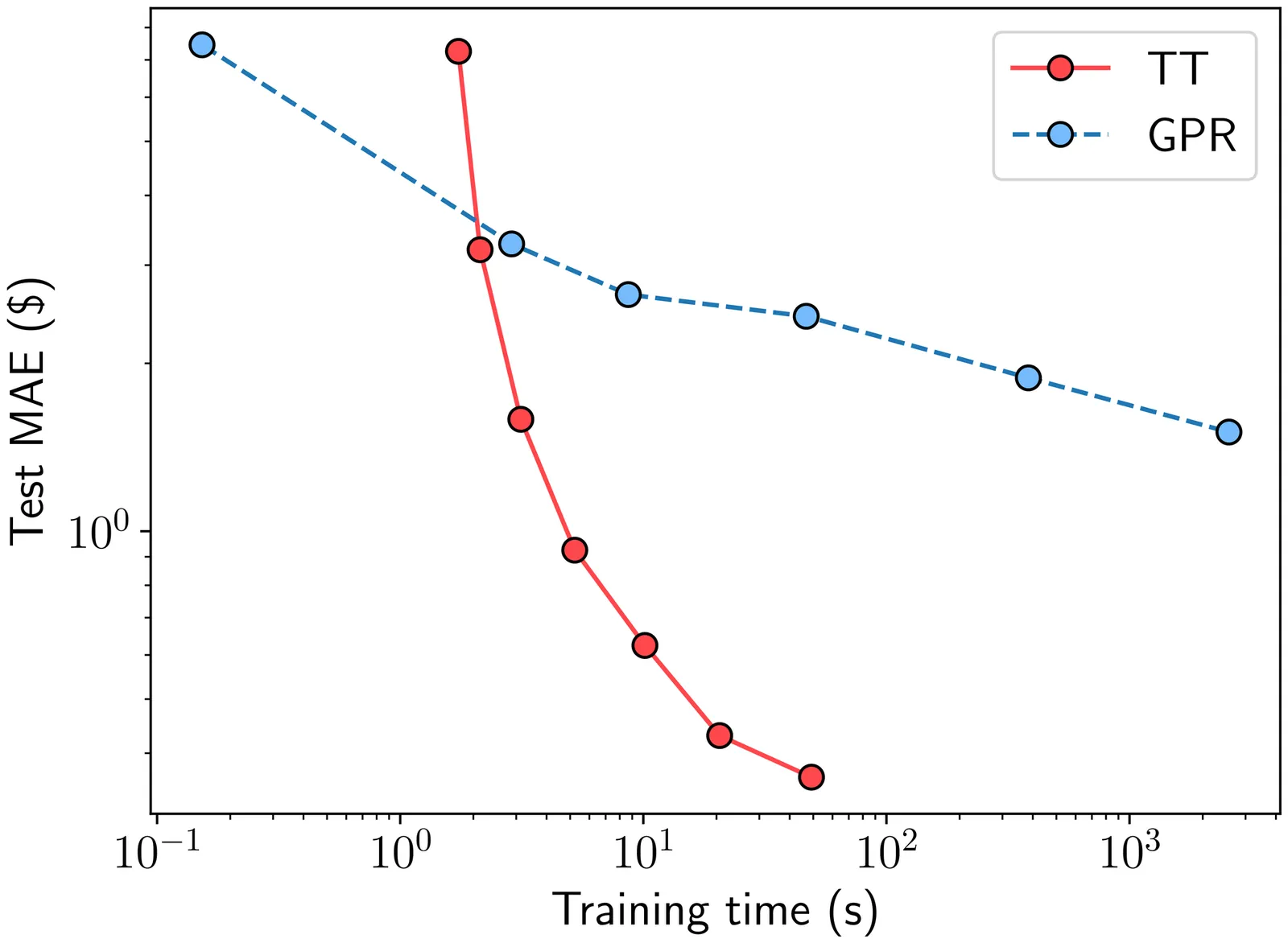
We develop a tensor-network surrogate for option pricing, targeting large-scale portfolio revaluation problems arising in market risk management (e.g., VaR and Expected Shortfall computations). The method involves representing high-dimensional price surfaces in tensor-train (TT) form using TT-cross approximation, constructing the surrogate directly from black-box price evaluations without materializing the full training tensor. For inference, we use a Laplacian kernel and derive TT representations of the kernel matrix and its closed-form inverse in the noise-free setting, enabling TT-based Gaussian process regression without dense matrix factorization or iterative linear solves. We found that hyperparameter optimization consistently favors a large kernel length-scale and show that in this regime the GPR predictor reduces to multilinear interpolation for off-grid inputs; we also derive a low-rank TT representation for this limit. We evaluate the approach on five-asset basket options over an eight dimensional parameter space (asset spot levels, strike, interest rate, and time to maturity). For European geometric basket puts, the tensor surrogate achieves lower test error at shorter training times than standard GPR by scaling to substantially larger effective training sets. For American arithmetic basket puts trained on LSMC data, the surrogate exhibits more favorable scaling with training-set size while providing millisecond-level evaluation per query, with overall runtime dominated by data generation.
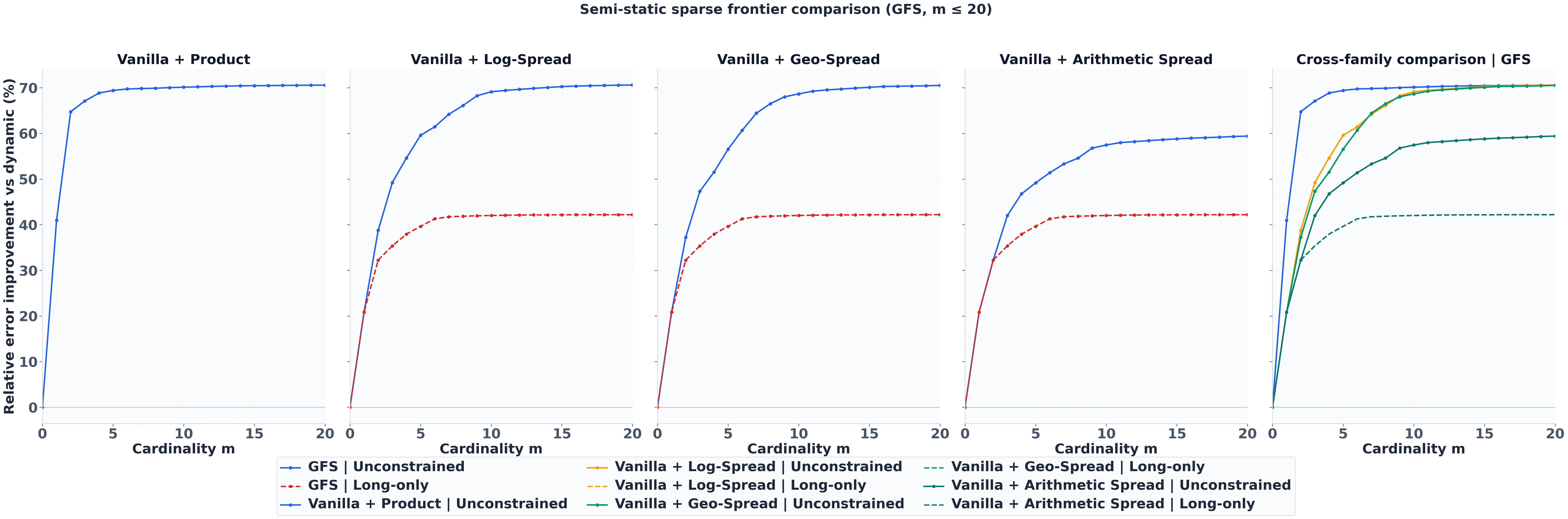
We develop a semi-static framework for the variance-optimal hedging of multi-asset derivatives exposed to correlation and covariance risk. The approach combines continuous-time dynamic trading in the underlying assets with a static portfolio of auxiliary contingent claims. Using a multivariate Galtchouk--Kunita--Watanabe decomposition, we show that the resulting global mean-variance problem decouples naturally into an inner continuous-time projection onto the space spanned by the underlying assets and an outer finite-dimensional quadratic optimization over the static hedging instruments. To systematically select suitable auxiliary claims, we leverage multidimensional functional spanning theory, establishing that otherwise unhedgeable cross-gamma exposures can be structurally mitigated through static strips of vanilla, product, and spread options. As a central application, we derive explicit semi-static replication formulas for covariance swaps and geometric dispersion trades. Our framework accommodates a broad class of asset dynamics, including quadratic and stochastic Volterra covariance models, as well as affine stochastic covariance models with jumps, yielding tractable semi-closed-form solutions via Fourier transform techniques. Extensive numerical experiments demonstrate that incorporating optimally weighted static strips of cross-asset instruments substantially reduces the mean-squared hedging error relative to purely dynamic benchmark strategies across various model classes.
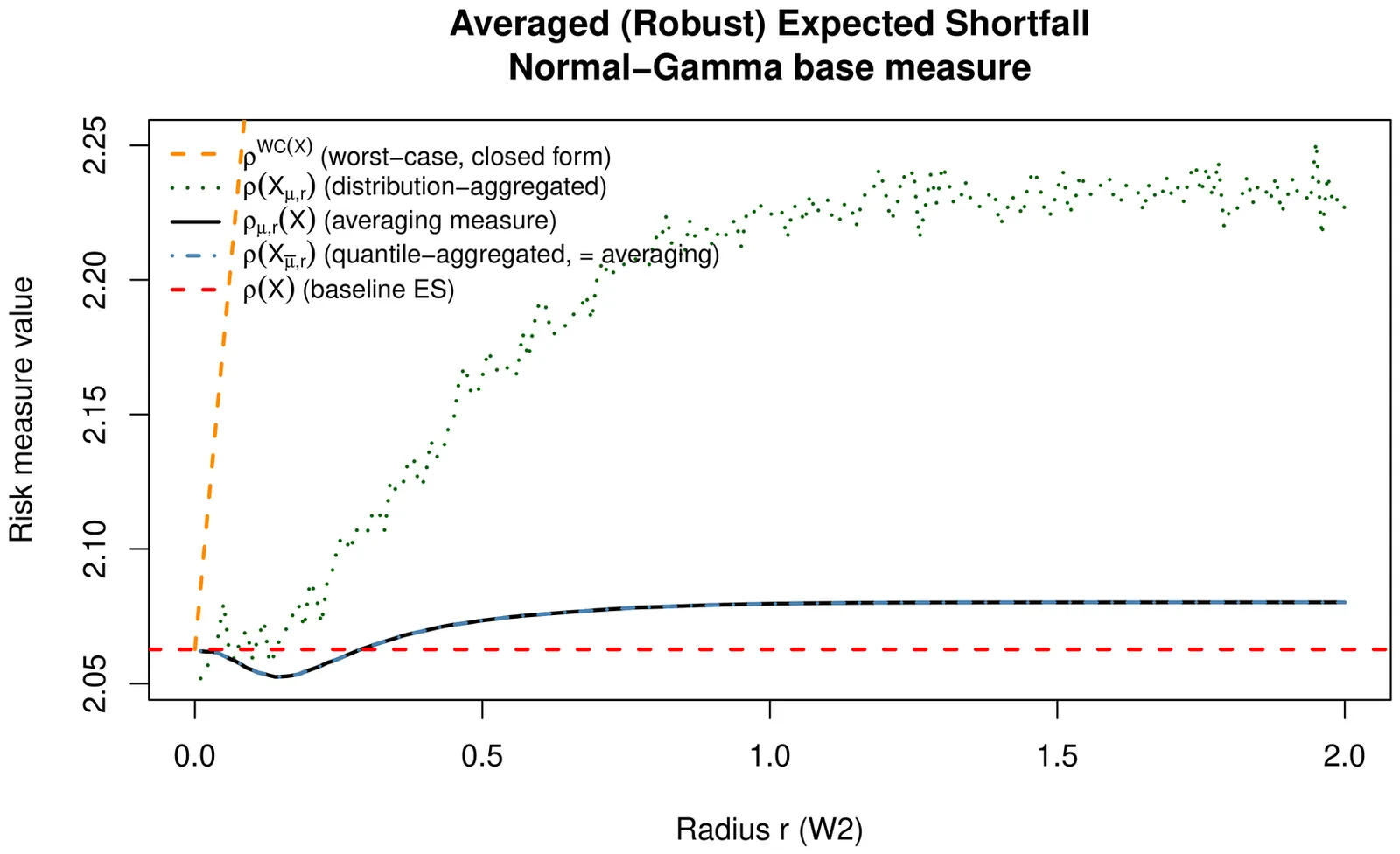
We develop an averaging approach to robust risk measurement under payoff uncertainty. Instead of taking a worst-case value over an uncertainty neighborhood, we weight nearby payoffs more heavily under a chosen metric and average the baseline risk measure. We prove continuity in the neighborhood radius and provide a stable large-radius behavior. In Banach lattices, the approach leads to a convex risk measure and under separability of the space, a dual representation through a penalty term based on an inf-convolution taken over a Gelfand integral constraint. We also relate our veraging to aggregation at the distribution and quantile levels of payoffs, obtaining dominance and coincidence results. Numerical illustrations are conducted to verify calibration and sensitivity.
2603.22058This thesis develops equilibrium asset pricing models in incomplete markets with a large number of heterogeneous agents using mean field game theory. The market equilibrium is characterized by a novel form of mean field backward stochastic differential equations (BSDEs). First, we propose a theoretical model that endogenously derives the equilibrium risk premium. Agents with exponential preferences are heterogeneous in initial wealth, risk aversion, and unspanned stochastic terminal liability. We solve the optimal investment problem using the optimal martingale principle. The equilibrium is characterized by a mean field BSDE whose driver has quadratic growth in both the stochastic integrands and their conditional expectations. We prove the existence of solutions and show that the risk premium clears the market in the large population limit. Second, we extend the model to include consumption and habit formation, relaxing the time-separability assumption of utility functions. A similar mean field BSDE is derived, and its well-posedness and asymptotic behavior are examined. We also introduce an exponential quadratic Gaussian (EQG) reformulation to obtain equilibrium solutions in semi-analytic form. Finally, the model is extended to partially observable markets where agents must infer the risk premium from stock price observations to determine trading strategies. We provide semi-analytic expressions for the equilibrium via the EQG framework, and the equilibrium risk-premium process is constructed endogenously using Kalman-Bucy filtering theory. Numerical simulations are included to visualize the resulting market dynamics.
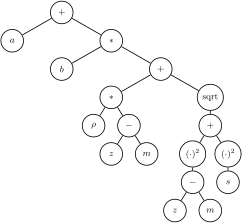
We investigate the data-driven discovery of parametric representations for implied volatility slices. Using symbolic regression, we search for simple analytic formulas that approximate the total implied variance as a function of log-moneyness and maturity. Our approach generates candidate parametrizations directly from market data without imposing a predefined functional form. We compare the resulting formulas with the widely used SVI parametrization in terms of accuracy and simplicity. Numerical experiments indicate that symbolic regression can identify compact parametrizations with competitive fitting performance.
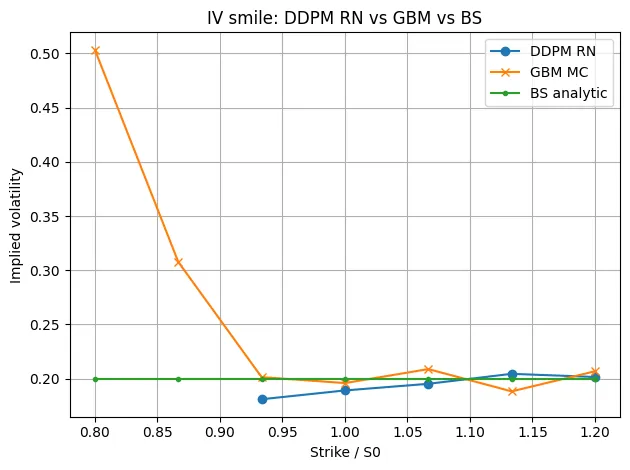
Denoising diffusion probabilistic models (DDPMs) have emerged as powerful generative models for complex distributions, yet their use in arbitrage-free derivative pricing remains largely unexplored. Financial asset prices are naturally modeled by stochastic differential equations (SDEs), whose forward and reverse density evolution closely parallels the forward noising and reverse denoising structure of diffusion models. In this paper, we develop a framework for using DDPMs to generate risk-neutral asset price dynamics for derivative valuation. Starting from log-return dynamics under the physical measure, we analyze the associated forward diffusion and derive the reverse-time SDE. We show that the change of measure from the physical to the risk-neutral measure induces an additive shift in the score function, which translates into a closed-form risk-neutral epsilon shift in the DDPM reverse dynamics. This correction enforces the risk-neutral drift while preserving the learned variance and higher-order structure, yielding an explicit bridge between diffusion-based generative modeling and classical risk-neutral SDE-based pricing. We show that the resulting discounted price paths satisfy the martingale condition under the risk-neutral measure. Empirically, the method reproduces the risk-neutral terminal distribution and accurately prices both European and path-dependent derivatives, including arithmetic Asian options, under a GBM benchmark. These results demonstrate that diffusion-based generative models provide a flexible and principled approach to simulation-based derivative pricing.
2603.16108We develop a continuous-time general equilibrium framework for economies with a heterogeneous population -- modeled as a continuum -- that repeatedly optimizes over short horizons under relative-income (Duesenberry-type) criteria. The cross-section evolves through a Brownian flow on a type space, transporting an effective impatience field that captures time variation in preferences induced by demographic changes, aging, and broader social shifts. We establish three main results. First, we prove an optimal consumption--investment theorem for infinite heterogeneous populations in this Brownian-flow setting. Second, we define a \emph{short-horizon Duesenberry equilibrium} -- a sequential-trading (Radner-type) equilibrium in which agents repeatedly solve vanishing-horizon problems under a relative-income criterion -- and provide a complete characterization and existence proof under mild regularity conditions; notably, market completeness and absence of (state-tame) arbitrage emerge endogenously from the market clearing, rather than being imposed as hypotheses. Third, we derive sharp asset-pricing implications: in equilibrium, the market price of risk is pinned down by the volatility of aggregate \emph{total wealth} (financial plus human capital), implying that the equity premium is governed by the magnitudes and correlations of wealth and equity volatilities rather than by consumption volatility alone. This shifts the equity premium puzzle from an implausibly low consumption volatility to a question about the volatility of aggregate total wealth. The framework delivers explicit decompositions of the risk-free rate that are consistent with macro-finance stylized facts. All equilibrium quantities are expressed in terms of market primitives.
2603.14760We develop at-the-money call-price and implied volatility asymptotic expansions in time to maturity for a class of asset-price models whose log returns follow a Lévy process. Under mild assumptions placing the driving Lévy process in the small-time domain of attraction of an $α$-stable law with $α\in (1,2)$, we give first-order at-the-money call-price and implied volatility asymptotics. A key observation is that both the stable domain of attraction and the finiteness of the centering constant $\barμ$ are preserved under the share measure transformation, so that all of the distributional input needed for the call-price expansion can be read off from the regular variation of the Lévy measure near the origin. When the Lévy process has no Brownian component, new rates of convergence of the form $t^{1/α} \ell(t)$ where $\ell$ is a slowly varying function are obtained. We provide an example of an exponential Lévy model exhibiting this behavior, with $\ell$ not asymptotically constant, yielding a convergence rate of $(t / \log(1/t))^{1/α}$. In the case of a Lévyprocess with Brownian component, we show that the jump contribution is always lower order, so that the leading $\sqrt{t}$ behavior of the at-the-money call price is universal and driven entirely by the Gaussian part of the characteristic triplet.
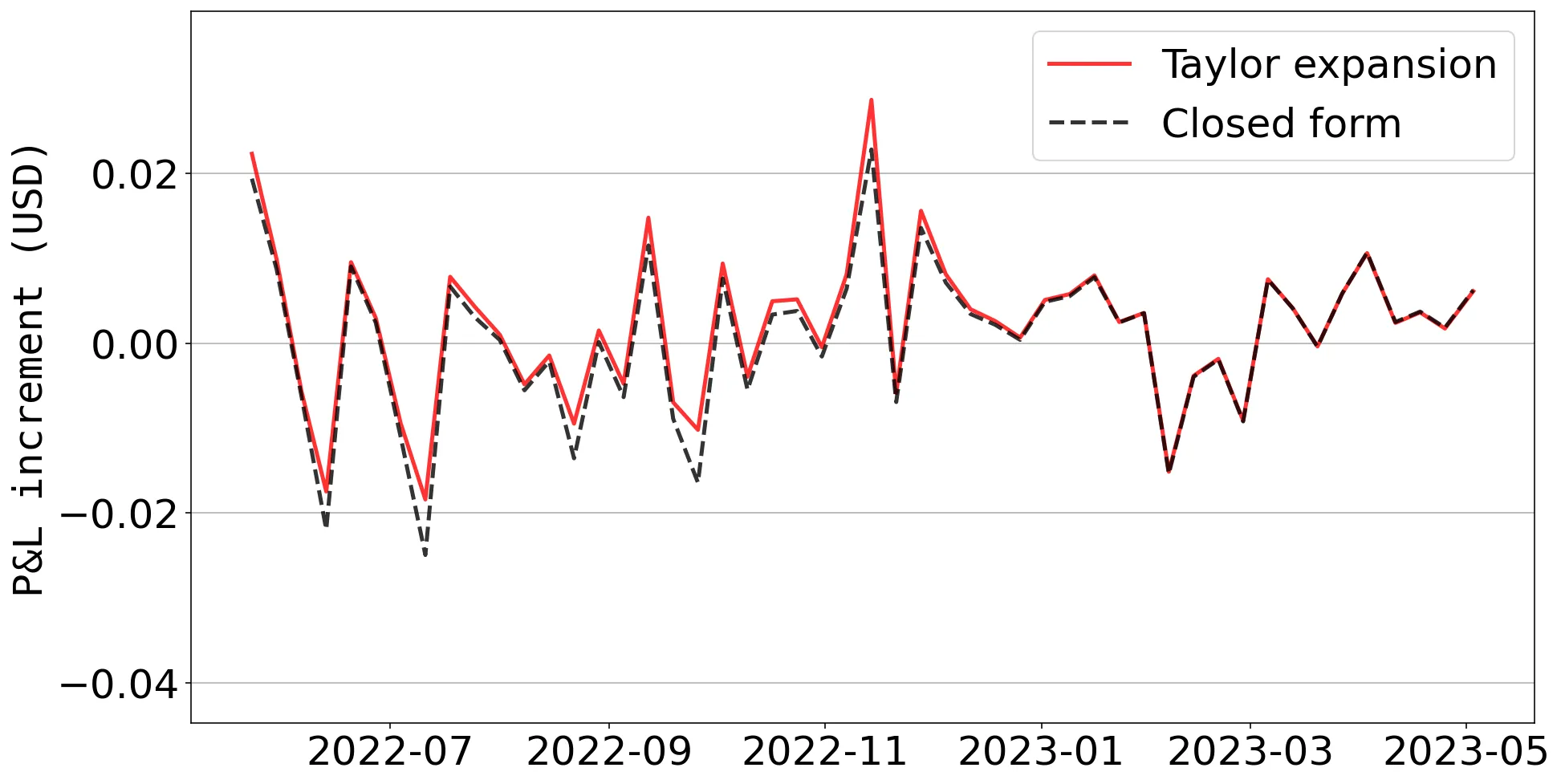
Short-horizon option book management relies on P&L expansions in a small set of risk factors. In practice, the quadratic term and common desk adjustments (smile corrections, execution cost add-ons) depend on the chosen factor coordinates, so predicted second-order P&L can change when moving between spot, forward, and log-forward parameterizations. We propose a local, model-agnostic framework that makes the quadratic term coordinate invariant. The usual Hessian is replaced by a covariant Hessian defined by an affine connection, yielding an invariant quadratic predictor. The connection is calibrated to match a desk target for quadratic P&L (Vanna-Volga for smile effects or, in principle, a local fit to realized P&L) while leaving first-order hedge Greeks unchanged. Execution frictions enter through a quadratic cost model for hedge trades. Combined with hedge ratios, this induces an equivalent quadratic penalty on factor moves, makes portfolio netting of costs explicit, and provides local liquidity-aware second-order sensitivities and rebalancing directions. Calibration reduces to small linear systems with clear identifiability conditions. Two FX barrier case studies (EURUSD, USDTRY) illustrate the workflow, and we briefly sketch extensions to other quadratic penalties (risk normalization, scenario/gap terms, and xVA/capital add-ons).
2603.14024Whenever dealing with horizons of different times scales, risk evaluation of losses may incur in both interest rate uncertainty and horizon risk as introduced in [11]. With the goal to capture both effects, we work with cash subadditive fully-dynamic risk measures. In this work we consider such measures obtained via the BSDE and the shortfall approaches. We stress that we consider BSDEs both with Lipschitz and quadratic drivers. We then introduce the hq-entropic risk measure on losses as an effective example of fully-dynamic risk measure serving the scope. Shortfall risk measures are extended to capture cash non-additivity. For our newly introduced h-generalized shortfall risk measures we provide a dual representation and we connect them to fully-dynamic certainty equivalent. To conclude, we can see that the hq-entropic risk measures on losses belong to the family h-generalized shortfall, but they are not of certainty equivalent type. We note that the classical entropic risk measure, besides being generated by a BSDE, is also both a shortfall and a certainty equivalent.
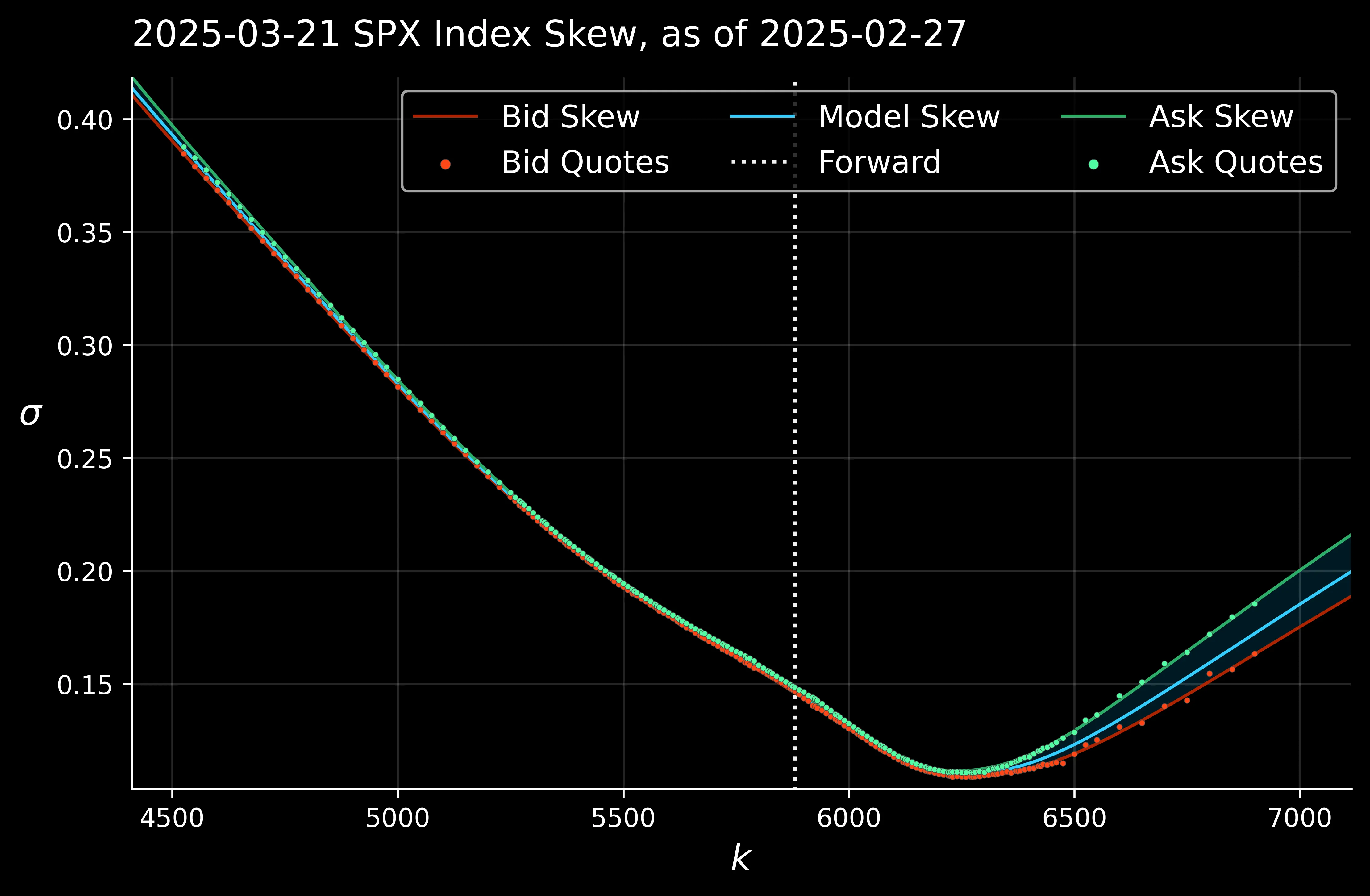
Martingale Optimal Transport (MOT) provides a framework for robust pricing and hedging of illiquid derivatives. Classical MOT enforces exact calibration of model marginals to the mid-prices of vanilla options. Motivated by the industry practice of fitting bid and ask marginals to vanilla prices, we introduce a relaxation of MOT in which model-implied volatilities are only required to lie within observed bid--ask spreads; equivalently, model marginals lie between the bid and ask marginals in convex order. The resulting Bid--Ask MOT (BAMOT) yields realistic price bounds for illiquid derivatives and, via strong duality, can be interpreted as the superhedging price when short and long positions in vanilla options are priced at the bid and ask, respectively. We further establish convergence of BAMOT to classical MOT as bid--ask spreads vanish, and quantify the convergence rate using a novel distance intrinsically linked to bid--ask spreads. Finally, we support our findings with several synthetic and real-data examples.