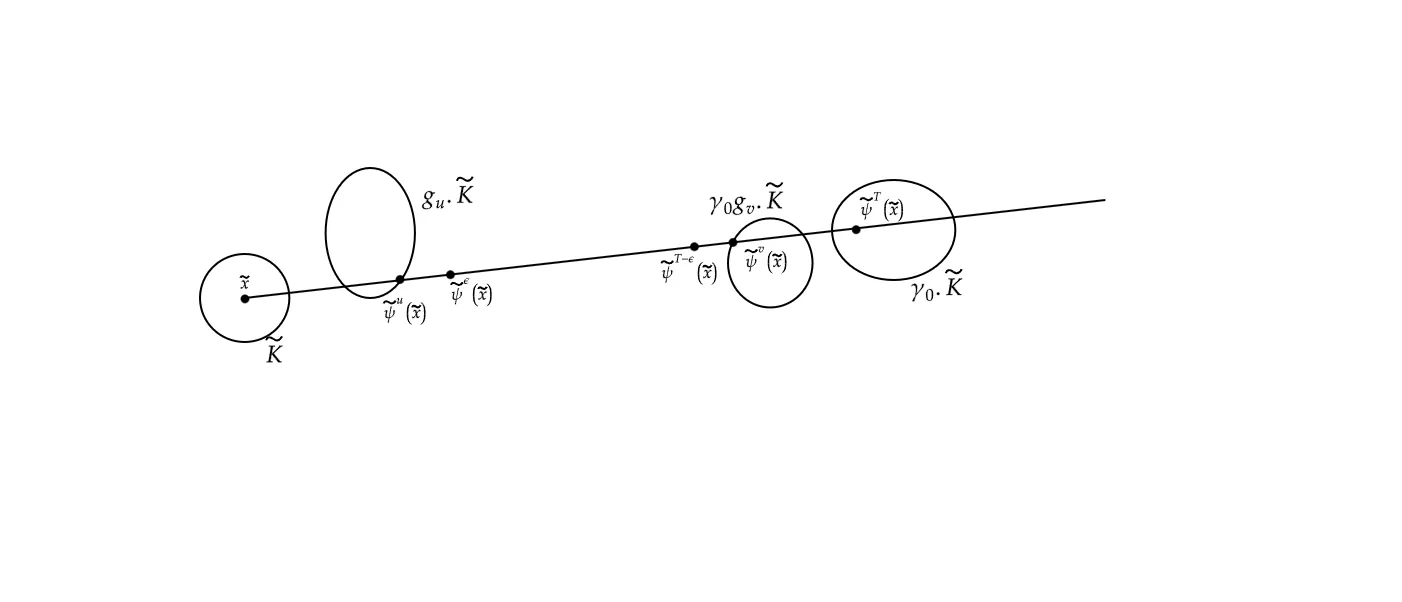
2604.04881Motivated by the study of unlikely intersection in the moduli space of rational maps, we initiate our investigation on algebraic dynamics for families of regular polynomial skew products in this article. Our goals are threefold. (1) We classify special loci -- which contain a Zariski dense set of postcritically finite points -- in the moduli space of quadratic regular polynomial skew products. More precisely, special loci include families of homogeneous polynomial endomorphisms, families of split endomorphisms, and polynomial endomorphisms of the form $(x^2,y^2+bx)$ up to conjugacy. As a consequence, we verify a special case of a conjecture proposed by Zhong. (2) Let $F_t$ be a family of regular polynomial skew products defined over a number field $K$ and let $P_t, Q_t\in K[t]\times K[t]$ be two initial marked points. We introduce a good height $h_{P_t}(t)$ which is built from the theory of adelic line bundles for quasi projective varieties. We show that the set of parameters $t_0\in \overline{K}$ for which $P_{t_0}$ and $Q_{t_0}$ are simultaneously $F_{t_0}$-preperiodic is infinite if and only if $h_{P_t}=h_{Q_t}$. (3) As an application of $h_{P_t}$, we show that, under some degree conditions of $P_t$, if there is an infinite set of parameters $t_0$ for which the marked point $P_{t_0}$ is preperiodic under $F_{t_0}$, then the Zariski closure of the forward orbit of $P_t$ lives in a proper subvariety of $\mathbb{P}^2$. As a by-product, we conditionally verify a special case of a conjecture of DeMarco--Mavraki which is a relative version of the Dynamical Manin--Mumford Conjecture.
2604.04711The Koopman operator framework enables global analysis of nonlinear systems through its inherent linearity. This study aims to clarify spectral properties of the Koopman operators for nonlinear systems with control inputs. To this end, we treat the inputs as parameters throughout this paper. We then introduce the Koopman operator for a parameterized dynamical system with a globally exponentially stable equilibrium point and analyze how eigenfunctions of the operator depend on the parameter. As a main result, we obtain a global linearization, which enables one to transform the nonlinear system into a finite-dimensional linear system, and we show that it depends continuously on the parameter. Subsequently, for a control-affine system, we investigate a condition under which the transformation providing a global bilinearization does not depend on the parameter. This provides the condition under which the global bilinearization for the control-affine system is independent of the parameter.
2604.04665In this paper, we investigate the sharp regularity properties of a special weighted Sobolev space defined on the $ n $-dimensional torus, which is of independent interest. As a key application, we show that for almost all $ n $-dimensional vector fields, the Kolmogorov-Arnold-Moser (KAM) theory holds via this regularity, and in this case, the perturbation must have classical derivatives up to order $ \left[ {n/2} \right] $, yet it can admit unbounded weak derivatives from order $ \left[ {n/2} \right]+1 $ to $ n$. This result may appear surprising within the classical framework of KAM theory. We also provide further discussion of historical KAM theorems and relevant counterexamples. These findings constitute a new step in the long-standing KAM regularity conjecture.
2604.04610We investigate the degeneracy of the central configuration formed by a regular $ n $-gon of equal masses together with an additional mass at the center. While degeneracy of such configurations has traditionally been studied through direct spectral computations, a structural understanding of the origin and multiplicity of degeneracy values has remained unclear. Exploiting the dihedral symmetry $ D_n $, we develop a representation-theoretic framework that decomposes the Hessian of $ \sqrt{IU} $ into invariant blocks associated with irreducible symmetry modes. This reduces the degeneracy problem to a finite collection of low-dimensional determinants, including a distinguished $3 \times 3$ block arising from the coupling between the central mass and the first Fourier mode. Within this framework, we show that degeneracy is completely governed by symmetry modes: for each admissible Fourier mode $ l \geq 2 $, there exists at most one critical value of the central mass parameter at which degeneracy occurs, while the mode $ l = 1 $ exhibits a qualitatively different behavior. As a consequence, the number of degeneracy values increases with $ n $, reflecting the growing number of independent symmetry modes. Our results provide a conceptual explanation for the multiplicity of degeneracy values and reveal that degeneracy is not an isolated phenomenon, but a structural consequence of the underlying group symmetry. The approach also suggests a general strategy for analyzing degeneracy in symmetric central configurations.
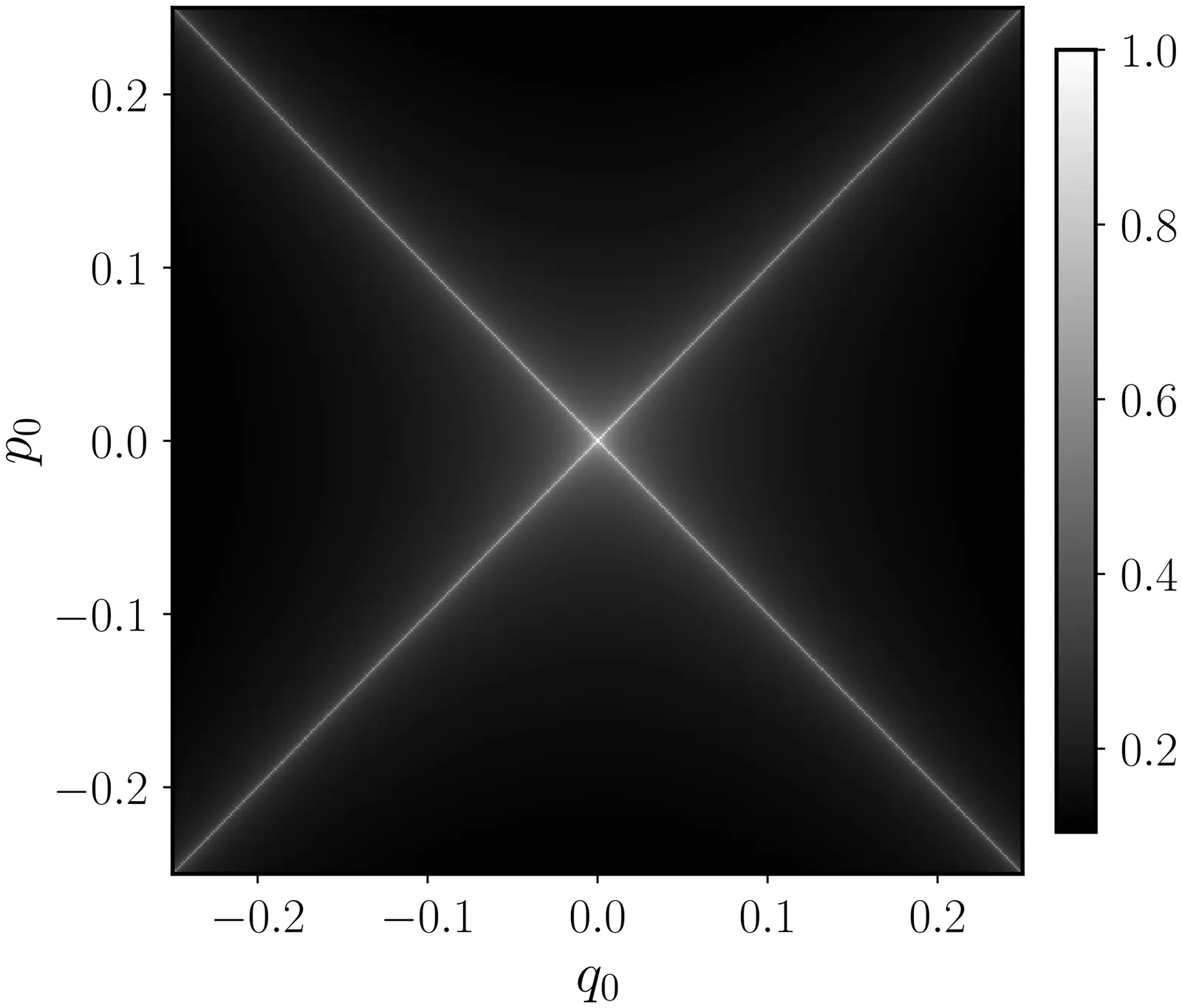
We formulate Lagrangian descriptors (LDs) in the path integral framework. Averaging the classical LD over fluctuations about extremal trajectories defines a quantum LD that incorporates quantum effects. Invariant manifolds, which sharply organize classical transport, become finite-width phase space structures under quantum fluctuations, and their overlap provides a geometric mechanism consistent with tunneling as fluctuation-induced delocalization of transport barriers. We demonstrate this approach for the Hamiltonian saddle, where path integral sampling reveals manifold broadening and barrier penetration. This establishes a geometric framework for studying phase space transport and tunneling beyond the classical regime, while also providing a natural route toward the application of LDs to field theory.
In this paper, we develop a notion of \emph{strongly positive reccurent} (SPR) property for a convergence group with a continuous Gromov-Patterson-Sullivan (GPS) system defined by Blayac-Canary-Zhang-Zimmer. We prove that these SPR groups admits a finite Bowen-Margulis-Sullivan (BMS) measure on some associated flow spaces, which means that dynamically they admit a cocompact action on the flow spaces. This notion of SPR groups gives rise to many new examples of subgroups in higher rank Lie group that admit finite BMS measure beyond relatively Anosov groups.
2604.03528We prove stochastic stability of absolutely continuous invariant measures (ACIMs) for piecewise expanding $C^{1+\varepsilon}$ maps of the interval. For maps $τ$ in the class $\mathcal{T}([0,1]; s, \varepsilon)$, we consider perturbed Frobenius--Perron operators $P_δ= Q_δP_τ$, where $Q_δ$ is a Markov smoothing operator modeling noise of intensity $δ> 0$. In the generalized bounded variation space $BV_{1,1/p}$, we establish a Lasota--Yorke inequality uniform in $δ$. Consequently, each $P_δ$ admits an invariant density $h_δ\in BV_{1,1/p}$, and $h_δ\to h$ in $L^1$ as $δ\to 0$, where $h$ is the ACIM density of $P_τ$. Our proof combines the $BV_{1,1/p}$ framework, adapted from recent ACIM existence results, with uniform quasi-compactness and perturbation theory for transfer operators. This establishes stochastic stability under minimal $C^{1+\varepsilon}$ regularity ($\varepsilon > 0$), where the $C^1$ case is known to fail.
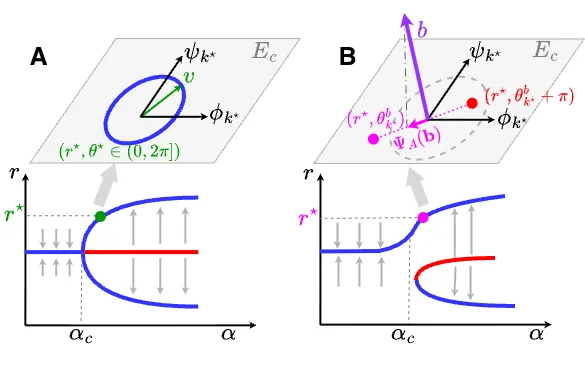
We develop a mechanistic dynamical-systems formulation of best response in finite-action games with relational structure on the action set. The proposed neuromorphic decision dynamics realize bestresponse as the stable outcome of an internal state-space process, rather than as an externally imposed choice rule. This provides a deterministic account of commitment formation, symmetry resolution through basins of attraction, and hysteresis and decision persistence under perturbations. For action spaces with circulant coupling, we prove using Lyapunov-Schmidt reduction that the action-coupling operator determines which components of evidence govern decision formation. We further show that the dynamics implicitly compute a geometry-aware utility, converge exponentially to the corresponding best response with rate independent of the number of actions, and switch only when evidence is sufficiently strong. In contrast, supplying the same geometry-aware utility directly to logit dynamics does not recover these properties, showing that relational structure must be embedded in the decision mechanism itself. We illustrate the framework in a repeated coverage game, prove that the induced game is an exact potential game, and show that its Nash equilibria are reached by the neuromorphic dynamics.
2604.03100In the paper we study expansiveness along distinguished subsets in the case of a continuous action of the discrete Heisenberg group on a compact metric space $(\mathbb X,ρ)$. Transferring the ideas proposed by Boyle and Lind for continuous actions of $\mathbb{Z}^D$, we embed the acting group in the (continuous) $(2D+1)$-dimensional Heisenberg group $\mathcal H$ and define expansive subsets of $\mathcal H$. We focus on the expansiveness of vertical subgroups of the Heisenberg group. In particular, we show that, if only the space $\mathbb X$ is infinite, the center of $\mathcal H$ cannot be expansive, and that there always exists at least one nonexpansive $2D$-dimensional vertical subgroup.
2604.02810In this paper we prove that every homeomorphism of a compact metric space admitting an invariant probability measure with full support can be approximated in the $C^0$-Gromov--Hausdorff topology by homeomorphisms with zero topological entropy. The argument relies on the ergodic decomposition theorem and on the existence of points with dense positive orbit in the supports of suitable ergodic components. As a consequence, topological entropy is not stable under $C^0$-Gromov--Hausdorff perturbations within this class. We also show that if, in addition, the homeomorphism is topologically $GH$-stable, then its periodic points are dense in the ambient space. Finally, by combining this framework with a previous result on transitive and topologically $GH$-stable homeomorphisms, we deduce that every dynamics in this class admits an invariant measure with full support and therefore falls within the scope of the general approximation theorem by zero-entropy systems.
2604.02750We study linear response for families of intermittent maps whose SRB measure undergoes a transition from finite to infinite total mass at a critical parameter value. Our results reveal the following fundamental asymmetry arising from this transition. Smooth parameter dependence of the SRB measure implies continuity of the physical measure at the transition point, while simultaneously precluding its differentiability there. In particular, although the physical measure varies continuously with respect to the parameter at the transition, it fails to admit a linear response for a large class of potentials in the usual sense. We derive an explicit one-sided derivative formula describing this singular behavior and thereby give a quantitative characterization of how statistical properties degenerate as the total mass of the SRB measure diverges. The key ingredient in the proof of our main theorem is a new method that relates the parameter dependence of physical measures near the transition point to the behavior of the Riemann zeta function near its pole at 1.
2604.02649We provide a corrected proof of a theorem of A. Bellis on strong stable sets in the unit tangent bundle of certain hyperbolic surfaces. The theorem states that, for vectors whose geodesic rays encounter arbitrarily short closed geodesics, the strong stable set in the dynamical sense does not coincide with the associated horocyclic orbit. The proof is based on Bellis' idea of constructing geodesic rays that wind around infinitely many closed geodesics.
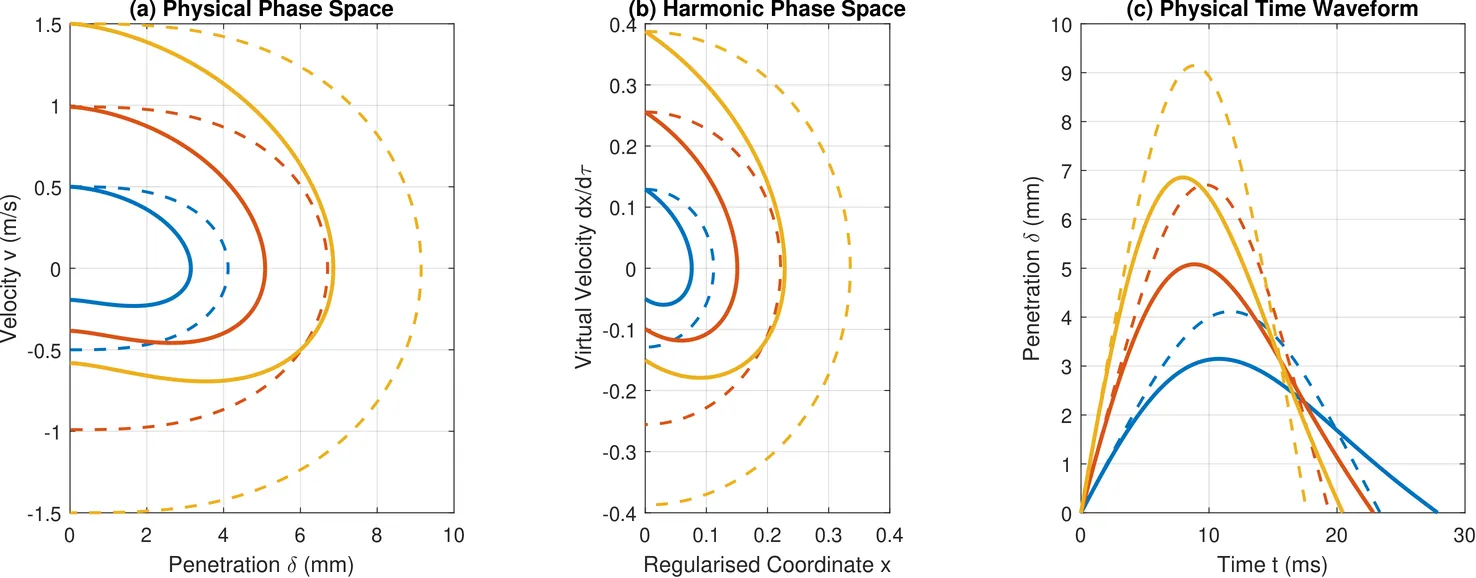
Nonlinear contact dynamics are widely regarded as intrinsically nonlinear systems whose behaviour depends strongly on geometry and impact conditions. Here we show that any one-dimensional conservative contact system satisfying monotone energy-consistent conditions admits two complementary structures: (i) a canonical action-angle representation in physical time, and (ii) an exact harmonic oscillator representation under an energy-based coordinate transformation combined with time reparametrisation. This reveals a hidden linear structure underlying nonlinear contact interactions. Building on this result, we derive a unique universal damping law that preserves linear dissipative dynamics in the transformed harmonic space, and establish a rigorous, closed-form lower bound for the critical timestep in numerical simulations. The framework generalises classical power-law contact models and provides a unified basis for restitution control across arbitrary geometries, recovering known exact solutions as explicit monomial special cases.
2604.02510We present a broadly applicable structurally flat triangular form for x-flat control-affine systems with three inputs. Building on recent results for the derivative structure of flat outputs, we define the triangular form together with regularity conditions that guarantee structural flatness, and derive necessary and sufficient conditions for a system with a given x-flat output to be static feedback equivalent to this form. Further, we present sufficient conditions under which general x-flat three-input systems can be rendered static feedback equivalent to the proposed triangular form after a finite number of input prolongations.
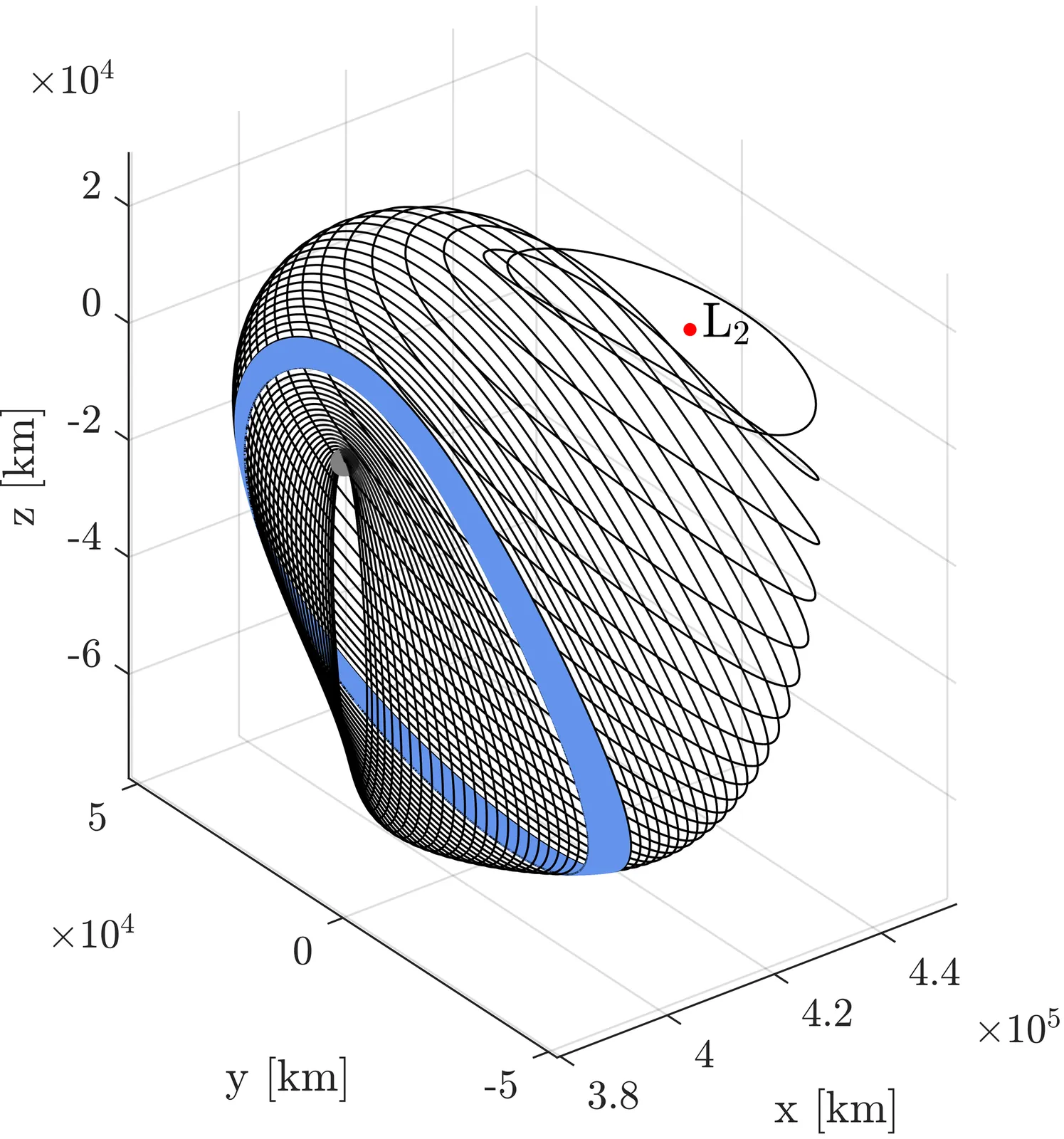
Near-rectilinear halo orbits (NRHOs) around Earth-Moon L2 in the Circular Restricted 3-Body Problem (CR3BP) exhibit a complex dynamical landscape, featuring a band of normally elliptic orbits embedded within regions of strong instability. This coexistence of stable and unstable dynamics, amplified by the numerical sensitivity associated with close lunar passages, makes the long-term behavior of trajectories near NRHOs a delicate and intrinsically nonlinear problem. Understanding the effective stability of these elliptic orbits is therefore a critical challenge, lying at the intersection of local normal form theory and global instability mechanisms. To quantify finite-time confinement, we formulate a rigorous framework for effective stability using discrete Poincaré maps. By employing jet transport to compute high-order Taylor expansions, we construct explicit polynomial normal forms. We derive discrete Nekhoroshev-type estimates by identifying the normalization order, which balances the asymptotic convergence of the map's analyticity domain against the cumulative penalty of low-order small divisors. Applying this framework to the Earth-Moon system, we map the resulting geometric limits directly into physical spatial coordinates. Crucially, we demonstrate that for practical mission lifetimes (e.g., 10-50 years), the required stability is vastly shorter than the characteristic Nekhoroshev accumulation time. Consequently, the effective stability region is not constrained by the time-dependent exponential drift, but is instead governed entirely by the maximum analytical domain of the optimized normal form. These derived spatial envelopes establish explicit geometric boundaries for the intrinsic local stability of elliptic NRHOs, providing a rigorous mathematical characterization of their nonlinear confinement within the CR3BP.
2604.02213This article is concerned with Kronecker flows on the infinite torus. The work is partly motivated by the fact that many Hamiltonian PDEs and systems on infinite lattices admit invariant tori, of possibly infinite dimension, on which the dynamics is linearizable. Finite-dimensional Kronecker flows are well understood: the dynamics can be reduced to a non-resonant flow on a subtorus, which is equivalent to being topologically transitive, to minimality, and to unique ergodicity in the projection. We prove that these properties still hold when the dimension of the torus is infinite if and only if the integer (finite) linear combinations of the frequencies form a free abelian group. Next, we construct a class of orbits whose closure is locally homeomorphic to the product of a ball and a Cantor set, extending a recent result by Sakbaev and Volovich. We also show that the Benjamin-Ono equation admits this type of solutions. Finally, we prove the equivalence between a classification problem for Kronecker flows and that for countable abelian groups without torsion.
2604.02089It is an immediate consequence of the ergodic structure theorem of Host and Kra that every factor of an ergodic $k$-step pro-nilsystem is again an ergodic $k$-step pro-nilsystem. It has remained open whether this fact can be proved independently of the structure theorem itself. In this note, we give such a proof, avoiding the machinery behind that theorem entirely. The key new ingredient is a local rigidity theorem for nilsystems: any ergodic self-joining sufficiently close to the diagonal joining is necessarily the graph joining of an automorphism. This rigidity result may be of independent interest. Together with a complementary result of Tao, our proof of the factor-closure of pro-nilsystems yields a new proof of the ergodic inverse theorem of Host and Kra from the combinatorial inverse theorem of Green, Tao, and Ziegler for the Gowers norms on cyclic groups.
We study the local synchronization of phases and frequencies for the Kuramoto model driven by rough noise. In particular, we prove exponential convergence towards synchronization and we give the explicit rate of convergence and quantify the size of the random basin of attraction. Furthermore, we show that the long time behavior of the system is determined by the evolution of phases' mean. Our result relies on the use of a Lyapunov function, capable of overriding the particular structure of the noise, taking in account only its intensity. Finally, we illustrate our analytical results and possible extensions with the help of numerical simulations.
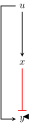
We study the monotonicity of the cumulative dose response (cDR) for a class of incoherent feedforward motifs (IFFM) systems with linear intermediate dynamics and nonlinear output dynamics. While the instantaneous dose response (DR) may be nonmonotone with respect to the input, the cDR can still be monotone. To analyze this phenomenon, we derive an integral representation of the sensitivity of cDR with respect to the input and establish general sufficient conditions for both monotonicity and non-monotonicity. These results reduce the problem to verifying qualitative sign properties along system trajectories. We apply this framework to four canonical IFFM systems and obtain a complete characterization of their behavior. In particular, IFFM1 and IFFM3 exhibit monotone cDR despite potentially non-monotone DR, while IFFM2 is monotone already at the level of DR, which implies monotonicity of cDR. In contrast, IFFM4 violates these conditions, leading to a loss of monotonicity. Numerical simulations indicate that these properties persist beyond the structured initial conditions used in the analysis. Overall, our results provide a unified framework for understanding how network structure governs monotonicity in cumulative input-output responses.
Linear finite dynamical systems play an important role, for example, in coding theory and simulations. Methods for analyzing such systems are often restricted to cases in which the system is defined over a field %and usually strive to achieve a complete description of the system and its dynamics. or lack practicability to effectively analyze the system's dynamical behavior. However, when analyzing and prototyping finite dynamical systems, it is often desirable to quickly obtain basic information such as the length of cycles and transients that appear in its dynamics, which is reflected in the structure of the connected components of the corresponding functional graphs. In this paper, we extend the analysis of the dynamics of linear finite dynamical systems that act over cyclic modules to Galois rings. Furthermore, we propose algorithms for computing the length of the cycles and the height of the trees that make up their functional graphs.