Mathematical Physics
Rigorous mathematical treatment of physical theories
We consider random integer partitions~$λ$ that follow the Poissonized Plancherel measure of parameter~$t^2$. Using Riemann--Hilbert techniques, we establish the asymptotics of the multiplicative averages \[ Q(t,s)=\mathbb{E} \left[ \prod_{i\geq 1} \left(1+\e^{η(λ_i-i+\frac{1}{2}-s)}\right)^{-1} \right] \] for fixed $η>0$ in the regime $t\to+\infty$ and $s/t=O(1)$. We compute the large-$t$ expansion of $\log Q(t,xt)$ expressing the rate function $\mathcal{F}(x) = -\lim_{t \to \infty}t^{-2}\log Q(t,xt)$ and the subsequent divergent and oscillatory contributions explicitly in terms of elliptic theta functions. The associated equilibrium measure presents, in general, nontrivial saturated regions and it undergoes two third-order phase transitions of different nature which we describe. Applications of our results include an explicit characterization of tail probabilities of the height function of the $q$-deformed polynuclear growth model and of the edge of the positive-temperature discrete Bessel process and asymptotics of radially symmetric solutions to the 2D~Toda equation with step-like shock initial data.
We present a high-order accurate fully discrete numerical scheme for solving Initial Boundary Value Problems (IBVPs) within the Continuous Galerkin (CG)-based Finite Element framework. Both the spatial and time approximation in Summation-By-Parts (SBP) form are considered here. The initial and boundary conditions are imposed weakly using the Simultaneous Approximation Term (SAT) technique. The resulting SBP-SAT formulation yields an energy estimate in terms of the initial and external boundary data, leading to an energy-stable discretization in both space and time. The proposed method is evaluated numerically using the Method of Manufactured Solutions (MMS). The scheme achieves super-convergence in both spatial and temporal direction with accuracy $\mathcal{O}(p+2)$ for $p\geq 2$, where $p$ refers to the degree of the Lagrange basis. In an application case, we show that the fully discrete formulation efficiently captures space-time variations even on coarse meshes, demonstrating the method's computational effectiveness.
In the Material Point Method (MPM), accurately imposing Neumann-type thermal boundary conditions, particularly convective heat flux boundaries, remains a significant challenge due to the inherent nonconformity between complex evolving material boundaries and the fixed background grid. This paper introduces a novel Virtual Heat Flux Method (VHFM) to overcome this limitation. The core idea is to construct a virtual flux field on an auxiliary domain surrounding the physical boundary, which exactly satisfies the prescribed boundary condition. This transforms the surface integral in the weak form into an equivalent, and easily computed, volumetric integral. Consequently, VHFM eliminates the need for explicit boundary tracking, specialized boundary particles, or complex surface reconstruction. A unified formulation is presented, demonstrating the method's straightforward extension to general scalar, vector, and tensor Neumann conditions. The accuracy, robustness, and convergence of VHFM are rigorously validated through a series of numerical benchmarks, including 1D transient analysis, 2D and 3D curved boundaries, and problems with large rotations and complex moving geometries. The results show that VHFM achieves accuracy comparable to conforming node-based imposition and significantly outperforms conventional particle-based approaches. Its simplicity, computational efficiency, and robustness make it an attractive solution for integrating accurate thermal boundary conditions into thermo-mechanical and other multiphysics MPM frameworks.
This paper develops a bridge between bi-Hamiltonian structures of Poisson-Lie type, contact Hamiltonian dynamics, and the Gorini-Kossakowski-Sudarshan-Lindblad (GKSL) formalism for quantum open systems. On the classical side, we consider bi-Hamiltonian systems defined by a Poisson pencil with non-trivial invariants. Using an exact symplectic realization, these invariants are lifted and projected onto a contact manifold, yielding a completely integrable contact Hamiltonian system in terms of dissipated quantities and a Jacobi-commutative algebra of observables. On the quantum side, we introduce a class of contact-compatible Lindblad generators: GKSL evolutions whose dissipative part preserves a commutative $C^\ast$-subalgebra generated by the quantizations of the classical dissipated quantities, and whose Hamiltonian part admits an Egorov-type semiclassical limit to the contact dynamics. This construction provides a mathematical mechanism compatible with the semiclassical limit for pure dephasing, compatible with integrability and contact dissipation. An explicit Euler-top-type Poisson-Lie pencil, inspired by deformed Euler top models, is developed as a fully worked-out example illustrating the resulting bi-Lindblad structure and its semiclassical behavior.
2601.02755We obtain infinitely many boundary operators in the Brownian loop soup in the subcritical phase by analyzing the conformal block expansion of the two-point function that computes the probability of having two marked points on the upper half-plane being separated by Brownian loops. The resulting boundary operators are primary operators in a 2D CFT with central charge $c\leq1$ and have conformal dimensions that are non-negative integers. By comparing the above-mentioned conformal block expansion with probabilities in the Brownian loop soup, we provide a physical interpretation of the boundary operators of even dimensions as operators that insert multiple outer boundaries of Brownian loops at points on the real axis.
We consider here several aspects of the following challenging question: is it possible to use a passive cloak to make invisible a dielectric inclusion on a finite frequency interval in the quasistatic regime of Maxwell's equations for an observer close to the object? In this work, by considering the Dirichlet-to-Neumann (DtN) map, we not only answer negatively this question, but we go further and provide some quantitative bounds on this map that provide fundamental limits to both cloaking as well as approximate cloaking. These bounds involve the following physical parameters: the length and center of the frequency interval, the volume of the cloaking device, the volume of the obstacle, and the relative permittivity of the object. Our approach is based on two key tools: i) variational principles from the abstract theory of composites and ii) the analytic approach to deriving bounds from sum rules for passive systems. To use i), we prove a new representation theorem for the DtN map which allows us to interpret this map as an effective operator in the abstract theory of composites. One important consequence of this representation is that it allows one to incorporate the broad and deep results from the theory of composites, such as variational principles, and to apply the bounds derived from them to the DtN map. These results could be useful in other contexts other than cloaking. Next, to use ii), we show that the passivity assumption allows us to connect the DtN map (as function of the frequency) with two important classes of analytic functions, namely, Herglotz and Stieltjes functions. The sum rules for these functions, combined with the variational approach, allows us to derive new inequalities on the DtN map which impose fundamental limitations on passive cloaking, both exact and approximate, over a frequency interval. We consider both cases of lossy and lossless cloaks.
2601.01612For simple Lie algebras we construct characteristic identities for split (polarized) Casimir operators in representations $T \otimes Y_n$ and $T \otimes Y_n'$, where $T$ -- defining (minimal fundamental for exceptional Lie algebras) representation, $Y_n$ -- n-Cartan powers of the adjoint representations $ad = Y_1$ and Y_n' -- special representations appeared in the Clebsch-Gordan decomposition of symmetric part of $ad^{\otimes n}$. By means of these characteristic identities, we derive (for all simple Lie algebras, except $\mathfrak{e}_8$) explicit formulae for invariant projectors onto irreducible subrepresentations arose in the decomposition of $T \otimes Y_n$. These projectors and characteristic identities are written in the universal form for all simple Lie algebras (except $\mathfrak{e}_8$) in terms of Vogel parameters. Universal formulas for the dimensions of the Casimir subrepresentations appeared in the decompositions of $T \otimes Y_n$ where found.
2601.01102We discuss the low energy resolvent estimates for the Schrödinger operator with slowly decaying attractive potential. The main results are Rellich's theorem, the limiting absorption principle and Sommerfeld's uniqueness theorem. For the proofs we employ an elementary commutator method due to Ito--Skibsted, for which neither of microlocal or functional-analytic techniques is required.
2601.00750We rigorously establish a formula for the correlation energy of a two-dimensional Fermi gas in the mean-field regime for potentials whose Fourier transform $\hat{V}$ satisfies $\hat{V}(\cdot) | \cdot | \in \ell^1$. Further, we establish the analogous upper bound for $\hat{V}(\cdot)^2 | \cdot |^{1 + \varepsilon} \in \ell^1$, which includes the Coulomb potential $\hat{V}(k) \sim |k|^{-2}$. The proof is based on an approximate bosonization using slowly growing patches around the Fermi surface. In contrast to recent proofs in the three-dimensional case, we need a refined analysis of low-energy excitations, as they are less numerous, but carry larger contributions.
2601.00713The first goal of this paper is to give a precise and simple definition for off-shell Bethe vectors in a generic $g$-invariant integrable model for $g=gl_n$, $o_{2n+1}$, $sp_{2n}$ and $o_{2n}$. We prove from our definition that the off-shell Bethe vectors indeed become on-shell when the Bethe equations are obeyed. Then, we show that some properties for these off-shell Bethe vectors, such as the action formulas of monodromy entries on these vectors, their rectangular recurrence relations and their coproduct formula, are a consequence of our definition.
We investigate the strong-field limit of a charged particle in an electromagnetic field as a toy model for general covariant systems, establishing a novel connection between constrained Hamiltonian dynamics and noncommutative geometry. Starting from the action $S=\int dτ\, \dot{x}^i A_i(x)$, which represents the holonomy of the particle's path with respect to the electromagnetic potential $A_i$, we analyze the resulting general covariant system with vanishing Hamiltonian. The equations of motion $F_{ij}\dot{x}^j=0$ confine the particle to leaves of a singular foliation defined by the field strength tensor $F_{ij}=\partial_i A_j -\partial_j A_i$. We show that the physical state space corresponds to the space of leaves of this foliation, with points connected by field lines being gauge equivalent. The Hamiltonian analysis reveals constraints $κ_i=p_i-A_i$ that are locally classified as first-class or second-class depending on the rank of the field strength tensor. Upon quantization, this leads to noncommuting coordinate operators, establishing the physical state space as a noncommutative geometry. We provide explicit examples and show in particular that the magnetic monopole field strength yields a fuzzy sphere.
2601.00113Despite being under intense scrutiny for 50 years, the Kuramoto oscillator model has remained a quintessential representative of non-equilibrium phase transitions. One of the reasons for its enduring relevance is the apparent lack of an optimization formulation, due to the fact that (superficially), the equations of motion seem to not be compatible with a Lagrangian structure. We show that, as a mean-field classical (twisted) spin model on $S^2$, the Kuramoto model can be described variationaly. Based on this result perturbation analysis around (unstable) Kuramoto equilibria are shown to be equivalent to low-energy fluctuations of mean-field Heisenberg spin models. Intriguingly, off-plane perturbations around these equilibria configurations turn out to be described by a semiclassical Gaudin model, pointing to the fact that oscillator synchronization maps to the spin pairing mechanism investigated by Richardson and subsequently by others.
We derive bilinear tau forms of the canonically quantized Painlevé equations, thereby relating them to those previously obtained from the $\mathbb{C}^2/\mathbb{Z}_2$ blowup relations for the $\mathcal{N}=2$ supersymmetric gauge theory partition functions on a general $Ω$-background. We fully fix the refined Painlevé/gauge theory dictionary by formulating the proper equations for the quantum nonautonomous Painlevé Hamiltonians. We also describe the symmetry structure of the quantum Painlevé tau functions and, as a byproduct of this analysis, obtain the $\mathbb{C}^2/\mathbb{Z}_2$ blowup relations in the nontrivial holonomy sector of the gauge theory.
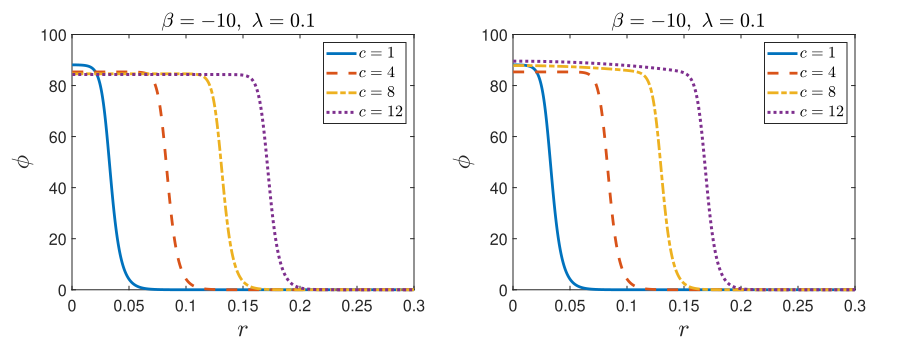
We use numerics to construct solitary waves in Dirac--Klein--Gordon (in one and three spatial dimensions) and study the dependence of energy and charge on $ω$. For the construction, we use the iterative procedure, starting from solitary waves of nonlinear Dirac equation, computing the corresponding scalar field, and adjusting the coupling constant. We also consider the case of massless scalar field, when the iteration procedure could be compared with the shooting method. We use the virial identities to control the error of simulations. We also discuss possible implications from the obtained results for the spectral stability of solitary waves.
2512.24666In this paper, we study the momentum distribution of an electron gas in a $3$-dimensional torus. The goal is to compute the occupation number of Fourier modes for some trial state obtained through random phase approximation. We obtain the mean-field analogue of momentum distribution formulas for electron gas in [Daniel and Voskov, Phys. Rev. 120, (1960)] in high density limit and [Lam, Phys. Rev. \textbf{3}, (1971)] at metallic density. Our findings are related to recent results obtained independently by Benedikter, Lill and Naidu, and our analysis applies to a general class of singular potentials rather than just the Coulomb case.
We construct a four-dimensional lattice-gas model with finite-range interactions that has non-periodic, ``quasicrystalline'' Gibbs states at low temperatures. Such Gibbs states are probability measures which are small perturbations of non-periodic ground-state configurations corresponding to tilings of the plane with Ammann's aperiodic tiles. Our construction is based on the correspondence between probabilistic cellular automata and Gibbs measures on their space-time trajectories, and a classical result on noise-resilient computing with cellular automata. The cellular automaton is constructed on the basis of Ammann's tiles, which are deterministic in one direction, and has non-periodic space-time trajectories corresponding to each valid tiling. Repetitions along two extra dimensions, together with an error-correction mechanism, ensure stability of the trajectories subjected to noise.
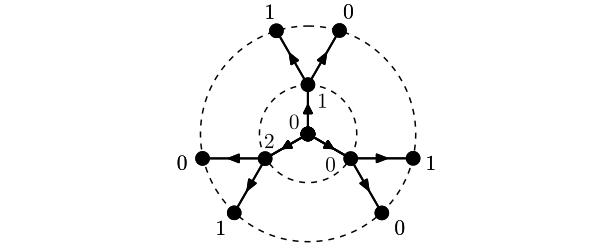
The charge functions for n-dimensional partitions are known for n=2,3,4 in the literature. We give the expression for arbitrary odd dimension in a recent work, and now further conjecture a formula for all even dimensional cases. This conjecture is proved rigorously for 6D, and numerically verified for 8D.
2512.24045In this short review paper the detailed analysis of six two-dimensional quantum {\it superintegrable} systems in flat space is presented. It includes the Smorodinsky-Winternitz potentials I-II (the Holt potential), the Fokas-Lagerstrom model, the 3-body Calogero and Wolfes (equivalently, $G_2$ rational, or $I_6$) models, and the Tremblay-Turbiner-Winternitz (TTW) system with integer index $k$. It is shown that all of them are exactly-solvable, thus, confirming the Montreal conjecture (2001); they admit algebraic forms for the Hamiltonian and both integrals (all three can be written as differential operators with polynomial coefficients without a constant term), they have polynomial eigenfunctions with the invariants of the discrete symmetry group of invariance taken as variables, they have hidden (Lie) algebraic structure $g^{(k)}$ with various $k$, and they possess a (finite order) polynomial algebras of integrals. Each model is characterized by infinitely-many finite-dimensional invariant subspaces, which form the infinite flag. Each subspace coincides with the finite-dimensional representation space of the algebra $g^{(k)}$ for a certain $k$. In all presented cases the algebra of integrals is a 4-generated $(H, I_1, I_2, I_{12}\equiv[I_1, I_2])$ infinite-dimensional algebra of ordered monomials of degrees 2,3,4,5, which is a subalgebra of the universal enveloping algebra of the hidden algebra.
2512.23338In this paper we introduce a new class of integrable 3D lattice models, possessing continuous families of commuting layer-to-layer transfer matrices. Algebraically, this commutativity is based on a very special construction of local Boltzmann weights in terms of quantum dilogarithms satisfying the inversion and pentagon identities. We give three examples of such quantum dilogarithms, leading to integrable 3D lattice models. The partition function per site in these models can be exactly calculated in the limit of an infinite lattice by using the functional relations, symmetry and factorization properties of the transfer matrix. The results of such calculations for 3D models associated with the Faddeev modular quantum dilogarithm are briefly presented.
We consider the five-vertex model on a rectangular domain of the square lattice, with the so-called `scalar-product' boundary conditions. We address the evaluation of the free-energy density of the model in the scaling limit, that is when the number of sites is sent to infinity and the mesh of the lattice to zero, while keeping the size of the domain constant. To this aim, we reformulate the partition function of the model in terms of a discrete log-gas, and study its behaviour in the thermodynamic limit. We reproduce previous results, obtained by using a differential equation approach. Moreover, we provide the explicit form of the resolvent in all possible regimes. This work is preliminary to further studies of limit shape phenomena in the model.